Department of English Language and Literature
Major: English Language and Literature
Semantics Session 9
“Semantics and word properties: Word Meaning”
Dr. Badriya Al Mamari
Academic year 2021/2022
A dictionary
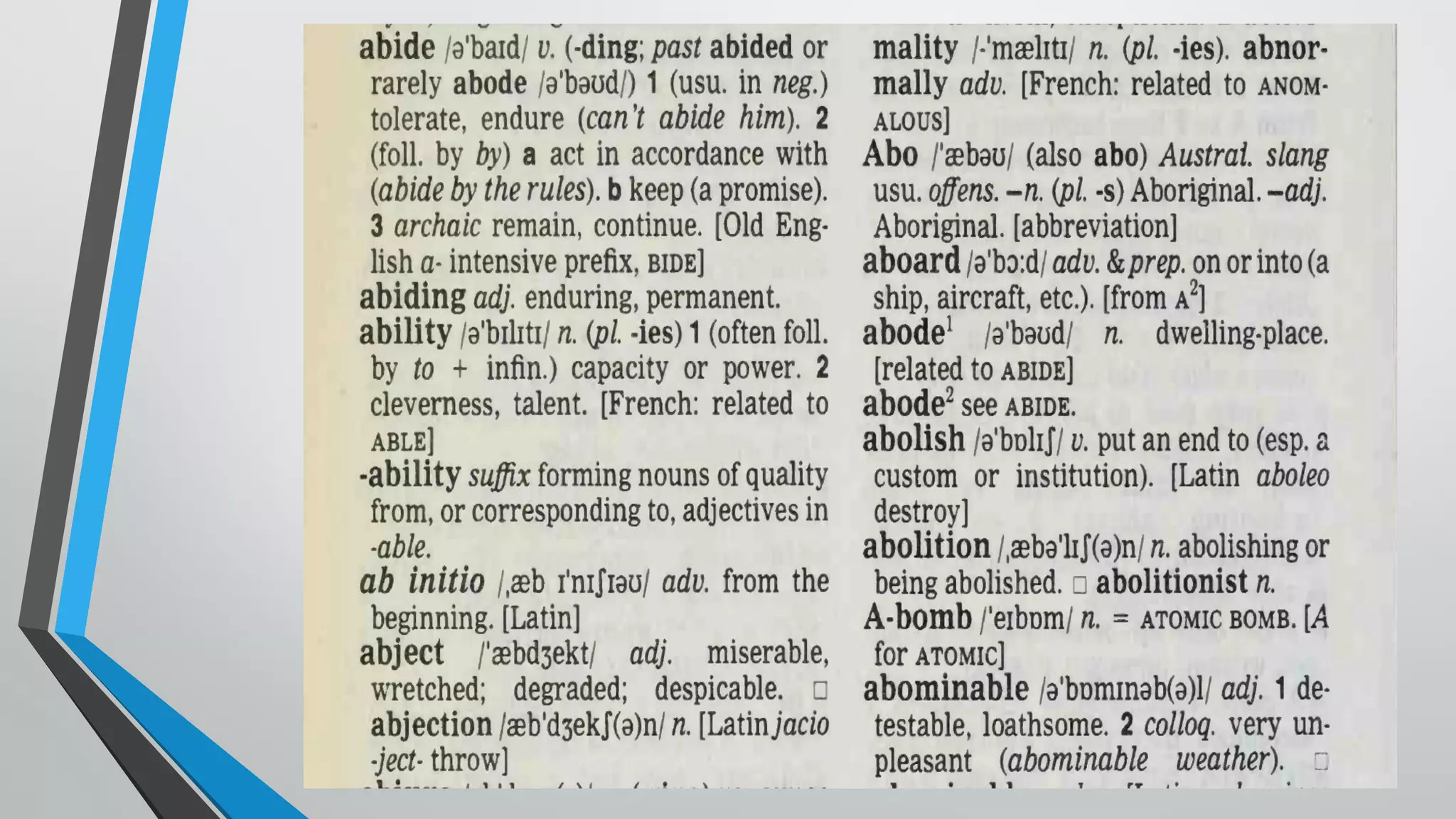
• A dictionary is a central part of the description of any
language. A good ordinary household dictionary typically
gives (at least) three kinds of information about words:
• 1.phonological information about how the word is
pronounced,
• 2.grammatical (syntactical and morphological) information
about its part of speech (e.g. noun, verb) and inflections (e.g.
for plural number or past tense),
• 3.semantic information about the word’s meaning.
• A dictionary tells you what words mean. The semanticist
dictionary-writer and the ordinary dictionary-writer have
quite similar goals, but they differ markedly in their style of
approach and the emphasis which they place on their various
goals.
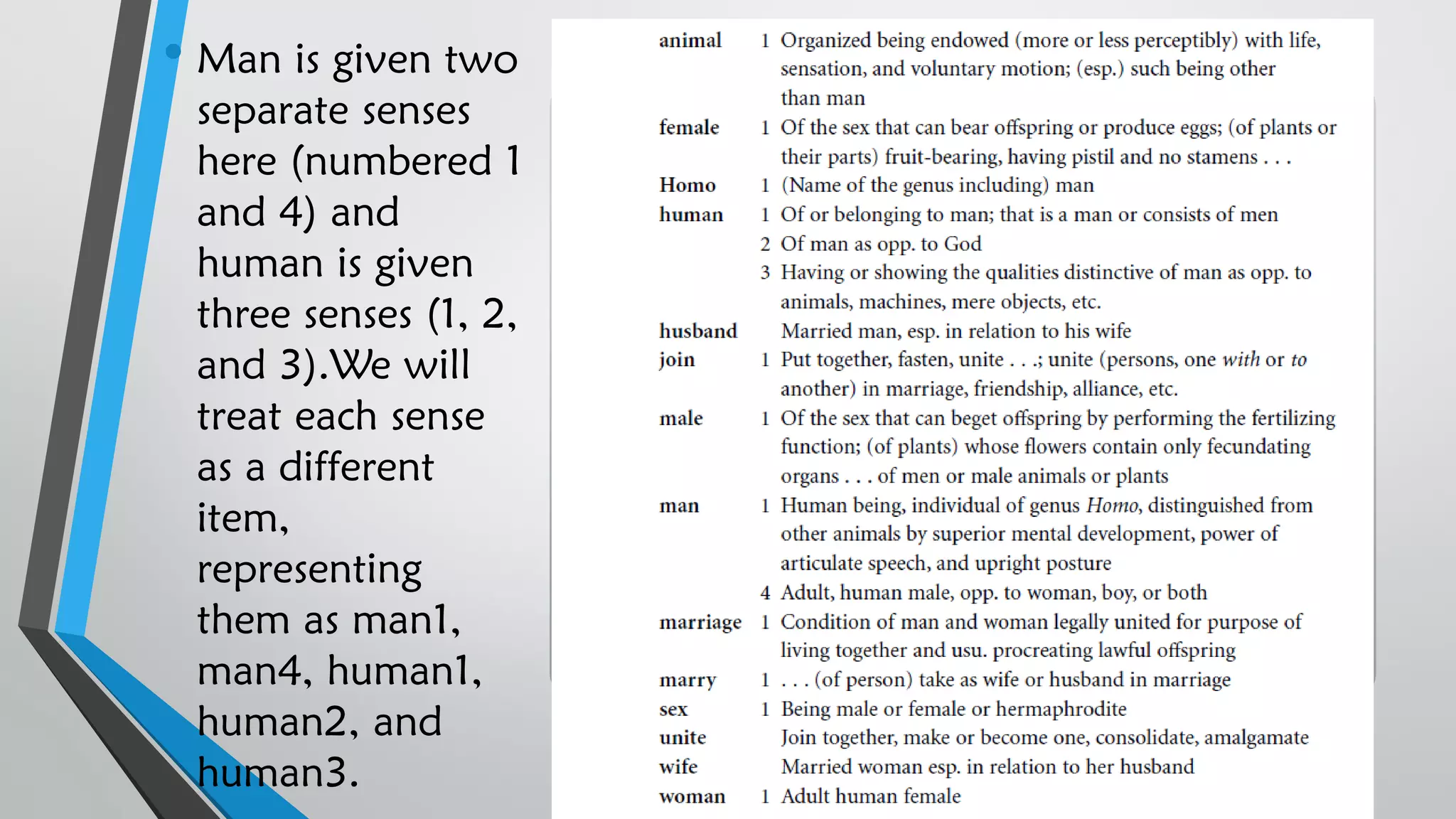
• Man is given two
separate senses
here (numbered 1
and 4) and
human is given
three senses (1, 2,
and 3).We will
treat each sense
as a different
item,
representing
them as man1,
man4, human1,
human2, and
human3.
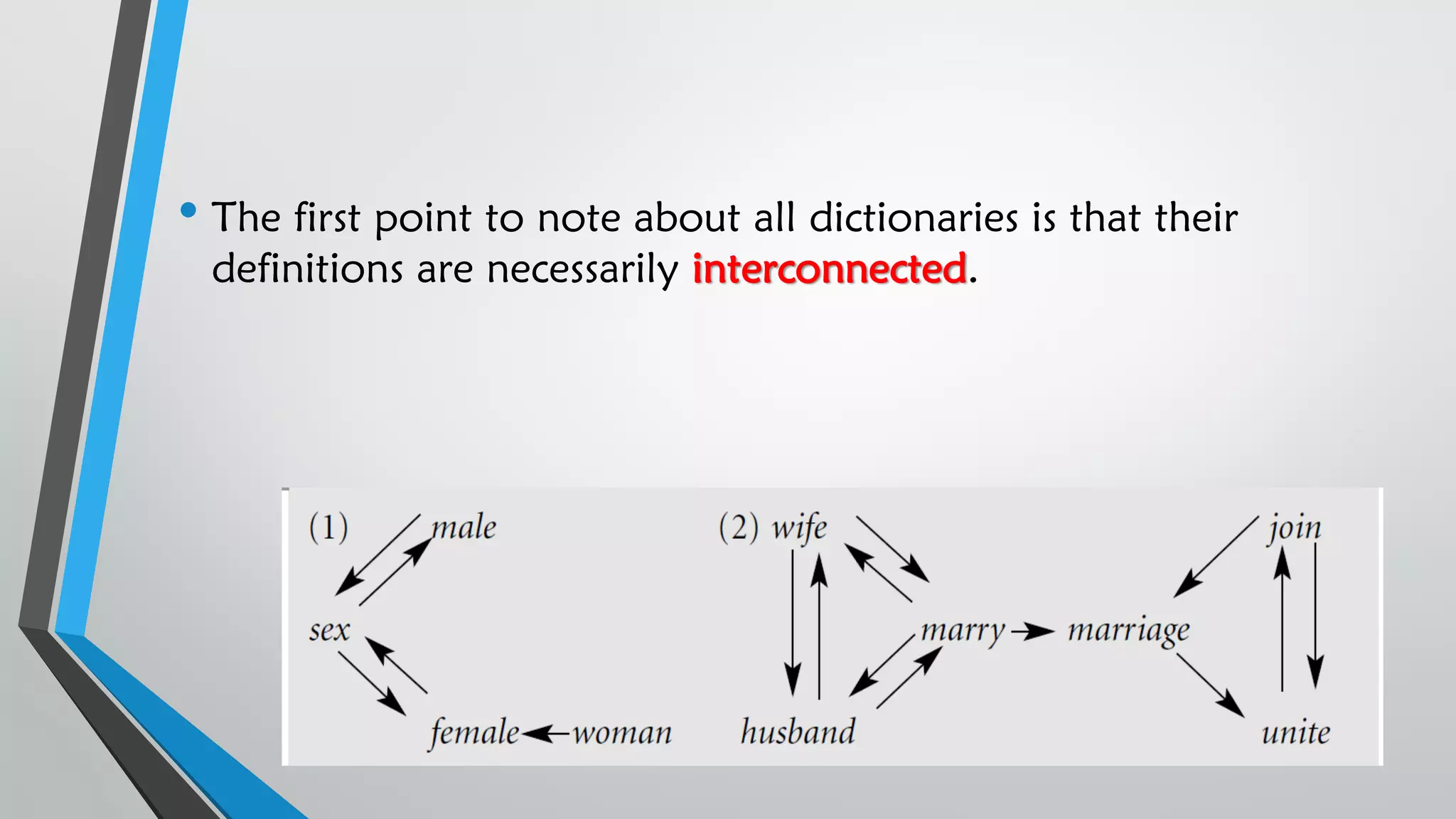
• The first point to note about all dictionaries is that their
definitions are necessarily interconnected.
• Traditionally, the linguistic semanticist is interested in the
meanings of words and not in non-linguistic facts about the
world. Linguistic semanticist makes the assumption that non-
linguistic facts are not particularly relevant to the study of
linguistic meaning (that is, the meanings conveyed by the
sense relations of the words within the language itself as
opposed to meaning conveyed by information from the
context or situation in which the language is used).
• Sibling is not a word in the everyday English vocabulary, but
is a technical term used to refer to someone who is either a
brother or a sister.
• Parent refers to father and mother!
• The meaning of sibling contains no concept of sex. Clearly,
the two predicates brother and sister form a natural class.
• These are called Theoretical’ or ‘technical’ predicates (session6)
Dictionary vs Encyclopaedia
• A Dictionary describes the senses of predicates.
• An Encyclopaedia contains factual information of a variety of
types, but generally no information specifically on the
meanings of words.
• The stereotype of a predicate contains, strictly speaking, only
encyclopaedic information, although the importance of
stereotypes in the use and understanding of words fuzzes the
distinction between dictionary and encyclopaedia. (session 8)
• From a traditional point of view, the descriptive semanticist is
basically interested in that information about words which can
give rise to sentences containing them being either analytic (e.g.
The cheetah is an animal) or contradictions (e.g. The cheetah is
not an animal). Any other information is not strictly semantic
but encyclopaedic, at least under the assumption that such a
distinction can indeed be made.
• Many semanticists are coming to the realization that the
study of meaning has to include the study of encyclopaedic
information in some way along with dictionary information
in order to represent more adequately the knowledge a
speaker has about the language.
References:
Hurford, J. R., Heasley, B., & Smith, M. B. (2007). Semantics: a
coursebook. Cambridge university press. (pp. 141 -151

Semantics Session 9_15_11_2021 Word Meaning.pdf

  • 1.
    Department of EnglishLanguage and Literature Major: English Language and Literature Semantics Session 9 “Semantics and word properties: Word Meaning” Dr. Badriya Al Mamari Academic year 2021/2022
  • 2.
    A dictionary • Adictionary is a central part of the description of any language. A good ordinary household dictionary typically gives (at least) three kinds of information about words: • 1.phonological information about how the word is pronounced, • 2.grammatical (syntactical and morphological) information about its part of speech (e.g. noun, verb) and inflections (e.g. for plural number or past tense), • 3.semantic information about the word’s meaning.
  • 4.
    • A dictionarytells you what words mean. The semanticist dictionary-writer and the ordinary dictionary-writer have quite similar goals, but they differ markedly in their style of approach and the emphasis which they place on their various goals.
  • 5.
    • Man isgiven two separate senses here (numbered 1 and 4) and human is given three senses (1, 2, and 3).We will treat each sense as a different item, representing them as man1, man4, human1, human2, and human3.
  • 6.
    • The firstpoint to note about all dictionaries is that their definitions are necessarily interconnected.
  • 7.
    • Traditionally, thelinguistic semanticist is interested in the meanings of words and not in non-linguistic facts about the world. Linguistic semanticist makes the assumption that non- linguistic facts are not particularly relevant to the study of linguistic meaning (that is, the meanings conveyed by the sense relations of the words within the language itself as opposed to meaning conveyed by information from the context or situation in which the language is used).
  • 8.
    • Sibling isnot a word in the everyday English vocabulary, but is a technical term used to refer to someone who is either a brother or a sister. • Parent refers to father and mother! • The meaning of sibling contains no concept of sex. Clearly, the two predicates brother and sister form a natural class. • These are called Theoretical’ or ‘technical’ predicates (session6)
  • 9.
    Dictionary vs Encyclopaedia •A Dictionary describes the senses of predicates. • An Encyclopaedia contains factual information of a variety of types, but generally no information specifically on the meanings of words.
  • 10.
    • The stereotypeof a predicate contains, strictly speaking, only encyclopaedic information, although the importance of stereotypes in the use and understanding of words fuzzes the distinction between dictionary and encyclopaedia. (session 8) • From a traditional point of view, the descriptive semanticist is basically interested in that information about words which can give rise to sentences containing them being either analytic (e.g. The cheetah is an animal) or contradictions (e.g. The cheetah is not an animal). Any other information is not strictly semantic but encyclopaedic, at least under the assumption that such a distinction can indeed be made.
  • 11.
    • Many semanticistsare coming to the realization that the study of meaning has to include the study of encyclopaedic information in some way along with dictionary information in order to represent more adequately the knowledge a speaker has about the language.
  • 12.
    References: Hurford, J. R.,Heasley, B., & Smith, M. B. (2007). Semantics: a coursebook. Cambridge university press. (pp. 141 -151