
 Preservation of RRF
 Higher Hb concentration
 Less risk of acquiring blood
borne infections e.g. HCV
 Better quality of life
 It allows expansion with
limited resources
 Lower staff / patient ratio
 saves vascular access
 preferred for children
Complications of PD
therapy
infectious Non infectious
Peritonitis TunnelExit site
Acute Chronic
• It is the major complication of PD and
remains the main reason for switching
patient to HD .
• The rate should not be > 1 episode/18
patient-month or 0.67 episode / year at risk
(ISPD guidelines)
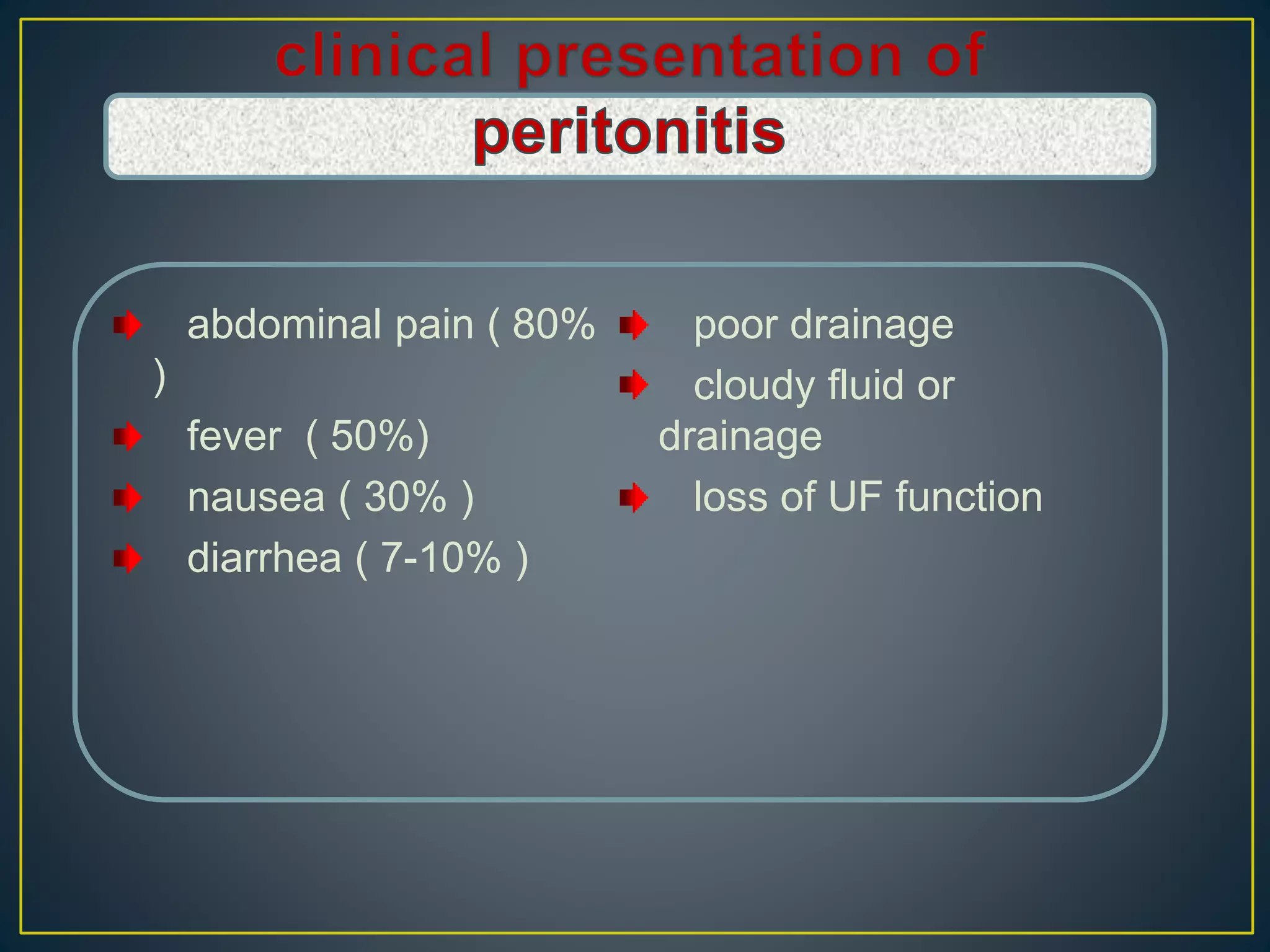
abdominal pain ( 80%
)
fever ( 50%)
nausea ( 30% )
diarrhea ( 7-10% )
poor drainage
cloudy fluid or
drainage
loss of UF function
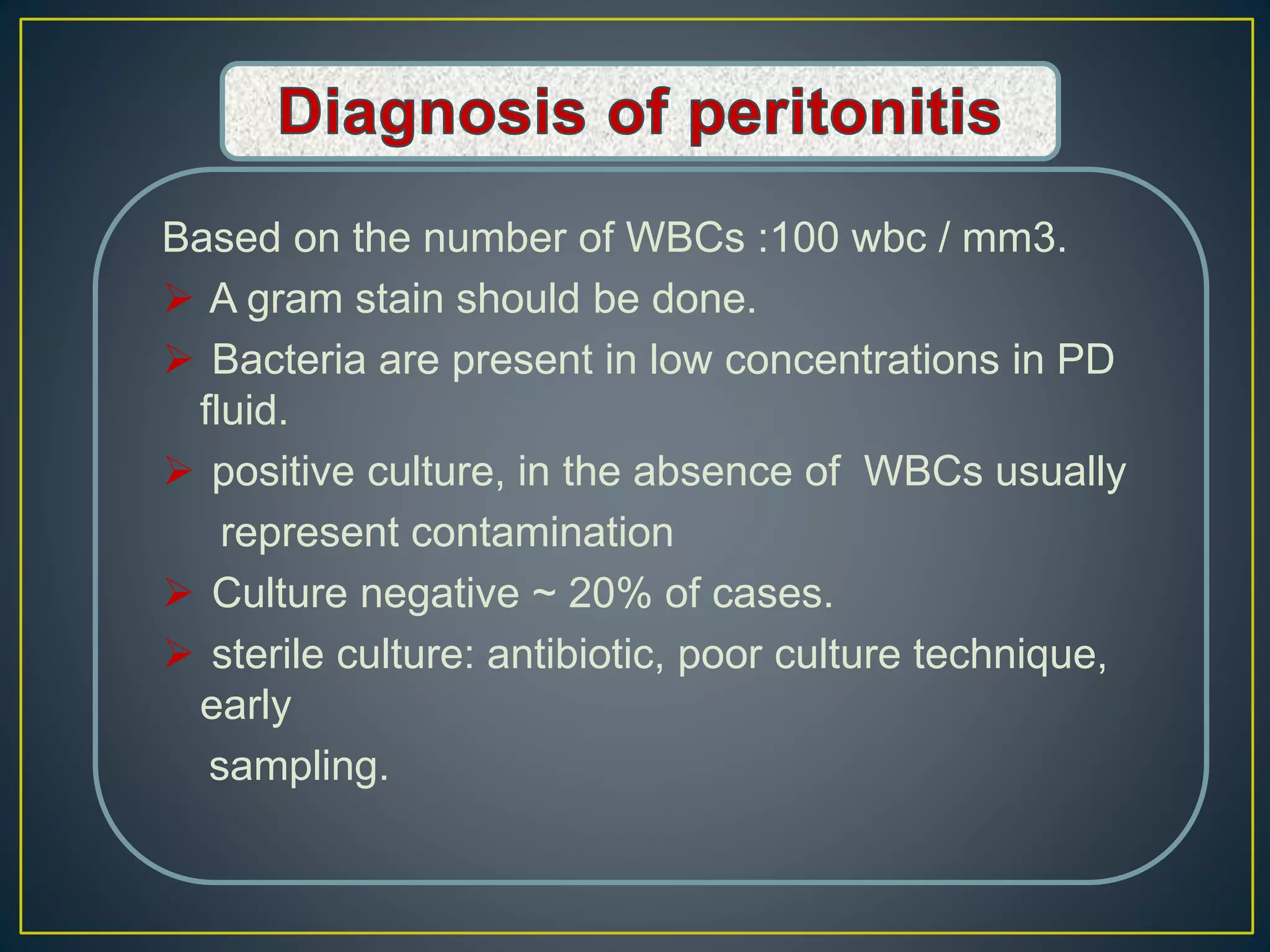
Based on the number of WBCs :100 wbc / mm3.
 A gram stain should be done.
 Bacteria are present in low concentrations in PD
fluid.
 positive culture, in the absence of WBCs usually
represent contamination
 Culture negative ~ 20% of cases.
 sterile culture: antibiotic, poor culture technique,
early
sampling.
Initiate empiric therapy with Cefazolin or Cephalothin and OR
Glycopeptide ( Vancomycin or Teicoplanin) and Ceftazidime
Continuous dosing Intermitt. dosing
Cefazolin or
cephalothin
250 mg/L load,then 125 mg/L in
each exchange
15 mg/kg in a single
exchange/day
Ceftazidime 250 mg/L load,then 125 mg/L
/change
15 mg/kg in a single
exchange /day
Vancomycin 500 mg/L load,then 30mg/L /change 30 mg/kg in a single
exchange q 5-7 days
Teicoplanin 200 mg/L load,then 20mg/L /change 15 mg/kg in a single
exchange q 5-7 d.
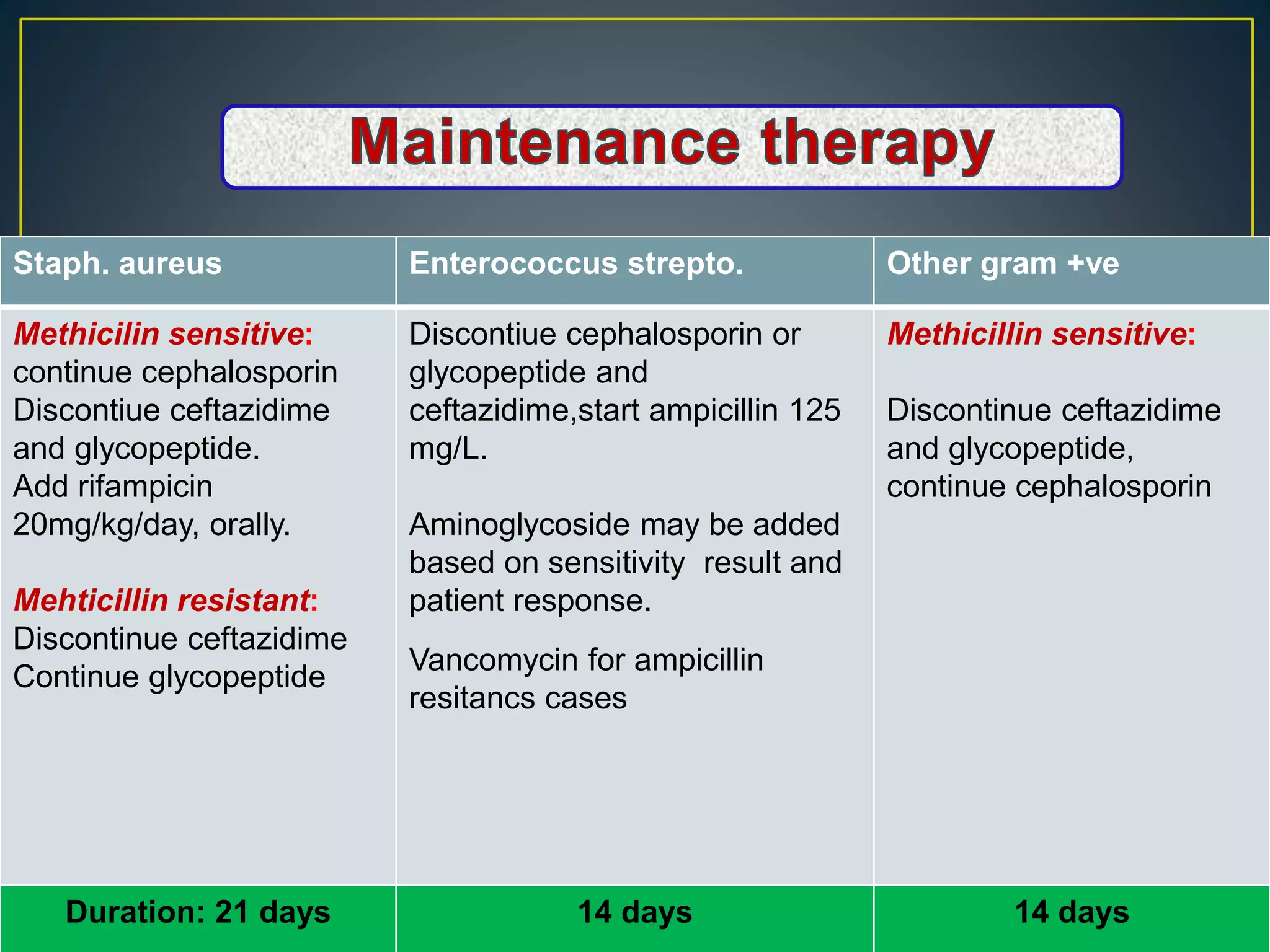
Staph. aureus Enterococcus strepto. Other gram +ve
Methicilin sensitive:
continue cephalosporin
Discontiue ceftazidime
and glycopeptide.
Add rifampicin
20mg/kg/day, orally.
Mehticillin resistant:
Discontinue ceftazidime
Continue glycopeptide
Discontiue cephalosporin or
glycopeptide and
ceftazidime,start ampicillin 125
mg/L.
Aminoglycoside may be added
based on sensitivity result and
patient response.
Vancomycin for ampicillin
resitancs cases
Methicillin sensitive:
Discontinue ceftazidime
and glycopeptide,
continue cephalosporin
Duration: 21 days 14 days 14 days
Single gram –ve /non
Pseudomonas
pseudomonas Multiple organisms and
/or anaerobe
Adjust antibiotics to
sensitivity pattern.
May continue
ceftazidime
Discontinue
cephalosporin or
glycopeptide.
Continue ceftazidime,
add agent with activity
against pseudomonas (
piperacillin,ciprofloxacin,
aminoglycoside or
aztreonam
Consider surgical
intervention and add :
Metronidazole 15
mg/kg/day in divided
doses (max. 1.5gm/day).
Duration: 14 days 21 days 21 days
Non-infectious Complications of Peritoneal Dialysis
Mechanical complications Metabolic Disturbances
Early
Pain
Bleeding
Perforation of a
viscera
Exit site leak
Late
Catheter –
related
complications
Pain
Bleeding
Catheter
obstruction
Catheter cuff
extrusion
Increased intra –
peritoneal pressure
Fluid leak
Hernias
Low back pain
GERD
Alteration of
diaphragmatic
mechanics
Alteration of peritoneal
transport
Peritoneal –
membrane
related
complications
Ultrafiltration Failure
(UFF)
Encapsulating
peritoneal Sclerosis
Hyperglycaemia
Hyperlipidemia
Malnutrition Hypokalemia
Hypermagnesaemia
PD HD
Peritoneal dialysis   4

Peritoneal dialysis 4

  • 1.
     Preservation ofRRF  Higher Hb concentration  Less risk of acquiring blood borne infections e.g. HCV  Better quality of life  It allows expansion with limited resources  Lower staff / patient ratio  saves vascular access  preferred for children
  • 2.
    Complications of PD therapy infectiousNon infectious Peritonitis TunnelExit site Acute Chronic
  • 3.
    • It isthe major complication of PD and remains the main reason for switching patient to HD . • The rate should not be > 1 episode/18 patient-month or 0.67 episode / year at risk (ISPD guidelines)
  • 4.
    abdominal pain (80% ) fever ( 50%) nausea ( 30% ) diarrhea ( 7-10% ) poor drainage cloudy fluid or drainage loss of UF function
  • 5.
    Based on thenumber of WBCs :100 wbc / mm3.  A gram stain should be done.  Bacteria are present in low concentrations in PD fluid.  positive culture, in the absence of WBCs usually represent contamination  Culture negative ~ 20% of cases.  sterile culture: antibiotic, poor culture technique, early sampling.
  • 6.
    Initiate empiric therapywith Cefazolin or Cephalothin and OR Glycopeptide ( Vancomycin or Teicoplanin) and Ceftazidime Continuous dosing Intermitt. dosing Cefazolin or cephalothin 250 mg/L load,then 125 mg/L in each exchange 15 mg/kg in a single exchange/day Ceftazidime 250 mg/L load,then 125 mg/L /change 15 mg/kg in a single exchange /day Vancomycin 500 mg/L load,then 30mg/L /change 30 mg/kg in a single exchange q 5-7 days Teicoplanin 200 mg/L load,then 20mg/L /change 15 mg/kg in a single exchange q 5-7 d.
  • 7.
    Staph. aureus Enterococcusstrepto. Other gram +ve Methicilin sensitive: continue cephalosporin Discontiue ceftazidime and glycopeptide. Add rifampicin 20mg/kg/day, orally. Mehticillin resistant: Discontinue ceftazidime Continue glycopeptide Discontiue cephalosporin or glycopeptide and ceftazidime,start ampicillin 125 mg/L. Aminoglycoside may be added based on sensitivity result and patient response. Vancomycin for ampicillin resitancs cases Methicillin sensitive: Discontinue ceftazidime and glycopeptide, continue cephalosporin Duration: 21 days 14 days 14 days
  • 8.
    Single gram –ve/non Pseudomonas pseudomonas Multiple organisms and /or anaerobe Adjust antibiotics to sensitivity pattern. May continue ceftazidime Discontinue cephalosporin or glycopeptide. Continue ceftazidime, add agent with activity against pseudomonas ( piperacillin,ciprofloxacin, aminoglycoside or aztreonam Consider surgical intervention and add : Metronidazole 15 mg/kg/day in divided doses (max. 1.5gm/day). Duration: 14 days 21 days 21 days
  • 9.
    Non-infectious Complications ofPeritoneal Dialysis Mechanical complications Metabolic Disturbances Early Pain Bleeding Perforation of a viscera Exit site leak Late Catheter – related complications Pain Bleeding Catheter obstruction Catheter cuff extrusion Increased intra – peritoneal pressure Fluid leak Hernias Low back pain GERD Alteration of diaphragmatic mechanics Alteration of peritoneal transport Peritoneal – membrane related complications Ultrafiltration Failure (UFF) Encapsulating peritoneal Sclerosis Hyperglycaemia Hyperlipidemia Malnutrition Hypokalemia Hypermagnesaemia
  • 10.