FHWA Planning for Operations A Pre-Release Overview of the Model Plans Desk Reference Presentation by Jessica Josselyn and Phill Worth February 4, 2010
Presentation Overview FHWA Planning for Operations Model Plans Desk Reference
FHWA Planning for Operations
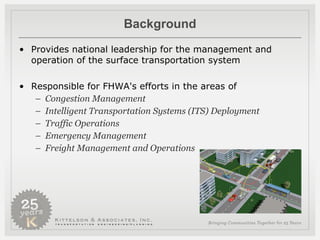
Background Provides national leadership for the management and operation of the surface transportation system  Responsible for FHWA's efforts in the areas of  Congestion Management  Intelligent Transportation Systems (ITS) Deployment  Traffic Operations  Emergency Management Freight Management and Operations
Program Areas Arterial Management Congestion Mitigation Corridor Traffic Management Emergency Transportation Operations Facilitating Integrated ITS Deployment Freeway Management Freight Analysis Freight Operations and Technology Freight Professional Development Freight Vehicle Size and Weight Localized Bottleneck Reduction Manual on Uniform Traffic Control Devices (MUTCD) Operations Asset Management Performance Measurement Planned Special Events Traffic Management Planning for Operations (Formerly Regional Transportation Operations Collaboration and Coordination (RTOCC))   Real Time Traveler Information Road Weather Management Tolling and Pricing Program  Traffic Analysis Tools Traffic Incident Management Travel Demand Management Work Zone Management
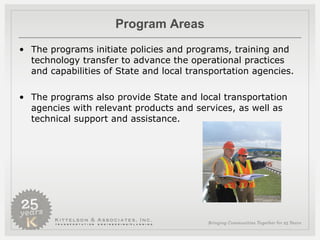
Program Areas The programs initiate policies and programs, training and technology transfer to advance the operational practices and capabilities of State and local transportation agencies.  The programs also provide State and local transportation agencies with relevant products and services, as well as technical support and assistance.
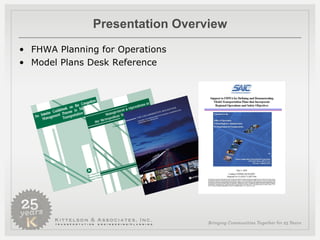
Publications A Primer - Statewide Opportunities For Linking Planning and Operations An Interim Guidebook on the Congestion Management Process in Metropolitan Transportation Planning Management & Operations in the Metropolitan Transportation Plan: A Guidebook for Creating an Objectives-Driven, Performance-Based Approach And many more! Visit  http://ops.fhwa.dot.gov
Model Plans Desk Reference
Background Title Advancing Planning For Operations: A Model Plan Desk Reference for an Objectives-Driven, Performance-Based Approach to Integrating Operations in Metropolitan Transportation Planning Purpose A resource  designed to enable transportation planners and their planning partners  to build a transportation plan  that includes operations objectives, performance measures, and strategies Offers a menu of options  Features a model MTP
Background Companion to the FHWA and FTA resource,  Advancing Planning for Operations: A Guidebook for Integrating Operations in the Metropolitan Transportation Plan . The  guidebook  introduces the objectives-driven, performance-based approach to planning for operations and how to use this approach The  desk reference  supplies the reader with examples of operations objectives and associated performance measures
Core Project Team Phill Worth, Principal Investigator Jessica Josselyn, Task Planner Jocelyn Bauer, Task Manager  Harrison Rue and Michael Grant, Task Leaders
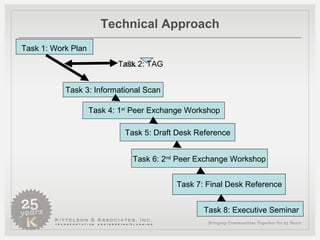
Technical Approach Task 7: Final Desk Reference Task 5: Draft Desk Reference Task 6: 2 nd  Peer Exchange Workshop Task 8: Executive Seminar Task 1: Work Plan Task 3: Informational Scan Task 2: TAG Task 4: 1 st  Peer Exchange Workshop
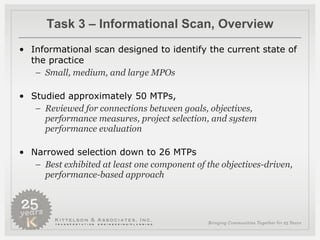
Task 3 – Informational Scan, Overview Informational scan designed to identify the current state of the practice Small, medium, and large MPOs Studied approximately 50 MTPs, Reviewed for connections between goals, objectives, performance measures, project selection, and system performance evaluation  Narrowed selection down to 26 MTPs  Best exhibited at least one component of the objectives-driven, performance-based approach
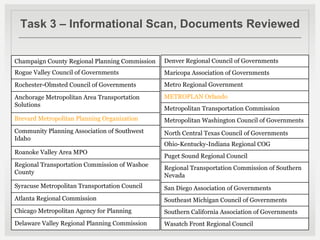
Task 3 – Informational Scan, Documents Reviewed Delaware Valley Regional Planning Commission Chicago Metropolitan Agency for Planning Atlanta Regional Commission Syracuse Metropolitan Transportation Council Regional Transportation Commission of Washoe County Roanoke Valley Area MPO Community Planning Association of Southwest Idaho  Brevard Metropolitan Planning Organization Anchorage Metropolitan Area Transportation Solutions Rochester-Olmsted Council of Governments Rogue Valley Council of Governments Champaign County Regional Planning Commission Denver Regional Council of Governments Wasatch Front Regional Council Southern California Association of Governments Southeast Michigan Council of Governments San Diego Association of Governments Regional Transportation Commission of Southern Nevada Puget Sound Regional Council Ohio-Kentucky-Indiana Regional COG North Central Texas Council of Governments  Metropolitan Washington Council of Governments Metropolitan Transportation Commission METROPLAN Orlando Metro Regional Government Maricopa Association of Governments
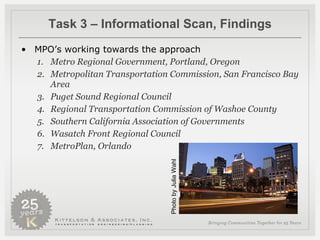
Task 3 – Informational Scan, Findings MPO’s working towards the approach Metro Regional Government, Portland, Oregon Metropolitan Transportation Commission, San Francisco Bay Area Puget Sound Regional Council Regional Transportation Commission of Washoe County Southern California Association of Governments Wasatch Front Regional Council  MetroPlan, Orlando Photo by Julia Wahl
Task 3 – Informational Scan, Findings Among the plans that do address safety and operations together, a variety of strategies are outlined that promote safety as a part of the process for increasing operational efficiency Heavy vehicles ITS Incident detection and response Several MPOs are in the process of conducting safety-related performance initiatives, or  identifying operations improvement projects where safety-related performance monitoring is planned.
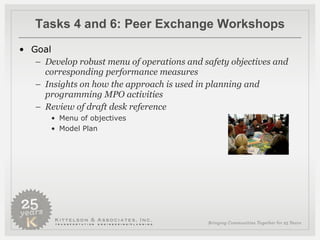
Tasks 4 and 6: Peer Exchange Workshops Goal Develop robust menu of operations and safety objectives and corresponding performance measures Insights on how the approach is used in planning and programming MPO activities Review of draft desk reference Menu of objectives Model Plan
Tasks 4 and 6: Peer Exchange Workshop Participants Anchorage Metropolitan Area Transportation Solutions Champaign County Regional Planning Commission Community Planning Association of Southwest Idaho Dallas Area Rapid Transit Delaware Valley Regional Planning Commission Genesee Transportation Council METROPLAN Orlando Michigan Department of Transportation Oregon Metro Rochester Olmsted Council of Governments Rogue Valley Council of Governments San Diego Association of Governments Southeastern Pennsylvania Transportation Authority Virginia Department of Transportation Wasatch Front Regional Council
Tasks 4 and 6: Peer Exchange Workshop Participants Inputs Organization Content Fact Sheets Fact sheet categories Fact sheet objectives and supporting information Model Plan Functionality Practicality Applicability
Tasks 5 and 7: Draft and Final Desk Reference Table of Contents Section 1, Introduction Section 2, Developing Operations Objectives Section 3, Menu of Operations Objectives  Section 4, Model Metropolitan Transportation Plan Section 5, References and Resources
Tasks 5 and 7: Draft and Final Desk Reference Section 1, Introduction:   Provides a quick overview of the objectives-driven, performance-based approach to planning for operations.  Planning for Operations in the Metropolitan Transportation Plan An Objectives-Driven, Performance-Based Approach Getting Started With the Approach Purpose of the Desk Reference
Tasks 5 and 7: Draft and Final Desk Reference Section 2, Developing Operations Objectives:  Gives the fundamentals of developing operations objectives, a cornerstone of the objectives-driven, performance-based approach. Outcome-Based and Activity-Based Operations Objectives Characteristics of Operations Objectives Scope of Operations Objectives Connecting Operations Objectives Using Objectives to Identify and Select M&O Strategies
Tasks 5 and 7: Draft and Final Desk Reference Section 3, Menu of Operations Objectives: Menu Structure and Definitions Cross Reference Tables Fact Sheets System Efficiency System Reliability System Options Arterial Management Emergency/Incident Management Freeway Management Freight Management Special Event Management Transit Operations and  Management Travel Demand Management Travel Weather Management Traveler Information Work Zone Management
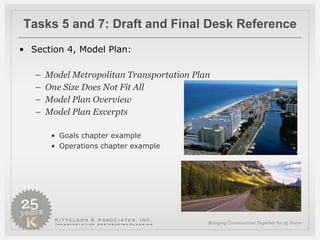
Tasks 5 and 7: Draft and Final Desk Reference Section 4, Model Plan: Model Metropolitan Transportation Plan One Size Does Not Fit All Model Plan Overview Model Plan Excerpts Goals chapter example Operations chapter example
Summary Purpose of going to the Desk Reference To answer the question “What is an objectives-driven, performance-based approach?” To get ideas for operations objectives to be included in the MTP (or supporting operations planning documents). To find an operations objective for a specific operations area such as traveler information.
Summary To find operations objectives for a specific mode such as transit. To learn what performance measures and data would be needed to track an operations objective. To find potential M&O strategies to help improve transportation system efficiency, reliability, or options. To see an example of how to shape the operations-related portions of the MTP to incorporate selected operations objectives and performance measures.
Webinar Information Talking Operations Webinar: Objectives-Driven, Performance-Based Planning for Operations - A New Resource  Date/Time:  Tuesday, February 23rd from 1 – 2:30 PM EST  Registration Link:  http:// www.ntoctalks.com/web_casts.php   Speakers are  Richard Backlund, FHWA Office of Operations  Deena Platman, Metro Portland Lance Wilber, Anchorage/Alaska
Thank you! Phill Worth pworth@kittelson.com  Jessica Josselyn [email_address]

Planning for Operations

  • 1.
    FHWA Planning forOperations A Pre-Release Overview of the Model Plans Desk Reference Presentation by Jessica Josselyn and Phill Worth February 4, 2010
  • 2.
    Presentation Overview FHWAPlanning for Operations Model Plans Desk Reference
  • 3.
  • 4.
    Background Provides nationalleadership for the management and operation of the surface transportation system Responsible for FHWA's efforts in the areas of Congestion Management Intelligent Transportation Systems (ITS) Deployment Traffic Operations Emergency Management Freight Management and Operations
  • 5.
    Program Areas ArterialManagement Congestion Mitigation Corridor Traffic Management Emergency Transportation Operations Facilitating Integrated ITS Deployment Freeway Management Freight Analysis Freight Operations and Technology Freight Professional Development Freight Vehicle Size and Weight Localized Bottleneck Reduction Manual on Uniform Traffic Control Devices (MUTCD) Operations Asset Management Performance Measurement Planned Special Events Traffic Management Planning for Operations (Formerly Regional Transportation Operations Collaboration and Coordination (RTOCC)) Real Time Traveler Information Road Weather Management Tolling and Pricing Program Traffic Analysis Tools Traffic Incident Management Travel Demand Management Work Zone Management
  • 6.
    Program Areas Theprograms initiate policies and programs, training and technology transfer to advance the operational practices and capabilities of State and local transportation agencies. The programs also provide State and local transportation agencies with relevant products and services, as well as technical support and assistance.
  • 7.
    Publications A Primer- Statewide Opportunities For Linking Planning and Operations An Interim Guidebook on the Congestion Management Process in Metropolitan Transportation Planning Management & Operations in the Metropolitan Transportation Plan: A Guidebook for Creating an Objectives-Driven, Performance-Based Approach And many more! Visit http://ops.fhwa.dot.gov
  • 8.
  • 9.
    Background Title AdvancingPlanning For Operations: A Model Plan Desk Reference for an Objectives-Driven, Performance-Based Approach to Integrating Operations in Metropolitan Transportation Planning Purpose A resource designed to enable transportation planners and their planning partners to build a transportation plan that includes operations objectives, performance measures, and strategies Offers a menu of options Features a model MTP
  • 10.
    Background Companion tothe FHWA and FTA resource, Advancing Planning for Operations: A Guidebook for Integrating Operations in the Metropolitan Transportation Plan . The guidebook introduces the objectives-driven, performance-based approach to planning for operations and how to use this approach The desk reference supplies the reader with examples of operations objectives and associated performance measures
  • 11.
    Core Project TeamPhill Worth, Principal Investigator Jessica Josselyn, Task Planner Jocelyn Bauer, Task Manager Harrison Rue and Michael Grant, Task Leaders
  • 12.
    Technical Approach Task7: Final Desk Reference Task 5: Draft Desk Reference Task 6: 2 nd Peer Exchange Workshop Task 8: Executive Seminar Task 1: Work Plan Task 3: Informational Scan Task 2: TAG Task 4: 1 st Peer Exchange Workshop
  • 13.
    Task 3 –Informational Scan, Overview Informational scan designed to identify the current state of the practice Small, medium, and large MPOs Studied approximately 50 MTPs, Reviewed for connections between goals, objectives, performance measures, project selection, and system performance evaluation Narrowed selection down to 26 MTPs Best exhibited at least one component of the objectives-driven, performance-based approach
  • 14.
    Task 3 –Informational Scan, Documents Reviewed Delaware Valley Regional Planning Commission Chicago Metropolitan Agency for Planning Atlanta Regional Commission Syracuse Metropolitan Transportation Council Regional Transportation Commission of Washoe County Roanoke Valley Area MPO Community Planning Association of Southwest Idaho Brevard Metropolitan Planning Organization Anchorage Metropolitan Area Transportation Solutions Rochester-Olmsted Council of Governments Rogue Valley Council of Governments Champaign County Regional Planning Commission Denver Regional Council of Governments Wasatch Front Regional Council Southern California Association of Governments Southeast Michigan Council of Governments San Diego Association of Governments Regional Transportation Commission of Southern Nevada Puget Sound Regional Council Ohio-Kentucky-Indiana Regional COG North Central Texas Council of Governments Metropolitan Washington Council of Governments Metropolitan Transportation Commission METROPLAN Orlando Metro Regional Government Maricopa Association of Governments
  • 15.
    Task 3 –Informational Scan, Findings MPO’s working towards the approach Metro Regional Government, Portland, Oregon Metropolitan Transportation Commission, San Francisco Bay Area Puget Sound Regional Council Regional Transportation Commission of Washoe County Southern California Association of Governments Wasatch Front Regional Council MetroPlan, Orlando Photo by Julia Wahl
  • 16.
    Task 3 –Informational Scan, Findings Among the plans that do address safety and operations together, a variety of strategies are outlined that promote safety as a part of the process for increasing operational efficiency Heavy vehicles ITS Incident detection and response Several MPOs are in the process of conducting safety-related performance initiatives, or identifying operations improvement projects where safety-related performance monitoring is planned.
  • 17.
    Tasks 4 and6: Peer Exchange Workshops Goal Develop robust menu of operations and safety objectives and corresponding performance measures Insights on how the approach is used in planning and programming MPO activities Review of draft desk reference Menu of objectives Model Plan
  • 18.
    Tasks 4 and6: Peer Exchange Workshop Participants Anchorage Metropolitan Area Transportation Solutions Champaign County Regional Planning Commission Community Planning Association of Southwest Idaho Dallas Area Rapid Transit Delaware Valley Regional Planning Commission Genesee Transportation Council METROPLAN Orlando Michigan Department of Transportation Oregon Metro Rochester Olmsted Council of Governments Rogue Valley Council of Governments San Diego Association of Governments Southeastern Pennsylvania Transportation Authority Virginia Department of Transportation Wasatch Front Regional Council
  • 19.
    Tasks 4 and6: Peer Exchange Workshop Participants Inputs Organization Content Fact Sheets Fact sheet categories Fact sheet objectives and supporting information Model Plan Functionality Practicality Applicability
  • 20.
    Tasks 5 and7: Draft and Final Desk Reference Table of Contents Section 1, Introduction Section 2, Developing Operations Objectives Section 3, Menu of Operations Objectives Section 4, Model Metropolitan Transportation Plan Section 5, References and Resources
  • 21.
    Tasks 5 and7: Draft and Final Desk Reference Section 1, Introduction: Provides a quick overview of the objectives-driven, performance-based approach to planning for operations. Planning for Operations in the Metropolitan Transportation Plan An Objectives-Driven, Performance-Based Approach Getting Started With the Approach Purpose of the Desk Reference
  • 22.
    Tasks 5 and7: Draft and Final Desk Reference Section 2, Developing Operations Objectives: Gives the fundamentals of developing operations objectives, a cornerstone of the objectives-driven, performance-based approach. Outcome-Based and Activity-Based Operations Objectives Characteristics of Operations Objectives Scope of Operations Objectives Connecting Operations Objectives Using Objectives to Identify and Select M&O Strategies
  • 23.
    Tasks 5 and7: Draft and Final Desk Reference Section 3, Menu of Operations Objectives: Menu Structure and Definitions Cross Reference Tables Fact Sheets System Efficiency System Reliability System Options Arterial Management Emergency/Incident Management Freeway Management Freight Management Special Event Management Transit Operations and Management Travel Demand Management Travel Weather Management Traveler Information Work Zone Management
  • 24.
    Tasks 5 and7: Draft and Final Desk Reference Section 4, Model Plan: Model Metropolitan Transportation Plan One Size Does Not Fit All Model Plan Overview Model Plan Excerpts Goals chapter example Operations chapter example
  • 25.
    Summary Purpose ofgoing to the Desk Reference To answer the question “What is an objectives-driven, performance-based approach?” To get ideas for operations objectives to be included in the MTP (or supporting operations planning documents). To find an operations objective for a specific operations area such as traveler information.
  • 26.
    Summary To findoperations objectives for a specific mode such as transit. To learn what performance measures and data would be needed to track an operations objective. To find potential M&O strategies to help improve transportation system efficiency, reliability, or options. To see an example of how to shape the operations-related portions of the MTP to incorporate selected operations objectives and performance measures.
  • 27.
    Webinar Information TalkingOperations Webinar: Objectives-Driven, Performance-Based Planning for Operations - A New Resource Date/Time:  Tuesday, February 23rd from 1 – 2:30 PM EST Registration Link: http:// www.ntoctalks.com/web_casts.php Speakers are Richard Backlund, FHWA Office of Operations Deena Platman, Metro Portland Lance Wilber, Anchorage/Alaska
  • 28.
    Thank you! PhillWorth pworth@kittelson.com Jessica Josselyn [email_address]

Editor's Notes

  • #8 A Primer - Statewide Opportunities For Linking Planning and Operations Raises awareness of the benefits and opportunities for coordinating planning and operations activities within DOTs Targeted at mid-level DOT planning and operations staff An Interim Guidebook on the Congestion Management Process in Metropolitan Transportation Planning How to create an objectives-driven, performance-based process Management & Operations in the Metropolitan Transportation Plan: A Guidebook for Creating an Objectives-Driven, Performance-Based Approach Provides a basis on which to integrate transportation system M&O into the planning process Assists MPOs in meeting Federal requirements under SAFETEA-LU calling for M&O strategies to be incorporated into the MTP And many more! Visit http://ops.fhwa.dot.gov
  • #17 Among the plans that do address safety and operations together, a variety of strategies are outlined that promote safety as a part of the process for increasing operational efficiency Improve the safety of heavy vehicles by improving the design, maintenance, and operation of work zones. Integrate transportation safety with management, operations, and ITS. Smooth traffic flow and control conflict points through operations to decrease the likelihood of crashes. Use incident detection and response to reduce secondary crashes. Several MPOs are in the process of conducting safety-related performance initiatives or identifying operations improvement projects where safety-related performance monitoring is planned.