Transportation Planning
5 Key Things Our Clients Need to Know


    Presented by Ronan Kearns, B.A, B.A.I, MSc, CEng MIEI
    Senior Transport Planner, Dublin


                                   ronan.k@adviceyoucanbuildon.com
Purpose of Presentation

     Understand what our Clients need to know
     Be able to offer high level advice to existing/prospective clients
      in the area of roads and transportation
     Give advice on costs and programme for completion of a TIA
Presentation outline
   1.   Feasibility
   2.   Engineering
   3.   Need
   4.   Scoping
   5.   TIA
Presentation outline
   1.   Feasibility
   2.   Engineering
   3.   Need
   4.   Scoping
   5.   TIA
Feasibility

     Having Pinnacle onboard at an early stage results in:
         Reduced design period
         Reduced costs as less iterations are involved
         Designs conform more readily to engineering design
          standards

     Pinnacle can offer design advice on the following:
         Road layouts including junction radii, turning circles and
          sight line provision, etc;
         Parking layout
         Identification of issues likely to have an impact on budget
          and/or costs;
         Investigate the feasibility of several options in parallel with
          the design team
Feasibility
Common issues to look out for


                 Has the minimum
                 car          parking
                 dimensions     been
                 catered for?


                                        In the case of a commercial/retail
                                        development    the   number     of
                                        disabled spaces to be provided
                                        ranges from 4-10% of total spaces.
                                        A similar amount is provided for
                                        “mother & baby” spaces
Feasibility
Common issues to look out for
                       Has the 6.0m
                       carriageway been
                       provided?
                       Anything less will
                       result           in
                       difficulties    for
                       vehicles         to
                       access         the
                       spaces safely.


                 Angled parking should
                 only     be   used    in
                 situations were a two-
                 way     system    would
                 reduce          parking
                 numbers
Feasibility
Common roads input advice

   Vehicle        Radius        Road      Max. Gully       Road           Max. Length
    Type           (m)          Width      Spacing       Category          of straight
                                 (m)         (m)                           section of
   Private            6
                                                                              road
     Car
                                                          Shared               40m
    Fire              9         5.5-6.5      55           Surface
   Engine
                                 7.5         50         Cul-de-sac             60m
   Refuse            10
   Vehicle                                              Access (<50            60m
                                 9.0         40
                                                          houses)
  Furniture          11
  Removal                        10.0        35         Access (>50           100m
                                                          houses)

  For junctions on to highway
  min radius should be 10m                             In order to prevent speeding the
  For internal estate roads                            length of straight road should be
  this can be relaxed to 6m                            minimised with either horizontal or
                                                       vertical deflection
Feasibility
Sight Lines
  Major Road Type     Major Road    X (m)   Y (m)        Y (m)
                      Speed (mph)           (Excluding   (Including
                                            bonnet       bonnet
                                            allowance)   allowance)


  Secondary           40            4.5     66           66
  Distributor
  Local Distributor   30            4.5     43           43


  Major Access        25            2.4     31           33
  Road
  Minor Access        30            2.4     22           25
  Road
  Shared Surface      10            2.4     9            11
  Road
  Industrial Road     25            4.5     50           50
Feasibility
Parking Standards

  Residential       Cycle parking                            Car Parking                               Servicing
  Dwellings         standards (minimum)                      Standards                                 Requirements
  (Use Class C3)                                             (maximum)


  Norwich (Link)    One covered and secure cycle             1 and 2 bed units: 1 space per dwelling   Access for emergency services,
                    storage space or shed per dwelling.      3+ bed units: 2 spaces per dwelling.      removal lorries, refuse vehicles
                                                             On average, developments should           will be necessary.
                    Cycle parking for visitors is required   average 1.5 parking spaces per unit or
                    in the vicinity.                         fewer.


  Herefordshire –   One l/t space provided per dwelling      1 bed: 0.75 space per dwelling            Access for emergency services,
                    if no storage or shed is provided        2 bed: 1 space per dwelling               removal lorries, refuse vehicles
  Welwyn
                                                             3 bed: 1.5 spaces per dwelling            will be necessary.
  Hatfield (Zone                                             4 or more: 2 spaces per dwelling
  1 & 2) (Link)

  Wiltshire         Not available                            1 bed:1space per dwelling                 Access for emergency services,
                                                             2-3 bed: 2 space per dwelling             removal lorries, refuse vehicles
  Council (Link)
                                                             4 or more: 3 spaces per dwelling          will be necessary.
                                                             Visitor spaces: 0.2 per dwelling
                                                             (unallocated)


  Greater           1 space per 20 dwellings (minimum        1 bed:1space per dwelling                 Access for emergency services,
                    of 2)                                    2-3 bed: 2 space per dwelling             removal lorries, refuse vehicles
  Manchester –
                                                             4 or more: 3 spaces per dwelling          will be necessary.
  Trafford
  Council (Area
  B) (Link)
Presentation outline
   1.   Feasibility
   2.   Engineering
   3.   Need
   4.   Scoping
   5.   TIA
Engineering

     Clients need to be aware of the following when considering
      engineering specifications and/or costs:
         Section 278 Agreement (Section 278 of the Highways Act 1980)
          (Link) – Need to carry out works to the public highway
         Section 38 Agreements (Section 38 of the Highways Act 1980) (Link)
          – Needed for development roads to be adopted
         Section 104 Agreements (Water Industry Act 1991)- Needs to
          completed before a Section 38 Agreement
Engineering

     Clients need to be aware of the following when considering
      engineering specifications and/or costs:
         Section 278 Agreement (Section 278 of the Highways Act 1980)
          (Link) – Need to carry out works to the public highway
         Section 38 Agreements (Section 38 of the Highways Act 1980) (Link)
          – Needed for development roads to be adopted
         Section 104 Agreements (Water Industry Act 1991)- Needs to
          completed before a Section 38 Agreement
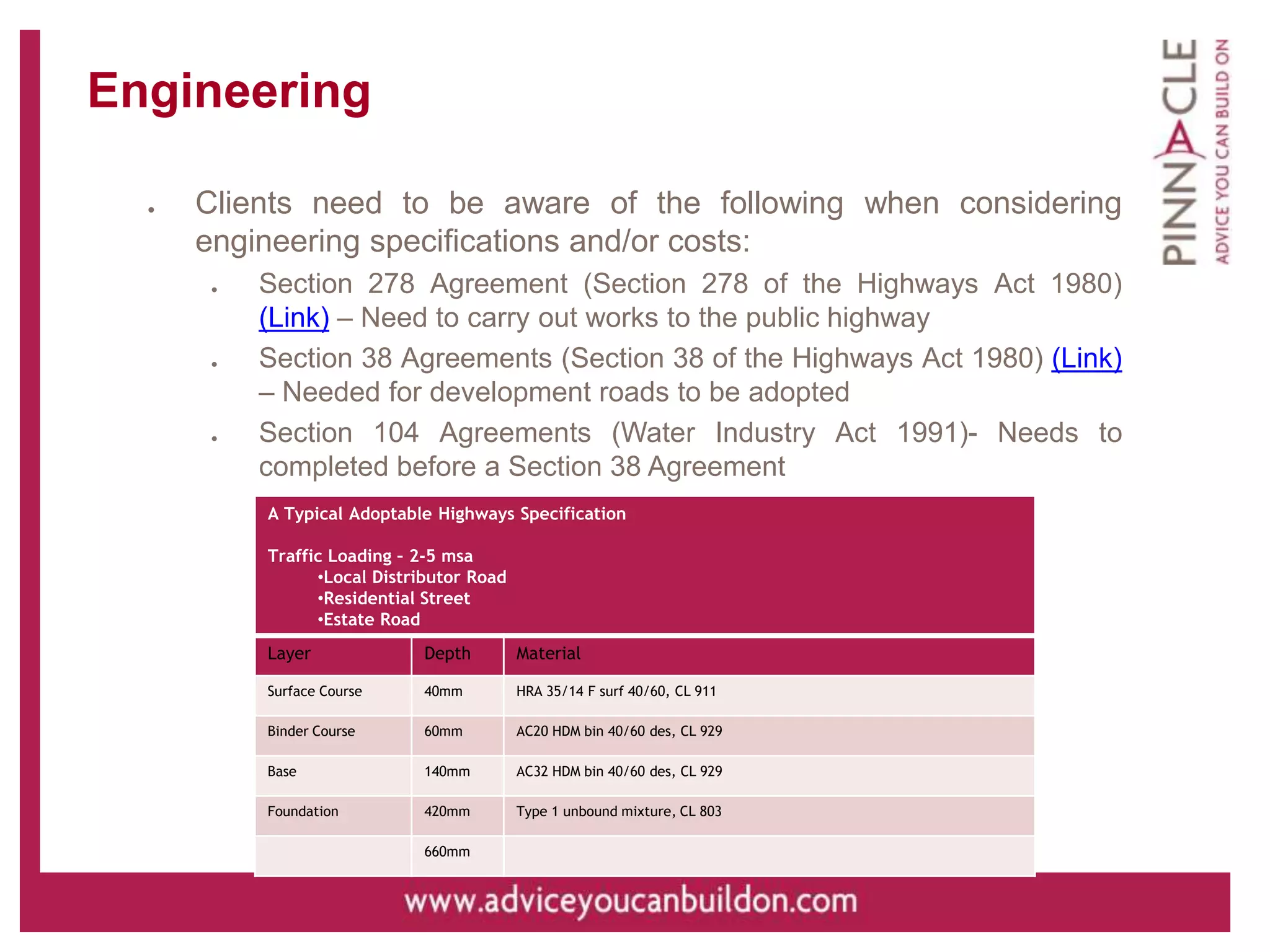
          A Typical Adoptable Highways Specification

          Traffic Loading – 2-5 msa
                •Local Distributor Road
                •Residential Street
                •Estate Road
          Layer              Depth        Material

          Surface Course     40mm         HRA 35/14 F surf 40/60, CL 911

          Binder Course      60mm         AC20 HDM bin 40/60 des, CL 929

          Base               140mm        AC32 HDM bin 40/60 des, CL 929

          Foundation         420mm        Type 1 unbound mixture, CL 803

                             660mm
Presentation outline
   1.   Feasibility
   2.   Engineering
   3.   Need
   4.   Scoping
   5.   TIA
Need
     A TIA is generally required where either of the following conditions
      are met:
         Traffic to and from the development exceeds 10% of the two-
          way traffic flow on the adjoining highway.
         Traffic to and from the development exceeds 5% of the two-
          way traffic flow on the adjoining highway, where traffic
          congestion exists or will exist during the assessment period.

     To quickly assess the need assume the following:
         35% of dwellings will have a peak period arrival/departure i.e.
          for every 100 dwellings there will be 35 AM departures and 35
          PM arrivals
         A two way-way traffic flow of 2100
         Calculate the % change and double it
Presentation outline
   1.   Feasibility
   2.   Engineering
   3.   Need
   4.   Scoping
   5.   TIA
Scoping

     Scoping carried out with developer & highway authority to agree
      key aspects of the project that the TIA should address. This would
      include
          Data     to    be    collected     (traffic counts,     speed
           surveys, pedestrian surveys etc)
          The areas of analysis (minimum development access on to
           highway; consider also other key local junctions with known
           issues)
          TIA methodology (imperial for “typical” developments, micro-
           simulation for developments with multi modal impacts)

     Pinnacle‟s input to scoping:
         Identification of areas of analysis
         Pre planning meeting with highway authority
         Commission traffic counts (Costs vary depending on
          complexity - £1000 upwards)
Scoping


          Typical scoping drawing
Scoping
Traffic Counts

      Pinnacle has long established relationships with various traffic
       survey companies. We can recommend the following survey
       companies:
          Count On Us
          Traffic Wise - Fraser Menzies
          Traffic Watch – Amanda Work
Scoping
Traffic Counts

      Pinnacle has long established relationships with various traffic
       survey companies. We can recommend the following survey
       companies:
          Count On Us
          Traffic Wise - Fraser Menzies
          Traffic Watch – Amanda Work
Presentation outline


   1.   Feasibility
   2.   Engineering
   3.   Need
   4.   Scoping
   5.   TIA
TIA
     The TIA „process‟ consist of 3 fundamental steps:
         The determination of the need for a TIA
         The scope of the TIA
         The preparation of the TIA itself
     A TIA is generally required where either of the following conditions
      are met:
         Traffic to and from the development exceeds 10% of the two-
          way traffic flow on the adjoining highway.
         Traffic to and from the development exceeds 5% of the two-
          way traffic flow on the adjoining highway, where traffic
          congestion exists or will exist during the assessment period.
TIA
Structure


      The format of the TIA depends on the complexity and size of the
       proposal, any Local Authority requirements and the type of
       permission sought.
      Disabilities/Public Transport)
TIA
Structure


      The format of the TIA depends on the complexity and size of the
       proposal, any Local Authority requirements and the type of
       permission sought.
      Disabilities/Public Transport)
TIA
Structure


          The format of the TIA depends on the complexity and size of the
           proposal, any Local Authority requirements and the type of
           permission sought.
          Disabilities/Public Transport)

                     Receiving Environed                       Development Characteristics                   Highways Impact


       Purpose       Describes the existing conditions, both   Describe and quantify the resulting traffic   Determine the likely opening year
                     in quantitative terms and subjective      generated from the proposed development.      of the development and the design
                     descriptions                              Assessment of modal split and trip            horizon.
                                                               assignment onto public highway.
                                                                                                             Application of network traffic
                                                                                                             growth factors to traffic surveys for
                                                                                                             the opening year and design year.

                                                                                                             Traffic assessments on key links
                                                                                                             and junctions within the study area
                                                                                                             to indentify reserve capacity and
                                                                                                             queue length thus determining the
                                                                                                             impact the development has on the
                                                                                                             surrounding road network

       Information   Traffic Surveys; Local public transport   Local planning standards; Local area plans;   Assignment flow diagrams. Access
                     information, Topographical survey of      Planning history; Frozen schedule of          to relevant computer software
       required
                     local highway ;                           accommodation; Frozen road layouts; TRICS     packages.
                                                               Database
TIA
Analysis
      Highways Impact
          Determination of the impact the development will have on the
           local highways network using the following:
               OSCADY
               ARCADY
               PICADY
               LinSig
               AutoTrack

        


                                      OSCADY (Isolated Signalised Junctions)


  ARCADY (Roundabouts)
TIA
Analysis


             LinSig(Multi Location Signalised Junctions)


                                                           PICADY(Priority Junctions


     AutoTrack (Swept Path Analysis
TIA
Analysis

      We also have access to more sophisticated computer software
       programmes such as:
             VISSIM
             VISSUM
             COBA
             SATURN


                                                  VISSIM (MicroSimulation)


                VISSUM (MacroSimulation)
TIA
Costs
   Number of Units           Complexity                                  Time to Complete                                  Costs

   50                        Low; Junctions to be analyzed readily       4-5 days after receipt of frozen                  Up to £5,000 to include:
                             known and close to site access              accommodation schedule and drawings               •Scoping discussions
                                                                                                                           •Drafting & geometric design of
                                                                                                                           internal layout
                                                                                                                           •Junction assessment and report


   150                       Low to medium; Junctions to be              7-10 days after receipt of frozen                 Up to £8,000 to include:
                             analyzed readily know and close to site     accommodation schedule and drawings               •Scoping discussions
                             access. In congested areas highway                                                            •Drafting & geometric design of
                             authority to be consulted.                                                                    internal layout
                                                                                                                           •Junction assessment and report


   300                       Medium; Pre-planning consultation           Once pre planning meeting has taken place,        €10,000 -£12,000 to include:
                             with high authority with highway            up to 15 days after receipt of traffic surveys    •Scoping discussions
                             authority to confirm scope of report        and/or frozen accommodation schedule and          •Drafting & geometric design of
                                                                         drawings                                          internal layout
                                                                                                                           •Junction assessment and report


   500                       High; Scoping of project of critical        Once pre planning meeting has taken place,        Up to £15,000 to include:
                             importance. Pre-planning consultation       up to 15-20 days after receipt of traffic         •Scoping discussions
                             with high authority a must                  surveys and/or frozen accommodation               •Drafting & geometric design of
                                                                         schedule and drawings                             internal layout
                                                                                                                           •Junction assessment and report


   Please Note:
   1. It is assumed that the development meets with relevant local guidelines and that on three/four junctions in the immediate vicinity will need to be analysed, should
       further assessment or detailed micro simulation be required this will be subject to additional fees.
   2. All drawings to be passed on to us in a frozen state. Any changes that require updating of our drawings/analysis will be subject to additional fees.
   3. Additional meetings to be charged at agreed hourly rate and to include travel expenses.
   4. Progress will be via E-Mail or Telephone discussion.
   5. Traffic surveys to be invoiced to client
Thank you


  Email:
      ronan.k@adviceyoucanbuildon.com

Transport planning things you need to know rev 1

  • 1.
    Transportation Planning 5 KeyThings Our Clients Need to Know Presented by Ronan Kearns, B.A, B.A.I, MSc, CEng MIEI Senior Transport Planner, Dublin ronan.k@adviceyoucanbuildon.com
  • 2.
    Purpose of Presentation  Understand what our Clients need to know  Be able to offer high level advice to existing/prospective clients in the area of roads and transportation  Give advice on costs and programme for completion of a TIA
  • 3.
    Presentation outline 1. Feasibility 2. Engineering 3. Need 4. Scoping 5. TIA
  • 4.
    Presentation outline 1. Feasibility 2. Engineering 3. Need 4. Scoping 5. TIA
  • 5.
    Feasibility  Having Pinnacle onboard at an early stage results in:  Reduced design period  Reduced costs as less iterations are involved  Designs conform more readily to engineering design standards  Pinnacle can offer design advice on the following:  Road layouts including junction radii, turning circles and sight line provision, etc;  Parking layout  Identification of issues likely to have an impact on budget and/or costs;  Investigate the feasibility of several options in parallel with the design team
  • 6.
    Feasibility Common issues tolook out for Has the minimum car parking dimensions been catered for? In the case of a commercial/retail development the number of disabled spaces to be provided ranges from 4-10% of total spaces. A similar amount is provided for “mother & baby” spaces
  • 7.
    Feasibility Common issues tolook out for Has the 6.0m carriageway been provided? Anything less will result in difficulties for vehicles to access the spaces safely. Angled parking should only be used in situations were a two- way system would reduce parking numbers
  • 8.
    Feasibility Common roads inputadvice Vehicle Radius Road Max. Gully Road Max. Length Type (m) Width Spacing Category of straight (m) (m) section of Private 6 road Car Shared 40m Fire 9 5.5-6.5 55 Surface Engine 7.5 50 Cul-de-sac 60m Refuse 10 Vehicle Access (<50 60m 9.0 40 houses) Furniture 11 Removal 10.0 35 Access (>50 100m houses) For junctions on to highway min radius should be 10m In order to prevent speeding the For internal estate roads length of straight road should be this can be relaxed to 6m minimised with either horizontal or vertical deflection
  • 9.
    Feasibility Sight Lines Major Road Type Major Road X (m) Y (m) Y (m) Speed (mph) (Excluding (Including bonnet bonnet allowance) allowance) Secondary 40 4.5 66 66 Distributor Local Distributor 30 4.5 43 43 Major Access 25 2.4 31 33 Road Minor Access 30 2.4 22 25 Road Shared Surface 10 2.4 9 11 Road Industrial Road 25 4.5 50 50
  • 10.
    Feasibility Parking Standards Residential Cycle parking Car Parking Servicing Dwellings standards (minimum) Standards Requirements (Use Class C3) (maximum) Norwich (Link) One covered and secure cycle 1 and 2 bed units: 1 space per dwelling Access for emergency services, storage space or shed per dwelling. 3+ bed units: 2 spaces per dwelling. removal lorries, refuse vehicles On average, developments should will be necessary. Cycle parking for visitors is required average 1.5 parking spaces per unit or in the vicinity. fewer. Herefordshire – One l/t space provided per dwelling 1 bed: 0.75 space per dwelling Access for emergency services, if no storage or shed is provided 2 bed: 1 space per dwelling removal lorries, refuse vehicles Welwyn 3 bed: 1.5 spaces per dwelling will be necessary. Hatfield (Zone 4 or more: 2 spaces per dwelling 1 & 2) (Link) Wiltshire Not available 1 bed:1space per dwelling Access for emergency services, 2-3 bed: 2 space per dwelling removal lorries, refuse vehicles Council (Link) 4 or more: 3 spaces per dwelling will be necessary. Visitor spaces: 0.2 per dwelling (unallocated) Greater 1 space per 20 dwellings (minimum 1 bed:1space per dwelling Access for emergency services, of 2) 2-3 bed: 2 space per dwelling removal lorries, refuse vehicles Manchester – 4 or more: 3 spaces per dwelling will be necessary. Trafford Council (Area B) (Link)
  • 11.
    Presentation outline 1. Feasibility 2. Engineering 3. Need 4. Scoping 5. TIA
  • 12.
    Engineering  Clients need to be aware of the following when considering engineering specifications and/or costs:  Section 278 Agreement (Section 278 of the Highways Act 1980) (Link) – Need to carry out works to the public highway  Section 38 Agreements (Section 38 of the Highways Act 1980) (Link) – Needed for development roads to be adopted  Section 104 Agreements (Water Industry Act 1991)- Needs to completed before a Section 38 Agreement
  • 13.
    Engineering  Clients need to be aware of the following when considering engineering specifications and/or costs:  Section 278 Agreement (Section 278 of the Highways Act 1980) (Link) – Need to carry out works to the public highway  Section 38 Agreements (Section 38 of the Highways Act 1980) (Link) – Needed for development roads to be adopted  Section 104 Agreements (Water Industry Act 1991)- Needs to completed before a Section 38 Agreement A Typical Adoptable Highways Specification Traffic Loading – 2-5 msa •Local Distributor Road •Residential Street •Estate Road Layer Depth Material Surface Course 40mm HRA 35/14 F surf 40/60, CL 911 Binder Course 60mm AC20 HDM bin 40/60 des, CL 929 Base 140mm AC32 HDM bin 40/60 des, CL 929 Foundation 420mm Type 1 unbound mixture, CL 803 660mm
  • 14.
    Presentation outline 1. Feasibility 2. Engineering 3. Need 4. Scoping 5. TIA
  • 15.
    Need  A TIA is generally required where either of the following conditions are met:  Traffic to and from the development exceeds 10% of the two- way traffic flow on the adjoining highway.  Traffic to and from the development exceeds 5% of the two- way traffic flow on the adjoining highway, where traffic congestion exists or will exist during the assessment period.  To quickly assess the need assume the following:  35% of dwellings will have a peak period arrival/departure i.e. for every 100 dwellings there will be 35 AM departures and 35 PM arrivals  A two way-way traffic flow of 2100  Calculate the % change and double it
  • 16.
    Presentation outline 1. Feasibility 2. Engineering 3. Need 4. Scoping 5. TIA
  • 17.
    Scoping  Scoping carried out with developer & highway authority to agree key aspects of the project that the TIA should address. This would include  Data to be collected (traffic counts, speed surveys, pedestrian surveys etc)  The areas of analysis (minimum development access on to highway; consider also other key local junctions with known issues)  TIA methodology (imperial for “typical” developments, micro- simulation for developments with multi modal impacts)  Pinnacle‟s input to scoping:  Identification of areas of analysis  Pre planning meeting with highway authority  Commission traffic counts (Costs vary depending on complexity - £1000 upwards)
  • 18.
    Scoping Typical scoping drawing
  • 19.
    Scoping Traffic Counts  Pinnacle has long established relationships with various traffic survey companies. We can recommend the following survey companies:  Count On Us  Traffic Wise - Fraser Menzies  Traffic Watch – Amanda Work
  • 20.
    Scoping Traffic Counts  Pinnacle has long established relationships with various traffic survey companies. We can recommend the following survey companies:  Count On Us  Traffic Wise - Fraser Menzies  Traffic Watch – Amanda Work
  • 21.
    Presentation outline 1. Feasibility 2. Engineering 3. Need 4. Scoping 5. TIA
  • 22.
    TIA  The TIA „process‟ consist of 3 fundamental steps:  The determination of the need for a TIA  The scope of the TIA  The preparation of the TIA itself  A TIA is generally required where either of the following conditions are met:  Traffic to and from the development exceeds 10% of the two- way traffic flow on the adjoining highway.  Traffic to and from the development exceeds 5% of the two- way traffic flow on the adjoining highway, where traffic congestion exists or will exist during the assessment period.
  • 23.
    TIA Structure  The format of the TIA depends on the complexity and size of the proposal, any Local Authority requirements and the type of permission sought.  Disabilities/Public Transport)
  • 24.
    TIA Structure  The format of the TIA depends on the complexity and size of the proposal, any Local Authority requirements and the type of permission sought.  Disabilities/Public Transport)
  • 25.
    TIA Structure  The format of the TIA depends on the complexity and size of the proposal, any Local Authority requirements and the type of permission sought.  Disabilities/Public Transport) Receiving Environed Development Characteristics Highways Impact Purpose Describes the existing conditions, both Describe and quantify the resulting traffic Determine the likely opening year in quantitative terms and subjective generated from the proposed development. of the development and the design descriptions Assessment of modal split and trip horizon. assignment onto public highway. Application of network traffic growth factors to traffic surveys for the opening year and design year. Traffic assessments on key links and junctions within the study area to indentify reserve capacity and queue length thus determining the impact the development has on the surrounding road network Information Traffic Surveys; Local public transport Local planning standards; Local area plans; Assignment flow diagrams. Access information, Topographical survey of Planning history; Frozen schedule of to relevant computer software required local highway ; accommodation; Frozen road layouts; TRICS packages. Database
  • 26.
    TIA Analysis  Highways Impact  Determination of the impact the development will have on the local highways network using the following:  OSCADY  ARCADY  PICADY  LinSig  AutoTrack  OSCADY (Isolated Signalised Junctions) ARCADY (Roundabouts)
  • 27.
    TIA Analysis LinSig(Multi Location Signalised Junctions) PICADY(Priority Junctions AutoTrack (Swept Path Analysis
  • 28.
    TIA Analysis  We also have access to more sophisticated computer software programmes such as:  VISSIM  VISSUM  COBA  SATURN VISSIM (MicroSimulation) VISSUM (MacroSimulation)
  • 29.
    TIA Costs Number of Units Complexity Time to Complete Costs 50 Low; Junctions to be analyzed readily 4-5 days after receipt of frozen Up to £5,000 to include: known and close to site access accommodation schedule and drawings •Scoping discussions •Drafting & geometric design of internal layout •Junction assessment and report 150 Low to medium; Junctions to be 7-10 days after receipt of frozen Up to £8,000 to include: analyzed readily know and close to site accommodation schedule and drawings •Scoping discussions access. In congested areas highway •Drafting & geometric design of authority to be consulted. internal layout •Junction assessment and report 300 Medium; Pre-planning consultation Once pre planning meeting has taken place, €10,000 -£12,000 to include: with high authority with highway up to 15 days after receipt of traffic surveys •Scoping discussions authority to confirm scope of report and/or frozen accommodation schedule and •Drafting & geometric design of drawings internal layout •Junction assessment and report 500 High; Scoping of project of critical Once pre planning meeting has taken place, Up to £15,000 to include: importance. Pre-planning consultation up to 15-20 days after receipt of traffic •Scoping discussions with high authority a must surveys and/or frozen accommodation •Drafting & geometric design of schedule and drawings internal layout •Junction assessment and report Please Note: 1. It is assumed that the development meets with relevant local guidelines and that on three/four junctions in the immediate vicinity will need to be analysed, should further assessment or detailed micro simulation be required this will be subject to additional fees. 2. All drawings to be passed on to us in a frozen state. Any changes that require updating of our drawings/analysis will be subject to additional fees. 3. Additional meetings to be charged at agreed hourly rate and to include travel expenses. 4. Progress will be via E-Mail or Telephone discussion. 5. Traffic surveys to be invoiced to client
  • 30.
    Thank you Email: ronan.k@adviceyoucanbuildon.com