
What is Livability?
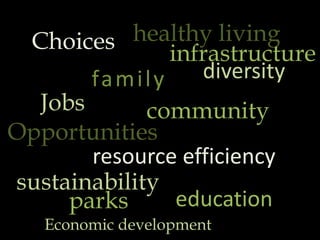
healthy livingChoicesinfrastructurediversityfamilyJobscommunityOpportunitiesresource efficiencysustainabilityeducationparksEconomic development
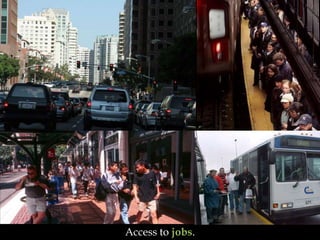
Access to jobs.
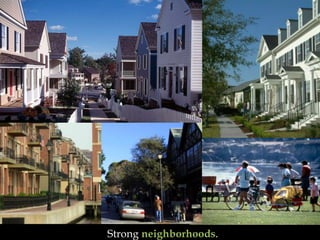
Strong neighborhoods.
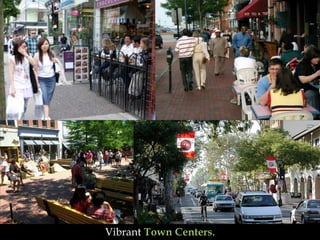
Vibrant Town Centers.
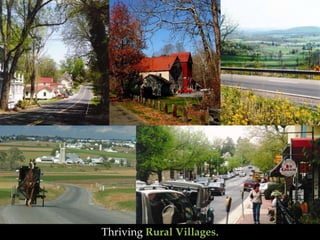
Thriving Rural Villages.
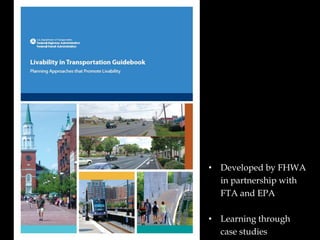
Developed by FHWA in partnership with FTA and EPA
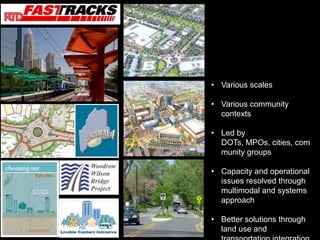
Learning through case studiesVarious scales
Various community contexts
Led by DOTs, MPOs, cities, community groups
Capacity and operational issues resolved through multimodal and systems approach
Better solutions through land use and transportation integration
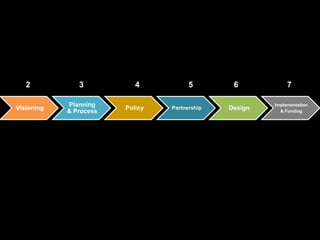
234567
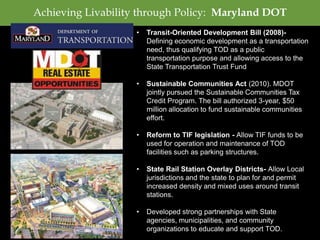
Achieving Livability through Policy:  Maryland DOTTransit-Oriented Development Bill (2008)-Defining economic development as a transportation need, thus qualifying TOD as a public transportation purpose and allowing access to the State Transportation Trust Fund
Sustainable Communities Act (2010). MDOT jointly pursued the Sustainable Communities Tax Credit Program. The bill authorized 3-year, $50 million allocation to fund sustainable communities effort.
Reform to TIF legislation - Allow TIF funds to be used for operation and maintenance of TOD facilities such as parking structures.
State Rail Station Overlay Districts- AllowLocal jurisdictions and the state to plan for and permit increased density and mixed uses around transit stations.
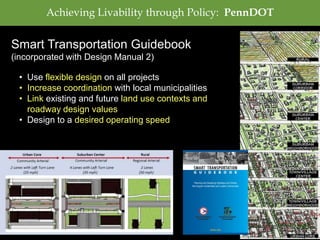
Developed strong partnerships with State agencies, municipalities, and community organizations to educate and support TOD.Achieving Livability through Policy:  PennDOTSmart Transportation Guidebook (incorporated with Design Manual 2) Use flexible design on all projects
Increase coordination with local municipalities
Link existing and future land use contexts and roadway design values
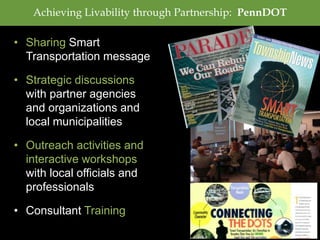
Design to a desired operating speedAchieving Livability through Partnership:  PennDOTSharingSmart Transportation message
Strategic discussions with partner agencies and organizations and local municipalities

Livability

Editor's Notes

  • #2 It is difficult to define livability. However, there are some common elements we think each one of us can relate to livability.
  • #3 Livability is…. [read each word as they appear] Can we try and relate these to our everyday functions at US DOT?
  • #4 … as it relates to transportation, we most closely associate with providing access to jobs.
  • #5 Livability means stable neighborhoods.
  • #6 … and vibrant town centers.
  • #7 A livable place is not always urban and dense. Maintaining the viability of rural villages is also important.
  • #8 It really goes back to….
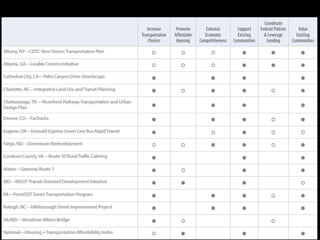
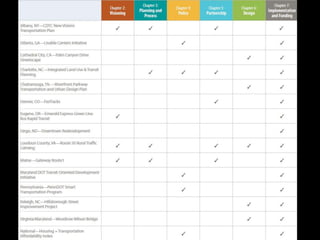
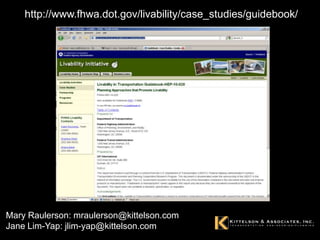
  • #9 The primary purpose of the Guidebook is to illustrate how livability principles have been incorporated into transportation planning, programming, and project design, using examples from State, regional, and local sponsors. It is intended to be useful to a diverse audience of transportation agency staff, partners, decision makers, and the general public, and is applicable in urban, suburban, and rural areas. While several of the example projects address capacity and operational issues on major roadways, the Guidebook primarily explores how transportation planning and programs can improve community quality of life, enhance environmental performance, increase transportation and housing choice while lowering costs, and support economic vitality. Many of the case studies resolve capacity and operational issues through a multimodal network and systems approach, reflecting better integration of land use with transportation.
  • #10 The primary purpose of the Guidebook is to illustrate how livability principles have been incorporated into transportation planning, programming, and project design, using examples from State, regional, and local sponsors. It is intended to be useful to a diverse audience of transportation agency staff, partners, decision makers, and the general public, and is applicable in urban, suburban, and rural areas. While several of the example projects address capacity and operational issues on major roadways, the Guidebook primarily explores how transportation planning and programs can improve community quality of life, enhance environmental performance, increase transportation and housing choice while lowering costs, and support economic vitality. Many of the case studies resolve capacity and operational issues through a multimodal network and systems approach, reflecting better integration of land use with transportation.
  • #13 The Office of Real Estate has real estate experts, architects, lawyers and all are in close partnership with the Governor’s office. It has evolved to have an oversight and transaction-oriented function with specific responsibility to help get MDOT-owned properties ready for sale and private development, more specifically to get properties around MDOT’s transit infrastructure ready for development, and to strengthen MDOT’s ability to support and fund construction of TODs.. MDOT has initiated and had the State legislature adopt groundbreaking legislation that allows for flexibility in funding and implementing TOD. In particular, this legislation extends MDOT’s authority to apply transportation funds by defining economic development as a transportation need, thus qualifying TOD as a public transportation purpose and allowing TOD projects access to the State Transportation Trust Fund. Revenues from TOD projects are paid back into the trust fund.TIF legislation reform would allow bonds to be issued by the Maryland Economic Development Commission (MEDCO) on behalf of municipalities that are not able to issue bonds for TOD financing.
  • #15 PennDOT has advanced the implementation of Smart Transportation in a number of ways.70 Presentations Logged by 11 Districts1,100 District staff attended training sessionsEngagement of Districts in local outreachWeekly Messages