PROMOTING 
COMMUNITY 
HEALTH
Health Promotion 
 ‘the process of enabling people to increase control 
over, and to improve their health’ (WHO,1986)’. 
 ‘Health promotion represents a comprehensive 
social and political process, it not only embraces 
actions directed at strengthening the skills and 
capabilities of individuals, but also action directed 
towards changing social, environmental and 
economic conditions so as to alleviate their impact 
on public and individual health. Health promotion 
is the process of enabling people to increase 
control over the determinants of health and 
thereby improve their health (WHO 1998)’.
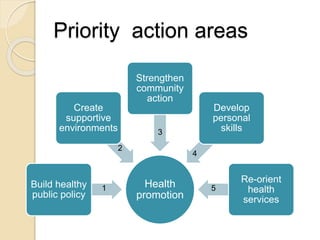
Priority action areas 
Health 
promotion 
Create 
supportive 
environments 
Build healthy 
public policy 
Strengthen 
community 
action 
Develop 
personal 
skills 
Re-orient 
health 
services 
3 
2 
1 
4 
5
1.Build healthy public policy 
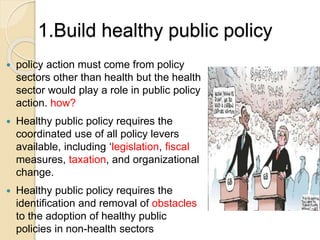
 policy action must come from policy 
sectors other than health but the health 
sector would play a role in public policy 
action. how? 
 Healthy public policy requires the 
coordinated use of all policy levers 
available, including ‘legislation, fiscal 
measures, taxation, and organizational 
change. 
 Healthy public policy requires the 
identification and removal of obstacles 
to the adoption of healthy public 
policies in non-health sectors
National policies 
 National health policy for food and drugs 
 National health policy for protection of 
water and environment 
 National health policy for health care and 
health insurance. 
 National health policy for social 
insurance, equity and social justice. 
 National policy for socio-economic 
development. 
 National policy for health promotion 
 National policy for ……etc.
2.Create supportive 
environments 
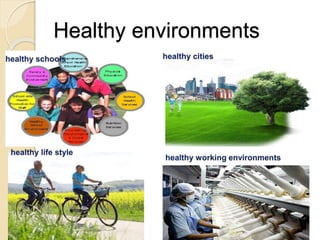
 Both the natural and built environments are 
inextricably linked with people's health. 
 It involves creating conditions that allow 
people to have ‘living and working conditions 
that are safe, stimulating, satisfying, and 
enjoyable. 
 both past endeavors and future prospects, 
one must take into account the lofty ambition 
of this programme of action (HIA, EIA)
Healthy environments
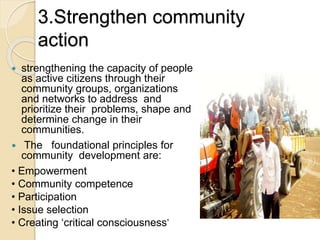
3.Strengthen community 
action 
 strengthening the capacity of people 
as active citizens through their 
community groups, organizations 
and networks to address and 
prioritize their problems, shape and 
determine change in their 
communities. 
 The foundational principles for 
community development are: 
• Empowerment 
• Community competence 
• Participation 
• Issue selection 
• Creating ‘critical consciousness’
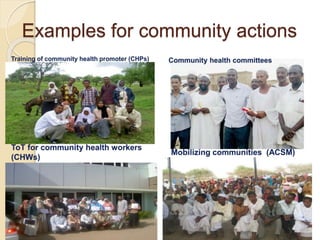
Examples for community actions
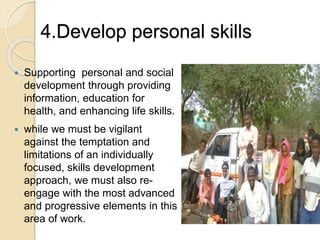
4.Develop personal skills 
 Supporting personal and social 
development through providing 
information, education for 
health, and enhancing life skills. 
 while we must be vigilant 
against the temptation and 
limitations of an individually 
focused, skills development 
approach, we must also re-engage 
with the most advanced 
and progressive elements in this 
area of work.
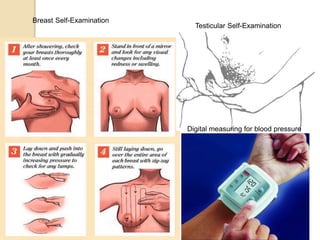
Testicular Self-Examination 
Breast Self-Examination 
Digital measuring for blood pressure
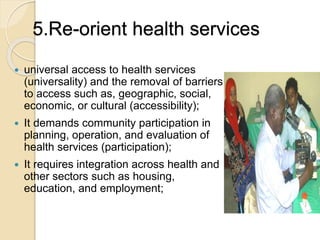
5.Re-orient health services 
 universal access to health services 
(universality) and the removal of barriers 
to access such as, geographic, social, 
economic, or cultural (accessibility); 
 It demands community participation in 
planning, operation, and evaluation of 
health services (participation); 
 It requires integration across health and 
other sectors such as housing, 
education, and employment;
5.Re-orient health 
services(cont.) 
 It recognizes the power of multi-disciplinary 
teams working as equal partners for the 
health of the community; 
 It focuses on a range of services, determined 
by the community, that include health 
promotion, primary prevention, rehabilitative, 
and curative (essentiality); and, 
 It demands a commitment to equity 
concerning issues of power and resources 
(equity and access
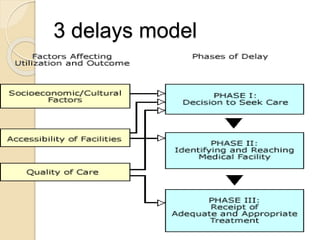
3 delays model

Promoting community health

  • 1.
  • 2.
    Health Promotion ‘the process of enabling people to increase control over, and to improve their health’ (WHO,1986)’.  ‘Health promotion represents a comprehensive social and political process, it not only embraces actions directed at strengthening the skills and capabilities of individuals, but also action directed towards changing social, environmental and economic conditions so as to alleviate their impact on public and individual health. Health promotion is the process of enabling people to increase control over the determinants of health and thereby improve their health (WHO 1998)’.
  • 3.
    Priority action areas Health promotion Create supportive environments Build healthy public policy Strengthen community action Develop personal skills Re-orient health services 3 2 1 4 5
  • 4.
    1.Build healthy publicpolicy  policy action must come from policy sectors other than health but the health sector would play a role in public policy action. how?  Healthy public policy requires the coordinated use of all policy levers available, including ‘legislation, fiscal measures, taxation, and organizational change.  Healthy public policy requires the identification and removal of obstacles to the adoption of healthy public policies in non-health sectors
  • 5.
    National policies National health policy for food and drugs  National health policy for protection of water and environment  National health policy for health care and health insurance.  National health policy for social insurance, equity and social justice.  National policy for socio-economic development.  National policy for health promotion  National policy for ……etc.
  • 6.
    2.Create supportive environments  Both the natural and built environments are inextricably linked with people's health.  It involves creating conditions that allow people to have ‘living and working conditions that are safe, stimulating, satisfying, and enjoyable.  both past endeavors and future prospects, one must take into account the lofty ambition of this programme of action (HIA, EIA)
  • 7.
  • 8.
    3.Strengthen community action  strengthening the capacity of people as active citizens through their community groups, organizations and networks to address and prioritize their problems, shape and determine change in their communities.  The foundational principles for community development are: • Empowerment • Community competence • Participation • Issue selection • Creating ‘critical consciousness’
  • 9.
  • 10.
    4.Develop personal skills  Supporting personal and social development through providing information, education for health, and enhancing life skills.  while we must be vigilant against the temptation and limitations of an individually focused, skills development approach, we must also re-engage with the most advanced and progressive elements in this area of work.
  • 11.
    Testicular Self-Examination BreastSelf-Examination Digital measuring for blood pressure
  • 12.
    5.Re-orient health services  universal access to health services (universality) and the removal of barriers to access such as, geographic, social, economic, or cultural (accessibility);  It demands community participation in planning, operation, and evaluation of health services (participation);  It requires integration across health and other sectors such as housing, education, and employment;
  • 13.
    5.Re-orient health services(cont.)  It recognizes the power of multi-disciplinary teams working as equal partners for the health of the community;  It focuses on a range of services, determined by the community, that include health promotion, primary prevention, rehabilitative, and curative (essentiality); and,  It demands a commitment to equity concerning issues of power and resources (equity and access
  • 14.

Editor's Notes

  • #3 Health promotion represents a comprehensive social and political process, it not only embraces actions directed at strengthening the skills and capabilities of individuals, but also action directed towards changing social, environmental and economic conditions so as to alleviate their impact on public and individual health.
  • #4 These strategies are supported by five priority action areas
  • #7 Active Living/Go for Green” program practices that are both healthy and environmentally-friendly.
  • #9 This action area is at the very heart of health promotion; in fact, it can be argued that it is in this one action area where the basic principles of health promotion lie
  • #12 computerized health risk assessment programs
  • #13 Creating a health system that is based on the principles of health promotion and advocates for equity and social justice