
Compiling P4 to XDP
Mihai Budiu, VMware Research
William Tu, VMware NSBU
{mbudiu,tuc}@vmware.com
February 27, 2017
IOVisor summit
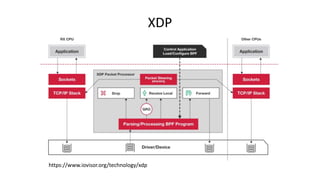
XDP
https://www.iovisor.org/technology/xdp
P4
P4: Programming Protocol-Independent Packet Processors
Pat Bosshart, Dan Daly, Glen Gibb, Martin Izzard, Nick McKeown, Jennifer Rexford, Cole Schlesinger, Dan
Talayco, Amin Vahdat, George Varghese, David Walker ACM SIGCOMM Computer Communications
Review (CCR). Volume 44, Issue #3 (July 2014)
Initially designed for programmable switches. P416 can support many kinds of packet processing devices.
http://P4.org
P4.org Consortium
Carriers, cloud operators, chip,
networking, systems, universities,
start-ups
P416
• C-like, strongly typed
• Arbitrary length bitstrings
• Match-action tables
• Parser = state machine
• No loops, no pointers, no memory allocation
• Support for external, target-specific accelerators
(e.g., checksum units, multicast, learning, etc.)
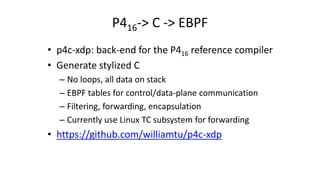
P416-> C -> EBPF
• p4c-xdp: back-end for the P416 reference compiler
• Generate stylized C
– No loops, all data on stack
– EBPF tables for control/data-plane communication
– Filtering, forwarding, encapsulation
– Currently use Linux TC subsystem for forwarding
• https://github.com/williamtu/p4c-xdp
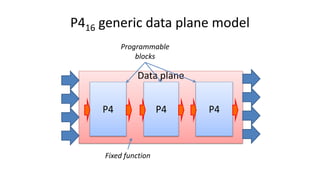
P416 generic data plane model
Data plane
P4 P4 P4
Programmable
blocks
Fixed function
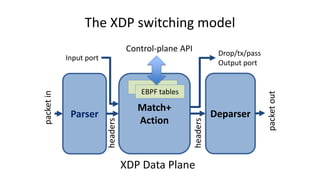
The XDP switching model
Parser
Match+
Action
Deparser
XDP Data Plane
packetin
packetout
EBPF tables
Control-plane API Drop/tx/pass
Output port
Input port
headers
headers
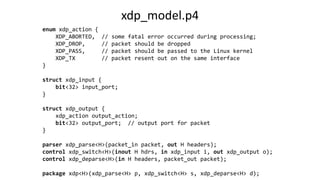
xdp_model.p4
enum xdp_action {
XDP_ABORTED, // some fatal error occurred during processing;
XDP_DROP, // packet should be dropped
XDP_PASS, // packet should be passed to the Linux kernel
XDP_TX // packet resent out on the same interface
}
struct xdp_input {
bit<32> input_port;
}
struct xdp_output {
xdp_action output_action;
bit<32> output_port; // output port for packet
}
parser xdp_parse<H>(packet_in packet, out H headers);
control xdp_switch<H>(inout H hdrs, in xdp_input i, out xdp_output o);
control xdp_deparse<H>(in H headers, packet_out packet);
package xdp<H>(xdp_parse<H> p, xdp_switch<H> s, xdp_deparse<H> d);
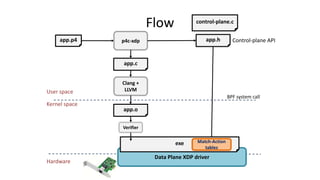
Flow
app.p4
Clang +
LLVM
Data Plane XDP driver
Verifier
app.h
BPF system call
Hardware
Kernel space
User space
app.c
p4c-xdp
control-plane.c
Control-plane API
app.o
exe Match-Action
tables
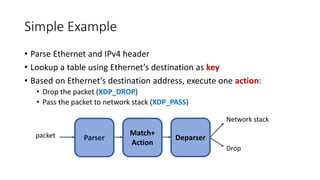
Simple Example
• Parse Ethernet and IPv4 header
• Lookup a table using Ethernet’s destination as key
• Based on Ethernet’s destination address, execute one action:
• Drop the packet (XDP_DROP)
• Pass the packet to network stack (XDP_PASS)
Parser
Match+
Action
Deparser
Drop
Network stack
packet
P4 Protocol Header Definition
header Ethernet {
bit<48> source;
bit<48> destination;
bit<16> protocol;
}
header IPv4{
bit<4> version;
bit<4> ihl;
bit<8> diffserv;
…
}
struct Headers {
Ethernet ethernet;
IPv4 ipv4;
}
C struct + valid bit
C struct
struct Ethernet{
u8 source[6];
u8 destination[6];
u16 protocol;
u8 ebpf_valid;
}
…
xdp.h
P4c-xdp
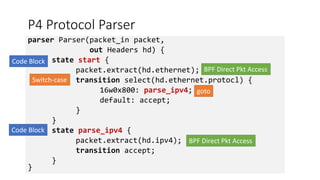
P4 Protocol Parser
parser Parser(packet_in packet,
out Headers hd) {
state start {
packet.extract(hd.ethernet);
transition select(hd.ethernet.protocl) {
16w0x800: parse_ipv4;
default: accept;
}
}
state parse_ipv4 {
packet.extract(hd.ipv4);
transition accept;
}
}
Code Block
Switch-case
Code Block
BPF Direct Pkt Access
goto
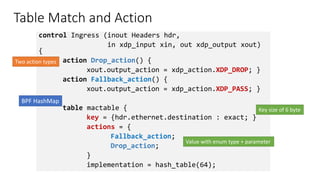
Table Match and Action
control Ingress (inout Headers hdr,
in xdp_input xin, out xdp_output xout)
{
action Drop_action() {
xout.output_action = xdp_action.XDP_DROP; }
action Fallback_action() {
xout.output_action = xdp_action.XDP_PASS; }
table mactable {
key = {hdr.ethernet.destination : exact; }
actions = {
Fallback_action;
Drop_action;
}
implementation = hash_table(64);
BPF HashMap
Key size of 6 byte
Value with enum type + parameter
Two action types
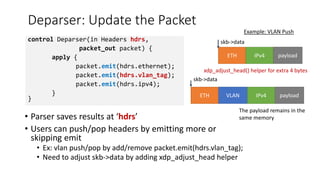
Deparser: Update the Packet
control Deparser(in Headers hdrs,
packet_out packet) {
apply {
packet.emit(hdrs.ethernet);
packet.emit(hdrs.vlan_tag);
packet.emit(hdrs.ipv4);
}
}
• Parser saves results at ‘hdrs’
• Users can push/pop headers by emitting more or
skipping emit
• Ex: vlan push/pop by add/remove packet.emit(hdrs.vlan_tag);
• Need to adjust skb->data by adding xdp_adjust_head helper
Example: VLAN Push
VLANETH payloadIPv4
skb->data
ETH payloadIPv4
skb->data
The payload remains in the
same memory
xdp_adjust_head() helper for extra 4 bytes
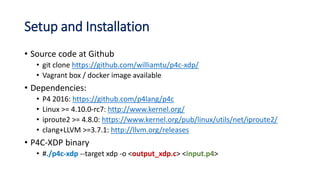
Setup and Installation
• Source code at Github
• git clone https://github.com/williamtu/p4c-xdp/
• Vagrant box / docker image available
• Dependencies:
• P4 2016: https://github.com/p4lang/p4c
• Linux >= 4.10.0-rc7: http://www.kernel.org/
• iproute2 >= 4.8.0: https://www.kernel.org/pub/linux/utils/net/iproute2/
• clang+LLVM >=3.7.1: http://llvm.org/releases
• P4C-XDP binary
• #./p4c-xdp --target xdp -o <output_xdp.c> <input.p4>
Experiences with BPF Verifier
• Typical packet access check: data + [off] <= data_end
• where [off] can be either immediate or
• coming from a tracked register that contains an immediate
• Two patches related to direct packet access
• bpf: enable verifier to better track const alu ops, commit 3fadc8011583
• bpf: enable verifier to add 0 to packet ptr, commit 63dfef75ed753
R1=pkt(id=0,off=0,r=22) R2=pkt_end R3=imm144,min_value=144,max_value=144
30: (bf) r5 = r3
31: (07) r5 += 23
32: (77) r5 >>= 3
33: (bf) r6 = r1 // r6 == pkt
34: (0f) r6 += r5 // pkt += r5
Pending Issues
• BPF 512 Byte maximum stack size [#22]
• Not necessarily due to the size of local variables
• LLVM allocates too many things into 8 byte registers
• LLVM spills registers onto the stack
• Possible workarounds:
• Bump up the maximum stack size in kernel
• Enable more efficient use of stack in LLVM
• Registers having const_imm spills without tracking state [#34]
• BPF only has 10 registers, LLVM spills the register to stack when necessary
• BPF verifier keeps the register states and restore after BPF_LOAD
• Current version does not support spill const_imm
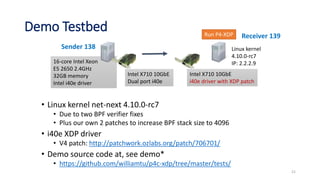
Demo Testbed
• Linux kernel net-next 4.10.0-rc7
• Due to two BPF verifier fixes
• Plus our own 2 patches to increase BPF stack size to 4096
• i40e XDP driver
• V4 patch: http://patchwork.ozlabs.org/patch/706701/
• Demo source code at, see demo*
• https://github.com/williamtu/p4c-xdp/tree/master/tests/
16-core Intel Xeon
E5 2650 2.4GHz
32GB memory
Intel i40e driver
Intel X710 10GbE
Dual port i40e
21
Sender 138
Intel X710 10GbE
i40e driver with XDP patch
Linux kernel
4.10.0-rc7
IP: 2.2.2.9
Run P4-XDP Receiver 139
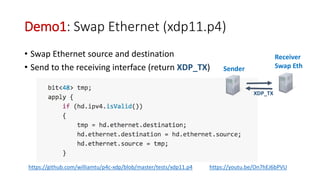
Demo1: Swap Ethernet (xdp11.p4)
• Swap Ethernet source and destination
• Send to the receiving interface (return XDP_TX)
https://github.com/williamtu/p4c-xdp/blob/master/tests/xdp11.p4 https://youtu.be/On7hEJ6bPVU
Sender
Receiver
Swap Eth
XDP_TX
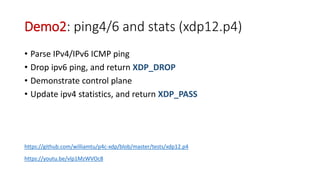
Demo2: ping4/6 and stats (xdp12.p4)
• Parse IPv4/IPv6 ICMP ping
• Drop ipv6 ping, and return XDP_DROP
• Demonstrate control plane
• Update ipv4 statistics, and return XDP_PASS
https://youtu.be/vlp1MzWVOc8
https://github.com/williamtu/p4c-xdp/blob/master/tests/xdp12.p4
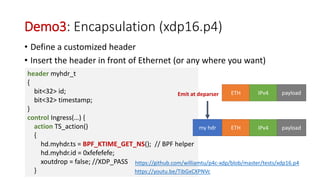
Demo3: Encapsulation (xdp16.p4)
• Define a customized header
• Insert the header in front of Ethernet (or any where you want)
ETH payloadIPv4
header myhdr_t
{
bit<32> id;
bit<32> timestamp;
}
control Ingress(…) {
action TS_action()
{
hd.myhdr.ts = BPF_KTIME_GET_NS(); // BPF helper
hd.myhdr.id = 0xfefefefe;
xoutdrop = false; //XDP_PASS
}
my hdr ETH payloadIPv4
Emit at deparser
https://youtu.be/TibGxCXPNVc
https://github.com/williamtu/p4c-xdp/blob/master/tests/xdp16.p4
Future Wok
• Forward / broadcast /clone
• Currently rely on TC (bpf_skb_clone_redirect)
• XDP_FORWARD support in driver/kernel?
• Recirculation
• Add recirculation support in XDP driver
• Return xdp_recirculate and tail call.
• Use cases
Thank You
Questions?

Compiling P4 to XDP, IOVISOR Summit 2017

  • 1.
    Compiling P4 toXDP Mihai Budiu, VMware Research William Tu, VMware NSBU {mbudiu,tuc}@vmware.com February 27, 2017 IOVisor summit
  • 2.
  • 3.
    P4 P4: Programming Protocol-IndependentPacket Processors Pat Bosshart, Dan Daly, Glen Gibb, Martin Izzard, Nick McKeown, Jennifer Rexford, Cole Schlesinger, Dan Talayco, Amin Vahdat, George Varghese, David Walker ACM SIGCOMM Computer Communications Review (CCR). Volume 44, Issue #3 (July 2014) Initially designed for programmable switches. P416 can support many kinds of packet processing devices. http://P4.org
  • 4.
    P4.org Consortium Carriers, cloudoperators, chip, networking, systems, universities, start-ups
  • 5.
    P416 • C-like, stronglytyped • Arbitrary length bitstrings • Match-action tables • Parser = state machine • No loops, no pointers, no memory allocation • Support for external, target-specific accelerators (e.g., checksum units, multicast, learning, etc.)
  • 6.
    P416-> C ->EBPF • p4c-xdp: back-end for the P416 reference compiler • Generate stylized C – No loops, all data on stack – EBPF tables for control/data-plane communication – Filtering, forwarding, encapsulation – Currently use Linux TC subsystem for forwarding • https://github.com/williamtu/p4c-xdp
  • 7.
    P416 generic dataplane model Data plane P4 P4 P4 Programmable blocks Fixed function
  • 8.
    The XDP switchingmodel Parser Match+ Action Deparser XDP Data Plane packetin packetout EBPF tables Control-plane API Drop/tx/pass Output port Input port headers headers
  • 9.
    xdp_model.p4 enum xdp_action { XDP_ABORTED,// some fatal error occurred during processing; XDP_DROP, // packet should be dropped XDP_PASS, // packet should be passed to the Linux kernel XDP_TX // packet resent out on the same interface } struct xdp_input { bit<32> input_port; } struct xdp_output { xdp_action output_action; bit<32> output_port; // output port for packet } parser xdp_parse<H>(packet_in packet, out H headers); control xdp_switch<H>(inout H hdrs, in xdp_input i, out xdp_output o); control xdp_deparse<H>(in H headers, packet_out packet); package xdp<H>(xdp_parse<H> p, xdp_switch<H> s, xdp_deparse<H> d);
  • 10.
    Flow app.p4 Clang + LLVM Data PlaneXDP driver Verifier app.h BPF system call Hardware Kernel space User space app.c p4c-xdp control-plane.c Control-plane API app.o exe Match-Action tables
  • 11.
    Simple Example • ParseEthernet and IPv4 header • Lookup a table using Ethernet’s destination as key • Based on Ethernet’s destination address, execute one action: • Drop the packet (XDP_DROP) • Pass the packet to network stack (XDP_PASS) Parser Match+ Action Deparser Drop Network stack packet
  • 12.
    P4 Protocol HeaderDefinition header Ethernet { bit<48> source; bit<48> destination; bit<16> protocol; } header IPv4{ bit<4> version; bit<4> ihl; bit<8> diffserv; … } struct Headers { Ethernet ethernet; IPv4 ipv4; } C struct + valid bit C struct struct Ethernet{ u8 source[6]; u8 destination[6]; u16 protocol; u8 ebpf_valid; } … xdp.h P4c-xdp
  • 13.
    P4 Protocol Parser parserParser(packet_in packet, out Headers hd) { state start { packet.extract(hd.ethernet); transition select(hd.ethernet.protocl) { 16w0x800: parse_ipv4; default: accept; } } state parse_ipv4 { packet.extract(hd.ipv4); transition accept; } } Code Block Switch-case Code Block BPF Direct Pkt Access BPF Direct Pkt Access goto
  • 14.
    Table Match andAction control Ingress (inout Headers hdr, in xdp_input xin, out xdp_output xout) { action Drop_action() { xout.output_action = xdp_action.XDP_DROP; } action Fallback_action() { xout.output_action = xdp_action.XDP_PASS; } table mactable { key = {hdr.ethernet.destination : exact; } actions = { Fallback_action; Drop_action; } implementation = hash_table(64); BPF HashMap Key size of 6 byte Value with enum type + parameter Two action types
  • 15.
    Deparser: Update thePacket control Deparser(in Headers hdrs, packet_out packet) { apply { packet.emit(hdrs.ethernet); packet.emit(hdrs.vlan_tag); packet.emit(hdrs.ipv4); } } • Parser saves results at ‘hdrs’ • Users can push/pop headers by emitting more or skipping emit • Ex: vlan push/pop by add/remove packet.emit(hdrs.vlan_tag); • Need to adjust skb->data by adding xdp_adjust_head helper Example: VLAN Push VLANETH payloadIPv4 skb->data ETH payloadIPv4 skb->data The payload remains in the same memory xdp_adjust_head() helper for extra 4 bytes
  • 16.
    Setup and Installation •Source code at Github • git clone https://github.com/williamtu/p4c-xdp/ • Vagrant box / docker image available • Dependencies: • P4 2016: https://github.com/p4lang/p4c • Linux >= 4.10.0-rc7: http://www.kernel.org/ • iproute2 >= 4.8.0: https://www.kernel.org/pub/linux/utils/net/iproute2/ • clang+LLVM >=3.7.1: http://llvm.org/releases • P4C-XDP binary • #./p4c-xdp --target xdp -o <output_xdp.c> <input.p4>
  • 17.
    Experiences with BPFVerifier • Typical packet access check: data + [off] <= data_end • where [off] can be either immediate or • coming from a tracked register that contains an immediate • Two patches related to direct packet access • bpf: enable verifier to better track const alu ops, commit 3fadc8011583 • bpf: enable verifier to add 0 to packet ptr, commit 63dfef75ed753 R1=pkt(id=0,off=0,r=22) R2=pkt_end R3=imm144,min_value=144,max_value=144 30: (bf) r5 = r3 31: (07) r5 += 23 32: (77) r5 >>= 3 33: (bf) r6 = r1 // r6 == pkt 34: (0f) r6 += r5 // pkt += r5
  • 18.
    Pending Issues • BPF512 Byte maximum stack size [#22] • Not necessarily due to the size of local variables • LLVM allocates too many things into 8 byte registers • LLVM spills registers onto the stack • Possible workarounds: • Bump up the maximum stack size in kernel • Enable more efficient use of stack in LLVM • Registers having const_imm spills without tracking state [#34] • BPF only has 10 registers, LLVM spills the register to stack when necessary • BPF verifier keeps the register states and restore after BPF_LOAD • Current version does not support spill const_imm
  • 19.
    Demo Testbed • Linuxkernel net-next 4.10.0-rc7 • Due to two BPF verifier fixes • Plus our own 2 patches to increase BPF stack size to 4096 • i40e XDP driver • V4 patch: http://patchwork.ozlabs.org/patch/706701/ • Demo source code at, see demo* • https://github.com/williamtu/p4c-xdp/tree/master/tests/ 16-core Intel Xeon E5 2650 2.4GHz 32GB memory Intel i40e driver Intel X710 10GbE Dual port i40e 21 Sender 138 Intel X710 10GbE i40e driver with XDP patch Linux kernel 4.10.0-rc7 IP: 2.2.2.9 Run P4-XDP Receiver 139
  • 20.
    Demo1: Swap Ethernet(xdp11.p4) • Swap Ethernet source and destination • Send to the receiving interface (return XDP_TX) https://github.com/williamtu/p4c-xdp/blob/master/tests/xdp11.p4 https://youtu.be/On7hEJ6bPVU Sender Receiver Swap Eth XDP_TX
  • 21.
    Demo2: ping4/6 andstats (xdp12.p4) • Parse IPv4/IPv6 ICMP ping • Drop ipv6 ping, and return XDP_DROP • Demonstrate control plane • Update ipv4 statistics, and return XDP_PASS https://youtu.be/vlp1MzWVOc8 https://github.com/williamtu/p4c-xdp/blob/master/tests/xdp12.p4
  • 22.
    Demo3: Encapsulation (xdp16.p4) •Define a customized header • Insert the header in front of Ethernet (or any where you want) ETH payloadIPv4 header myhdr_t { bit<32> id; bit<32> timestamp; } control Ingress(…) { action TS_action() { hd.myhdr.ts = BPF_KTIME_GET_NS(); // BPF helper hd.myhdr.id = 0xfefefefe; xoutdrop = false; //XDP_PASS } my hdr ETH payloadIPv4 Emit at deparser https://youtu.be/TibGxCXPNVc https://github.com/williamtu/p4c-xdp/blob/master/tests/xdp16.p4
  • 23.
    Future Wok • Forward/ broadcast /clone • Currently rely on TC (bpf_skb_clone_redirect) • XDP_FORWARD support in driver/kernel? • Recirculation • Add recirculation support in XDP driver • Return xdp_recirculate and tail call. • Use cases
  • 24.

Editor's Notes

  • #21 llvm, where it allocates too many things into wide registers and then it spills them onto the stack although they could be spilled into the original stack locations of the local variables. E.g. There are two locations for ethtype on the stack: One in our headers, and one in the spill location, the later being 64 bits. It would almost be better if there was no register allocation at all, and the data would just be manipulated directly on the stack.
  • #24 # ip link set dev enp66s0f0 xdp obj xdp11.o verb # ./xdp10
  • #25 action TS_action() { hd.myhdr.ts = BPF_KTIME_GET_NS(); hd.myhdr.id = 0xfefefefe; xoutdrop = false; }