Presented by
Date
Event
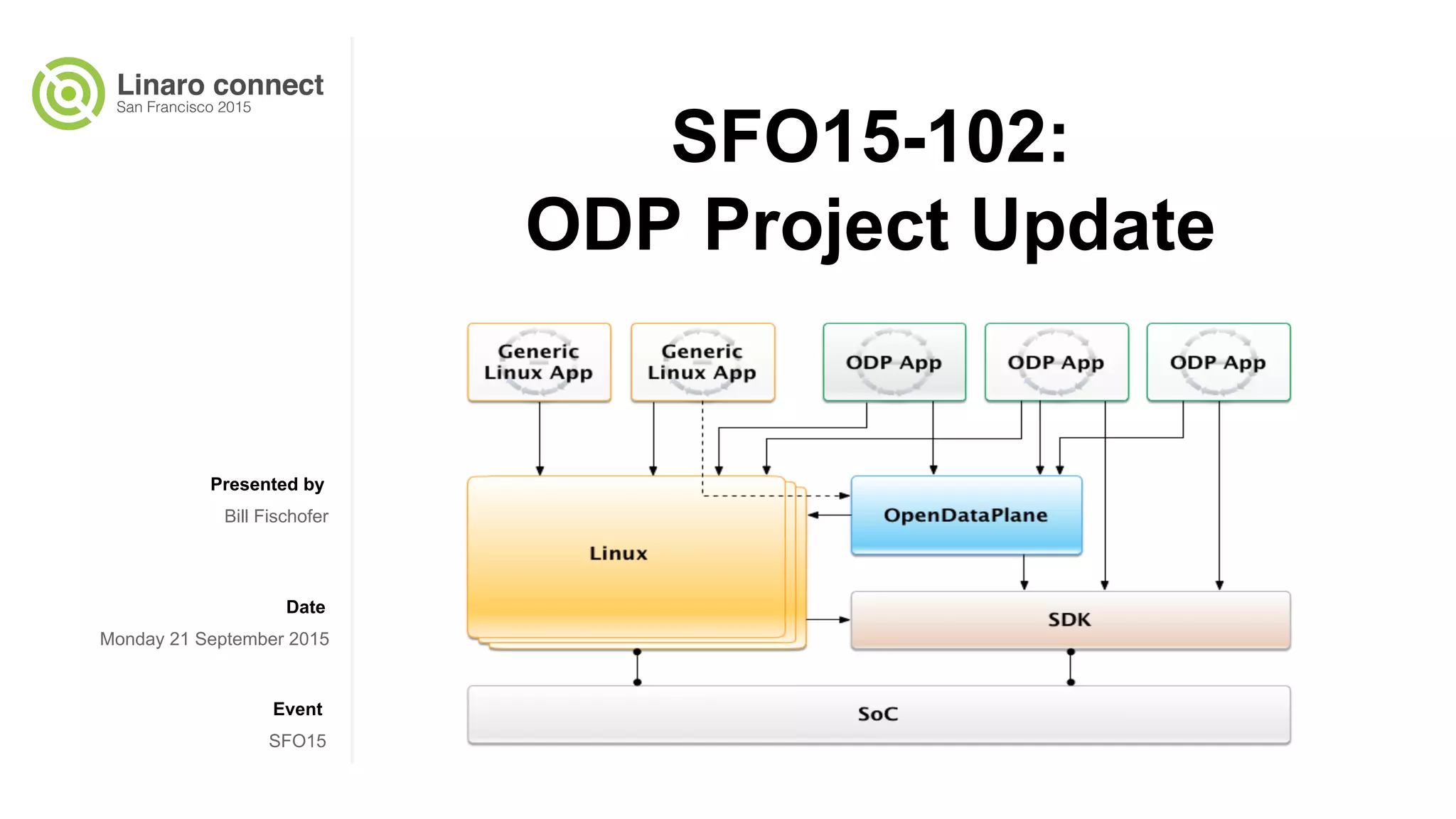
SFO15-102:
ODP Project Update
Bill Fischofer
Monday 21 September 2015
SFO15
Topics for Today
● OpenDataPlane overview and project status
● Key developments since HKG15
● Plans for rest of 2015 and into 2016
● ODP and OPNFV
● ODP Application Design
● LNG Sessions and Demos at SFO15
ODP Overview
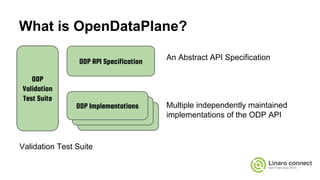
What is OpenDataPlane?
An Abstract API Specification
Multiple independently maintained
implementations of the ODP API
Validation Test Suite
ODP API Specification
ODP Implementations
ODP
Validation
Test Suite
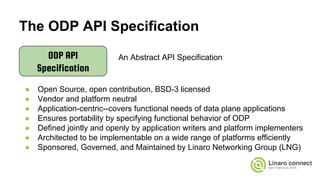
The ODP API Specification
ODP API
Specification
An Abstract API Specification
● Open Source, open contribution, BSD-3 licensed
● Vendor and platform neutral
● Application-centric--covers functional needs of data plane applications
● Ensures portability by specifying functional behavior of ODP
● Defined jointly and openly by application writers and platform implementers
● Architected to be implementable on a wide range of platforms efficiently
● Sponsored, Governed, and Maintained by Linaro Networking Group (LNG)
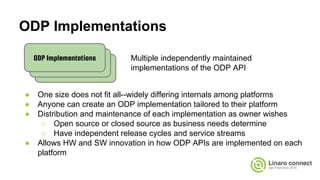
ODP Implementations
Multiple independently maintained
implementations of the ODP API
● One size does not fit all--widely differing internals among platforms
● Anyone can create an ODP implementation tailored to their platform
● Distribution and maintenance of each implementation as owner wishes
○ Open source or closed source as business needs determine
○ Have independent release cycles and service streams
● Allows HW and SW innovation in how ODP APIs are implemented on each
platform
ODP Implementations
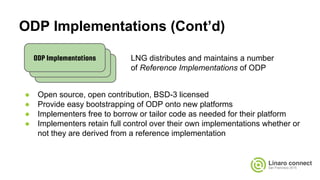
ODP Implementations (Cont’d)
LNG distributes and maintains a number
of Reference Implementations of ODP
● Open source, open contribution, BSD-3 licensed
● Provide easy bootstrapping of ODP onto new platforms
● Implementers free to borrow or tailor code as needed for their platform
● Implementers retain full control over their own implementations whether or
not they are derived from a reference implementation
ODP Implementations
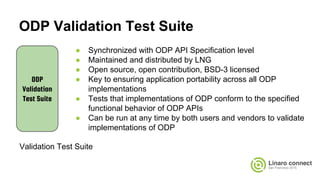
ODP Validation Test Suite
ODP
Validation
Test Suite
Validation Test Suite
● Synchronized with ODP API Specification level
● Maintained and distributed by LNG
● Open source, open contribution, BSD-3 licensed
● Key to ensuring application portability across all ODP
implementations
● Tests that implementations of ODP conform to the specified
functional behavior of ODP APIs
● Can be run at any time by both users and vendors to validate
implementations of ODP
ODP Project Status
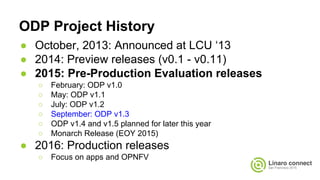
ODP Project History
● October, 2013: Announced at LCU ‘13
● 2014: Preview releases (v0.1 - v0.11)
● 2015: Pre-Production Evaluation releases
○ February: ODP v1.0
○ May: ODP v1.1
○ July: ODP v1.2
○ September: ODP v1.3
○ ODP v1.4 and v1.5 planned for later this year
○ Monarch Release (EOY 2015)
● 2016: Production releases
○ Focus on apps and OPNFV
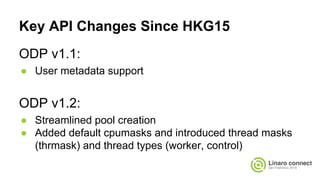
Key API Changes Since HKG15
ODP v1.1:
● User metadata support
ODP v1.2:
● Streamlined pool creation
● Added default cpumasks and introduced thread masks
(thrmask) and thread types (worker, control)
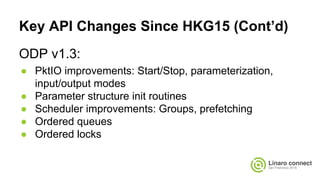
Key API Changes Since HKG15 (Cont’d)
ODP v1.3:
● PktIO improvements: Start/Stop, parameterization,
input/output modes
● Parameter structure init routines
● Scheduler improvements: Groups, prefetching
● Ordered queues
● Ordered locks
Other ODP Changes since HKG15
Platforms
● odp-dpdk launched as performance platform for x86
○ uses DPDK as underlying SDK
○ enables ODP to support various NICs that have
DPDK drivers
○ doing proof of concept work with applications like
Open vSwitch
● odp-mppa launched as open source platform supporting
Kalray MPPA SoCs
Other ODP Changes since HKG15 (Cont’d)
Validation Suite
● Restructured to be platform-independent
● Supports platform-specific extension tests that can be
added by vendors for additional internal validation
● Goal is to support validation repository separation as
described earlier
What’s ahead for ODP in 2015?
ODP v1.4:
● Egress Traffic Manager
● Interprocess Communication (IPC)
● Port counters and statistics
● Improved test capabilities (PCAP replay)
● Configuration APIs
What’s ahead for ODP in 2015? (Cont’d)
ODP v1.5
● Generic NIC driver interface
● Integration of RSS with Classifier and Scheduler
Monarch Release
● Transition to production release cycles and packaging
(RPM, Debian), formal use of Release Candidates
(RCs)
ODP and OPNFV
What is OPNFV?
From OPNFV.org:
OPNFV is a carrier-grade, integrated, open source
platform to accelerate the introduction of new NFV
products and services.
In Practice
OPNFV aims to realize the ETSI NFV vision.
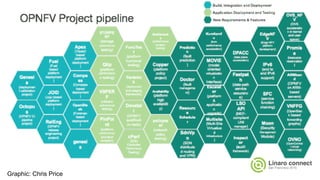
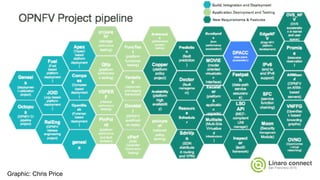
Graphic: Chris Price
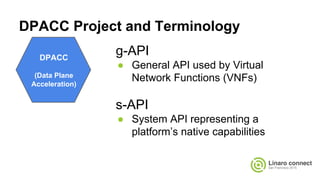
DPACC Project and Terminology
DPACC
(Data Plane
Acceleration)
g-API
● General API used by Virtual
Network Functions (VNFs)
s-API
● System API representing a
platform’s native capabilities
ODP and DPACC
DPACC

(Data Plane
Acceleration)
Both ODP and DPDK proposing themselves as DPACC’s
g-API layer
Discussions ongoing as to how the two projects can
cooperate on future architectural direction
Issues revolve around application design philosophy
ODP Application Design
ODP Application Design Focus Areas
● Portability
● Transparent access to platform acceleration
and offload
● Scalability
Also need to consider migration for existing
applications
ODP Approach to Portability
Abstract API Design
● Use of abstract types (e.g., odp_packet_t) rather than
platform-specific structs
● API selections reflect application use cases but are
balanced against ability to be mapped efficiently to
widely varying platform capabilities
○ Not interested in “least common denominator” APIs
○ Not interested in overly high-level APIs that few if any platforms can
support efficiently
○ Expect APIs to evolve over time
ODP Approach to Acceleration
Be able to exploit platform-specific acceleration
and offload capabilities (HW and SW) without
application effort
● Abstract APIs are efficiently mappable directly to
platform HW capabilities, e.g.:
○ HW buffer/packet mgmt
○ Integrated I/O adapters
○ HW parsing and classification
○ HW scheduling and flow ordering
○ HW egress traffic shaping and QoS, etc.
ODP Approach to Scalability
Support scalability to many-core architectures
without application redesign.
No changes to application design when running
on 4, 40, or 400 cores
● Classifier
● Events
● Queues
● Scheduler
● Traffic Manager
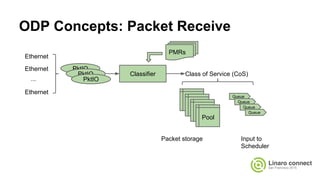
ODP Concepts: Packet Receive
Ethernet
Ethernet
Ethernet
...
Classifier
PMRs
Pool
Pool
Pool
Pool
Queue
Queue
Queue
Queue
Class of Service (CoS)
Packet storage Input to
Scheduler
PktIO
PktIO
PktIO
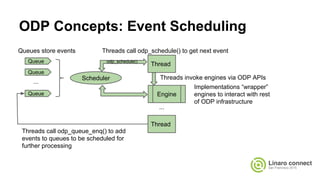
ODP Concepts: Event Scheduling
Queue
Queue
Queue
...
Scheduler
Thread
Thread
...
odp_schedule()
Threads call odp_schedule() to get next event
Engine
Queues store events
Threads invoke engines via ODP APIs
Implementations “wrapper”
engines to interact with rest
of ODP infrastructure
Threads call odp_queue_enq() to add
events to queues to be scheduled for
further processing
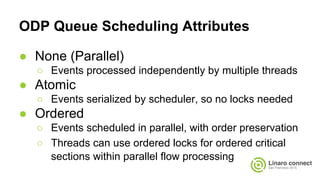
ODP Queue Scheduling Attributes
● None (Parallel)
○ Events processed independently by multiple threads
● Atomic
○ Events serialized by scheduler, so no locks needed
● Ordered
○ Events scheduled in parallel, with order preservation
○ Threads can use ordered locks for ordered critical
sections within parallel flow processing
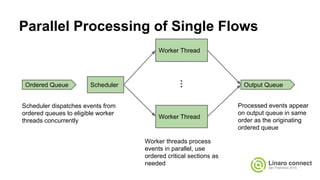
Parallel Processing of Single Flows
Ordered Queue Scheduler
Worker Thread
Worker Thread
...
Output Queue
Scheduler dispatches events from
ordered queues to eligible worker
threads concurrently
Worker threads process
events in parallel, use
ordered critical sections as
needed
Processed events appear
on output queue in same
order as the originating
ordered queue
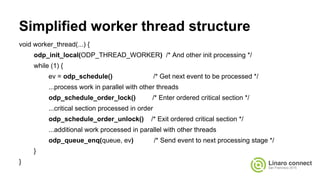
Simplified worker thread structure
void worker_thread(...) {
odp_init_local(ODP_THREAD_WORKER) /* And other init processing */
while (1) {
ev = odp_schedule() /* Get next event to be processed */
...process work in parallel with other threads
odp_schedule_order_lock() /* Enter ordered critical section */
...critical section processed in order
odp_schedule_order_unlock() /* Exit ordered critical section */
...additional work processed in parallel with other threads
odp_queue_enq(queue, ev) /* Send event to next processing stage */
}
}
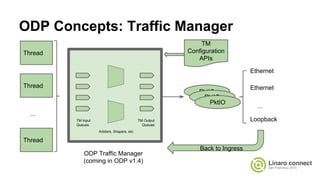
ODP Concepts: Traffic Manager
Ethernet
Ethernet
Loopback
...
PktIO
Thread
Thread
Thread
...
Back to Ingress
ODP Traffic Manager
(coming in ODP v1.4)
TM Input
Queues
Arbiters, Shapers, etc.
TM Output
Queues
TM
Configuration
APIs
PktIO
PktIO
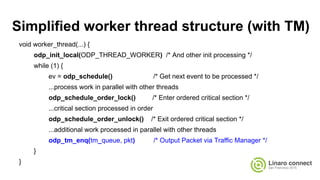
Simplified worker thread structure (with TM)
void worker_thread(...) {
odp_init_local(ODP_THREAD_WORKER) /* And other init processing */
while (1) {
ev = odp_schedule() /* Get next event to be processed */
...process work in parallel with other threads
odp_schedule_order_lock() /* Enter ordered critical section */
...critical section processed in order
odp_schedule_order_unlock() /* Exit ordered critical section */
...additional work processed in parallel with other threads
odp_tm_enq(tm_queue, pkt) /* Output Packet via Traffic Manager */
}
}
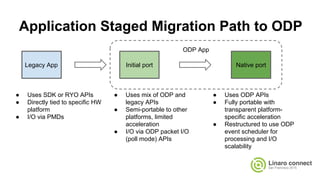
Application Staged Migration Path to ODP
ODP App
Legacy App Initial port Native port
● Uses SDK or RYO APIs
● Directly tied to specific HW
platform
● I/O via PMDs
● Uses mix of ODP and
legacy APIs
● Semi-portable to other
platforms, limited
acceleration
● I/O via ODP packet I/O
(poll mode) APIs
● Uses ODP APIs
● Fully portable with
transparent platform-
specific acceleration
● Restructured to use ODP
event scheduler for
processing and I/O
scalability
LNG Sessions and Demos at SFO15
Thursday
● SFO15-400: Core Isolation
● SFO15-404: ODP User Experience Roundtable
● SFO15-408: ODP-DPDK Platform Performance
Demo Thursday
● Demos by Broadcom, Cavium, EZchip, Freescale,
HiSilicon, and LNG
Thank you

SFO15-102:ODP Project Update

  • 1.
    Presented by Date Event SFO15-102: ODP ProjectUpdate Bill Fischofer Monday 21 September 2015 SFO15
  • 2.
    Topics for Today ●OpenDataPlane overview and project status ● Key developments since HKG15 ● Plans for rest of 2015 and into 2016 ● ODP and OPNFV ● ODP Application Design ● LNG Sessions and Demos at SFO15
  • 3.
  • 4.
    What is OpenDataPlane? AnAbstract API Specification Multiple independently maintained implementations of the ODP API Validation Test Suite ODP API Specification ODP Implementations ODP Validation Test Suite
  • 5.
    The ODP APISpecification ODP API Specification An Abstract API Specification ● Open Source, open contribution, BSD-3 licensed ● Vendor and platform neutral ● Application-centric--covers functional needs of data plane applications ● Ensures portability by specifying functional behavior of ODP ● Defined jointly and openly by application writers and platform implementers ● Architected to be implementable on a wide range of platforms efficiently ● Sponsored, Governed, and Maintained by Linaro Networking Group (LNG)
  • 6.
    ODP Implementations Multiple independentlymaintained implementations of the ODP API ● One size does not fit all--widely differing internals among platforms ● Anyone can create an ODP implementation tailored to their platform ● Distribution and maintenance of each implementation as owner wishes ○ Open source or closed source as business needs determine ○ Have independent release cycles and service streams ● Allows HW and SW innovation in how ODP APIs are implemented on each platform ODP Implementations
  • 7.
    ODP Implementations (Cont’d) LNGdistributes and maintains a number of Reference Implementations of ODP ● Open source, open contribution, BSD-3 licensed ● Provide easy bootstrapping of ODP onto new platforms ● Implementers free to borrow or tailor code as needed for their platform ● Implementers retain full control over their own implementations whether or not they are derived from a reference implementation ODP Implementations
  • 8.
    ODP Validation TestSuite ODP Validation Test Suite Validation Test Suite ● Synchronized with ODP API Specification level ● Maintained and distributed by LNG ● Open source, open contribution, BSD-3 licensed ● Key to ensuring application portability across all ODP implementations ● Tests that implementations of ODP conform to the specified functional behavior of ODP APIs ● Can be run at any time by both users and vendors to validate implementations of ODP
  • 9.
  • 10.
    ODP Project History ●October, 2013: Announced at LCU ‘13 ● 2014: Preview releases (v0.1 - v0.11) ● 2015: Pre-Production Evaluation releases ○ February: ODP v1.0 ○ May: ODP v1.1 ○ July: ODP v1.2 ○ September: ODP v1.3 ○ ODP v1.4 and v1.5 planned for later this year ○ Monarch Release (EOY 2015) ● 2016: Production releases ○ Focus on apps and OPNFV
  • 11.
    Key API ChangesSince HKG15 ODP v1.1: ● User metadata support ODP v1.2: ● Streamlined pool creation ● Added default cpumasks and introduced thread masks (thrmask) and thread types (worker, control)
  • 12.
    Key API ChangesSince HKG15 (Cont’d) ODP v1.3: ● PktIO improvements: Start/Stop, parameterization, input/output modes ● Parameter structure init routines ● Scheduler improvements: Groups, prefetching ● Ordered queues ● Ordered locks
  • 13.
    Other ODP Changessince HKG15 Platforms ● odp-dpdk launched as performance platform for x86 ○ uses DPDK as underlying SDK ○ enables ODP to support various NICs that have DPDK drivers ○ doing proof of concept work with applications like Open vSwitch ● odp-mppa launched as open source platform supporting Kalray MPPA SoCs
  • 14.
    Other ODP Changessince HKG15 (Cont’d) Validation Suite ● Restructured to be platform-independent ● Supports platform-specific extension tests that can be added by vendors for additional internal validation ● Goal is to support validation repository separation as described earlier
  • 15.
    What’s ahead forODP in 2015? ODP v1.4: ● Egress Traffic Manager ● Interprocess Communication (IPC) ● Port counters and statistics ● Improved test capabilities (PCAP replay) ● Configuration APIs
  • 16.
    What’s ahead forODP in 2015? (Cont’d) ODP v1.5 ● Generic NIC driver interface ● Integration of RSS with Classifier and Scheduler Monarch Release ● Transition to production release cycles and packaging (RPM, Debian), formal use of Release Candidates (RCs)
  • 17.
  • 18.
    What is OPNFV? FromOPNFV.org: OPNFV is a carrier-grade, integrated, open source platform to accelerate the introduction of new NFV products and services. In Practice OPNFV aims to realize the ETSI NFV vision.
  • 19.
  • 20.
  • 21.
    DPACC Project andTerminology DPACC (Data Plane Acceleration) g-API ● General API used by Virtual Network Functions (VNFs) s-API ● System API representing a platform’s native capabilities
  • 22.
    ODP and DPACC DPACC (DataPlane Acceleration) Both ODP and DPDK proposing themselves as DPACC’s g-API layer Discussions ongoing as to how the two projects can cooperate on future architectural direction Issues revolve around application design philosophy
  • 23.
  • 24.
    ODP Application DesignFocus Areas ● Portability ● Transparent access to platform acceleration and offload ● Scalability Also need to consider migration for existing applications
  • 25.
    ODP Approach toPortability Abstract API Design ● Use of abstract types (e.g., odp_packet_t) rather than platform-specific structs ● API selections reflect application use cases but are balanced against ability to be mapped efficiently to widely varying platform capabilities ○ Not interested in “least common denominator” APIs ○ Not interested in overly high-level APIs that few if any platforms can support efficiently ○ Expect APIs to evolve over time
  • 26.
    ODP Approach toAcceleration Be able to exploit platform-specific acceleration and offload capabilities (HW and SW) without application effort ● Abstract APIs are efficiently mappable directly to platform HW capabilities, e.g.: ○ HW buffer/packet mgmt ○ Integrated I/O adapters ○ HW parsing and classification ○ HW scheduling and flow ordering ○ HW egress traffic shaping and QoS, etc.
  • 27.
    ODP Approach toScalability Support scalability to many-core architectures without application redesign. No changes to application design when running on 4, 40, or 400 cores ● Classifier ● Events ● Queues ● Scheduler ● Traffic Manager
  • 28.
    ODP Concepts: PacketReceive Ethernet Ethernet Ethernet ... Classifier PMRs Pool Pool Pool Pool Queue Queue Queue Queue Class of Service (CoS) Packet storage Input to Scheduler PktIO PktIO PktIO
  • 29.
    ODP Concepts: EventScheduling Queue Queue Queue ... Scheduler Thread Thread ... odp_schedule() Threads call odp_schedule() to get next event Engine Queues store events Threads invoke engines via ODP APIs Implementations “wrapper” engines to interact with rest of ODP infrastructure Threads call odp_queue_enq() to add events to queues to be scheduled for further processing
  • 30.
    ODP Queue SchedulingAttributes ● None (Parallel) ○ Events processed independently by multiple threads ● Atomic ○ Events serialized by scheduler, so no locks needed ● Ordered ○ Events scheduled in parallel, with order preservation ○ Threads can use ordered locks for ordered critical sections within parallel flow processing
  • 31.
    Parallel Processing ofSingle Flows Ordered Queue Scheduler Worker Thread Worker Thread ... Output Queue Scheduler dispatches events from ordered queues to eligible worker threads concurrently Worker threads process events in parallel, use ordered critical sections as needed Processed events appear on output queue in same order as the originating ordered queue
  • 32.
    Simplified worker threadstructure void worker_thread(...) { odp_init_local(ODP_THREAD_WORKER) /* And other init processing */ while (1) { ev = odp_schedule() /* Get next event to be processed */ ...process work in parallel with other threads odp_schedule_order_lock() /* Enter ordered critical section */ ...critical section processed in order odp_schedule_order_unlock() /* Exit ordered critical section */ ...additional work processed in parallel with other threads odp_queue_enq(queue, ev) /* Send event to next processing stage */ } }
  • 33.
    ODP Concepts: TrafficManager Ethernet Ethernet Loopback ... PktIO Thread Thread Thread ... Back to Ingress ODP Traffic Manager (coming in ODP v1.4) TM Input Queues Arbiters, Shapers, etc. TM Output Queues TM Configuration APIs PktIO PktIO
  • 34.
    Simplified worker threadstructure (with TM) void worker_thread(...) { odp_init_local(ODP_THREAD_WORKER) /* And other init processing */ while (1) { ev = odp_schedule() /* Get next event to be processed */ ...process work in parallel with other threads odp_schedule_order_lock() /* Enter ordered critical section */ ...critical section processed in order odp_schedule_order_unlock() /* Exit ordered critical section */ ...additional work processed in parallel with other threads odp_tm_enq(tm_queue, pkt) /* Output Packet via Traffic Manager */ } }
  • 35.
    Application Staged MigrationPath to ODP ODP App Legacy App Initial port Native port ● Uses SDK or RYO APIs ● Directly tied to specific HW platform ● I/O via PMDs ● Uses mix of ODP and legacy APIs ● Semi-portable to other platforms, limited acceleration ● I/O via ODP packet I/O (poll mode) APIs ● Uses ODP APIs ● Fully portable with transparent platform- specific acceleration ● Restructured to use ODP event scheduler for processing and I/O scalability
  • 36.
    LNG Sessions andDemos at SFO15
  • 37.
    LNG Sessions andDemos at SFO15 Thursday ● SFO15-400: Core Isolation ● SFO15-404: ODP User Experience Roundtable ● SFO15-408: ODP-DPDK Platform Performance Demo Thursday ● Demos by Broadcom, Cavium, EZchip, Freescale, HiSilicon, and LNG
  • 38.