Programming
The	Network	Data	Plane
Changhoon	Kim
InfoQ.com: News & Community Site
• Over 1,000,000 software developers, architects and CTOs read the site world-
wide every month
• 250,000 senior developers subscribe to our weekly newsletter
• Published in 4 languages (English, Chinese, Japanese and Brazilian
Portuguese)
• Post content from our QCon conferences
• 2 dedicated podcast channels: The InfoQ Podcast, with a focus on
Architecture and The Engineering Culture Podcast, with a focus on building
• 96 deep dives on innovative topics packed as downloadable emags and
minibooks
• Over 40 new content items per week
Watch the video with slide
synchronization on InfoQ.com!
https://www.infoq.com/presentations/
pisa-asic-p4
Purpose of QCon
- to empower software development by facilitating the spread of
knowledge and innovation
Strategy
- practitioner-driven conference designed for YOU: influencers of
change and innovation in your teams
- speakers and topics driving the evolution and innovation
- connecting and catalyzing the influencers and innovators
Highlights
- attended by more than 12,000 delegates since 2007
- held in 9 cities worldwide
Presented at QCon San Francisco
www.qconsf.com
Beautiful	ideas:	What	if	you	could	…
• Realize	a	small,	but	super-fast	DNS	cache
• Perform	TCP	SYN	authentication	for	billions	of	SYNs	per	sec
• Build	a	replicated	key-value	store	ensuring	RW	ops	in	a	few	usecs
• Improve	your	consensus	service	performance	by	~100x
• Boost	your	Memcached cluster’s	throughput	by	~10x
• Speed	up	your	DNN	training	dramatically	by	realizing	parameter	
servers
2
… using	switches in	your	network?
You	couldn’t	do	any	of	those	so	far	because	…
• No	DIY	– must	work	with	vendors	at	feature level
• Excruciatingly	complicated	and	involved	process	to	build	
consensus	and	pressure	for	features
• Painfully	long	and	unpredictable	lead	time
• To	use	new	features,	you	must	get	new	switches
• What	you	finally	get	!=	what	you	asked	for
3
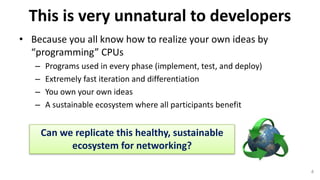
This	is	very	unnatural	to	developers
• Because	you	all	know	how	to	realize	your	own	ideas	by	
“programming”	CPUs
– Programs	used	in	every	phase	(implement,	test,	and	deploy)
– Extremely	fast	iteration	and	differentiation	
– You	own	your	own	ideas
– A	sustainable	ecosystem	where	all	participants	benefit
4
Can	we	replicate	this	healthy,	sustainable	
ecosystem	for	networking?
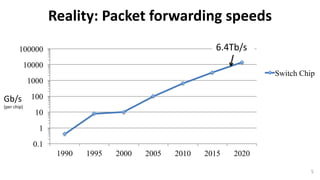
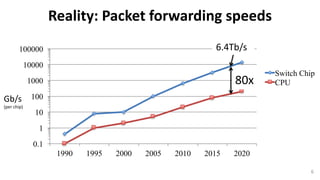
Reality:	Packet	forwarding	speeds
0.1
1
10
100
1000
10000
100000
1990 1995 2000 2005 2010 2015 2020
Switch Chip
CPU
5
Gb/s
(per	chip)
6.4Tb/s
Reality:	Packet	forwarding	speeds
0.1
1
10
100
1000
10000
100000
1990 1995 2000 2005 2010 2015 2020
Switch Chip
CPU
6
80x
Gb/s
(per	chip)
6.4Tb/s
7
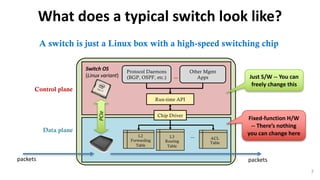
What	does	a	typical	switch	look	like?
Chip Driver
Run-time API
Protocol Daemons
(BGP, OSPF, etc.)
Other Mgmt
Apps
Data plane
Control plane
Switch	OS
(Linux	variant)
PCIe
…
L2
Forwarding
Table
L3
Routing
Table
ACL
Table
…
A switch is just a Linux box with a high-speed switching chip
packets packets
Just	S/W	-- You	can	
freely	change	this
Fixed-function	H/W	
-- There’s	nothing	
you	can	change	here
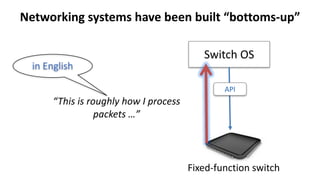
Networking	systems	have	been	built	“bottoms-up”
Switch	OS
“This	is	roughly	how	I	process	
packets	…”	
Fixed-function	switch
in	English
API
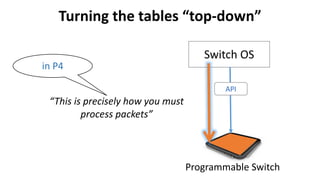
Turning	the	tables	“top-down”
Switch	OS
“This	is	precisely	how	you	must	
process	packets”	
Programmable	Switch
in	P4
API
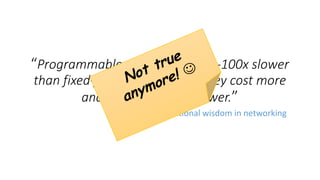
“Programmable	switches	are	10	-100x	slower	
than	fixed-function	switches.	They	cost	more	
and	consume	more	power.”
Conventional	wisdom	in	networking
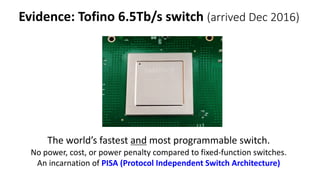
Evidence:	Tofino	6.5Tb/s	switch	(arrived	Dec	2016)
The	world’s	fastest	and most	programmable	switch.
No	power,	cost,	or	power	penalty	compared	to	fixed-function	switches.
An	incarnation	of	PISA	(Protocol	Independent	Switch	Architecture)
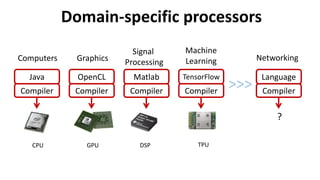
Domain-specific	processors
CPU
Computers
Java
Compiler
GPU
Graphics
OpenCL
Compiler
DSP
Signal	
Processing
Matlab
Compiler
Machine
Learning
?
TPU
TensorFlow
Compiler
Networking
?
Language
Compiler
>>>
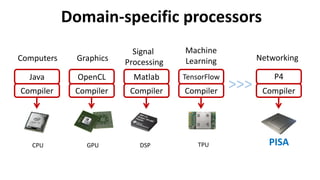
CPU
Computers
Java
Compiler
GPU
Graphics
OpenCL
Compiler
DSP
Signal	
Processing
Matlab
Compiler
Machine
Learning
?
TPU
TensorFlow
Compiler
PISA
Networking
P4
Compiler
>>>
Domain-specific	processors
PISA: An architecture for high-speed
programmable packet forwarding
14
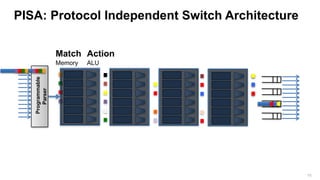
15
Programmable
Parser
Match
Memory
Action
ALU
PISA: Protocol Independent Switch Architecture
16
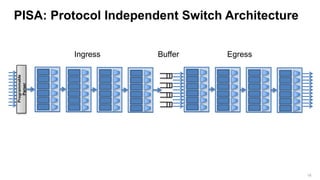
Programmable
Parser
PISA: Protocol Independent Switch Architecture
Ingress EgressBuffer
Buffer
M M
17
Programmable
Parser
PISA: Protocol Independent Switch Architecture
Match Logic
(Mix of SRAM and TCAM for lookup tables,
counters, meters, generic hash tables)
Action Logic
(ALUs for standard boolean and arithmetic operations,
header modification operations, hashing operations, etc.)
Recirculation
Programmable	
Packet	Generator
CPU (Control plane)
A
…
A
…
Ingress match-action stages (pre-switching) Egress match-action stages (post-switching)
Generalization of RMT [sigcomm’13]
Why we call it
protocol-independent packet
processing
18
Logical Data-plane View
(your P4 program)
Switch Pipeline
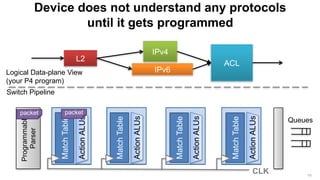
Device does not understand any protocols
until it gets programmed
Queues
Programmable
Parser
Fixed
Action
MatchTable
MatchTable
MatchTable
MatchTable
L2
IPv4
IPv6
ACL
ActionALUs
ActionALUs
ActionALUs
ActionALUs
packetpacket packetpacket
CLK 19
MatchTable
ActionALUs
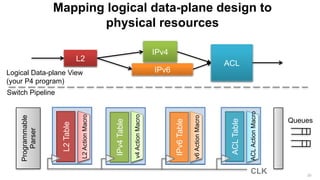
Mapping logical data-plane design to
physical resources
Queues
MatchTable
MatchTable
MatchTable
L2Table
IPv4Table
IPv6Table
ACLTable
ActionALUs
ActionALUs
ActionALUs
L2
IPv4
IPv6
ACL
Logical Data-plane View
(your P4 program)
Switch Pipeline
L2
IPv6
ACL
IPv4
L2ActionMacro
v4ActionMacro
v6ActionMacro
ACLActionMacro
Programmable
Parser
CLK 20
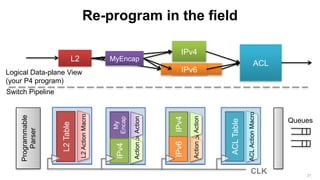
Re-program in the field
L2Table
IPv4Table
ACLTable
IPv6Table
My
Encap
L2
IPv4
IPv6
ACL
MyEncap
L2ActionMacro
v4ActionMacro
ACLActionMacro
Action
MyEncap
v6ActionMacro
IPv4
Action
IPv4
Action
IPv6
Action
IPv6
Programmable
Parser
CLK
Logical Data-plane View
(your P4 program)
Switch Pipeline
Queues
21
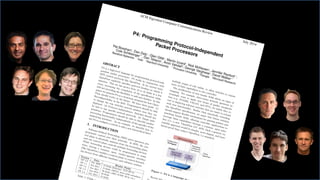
P4: Programming Protocol-Independent
Packet Processors
Pat Bosshart†
, Dan Daly*
, Glen Gibb†
, Martin Izzard†
, Nick McKeown‡
, Jennifer Rexford**
,
Cole Schlesinger**
, Dan Talayco†
, Amin Vahdat¶
, George Varghese§
, David Walker**
†
Barefoot Networks *
Intel ‡
Stanford University **
Princeton University ¶
Google §
Microsoft Research
ABSTRACTP4 is a high-level language for programming protocol-inde-
pendent packet processors. P4 works in conjunction with
SDN control protocols like OpenFlow. In its current form,
OpenFlow explicitly specifies protocol headers on which it
operates. This set has grown from 12 to 41 fields in a few
years, increasing the complexity of the specification while
still not providing the flexibility to add new headers. In this
paper we propose P4 as a strawman proposal for how Open-
Flow should evolve in the future. We have three goals: (1)
Reconfigurability in the field: Programmers should be able
to change the way switches process packets once they are
deployed. (2) Protocol independence: Switches should not
be tied to any specific network protocols. (3) Target inde-
pendence: Programmers should be able to describe packet-
processing functionality independently of the specifics of the
underlying hardware. As an example, we describe how to
use P4 to configure a switch to add a new hierarchical label.
1. INTRODUCTION
Software-Defined Networking (SDN) gives operators pro-
grammatic control over their networks. In SDN, the con-
trol plane is physically separate from the forwarding plane,
and one control plane controls multiple forwarding devices.
While forwarding devices could be programmed in many
ways, having a common, open, vendor-agnostic interface
(like OpenFlow) enables a control plane to control forward-
ing devices from di↵erent hardware and software vendors.
Version
Date
Header Fields
OF 1.0
Dec 2009 12 fields (Ethernet, TCP/IPv4)
OF 1.1
Feb 2011 15 fields (MPLS, inter-table metadata)
OF 1.2
Dec 2011 36 fields (ARP, ICMP, IPv6, etc.)
OF 1.3
Jun 2012 40 fields
OF 1.4
Oct 2013 41 fields
Table 1: Field
multiple stages of rule tables, to allow switches to expose
more of their capabilities to the controller.
The proliferation of new header fields shows no signs of
stopping. For example, data-center network operators in-
creasingly want to apply new forms of packet encapsula-
tion (e.g., NVGRE, VXLAN, and STT), for which they re-
sort to deploying software switches that are easier to extend
with new functionality. Rather than repeatedly extending
the OpenFlow specification, we argue that future switches
should support flexible mechanisms for parsing packets and
matching header fields, allowing controller applications to
leverage these capabilities through a common, open inter-
face (i.e., a new “OpenFlow 2.0” API). Such a general, ex-
tensible approach would be simpler, more elegant, and more
future-proof than today’s OpenFlow 1.x standard.
Figure 1: P4 is a language t
Recent ch
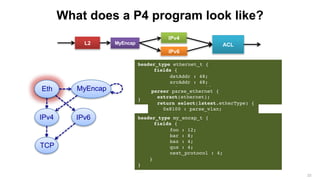
What does a P4 program look like?
L2
IPv4
ACLMyEncap
IPv6
header_type ethernet_t {
fields {
dstAddr : 48;
srcAddr : 48;
etherType : 16;
}
}
parser parse_ethernet {
extract(ethernet);
return select(latest.etherType) {
0x8100 : parse_vlan;
0x800 : parse_ipv4;
0x86DD : parse_ipv6;
}
}
TCP
IPv4 IPv6
MyEncapEth
header_type my_encap_t {
fields {
foo : 12;
bar : 8;
baz : 4;
qux : 4;
next_protocol : 4;
}
}
23
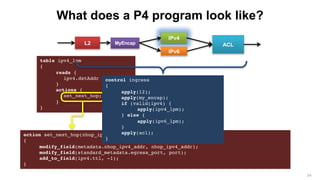
What does a P4 program look like?
L2
IPv4
ACLMyEncap
IPv6
table ipv4_lpm
{
reads {
ipv4.dstAddr : lpm;
}
actions {
set_next_hop; drop;
}
}
action set_next_hop(nhop_ipv4_addr, port)
{
modify_field(metadata.nhop_ipv4_addr, nhop_ipv4_addr);
modify_field(standard_metadata.egress_port, port);
add_to_field(ipv4.ttl, -1);
}
control ingress
{
apply(l2);
apply(my_encap);
if (valid(ipv4) {
apply(ipv4_lpm);
} else {
apply(ipv6_lpm);
}
apply(acl);
}
24
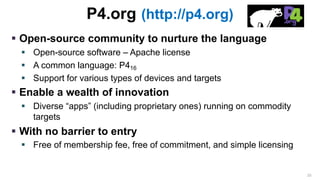
P4.org (http://p4.org)
§ Open-source community to nurture the language
§ Open-source software – Apache license
§ A common language: P416
§ Support for various types of devices and targets
§ Enable a wealth of innovation
§ Diverse “apps” (including proprietary ones) running on commodity
targets
§ With no barrier to entry
§ Free of membership fee, free of commitment, and simple licensing
25
So,	what	kinds	of	exciting	new	
opportunities	are	arising?
26
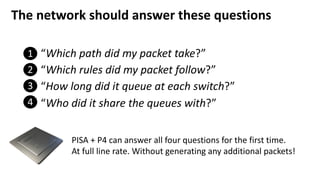
The	network	should	answer	these	questions
1. “Which	path	did	my	packet	take?”
2. “Which	rules	did	my	packet	follow?”
3. “How	long	did	it	queue	at	each	switch?”
4. “Who	did	it	share	the	queues	with?”
PISA	+	P4	can	answer	all	four	questions	for	the	first	time.		
At	full	line	rate.	Without	generating	any	additional	packets!
1
2
3
4
Log,	Analyze
Replay
Add:	SwitchID,	Arrival	Time,	
Queue	Delay,	Matched	Rules,	…
Original	Packet
Visualize
In-band	Network	Telemetry	(INT)
A	read-only	version	of	Tiny	Packet	Programs	[sigcomm’14]
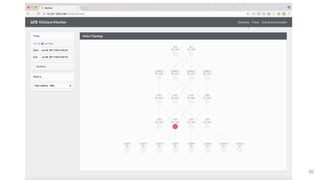
A	quick	demo	of	INT!
29
30
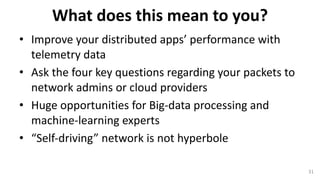
What	does	this	mean	to	you?
• Improve	your	distributed	apps’	performance	with	
telemetry	data
• Ask	the	four	key	questions	regarding	your	packets	to	
network	admins	or	cloud	providers	
• Huge	opportunities	for	Big-data	processing	and	
machine-learning	experts
• “Self-driving”	network	is	not	hyperbole
31
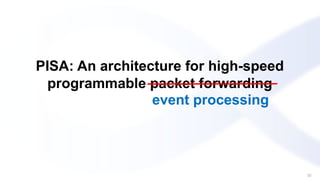
PISA: An architecture for high-speed
programmable packet forwarding
32
event processing
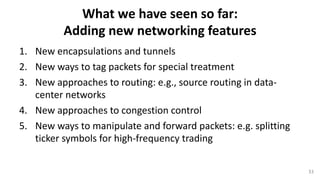
What	we	have	seen	so	far:
Adding	new	networking	features
1. New	encapsulations	and	tunnels
2. New	ways	to	tag	packets	for	special	treatment
3. New	approaches	to	routing:	e.g.,	source	routing	in	data-
center	networks
4. New	approaches	to	congestion	control
5. New	ways	to	manipulate	and	forward	packets:	e.g.	splitting	
ticker	symbols	for	high-frequency	trading
33
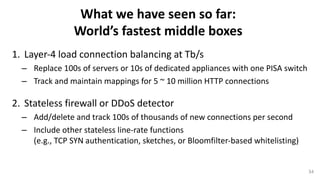
What	we	have	seen	so	far:
World’s	fastest	middle	boxes
1. Layer-4	load	connection	balancing	at	Tb/s
– Replace	100s	of	servers	or	10s	of	dedicated	appliances	with	one	PISA	switch
– Track	and	maintain	mappings	for	5	~	10	million	HTTP	connections
2. Stateless	firewall	or	DDoS	detector
– Add/delete	and	track	100s	of	thousands	of	new	connections	per	second
– Include	other	stateless	line-rate	functions	
(e.g.,	TCP	SYN	authentication,	sketches,	or	Bloomfilter-based	whitelisting)
34
What	we	have	seen	so	far:
Offloading	part	of	computing	to	network
1. DNS	cache
2. Key-value	cache	[ACM	SOSP’17]
3. Chain	replication
4. Paxos [ACM	CCR’16]	and	RAFT
5. Parameter	service	for	DNN	training
35
Example:	NetCache
Clients
Key-Value
Cache
Query
Statistics
High-performance Storage Servers
Key-Value Storage RackController
L2/L3
Routing
ToR Switch Data plane
• Non-goal
– Maximize	the	cache	hit	rate
• Goal
– Balance	the	workloads	of	backend	servers	by	serving	
only	O(NlogN)	hot	items	-- N is	the	number	of	
backend	servers
– Make	the	“fast,	small-cache”	theory	viable	for	
modern	in-memory	KV	servers	[Fan	et.	al.,	SOCC’11]
• Data	plane
– Unmodified	routing
– Key-value	cache	built	with	on-chip	SRAM
– Query	statistics	to	detect	hot	items
• Control	plane
– Update	cache	with	hot	items	to	handle	dynamic	
workloads
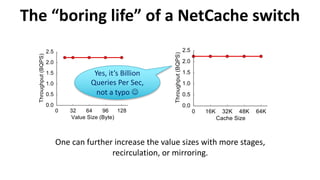
The	“boring	life”	of	a	NetCache switch
lue
an
ead
age
the
m.
one
We
or-
ipf
kes
ck.
.e.,
0 32 64 96 128
9alue 6ize (Byte)
0.0
0.5
1.0
1.5
2.0
2.5
ThroughSut(B436)
(a) Throughput vs. value size. (b) Throughput vs. cache size.
Figure 9: Switch microbenchmark (read and update).
one switch are organized to a snake structure. The switch
is configured to provide 62 100Gbps ports, and two 40Gbps
. The value
et passes an
ing for read
egress stage
l verify the
ted to them.
We use one
server. We
a full stor-
ng to a Zipf
server takes
in the rack.
titions (i.e.,
(a) Throughput vs. value size.
0 16. 32. 48. 64.
CacKe 6ize
0.0
0.5
1.0
1.5
2.0
2.5
TKrougKSut(B436)
(b) Throughput vs. cache size.
Figure 9: Switch microbenchmark (read and update).
one switch are organized to a snake structure. The switch
is configured to provide 62 100Gbps ports, and two 40Gbps
One	can	further	increase	the	value	sizes	with	more	stages,	
recirculation,	or	mirroring.
Yes,	it’s	Billion	
Queries	Per	Sec,	
not	a	typo	J
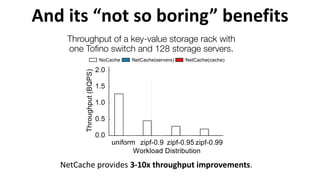
And	its	“not	so	boring”	benefits
NetCache	provides	3-10x	throughput	improvements.
Throughput of a key-value storage rack with
one Tofino switch and 128 storage servers.
uQiforP ziSf-0.9 ziSf-0.95 ziSf-0.99
WorNloDd DisWribuWioQ
0.0
0.5
1.0
1.5
2.0
ThroughSuW(BQPS)
1oCDche 1eWCDche(servers) 1eWCDche(cDche)
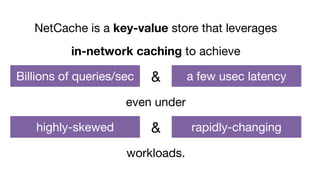
NetCache is a key-value store that leverages
&Billions of queries/sec a few usec latency
even under
workloads.
&highly-skewed rapidly-changing
in-network caching to achieve
Summing	it	up	…
40
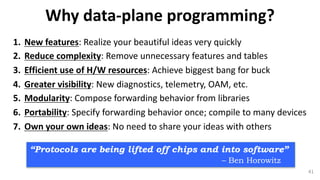
Why	data-plane	programming?
1. New	features:	Realize	your	beautiful	ideas	very	quickly
2. Reduce	complexity:	Remove	unnecessary	features	and	tables
3. Efficient	use	of	H/W	resources:	Achieve	biggest	bang	for	buck
4. Greater	visibility:	New	diagnostics,	telemetry,	OAM,	etc.
5. Modularity:	Compose	forwarding	behavior	from	libraries
6. Portability:	Specify	forwarding	behavior	once;	compile	to	many	devices
7. Own	your	own	ideas:	No	need	to	share	your	ideas	with	others
“Protocols are being lifted off chips and into software”
– Ben Horowitz
41
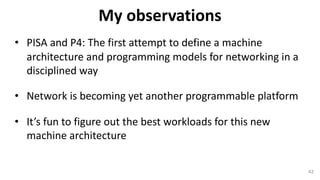
• PISA	and	P4:	The	first	attempt	to	define	a	machine	
architecture	and	programming	models	for	networking	in	a	
disciplined	way
• Network	is	becoming	yet	another	programmable	platform
• It’s	fun	to	figure	out	the	best	workloads	for	this	new	
machine	architecture
42
My	observations
Want	to	find	more	resources	or	follow	up?
• Visit	http://p4.org and	http://github.com/p4lang
– P4	language	spec	
– P4	dev	tools	and	sample	programs
– P4	tutorials	
• Join	P4	workshops	and	P4	developers’	days
• Participate	in	P4	working	group	activities
– Language,	target	architecture,	runtime	API,	applications
• Need	more	expertise	across	various	fields	in	computer	science
– To	enhance	PISA,	P4,	dev	tools	(e.g.,	for	formal	verification,	equivalence	
check,	and	many	more	…)
43
Thanks.	
Let’s	develop	your	beautiful	ideas	
in	P4!
44
Watch the video with slide
synchronization on InfoQ.com!
https://www.infoq.com/presentations/
pisa-asic-p4

Programming the Network Data Plane