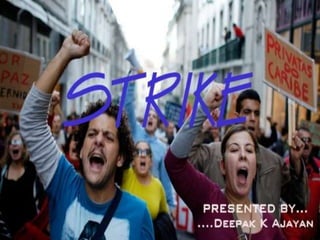
STRIKE
Presented by
Deepak K Ajayan
“STRIKE” has been defined in section 2(q) of the
Industrial Disputes Act, 1947 in the following
words:
“ ‘Strike’ means a cessation of work by a
body of persons employed in any industry, acting
in combination or a refusal, or a refusal under a
common understanding, of any number of
persons who are or have been so employed to
continue to work or to accept employment.”
WHAT IS STRIKE?
 A strike action is when a large no. of people used to
pressure government or an Organisation to change the
policy.
 Strike is a very powerful weapon to get its demands
accepted by a trade union or in the hand it’s the way of
showing strength of a union .
 The use of English word “strike” first appeared in
1768, when sailors in support of demonstration in
London. removed the topgallant sails of merchant
ships at port, thus crippling the ships.
 According to industrial disputes act, 1947, Strike
means , “cessation of work by a group of workers for
the purpose of bringing pressures on their
employers to accept their demands”.
TYPES OF STRIKES
ECONOMIC STRIKES
SYMPATHETIC STRIKES
GENERAL STRIKES
SIT-DOWN STRIKES
SLOW-DOWN STRIKES
HUNGER STRIKES
GHERAO
BOYCOTT
WILDCAT STRIKES
1. Economic strikes
Strikes arise for a number of reasons, though principally in
response to economic conditions.
Economic strike is conducted by the workers to improve wages
, benefits or to improve work conditions and facilities provided
to them.
SYMPATHETIC STRIKES
This type of strike is conducted in support of other
workers who are on strike.
In this case the workers may not have direct injustice
from the employer of the former union of workers.
GENERAL STRIKES
A general strike is a strike action in which a
substantial proportion of the total workers in a
region or country participates.
It may also be an extension of the sympathetic
strike to express generalized protest by the
workers.
SIT-DOWN STRIKES
A sit-down strike is a form of civil disobedience in which a
group of workers, usually employed at a factory take
possession of the workplace by "sitting down" at their
stations.
Main reason behind this is preventing their employers from
replacing them with strikebreakers or in some cases moving
production to other locations.
It is also called tools down or pens down strike.
SLOW-DOWN STRIKES
A slowdown is an industrial action in which
employees perform their duties but seek to reduce
productivity or efficiency in their performance of
these duties.
It an alternative to a strike, as it is seen as less
disruptive as well as less risky and costly for
workers employers
HUNGER STRIKES
It is followed either by leaders or by some
workers or by both for a limited period. The
purpose is to create sympathy of the employer &
to attract the attention of the public. It is non-
violent in nature.
In this method the participants try to
provoke feelings of guilt in others or the
employers , usually with the objective to achieve
a specific goal, such as a policy change.
GHERAO
Gherao, meaning "encirclement," is a word originally
from Hindi . This type of strike is restricted to India only
.
Usually, a group of people would surround a politician
or a government building until their demands are met, or
answers given.
It form of industrial action in India in which workers
imprison their
employers on the premises until their demands are met
BOYCOTT
A boycott is an act of voluntarily abstaining
from using, buying, or dealing with a person,
organization, or country as an expression of
protest.
In this case workers decide not to use the
company’s products the appealing the public
to do so. It is an voluntary withdrawal of co-
operation.
WILDCAT STRIKES
It is suddenly announced, without notice or at
very short notice & thereafter the issues of
disputes are discussed .
This type of strike action is taken by workers
without the authorization of their trade union
officials.
This is sometimes termed unofficial
industrial action
JUSTIFIED
 WHEN EXISTING FACILITIES
WITHDRAWN, BENEFITS
WITHDRAWN.
 UNFAIR LABOUR PRACTICE BY
MANAGEMENT.
 NO RESPONSE FROM
MANAGEMENT IN SPITE OF
REFERRING A DEMAND & ISSUING
A REMINDER.
UNJUSTIFIED
 STRIKES LAUNCHED FOR
POLITICAL REASONS.
 DEMANDS ARE EXCESSIVE, NOT
FEASIBLE AND UNREASONABLE
Section 26
Penalty for illegal strikes and lock-outs
Any workman who commences, continues or
otherwise acts in furtherance, of, a strike which
is illegal under that Act, shall be punishable
with imprisonment for a term which may
extend to one month, or with fine which may
extend to fifty rupees, or with both.
Any employer who commences, continues,
or otherwise acts in furtherance of a lock-out
which is illegal under this Act, shall be
punishable with imprisonment for a term
which may extend to one month, or with fine
which may extend to one thousand rupees, or
with both.
Section 74
Report of notice of strike or
lock-out
The report of notice of a
strike or lock-out to be
submitted by the employer
under sub-section (6) of
section 22 shall be sent by
registered post or given
personally to the Assistant
Labour Commissioner
(Central) appointed for the
(1) The Administrative Department of the
Government of India concerned,
(2) The Regional Labour Commissioner
(Central) for the Zone,
(3) Chief Labour Commissioner (Central),
(4) Ministry of Labour of the Government
of India,
(5) Labour Department of the State
Government concerned, and
(6) The District Magistrate Concerned.
Thankyou

Strike

  • 1.
  • 2.
    “STRIKE” has beendefined in section 2(q) of the Industrial Disputes Act, 1947 in the following words: “ ‘Strike’ means a cessation of work by a body of persons employed in any industry, acting in combination or a refusal, or a refusal under a common understanding, of any number of persons who are or have been so employed to continue to work or to accept employment.”
  • 3.
    WHAT IS STRIKE? A strike action is when a large no. of people used to pressure government or an Organisation to change the policy.  Strike is a very powerful weapon to get its demands accepted by a trade union or in the hand it’s the way of showing strength of a union .
  • 4.
     The useof English word “strike” first appeared in 1768, when sailors in support of demonstration in London. removed the topgallant sails of merchant ships at port, thus crippling the ships.  According to industrial disputes act, 1947, Strike means , “cessation of work by a group of workers for the purpose of bringing pressures on their employers to accept their demands”.
  • 5.
    TYPES OF STRIKES ECONOMICSTRIKES SYMPATHETIC STRIKES GENERAL STRIKES SIT-DOWN STRIKES SLOW-DOWN STRIKES HUNGER STRIKES GHERAO BOYCOTT WILDCAT STRIKES
  • 6.
    1. Economic strikes Strikesarise for a number of reasons, though principally in response to economic conditions. Economic strike is conducted by the workers to improve wages , benefits or to improve work conditions and facilities provided to them.
  • 7.
    SYMPATHETIC STRIKES This typeof strike is conducted in support of other workers who are on strike. In this case the workers may not have direct injustice from the employer of the former union of workers.
  • 8.
    GENERAL STRIKES A generalstrike is a strike action in which a substantial proportion of the total workers in a region or country participates. It may also be an extension of the sympathetic strike to express generalized protest by the workers.
  • 9.
    SIT-DOWN STRIKES A sit-downstrike is a form of civil disobedience in which a group of workers, usually employed at a factory take possession of the workplace by "sitting down" at their stations. Main reason behind this is preventing their employers from replacing them with strikebreakers or in some cases moving production to other locations. It is also called tools down or pens down strike.
  • 10.
    SLOW-DOWN STRIKES A slowdownis an industrial action in which employees perform their duties but seek to reduce productivity or efficiency in their performance of these duties. It an alternative to a strike, as it is seen as less disruptive as well as less risky and costly for workers employers
  • 11.
    HUNGER STRIKES It isfollowed either by leaders or by some workers or by both for a limited period. The purpose is to create sympathy of the employer & to attract the attention of the public. It is non- violent in nature. In this method the participants try to provoke feelings of guilt in others or the employers , usually with the objective to achieve a specific goal, such as a policy change.
  • 12.
    GHERAO Gherao, meaning "encirclement,"is a word originally from Hindi . This type of strike is restricted to India only . Usually, a group of people would surround a politician or a government building until their demands are met, or answers given. It form of industrial action in India in which workers imprison their employers on the premises until their demands are met
  • 13.
    BOYCOTT A boycott isan act of voluntarily abstaining from using, buying, or dealing with a person, organization, or country as an expression of protest. In this case workers decide not to use the company’s products the appealing the public to do so. It is an voluntary withdrawal of co- operation.
  • 14.
    WILDCAT STRIKES It issuddenly announced, without notice or at very short notice & thereafter the issues of disputes are discussed . This type of strike action is taken by workers without the authorization of their trade union officials. This is sometimes termed unofficial industrial action
  • 15.
    JUSTIFIED  WHEN EXISTINGFACILITIES WITHDRAWN, BENEFITS WITHDRAWN.  UNFAIR LABOUR PRACTICE BY MANAGEMENT.  NO RESPONSE FROM MANAGEMENT IN SPITE OF REFERRING A DEMAND & ISSUING A REMINDER. UNJUSTIFIED  STRIKES LAUNCHED FOR POLITICAL REASONS.  DEMANDS ARE EXCESSIVE, NOT FEASIBLE AND UNREASONABLE
  • 16.
    Section 26 Penalty forillegal strikes and lock-outs Any workman who commences, continues or otherwise acts in furtherance, of, a strike which is illegal under that Act, shall be punishable with imprisonment for a term which may extend to one month, or with fine which may extend to fifty rupees, or with both.
  • 17.
    Any employer whocommences, continues, or otherwise acts in furtherance of a lock-out which is illegal under this Act, shall be punishable with imprisonment for a term which may extend to one month, or with fine which may extend to one thousand rupees, or with both.
  • 18.
    Section 74 Report ofnotice of strike or lock-out The report of notice of a strike or lock-out to be submitted by the employer under sub-section (6) of section 22 shall be sent by registered post or given personally to the Assistant Labour Commissioner (Central) appointed for the
  • 19.
    (1) The AdministrativeDepartment of the Government of India concerned, (2) The Regional Labour Commissioner (Central) for the Zone, (3) Chief Labour Commissioner (Central), (4) Ministry of Labour of the Government of India, (5) Labour Department of the State Government concerned, and (6) The District Magistrate Concerned.
  • 20.

Editor's Notes

  • #8 Noun1.sympathetic strike - a strike in support of other workers who are on strike; a strike not resulting from direct grievances against the workers' employer
  • #9  a mass strike in all or many trades and industries in a section or in all parts of a country.
  • #14 Prevention of dealing