Unit 4- Describing learning and TeachingBrenda Carolina Venegas Garza 645184Stephanie Montse Lozano
Children and languageLanguage acquisition is almost guaranteed for children up to age 6 since they learn with incredible facility but also forget as easily. At fisrt they will begin with one word and two words utterances and will then begin to make complete sentences.
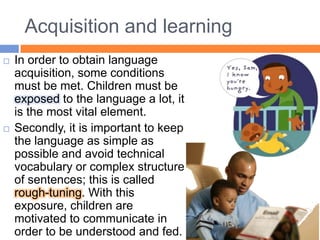
Acquisition and learningIn order to obtain language acquisition, some conditions must be met. Children must be exposed to the language a lot, it is the most vital element. Secondly, it is important to keep the language as simple as possible and avoid technical vocabulary or complex structure of sentences; this is called rough-tuning. With this exposure, children are motivated to communicate in order to be understood and fed.
Acquisiton and learningIn the teaching of a second language, teacher must be able to give the learner comprehensible input, this means, language students can more or less understand but are not able to reproduce.The principal function of learnt language is to monitor what is coming from our aquired store to check that it is OK.
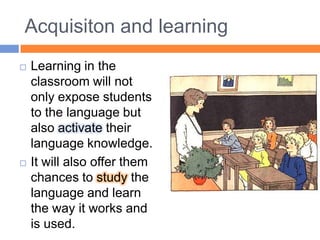
Acquisiton and learningLearning in the classroom will not only expose students to the language but also activate their language knowledge.It will also offer them chances to study the language and learn the way it works and is used.
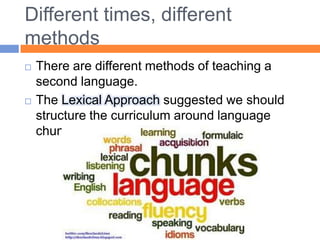
Different times, differentmethodsThere are different methods of teaching a second language. The Lexical Approach suggested we should structure the curriculumaround language chunks.
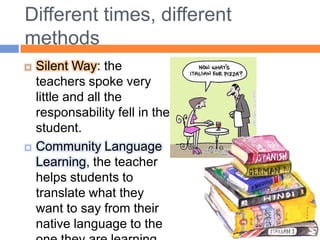
Different times, differentmethodsSilent Way: the teachers spoke very little and all the responsability fell in the student.Community Language Learning, the teacher helps students to translate what they want to say from their native language to the one they are learning.
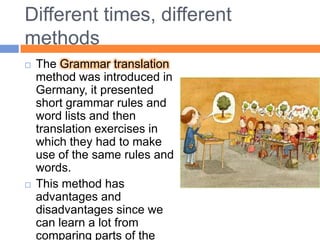
Different times, differentmethodsTheGrammar translation method was introduced in Germany, it presented short grammar rules and word lists and then translation exercises in which they had to make use of the same rules and words.This method has advantages and disadvantages since we can learn a lot from comparing parts of the second language with our mother tongue.
Different times, differentmethodsIn the audio-lingualismmethod, it emphasises on gramatical patterns w/behaviorist theories of learning. There is a response to the stimuli of the teacher which means that a reward is given. This porcedure is referred as conditioning. Some of the exercises in this method consist in giving cue-response drills and obviously doing any type of drill.
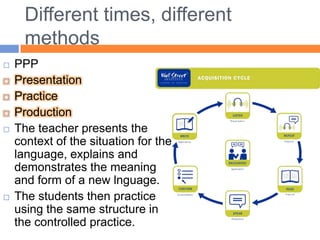
Different times, differentmethodsPPPPresentationPracticeProductionTheteacherpresentsthecontext of thesituationforthelanguage, explains and demonstratesthemeaning and form of a new lnguage.Thestudentsthenpracticeusingthesamestructure in thecontrolledpractice.
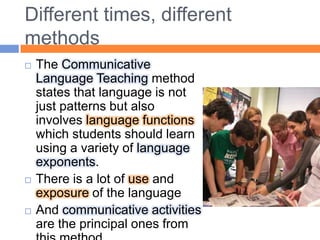
Different times, differentmethodsTheCommunicativeLanguageTeachingmethodstatesthatlanguageisnotjustpatternsbutalsoinvolveslanguagefunctionswhichstudentsshouldlearnusing a variety of languageexponents. Thereis a lot of use and exposure of thelanguageAnd communicativeactivitiesare theprincipal onesfromthismethod..
Differenttimes, differentmethodsTask-based LearningItstartswith a pre-taskwherestudents are introducedtothetopic. Followedby a taskcyclewherestudents plan thetask, gatherlanguageinfromation and produce a piece of writtingororal performance.
Elementsforsuccesfulllanguage learning (ESA)Thethreemainingredients are: ENGAGE- students are reallyinterested in whatyouhavetosay in class, askthemtomakepredictions, relate thetopicswith real lifesituations.
Elementsforsuccesfulllanguage learning (ESA)STUDY- Givethemcues, discoveractivities, askstudentsto do all intelectual workinstead of doingittheteacherhis/herself.
Elementsforsuccesfulllanguage learning (ESA)ACTIVATE- Personalization of theactivities, what do yourstudent’sliketo do, howit can behelpful in thefuture (debate, role play, etc.)