“Competency Based Music Teacher
Education: Is Systematic Accountability
          Worth the Effort?”

              Author: Dennis M. Holt
    Bulletin of the Council for Research in Music Education

                       Vol. 40 (1974): 1-6.


       Presented by: Amy Redeker
                       July 04, 2012
PURPOSE
• To explore the parameters of
  competency-based teacher education
  (CBTE) as a viable framework for
  the design of music CBTE (2)

• To describe a program of music
  CBTE evolving at the university of
  North Florida(2)
NEED FOR STUDY
Educational
           Accountability
• Interest for educational accountability
  has been growing.
Commission on Teacher
         Education
• In 1968 the Commission on Teacher
  Education developed
  recommendations for the improvement
  of music teacher education.
• 13 objectives were developed.
• The Music Educators National
  Conference (MENC) clarified each
  objective.
Commission on Teacher Education
          Statement:
          Music Teacher Competency
                 Framework
                              Certification

                        Teaching Institution

                             Competency
                   (rather than passing a course)

                    Adequate Final Assessment

     Proficiency    History      Theory          Style     Advanced
        Test                                  Techniques    Standing
                                                           Procedures
Outcome of Commission’s
        Work
• Design   and implement music
CBTE
CBTE
DESIGN
Competency Based Program
        has the following qualities:
•   Observable/measurable behaviors based on
    competencies
•   Identified learning conditions
•   Evaluation conditions congruent with behaviors
•   Identified minimal level of performance
•   Procedure for collecting formative and summative
    data
•   Procedure for external and internal evaluation
•   Constant feedback on learner’s performance
•   Procedure for evaluating effectiveness and
    appropriateness of program
Individualized Program
 Student and Professor have input to the
                  following:
• Learning objectives
• Rate of student progress
• Level of student achievement
• Testing conditions
• Selection of learning activities
Individualized Program
          Teaching-Learning Modules
•   Main vehicle
•   Guide to direct student learning
•   Means of organizing units of content
    for instruction
•   Learning tasks prepared by specialists
Field Based
• Students spend at least 50% of time
  allocated for professional education
  courses in an actual school setting.
                                     (3)
CBTE
           at the
University of North Florida
• The undergraduate and graduate
  music education program at UNF is
  evolving into a CBTE program.(3)


• The CBTE program at UNF is
  individualized and field based
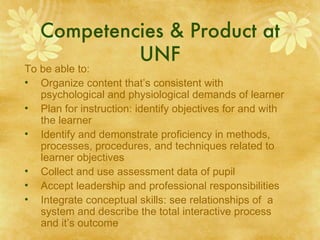
Competencies & Product at
            UNF
To be able to:
• Organize content that’s consistent with
   psychological and physiological demands of learner
• Plan for instruction: identify objectives for and with
   the learner
• Identify and demonstrate proficiency in methods,
   processes, procedures, and techniques related to
   learner objectives
• Collect and use assessment data of pupil
• Accept leadership and professional responsibilities
• Integrate conceptual skills: see relationships of a
   system and describe the total interactive process
   and it’s outcome
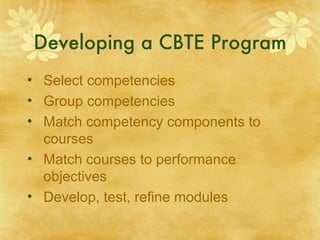
Developing a CBTE Program
• Select competencies
• Group competencies
• Match competency components to
  courses
• Match courses to performance
  objectives
• Develop, test, refine modules
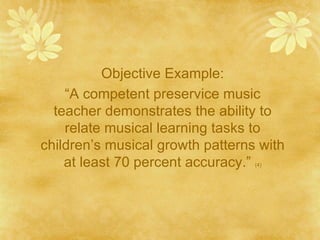
Objective Example:
    “A competent preservice music
  teacher demonstrates the ability to
    relate musical learning tasks to
children’s musical growth patterns with
    at least 70 percent accuracy.”(4)
Individualized Instruction
            at UNF
Each module contains:
• Classification
• General Directions
• Performance objective(s)
• Prerequisites
• Preassessment
• Learning Activities
• Post Assessment
Field Based Instruction
             at UNF
Includes 3 Elements:
n Opportunity for student to apply
    knowledge in schools
o Opportunity for all subjects involved to
    provide input about the UNF music
    teacher education program
n Opportunity for professors to be
    involved directly with public schools
Common misconception:
    “Study of theory almost
automatically improves practice”   (6)


Fact:
 “…theory improves practice if the
    student comprehends the
          linkages…”  (6)
CONCLUSION
Evaluation of CBTE at UNF
• Program is still evolving.
• Several dimensions are not described
  in the article.
• An informal evaluation of CBTE at UNF
  concludes that implementation of a
  music CBTE program is worth the
  effort.
        (6)
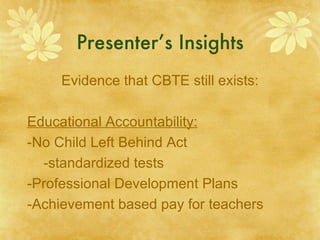
Presenter’s Insights
     Evidence that CBTE still exists:

Educational Accountability:
-No Child Left Behind Act
  -standardized tests
-Professional Development Plans
-Achievement based pay for teachers
Preservice teacher programs in WI
-Praxis Exams
Works Cited
Holt, Dennis M. “Competency Based Music
  Teacher Education: Is Systematic Accountability
  Worth the Effort?” Bulletin of the Council for
  Research in Music Education 40 (1974): 1-6.

Competency Based Teacher Education

  • 1.
    “Competency Based MusicTeacher Education: Is Systematic Accountability Worth the Effort?” Author: Dennis M. Holt Bulletin of the Council for Research in Music Education Vol. 40 (1974): 1-6. Presented by: Amy Redeker July 04, 2012
  • 2.
    PURPOSE • To explorethe parameters of competency-based teacher education (CBTE) as a viable framework for the design of music CBTE (2) • To describe a program of music CBTE evolving at the university of North Florida(2)
  • 3.
  • 4.
    Educational Accountability • Interest for educational accountability has been growing.
  • 5.
    Commission on Teacher Education • In 1968 the Commission on Teacher Education developed recommendations for the improvement of music teacher education. • 13 objectives were developed. • The Music Educators National Conference (MENC) clarified each objective.
  • 6.
    Commission on TeacherEducation Statement: Music Teacher Competency Framework Certification Teaching Institution Competency (rather than passing a course) Adequate Final Assessment Proficiency History Theory Style Advanced Test Techniques Standing Procedures
  • 7.
    Outcome of Commission’s Work • Design and implement music CBTE
  • 8.
  • 9.
    Competency Based Program has the following qualities: • Observable/measurable behaviors based on competencies • Identified learning conditions • Evaluation conditions congruent with behaviors • Identified minimal level of performance • Procedure for collecting formative and summative data • Procedure for external and internal evaluation • Constant feedback on learner’s performance • Procedure for evaluating effectiveness and appropriateness of program
  • 10.
    Individualized Program Studentand Professor have input to the following: • Learning objectives • Rate of student progress • Level of student achievement • Testing conditions • Selection of learning activities
  • 11.
    Individualized Program Teaching-Learning Modules • Main vehicle • Guide to direct student learning • Means of organizing units of content for instruction • Learning tasks prepared by specialists
  • 12.
    Field Based • Studentsspend at least 50% of time allocated for professional education courses in an actual school setting. (3)
  • 13.
    CBTE at the University of North Florida
  • 14.
    • The undergraduateand graduate music education program at UNF is evolving into a CBTE program.(3) • The CBTE program at UNF is individualized and field based
  • 15.
    Competencies & Productat UNF To be able to: • Organize content that’s consistent with psychological and physiological demands of learner • Plan for instruction: identify objectives for and with the learner • Identify and demonstrate proficiency in methods, processes, procedures, and techniques related to learner objectives • Collect and use assessment data of pupil • Accept leadership and professional responsibilities • Integrate conceptual skills: see relationships of a system and describe the total interactive process and it’s outcome
  • 16.
    Developing a CBTEProgram • Select competencies • Group competencies • Match competency components to courses • Match courses to performance objectives • Develop, test, refine modules
  • 17.
    Objective Example: “A competent preservice music teacher demonstrates the ability to relate musical learning tasks to children’s musical growth patterns with at least 70 percent accuracy.”(4)
  • 18.
    Individualized Instruction at UNF Each module contains: • Classification • General Directions • Performance objective(s) • Prerequisites • Preassessment • Learning Activities • Post Assessment
  • 19.
    Field Based Instruction at UNF Includes 3 Elements: n Opportunity for student to apply knowledge in schools o Opportunity for all subjects involved to provide input about the UNF music teacher education program n Opportunity for professors to be involved directly with public schools
  • 20.
    Common misconception: “Study of theory almost automatically improves practice” (6) Fact: “…theory improves practice if the student comprehends the linkages…” (6)
  • 21.
  • 22.
    Evaluation of CBTEat UNF • Program is still evolving. • Several dimensions are not described in the article. • An informal evaluation of CBTE at UNF concludes that implementation of a music CBTE program is worth the effort. (6)
  • 23.
    Presenter’s Insights Evidence that CBTE still exists: Educational Accountability: -No Child Left Behind Act -standardized tests -Professional Development Plans -Achievement based pay for teachers
  • 24.
    Preservice teacher programsin WI -Praxis Exams
  • 25.
    Works Cited Holt, DennisM. “Competency Based Music Teacher Education: Is Systematic Accountability Worth the Effort?” Bulletin of the Council for Research in Music Education 40 (1974): 1-6.