Introduction to Compensation
Management
Module 1
Compensation is referred to an money and other benefits
received by an employee for providing services to his
employer. Compensation refers to all forms of financial
returns tangible services and benefits employees receive as
part of an employment relationship.
Compensation
According to Keith Davis “Compensation is what employees
receive in exchange for their contribution to the organization”
3
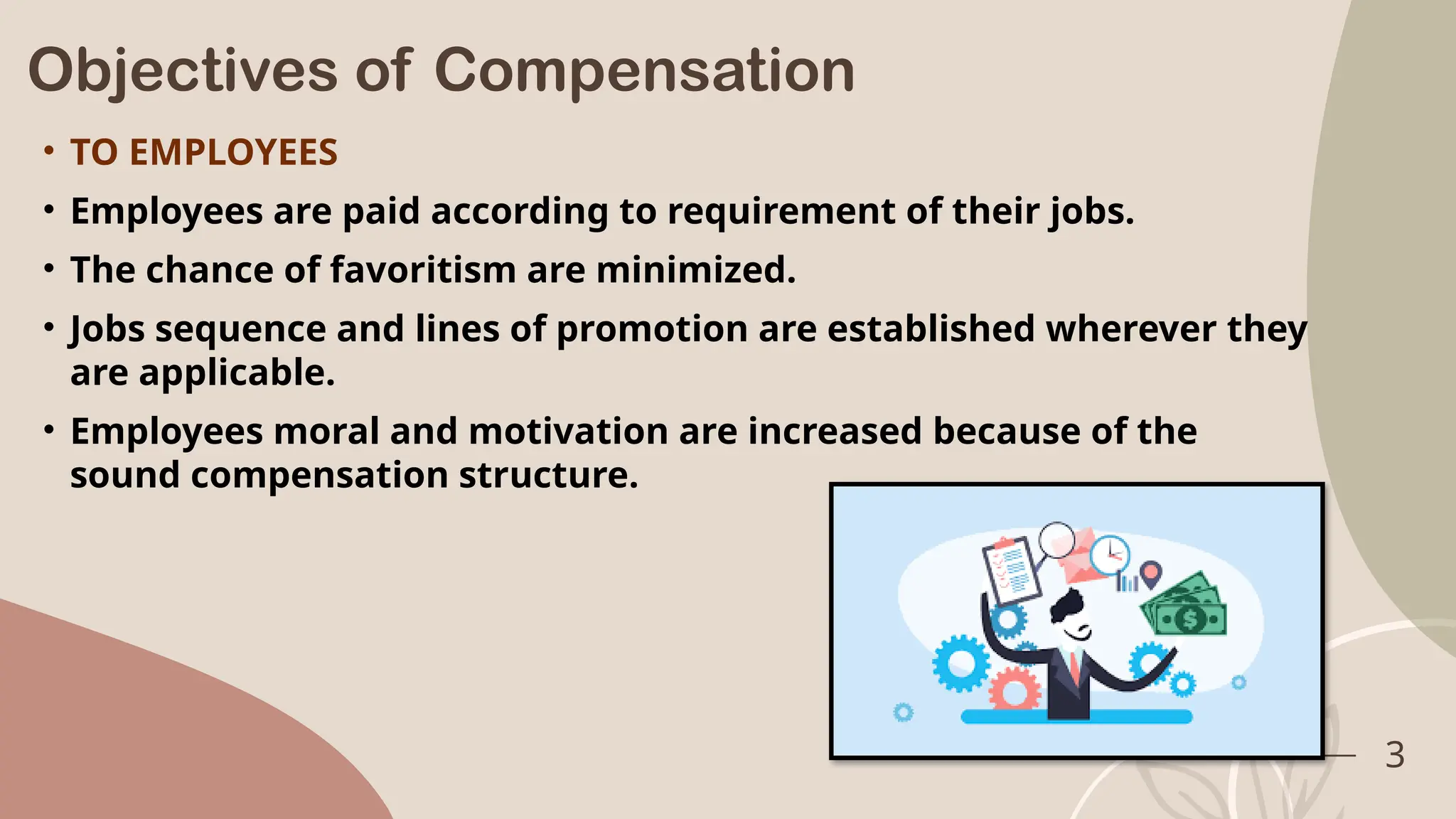
Objectives of Compensation
• TO EMPLOYEES
• Employees are paid according to requirement of their jobs.
• The chance of favoritism are minimized.
• Jobs sequence and lines of promotion are established wherever they
are applicable.
• Employees moral and motivation are increased because of the
sound compensation structure.
• TO EMPLOYERS
• They can systematically plan for and control the turnover in
the organization.
• A sound compensation structure reduces the likelihood of
friction and grievance over remuneration
• It enhances an employee morale and motivation because
adequate and fairly administrative incentives are basis to his
wants and need.
• It attracts qualified employees by ensuring and adequate
payment for all the jobs.
Objectives
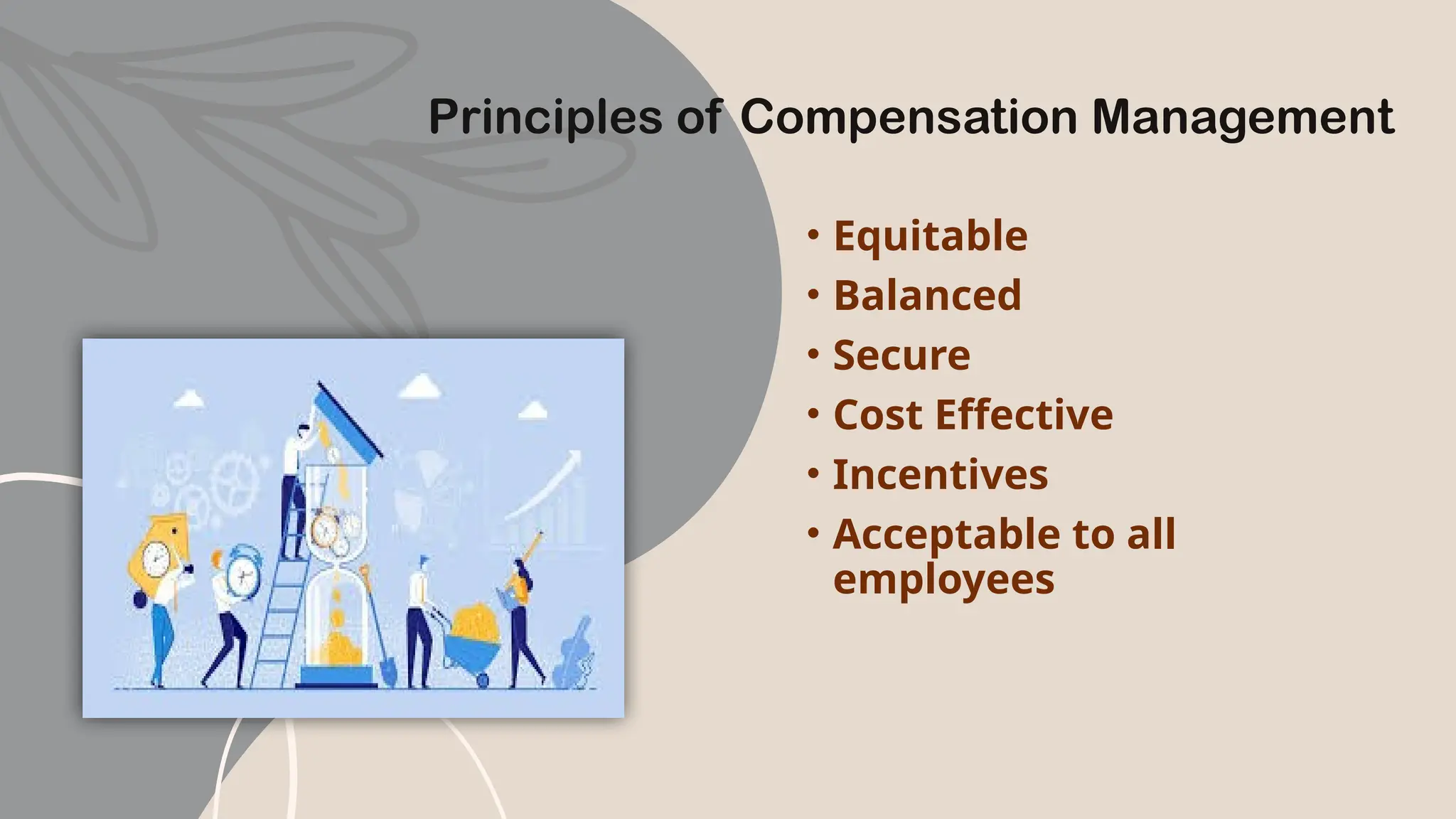
• Equitable
• Balanced
• Secure
• Cost Effective
• Incentives
• Acceptable to all
employees
Principles of Compensation Management
Wages:-
It is a payment usually of money for labor or
services usually according to contract and
on a hourly, daily, or piece work basis
In another words; It is a money that is paid
by an employer to an employee in exchange
for work
Salary:-
A salary is the money that someone is paid
each month by their employer, especially
when they are in a profession such as
teaching, law ect…,
DA (dearness allowance)
Click icon to add picture
It is an amount paid to employees as a cost of living
adjustment allowance to mitigate the impact of inflation. It
is typically calculated as a percentage of the basic salary
and is adjusted periodically to reflect changes in the cost of
living index. DA ensures that the purchasing power of
employees is maintained despite rising prices of essential
commodities.
Consolidated
Pay:-
It means a total salary without any breakup, which
means consolidated salary is not divided into salary
components like basic wages, HRA, transport & medical
allowance etc. ..,
It is paid weekly or monthly basis to the employees.
Equity Based Program:-
An equity based incentive plan is used to attract,
retain, and incentivize employees.
Companies often reward employees, partners, directors,
contractors, or other by granting them shares in an equity
plan.
Commission :-
It refers to a form of compensation provided to
employees based on the sales they generate or their
business they bring to the company.
It is a variable payment structure that reward
employees for their sales performance.
Rewards
It refers to the benefits or incentives that an individual receives in return
for their work, services, or achievements.
These rewards can be tangible or intangible and are often used to
motivate and recognize outstanding performance, achievements, or
contributions.
Remuneration
It refers to the compensation or payment received by an
individual for their work, services, or contributions. It
encompasses all the financial and non-financial benefits
that an individual receives in exchange for their efforts,
skills and time.
Bonus
A Bonus is an extra amount of money that is added to
someone pay, usually because they have worked very hard.
Various types of compensation and
supplementary compensation
1. Direct compensation
• Basic salary
• House rent allowances
• Leave travel allowances
• Bonus
• DeaRness allowances
2. INDIRECT OR SUPPLEMENTARY ALLOWANCES
• Leave policy
• Overtime policy
• Hospitalization
• Insurance
• Flexible timings
12
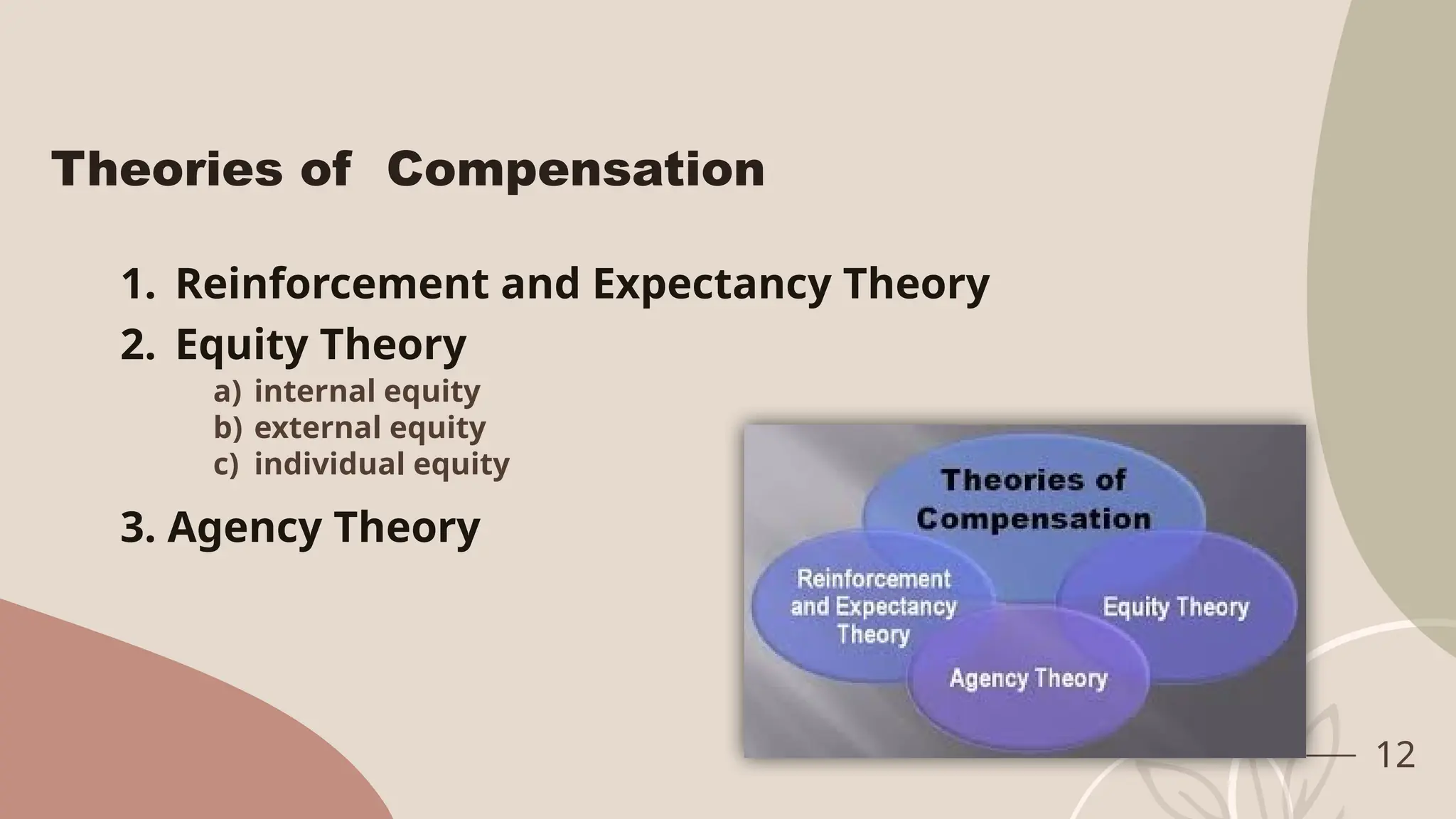
Theories of Compensation
1. Reinforcement and Expectancy Theory
2. Equity Theory
3. Agency Theory
a) internal equity
b) external equity
c) individual equity
Compensation Structure
1. STRAIGHT SALARY
COMPENSATION
2. SALARY PLUS COMMISSION
3. COMMISSION ONLY
4. TERRITORY VOLUME
COMPENSATION PLAN
5. RESIDUAL COMMISSION
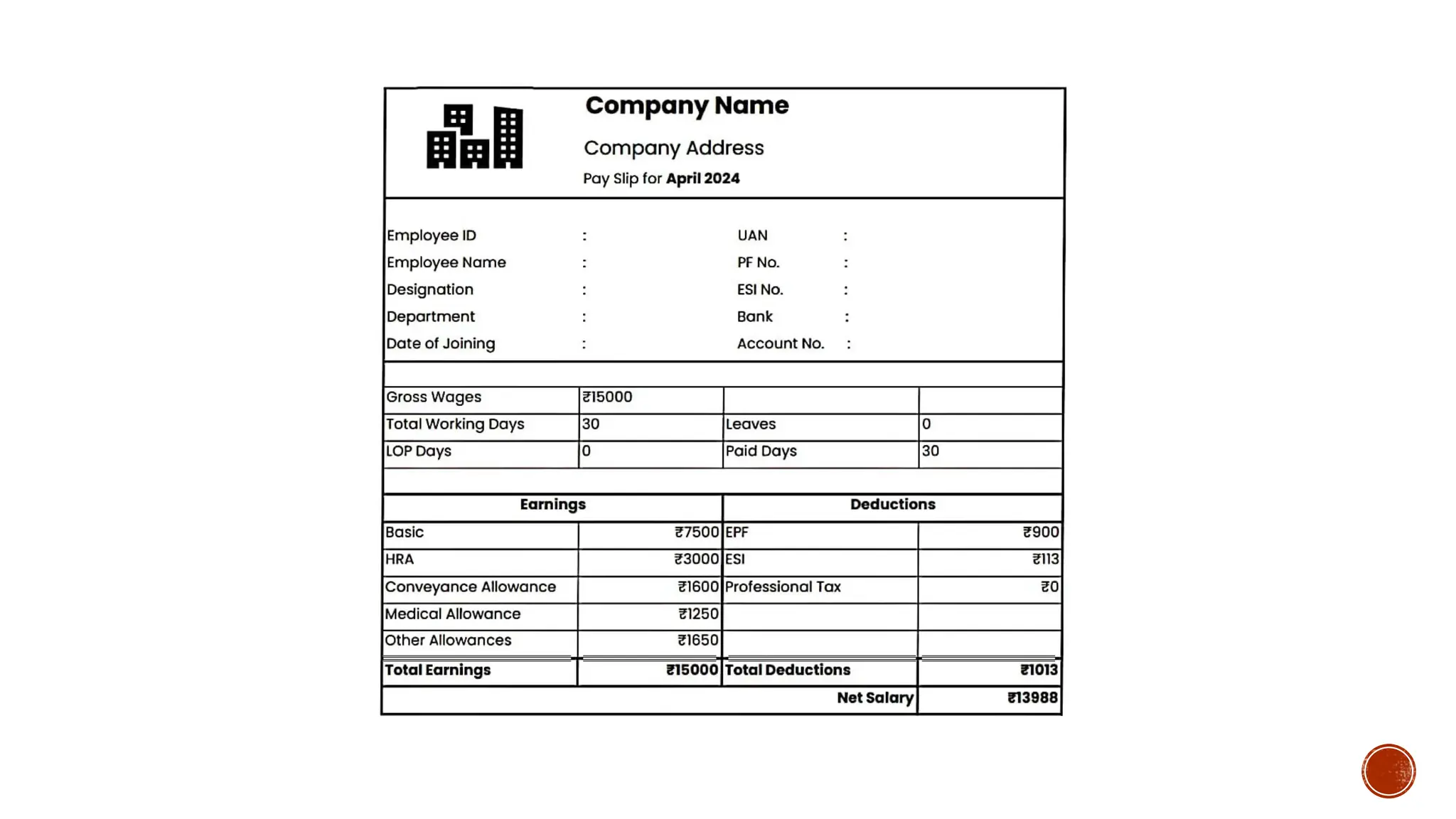
SALARY STRUCTURE
OR
COMPENSATION STRUCTURE
Basic Salary
HRA (House Rent Allowance)
LTA (Leave Travel Allowance)
Applicable Allowance
Performance Bonus
EPF (Employees’ Provident Fund)
Professional Tax
TDS (Tax Deducted at Source)
ESIC (Employees’ State Insurance Corporation)
Gratuity
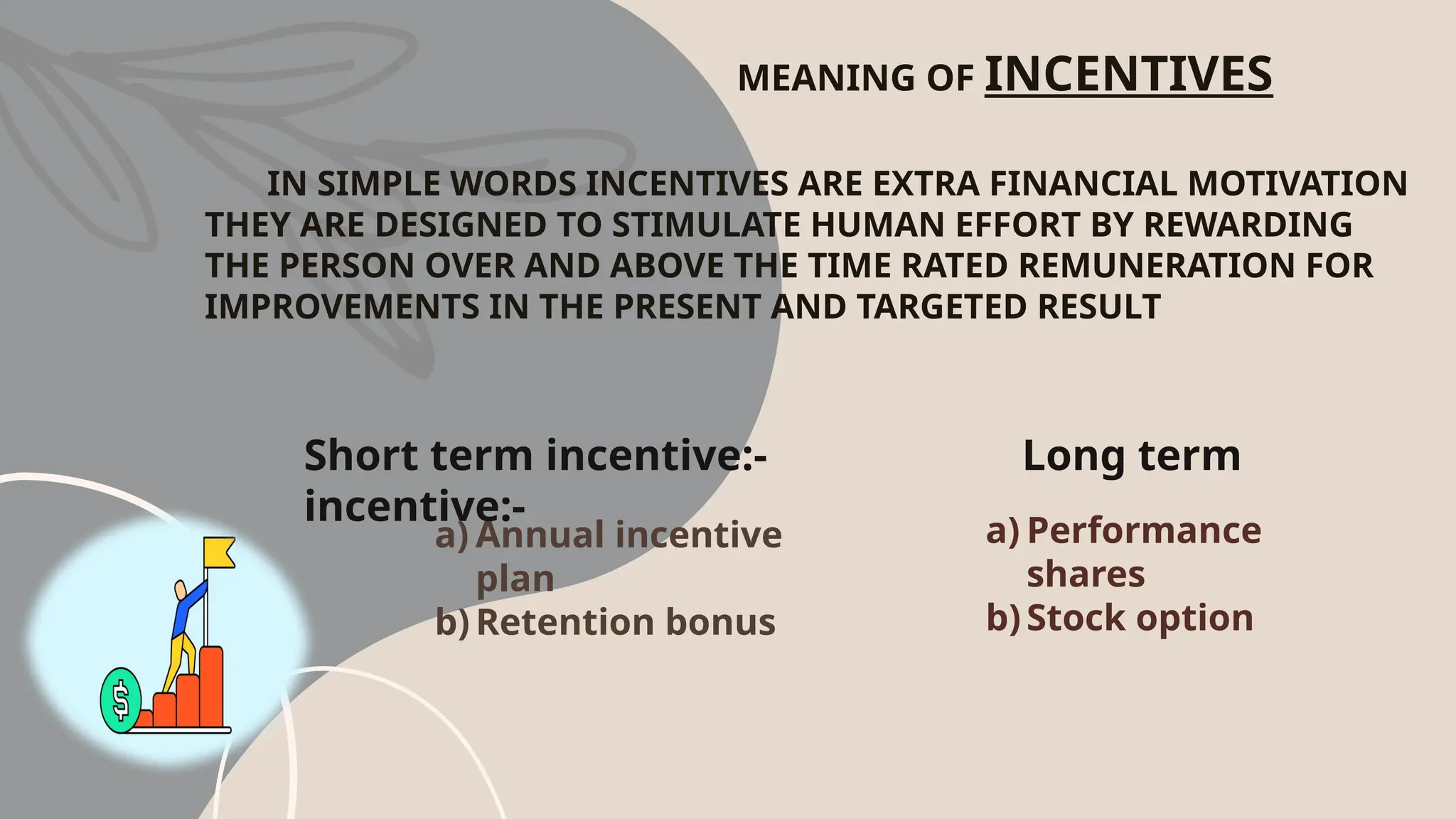
MEANING OF INCENTIVES
IN SIMPLE WORDS INCENTIVES ARE EXTRA FINANCIAL MOTIVATION
THEY ARE DESIGNED TO STIMULATE HUMAN EFFORT BY REWARDING
THE PERSON OVER AND ABOVE THE TIME RATED REMUNERATION FOR
IMPROVEMENTS IN THE PRESENT AND TARGETED RESULT
Short term incentive:- Long term
incentive:-
a) Annual incentive
plan
b) Retention bonus
a) Performance
shares
b) Stock option
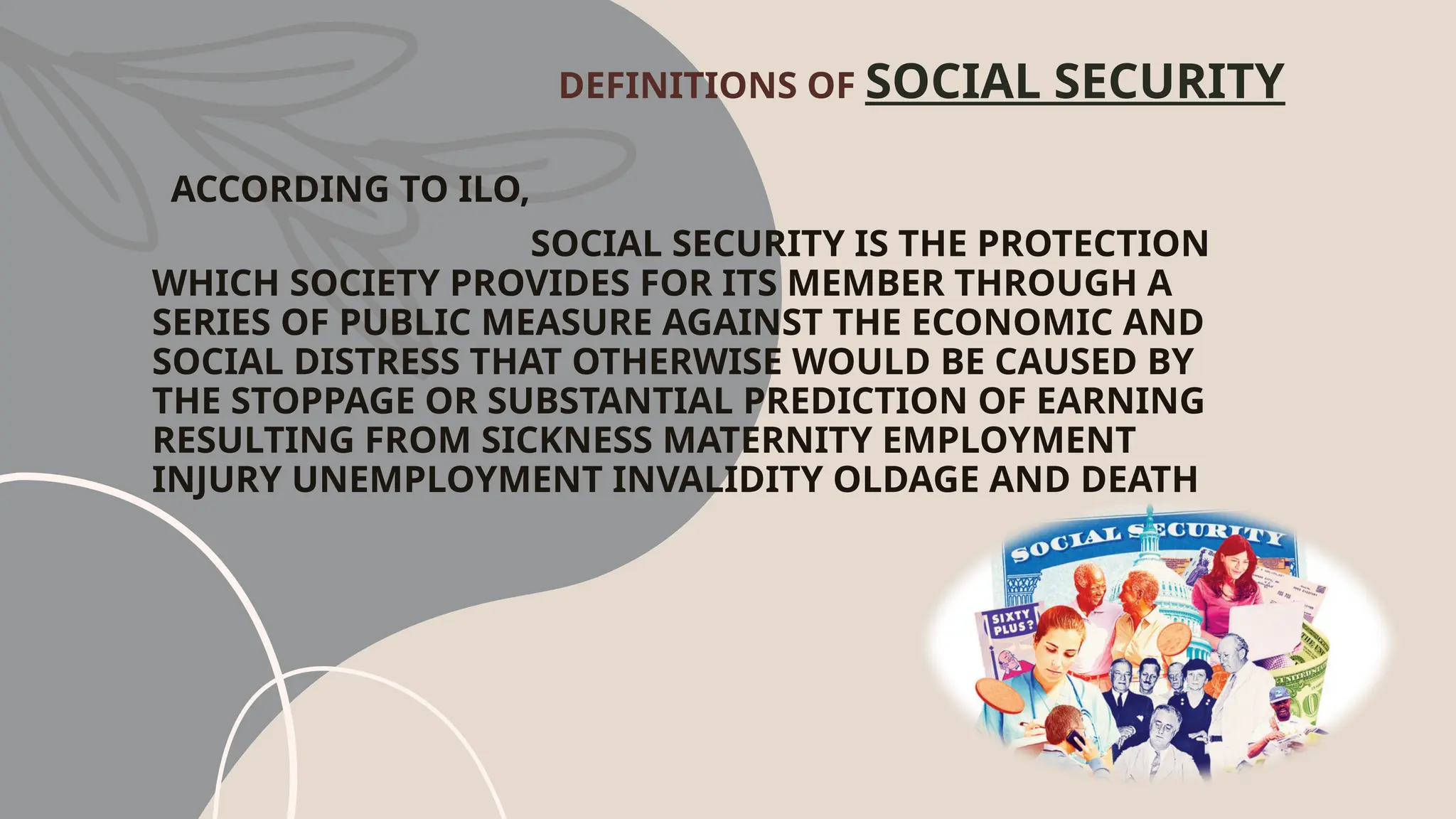
DEFINITIONS OF SOCIAL SECURITY
ACCORDING TO ILO,
SOCIAL SECURITY IS THE PROTECTION
WHICH SOCIETY PROVIDES FOR ITS MEMBER THROUGH A
SERIES OF PUBLIC MEASURE AGAINST THE ECONOMIC AND
SOCIAL DISTRESS THAT OTHERWISE WOULD BE CAUSED BY
THE STOPPAGE OR SUBSTANTIAL PREDICTION OF EARNING
RESULTING FROM SICKNESS MATERNITY EMPLOYMENT
INJURY UNEMPLOYMENT INVALIDITY OLDAGE AND DEATH
Retirement planning
Retirement planning means preparing todays for
your future life so that you continue to meet all your
goals and dreams independently.
Different plans for Retirement:-
a. National Pension Scheme
b. Annuity Plans
c. Pension Funds
d. Pension Plans with Life Cover
Meaning of Pension Plan
Pension plan is a type of retirement
plan where employers promise to
pay a defined benefit to employees
for life they retire.
Individual Retirement Account (IRA)
AN INDIVIDUAL RETIREMENT
ACCOUNT (IRA) IS A SAVING ACCOUNT
WITH TAX ADVANTAGES THAT
INDIVIDUALS CAN USE TO SAVE AND
INVEST LONG TERM.
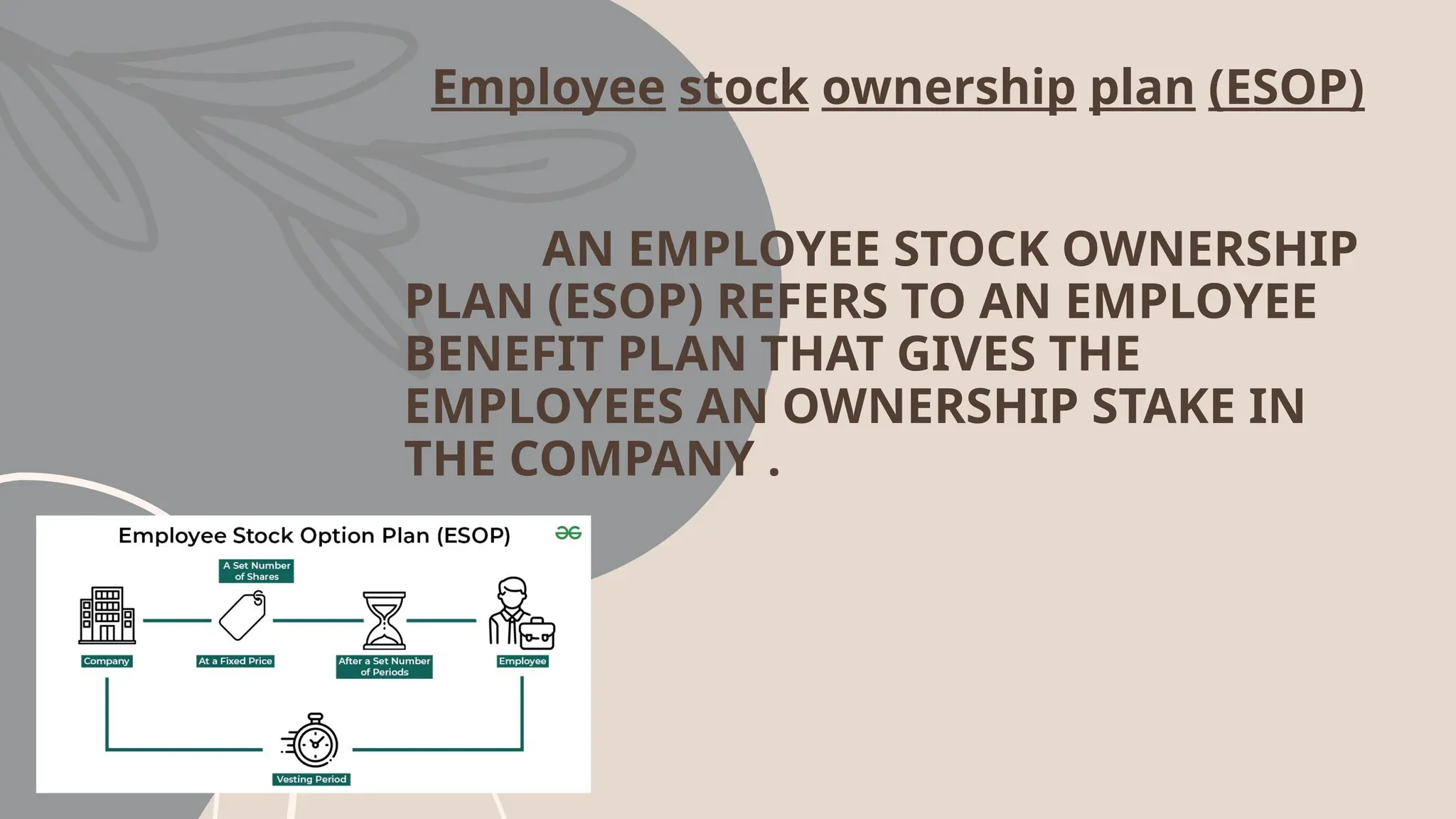
Employee stock ownership plan (ESOP)
AN EMPLOYEE STOCK OWNERSHIP
PLAN (ESOP) REFERS TO AN EMPLOYEE
BENEFIT PLAN THAT GIVES THE
EMPLOYEES AN OWNERSHIP STAKE IN
THE COMPANY .
Stock bonus plan meaning
A STOCK BONUS PLAN IS A TYPE OF RETIREMENT
PLAN DESIGNED TO INCREASE EMPLOYEES’ VESTED
INTEREST IN A COMPANY’S SUCCESS. A STOCK BONUS
PLAN IS A TYPE OF PROFIT-SHARING PLAN PAID IN
EMPLOYER STOCK INSTEAD OF CASH.
Profit sharing plan meaning
A profit-sharing plan is a pension plan, which gives an
employee a share in the company’s profits. As per this plan,
which also referred to as the deferred profit-sharing plan
(DPSP), employees will go onto receive a portion from the
company’s profits which depend on the annual or quarterly
earnings.
COMPENSATION MANAGEMENT
DEFINITION:
ACCORDING TO DEB,
“COMPENSATION MANAGEMENT IS A SYSTEM OF COMPENSATING
INDIVIDUALS FOR THE WORK THEY PERFORM IN SUCH A WAY THAT THE
ORGANIZATION IS ABLE TO ATTRACT, RETAIN AND MOTIVATE THEM TO
PERFORM WELL KEEPING IN VIEW ORGANIZATIONAL AND MARKET FACTORS.”
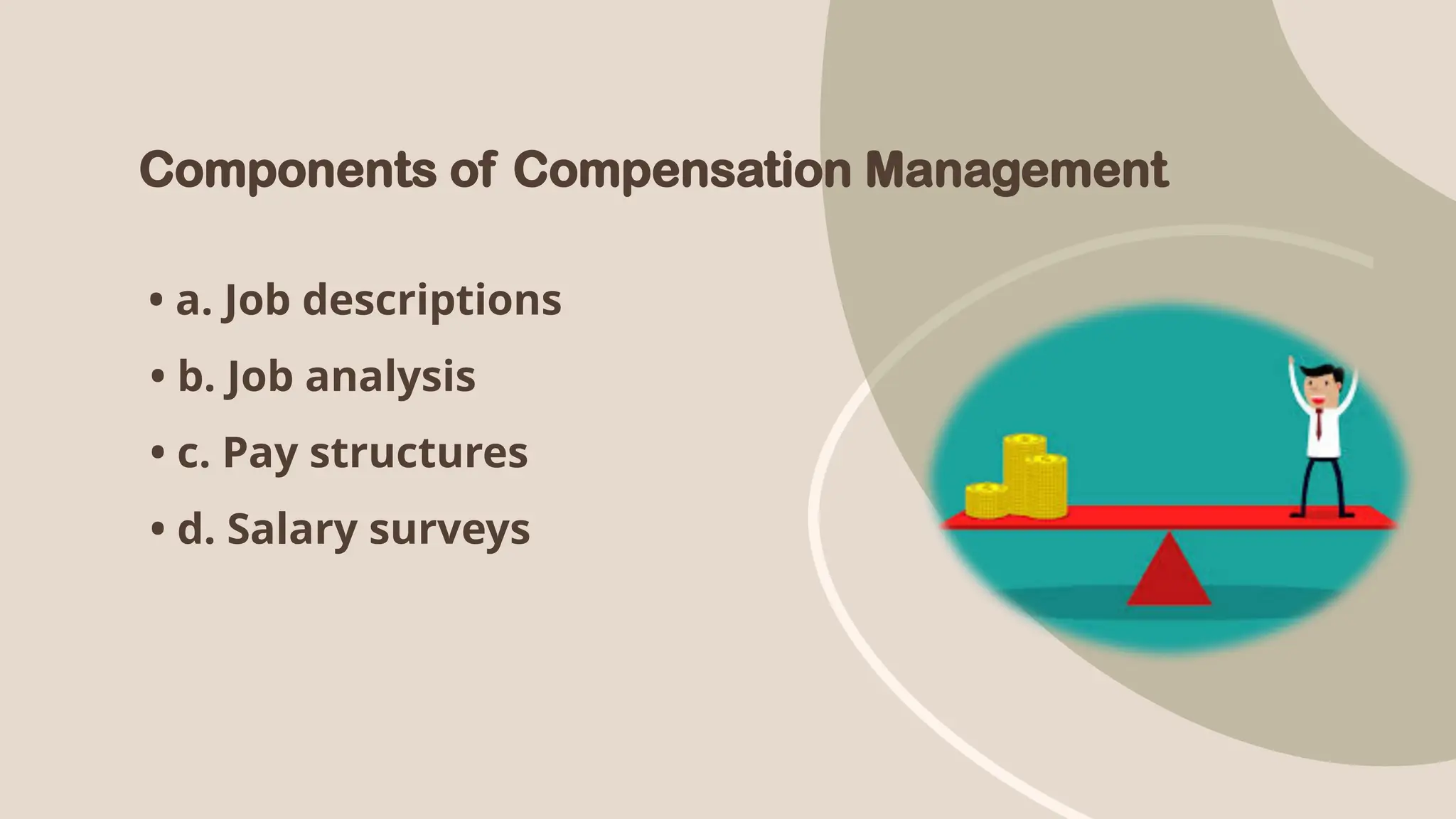
Components of Compensation Management
• a. Job descriptions
• b. Job analysis
• c. Pay structures
• d. Salary surveys
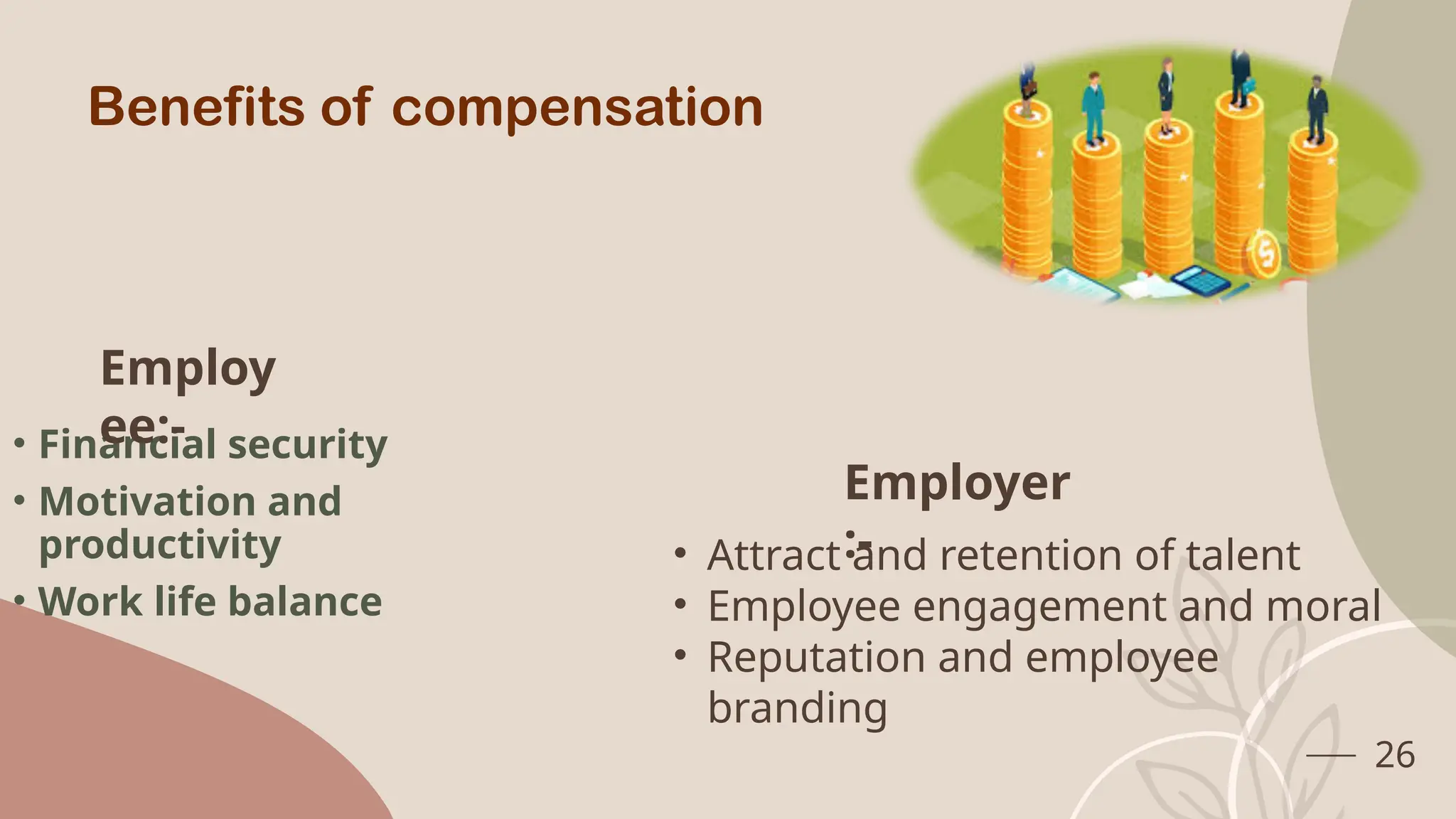
Benefits of compensation
• Financial security
• Motivation and
productivity
• Work life balance
26
Employ
ee:-
Employer
:-
• Attract and retention of talent
• Employee engagement and moral
• Reputation and employee
branding
Meaning of Non-
Monetary
Compensations
NON- MONETARY COMPENSATION IS DEFINED AS
ANY COMPENSATION OR REWARD GIVEN TO AN
EMPLOYEE IN A NON-CASH FORM FOR THEIR WORK
IN THE ORGANIZATION.
Forms of Non-Monetary
Compensation
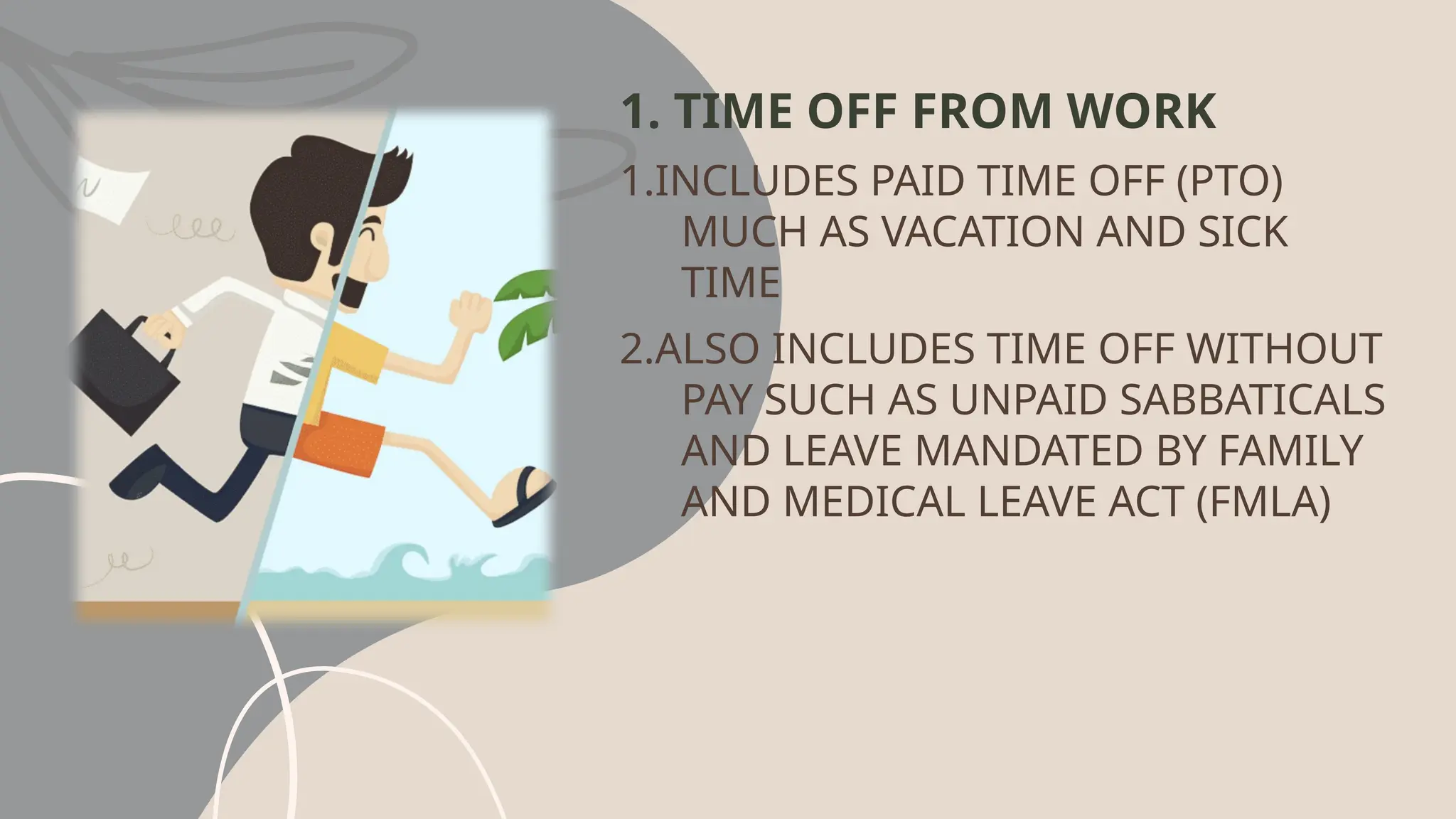
1. TIME OFF FROM WORK
1.INCLUDES PAID TIME OFF (PTO)
MUCH AS VACATION AND SICK
TIME
2.ALSO INCLUDES TIME OFF WITHOUT
PAY SUCH AS UNPAID SABBATICALS
AND LEAVE MANDATED BY FAMILY
AND MEDICAL LEAVE ACT (FMLA)
2. CAREER DEVELOPMENT
OPPORTUNITIES
HELPS THE EMPLOYEES TO
ENHANCE THEIR JOB-RELATED
SKILLS, WHICH HELPS THEM TO
TAKE UP NEW, EXPANDED PROJECTS
OR ROLES IN FUTURE
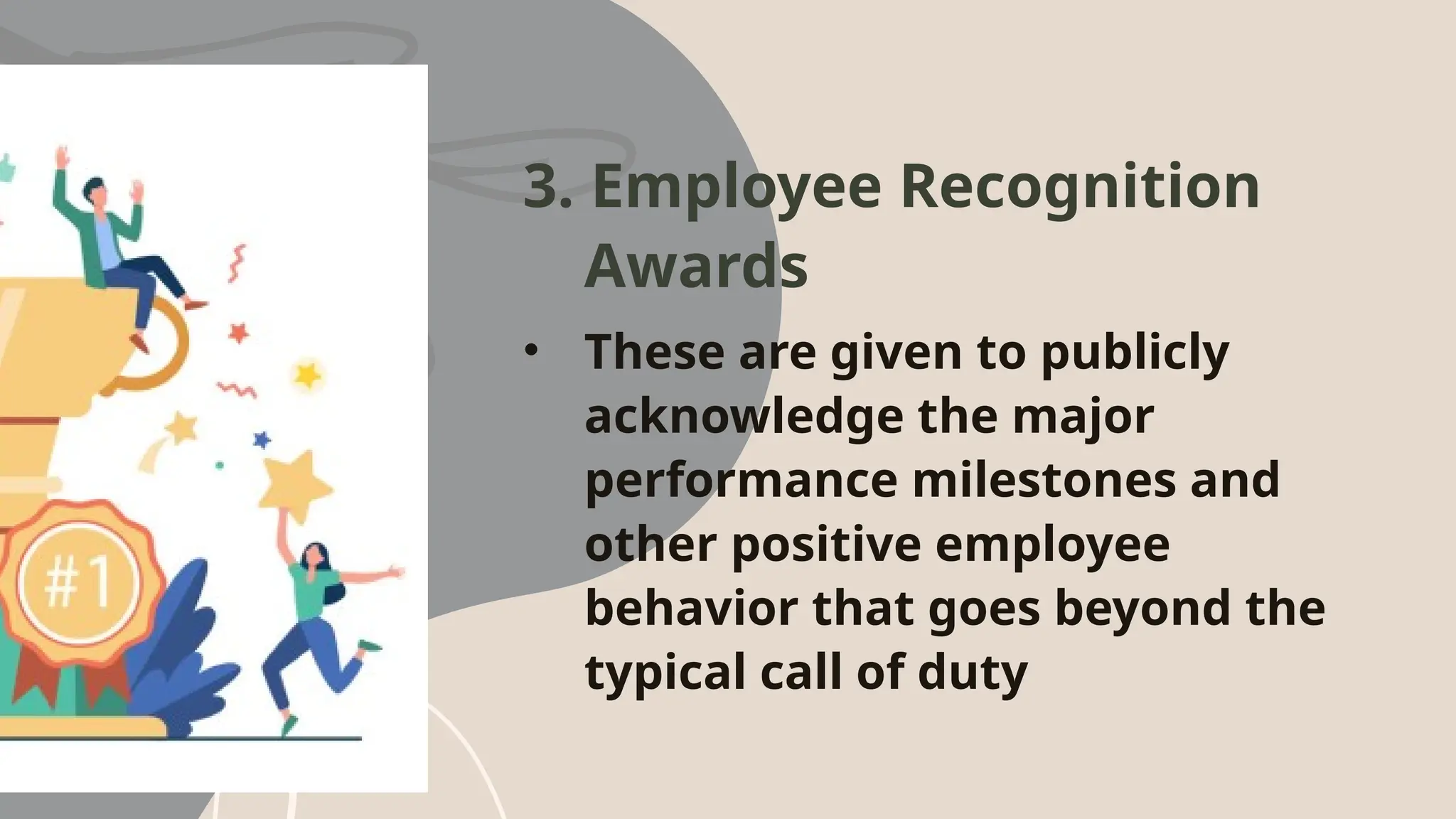
3. Employee Recognition
Awards
• These are given to publicly
acknowledge the major
performance milestones and
other positive employee
behavior that goes beyond the
typical call of duty
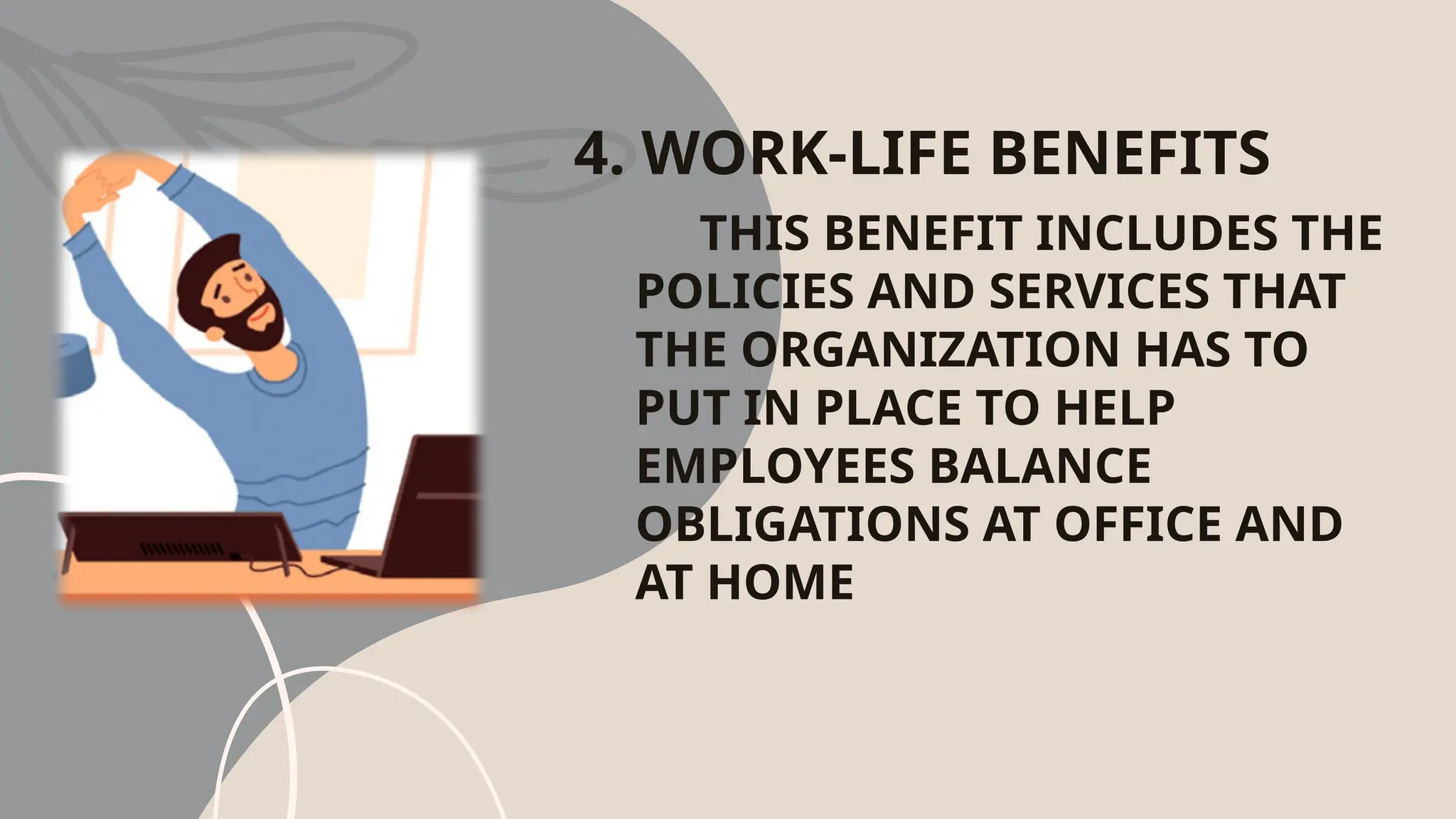
4. WORK-LIFE BENEFITS
THIS BENEFIT INCLUDES THE
POLICIES AND SERVICES THAT
THE ORGANIZATION HAS TO
PUT IN PLACE TO HELP
EMPLOYEES BALANCE
OBLIGATIONS AT OFFICE AND
AT HOME
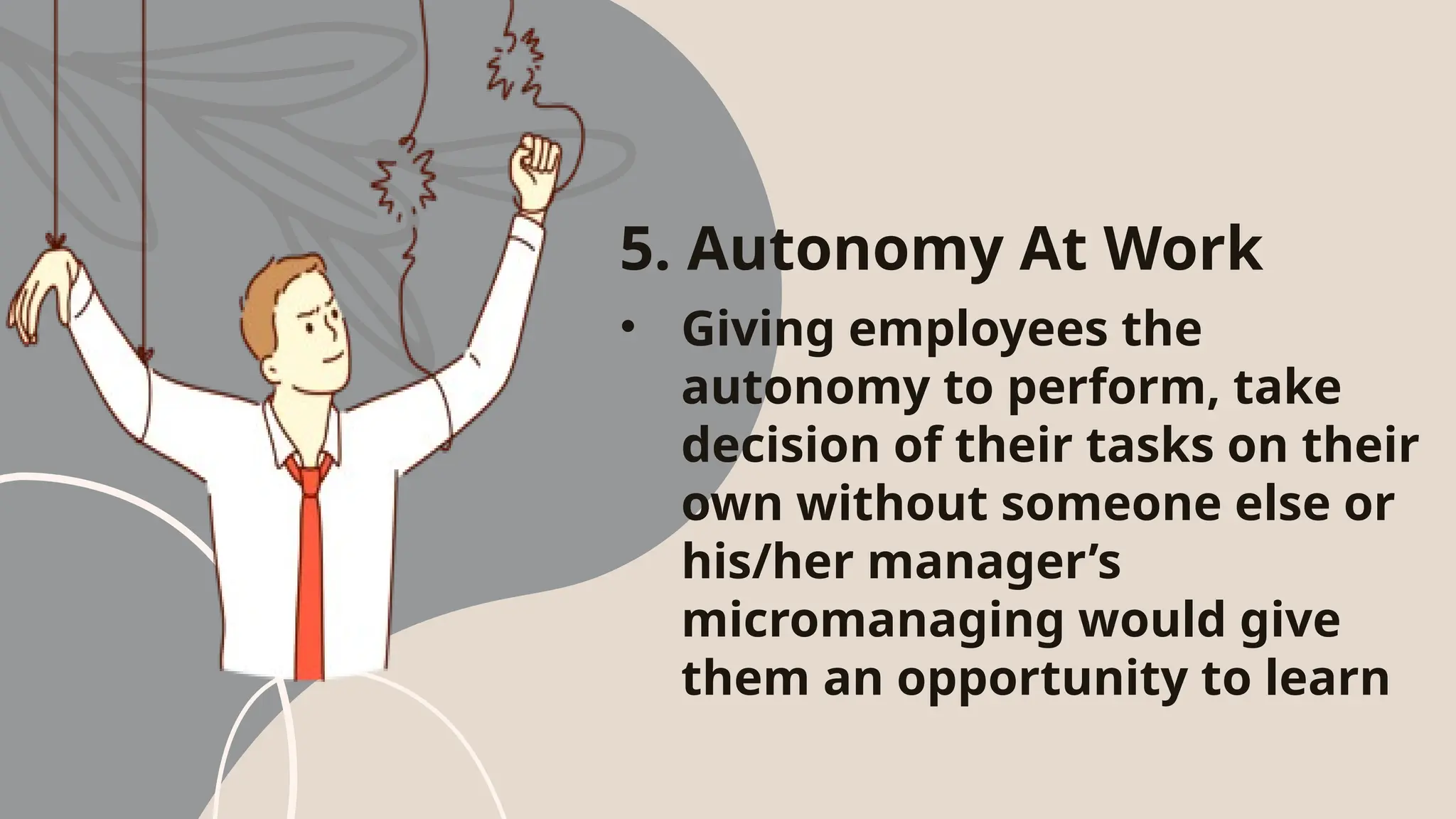
5. Autonomy At Work
• Giving employees the
autonomy to perform, take
decision of their tasks on their
own without someone else or
his/her manager’s
micromanaging would give
them an opportunity to learn
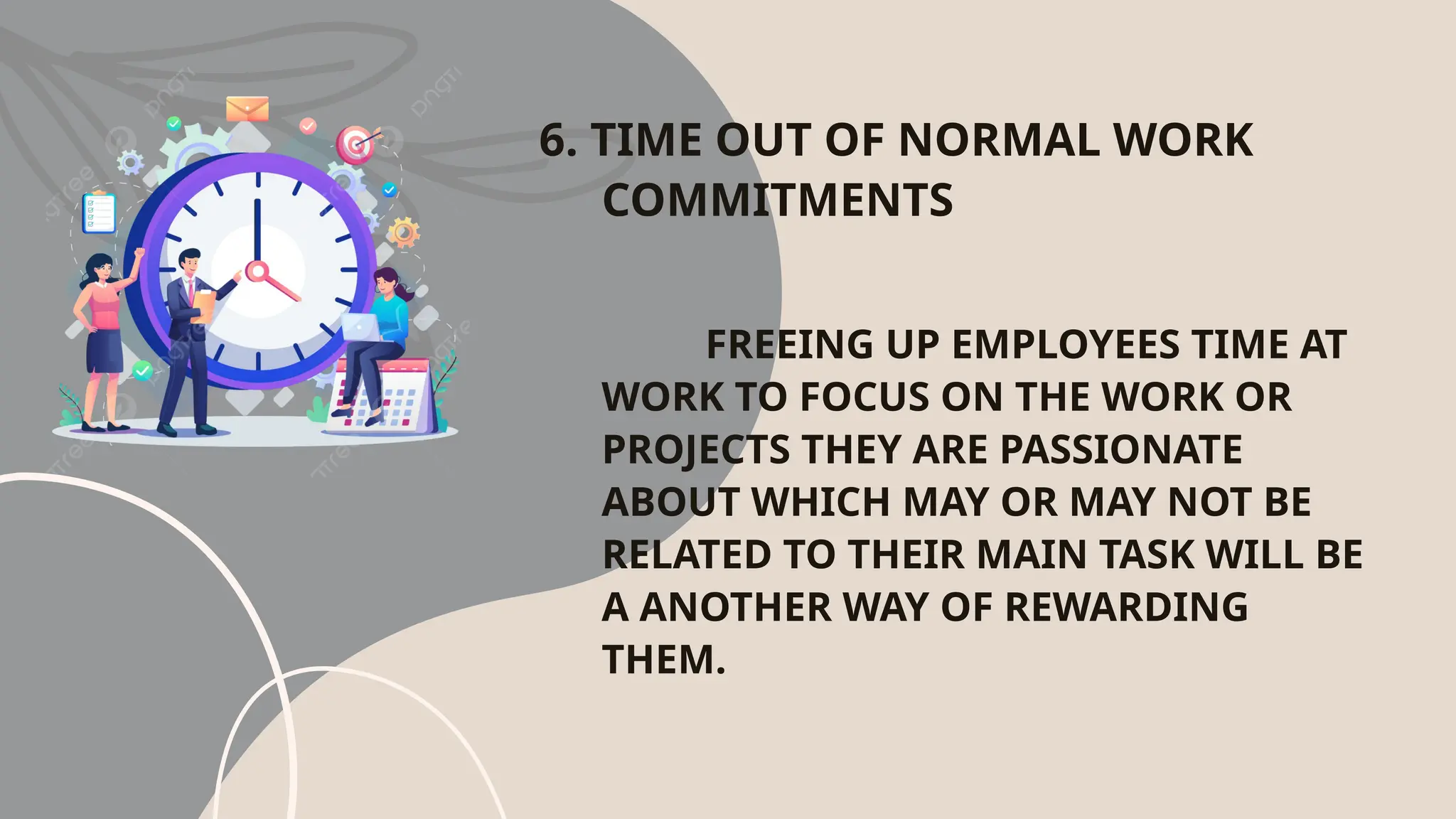
6. TIME OUT OF NORMAL WORK
COMMITMENTS
FREEING UP EMPLOYEES TIME AT
WORK TO FOCUS ON THE WORK OR
PROJECTS THEY ARE PASSIONATE
ABOUT WHICH MAY OR MAY NOT BE
RELATED TO THEIR MAIN TASK WILL BE
A ANOTHER WAY OF REWARDING
THEM.
3P APPROACH
3P Compensation is a system designed to pay salaries
according to employee’s merit and performance in
order to create fairness, encouragement in company
Helping each employee maximize his abilities in
works , contributing to company development
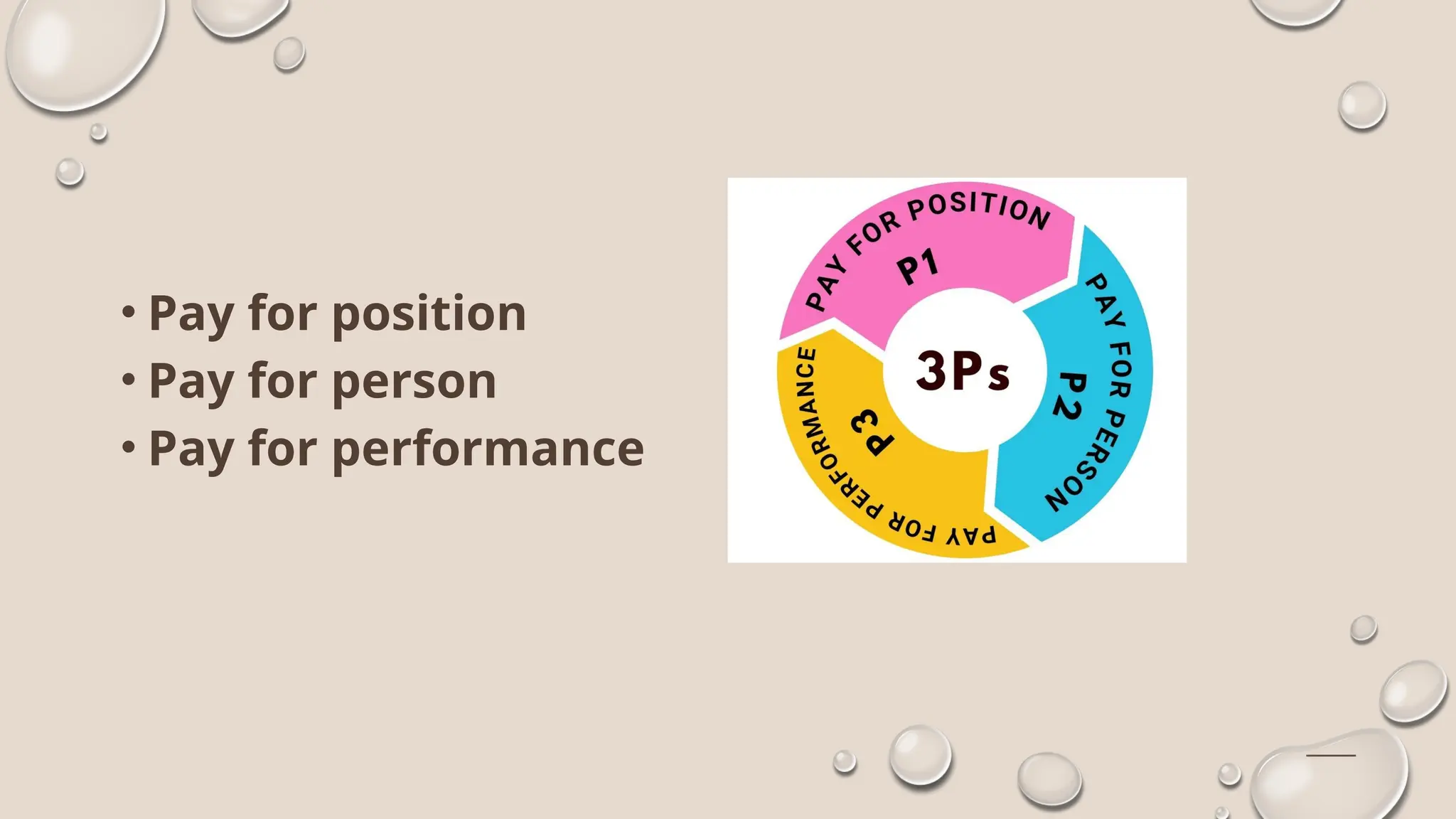
• Pay for position
• Pay for person
• Pay for performance
Compensation management in
multinational organization
Objectives:-
1. This policy should be consistent with the
overall strategy, structure and business need
to be accomplished.
2. It must be competitive and recognize factors
such as incentives to Foreign Service, in
reasonable costs.
3. This policy should facilitate the transfer of
international employees in the most cost-
effective manner for the firm.
4. The compensation policy must work to attract
and retain the staff in the areas where
Multinational has the greatest need.
Factor Affecting International
Compensation
A. Social Contract
B. Culture
C. Trade Union
D. Ownership and Capital Market
E. Cost of Living
Compensation statergies as a
integral part of HRM
Compensation Strategies play a important role in
Human Resource Management (HRM), serving as a
crucial component in attracting, retaining, and
motivating a talented workforce.
Compensation strategies are foundational elements of
HRM, intricately linked to an organization's ability to
attract, retain, and motivate a skilled workforce.
Why compensation is
important in
organization
1. ATTRACTING AND
RETAINING TALENT
2. EMPLOYEE MOTIVATION
AND PERFORMANCE
3. REDUCES TURNOVER COST
4. RETURN ON INVESTMENT
5. RISK MANAGEMENT
COMPENSATION POLICY
MEANING
A COMPENSATION POLICY IS A FORMAL
STATEMENT THAT OUTLINES AN
ORGANIZATION'S APPROACH TO
DETERMINING AND ADMINISTERING
EMPLOYEE COMPENSATION. IT DEFINES
HOW SALARIES, WAGES, BONUSES,
BENEFITS, AND OTHER FORMS OF
REMUNERATION ARE STRUCTURED AND
MANAGED TO ENSURE FAIRNESS,
COMPETITIVENESS, AND ALIGNMENT WITH
ORGANIZATIONAL GOALS
TYPES OF COMPENSATION
POLICY
• GENERAL COMPENSATION LEVEL
• WAGE AND SALARY STRUCTURE
• FORMULAS BASED ON TIME OR
PRODUCTIVITY GOVERNING
DISBURSEMENT OF WAGE OR SALARY
FUNDS TO INDIVIDUALS
Introduction to Compensation Management.pptx

Introduction to Compensation Management.pptx

  • 1.
  • 2.
    Compensation is referredto an money and other benefits received by an employee for providing services to his employer. Compensation refers to all forms of financial returns tangible services and benefits employees receive as part of an employment relationship. Compensation According to Keith Davis “Compensation is what employees receive in exchange for their contribution to the organization”
  • 3.
    3 Objectives of Compensation •TO EMPLOYEES • Employees are paid according to requirement of their jobs. • The chance of favoritism are minimized. • Jobs sequence and lines of promotion are established wherever they are applicable. • Employees moral and motivation are increased because of the sound compensation structure.
  • 4.
    • TO EMPLOYERS •They can systematically plan for and control the turnover in the organization. • A sound compensation structure reduces the likelihood of friction and grievance over remuneration • It enhances an employee morale and motivation because adequate and fairly administrative incentives are basis to his wants and need. • It attracts qualified employees by ensuring and adequate payment for all the jobs. Objectives
  • 5.
    • Equitable • Balanced •Secure • Cost Effective • Incentives • Acceptable to all employees Principles of Compensation Management
  • 6.
    Wages:- It is apayment usually of money for labor or services usually according to contract and on a hourly, daily, or piece work basis In another words; It is a money that is paid by an employer to an employee in exchange for work Salary:- A salary is the money that someone is paid each month by their employer, especially when they are in a profession such as teaching, law ect…,
  • 7.
    DA (dearness allowance) Clickicon to add picture It is an amount paid to employees as a cost of living adjustment allowance to mitigate the impact of inflation. It is typically calculated as a percentage of the basic salary and is adjusted periodically to reflect changes in the cost of living index. DA ensures that the purchasing power of employees is maintained despite rising prices of essential commodities. Consolidated Pay:- It means a total salary without any breakup, which means consolidated salary is not divided into salary components like basic wages, HRA, transport & medical allowance etc. .., It is paid weekly or monthly basis to the employees.
  • 8.
    Equity Based Program:- Anequity based incentive plan is used to attract, retain, and incentivize employees. Companies often reward employees, partners, directors, contractors, or other by granting them shares in an equity plan. Commission :- It refers to a form of compensation provided to employees based on the sales they generate or their business they bring to the company. It is a variable payment structure that reward employees for their sales performance.
  • 9.
    Rewards It refers tothe benefits or incentives that an individual receives in return for their work, services, or achievements. These rewards can be tangible or intangible and are often used to motivate and recognize outstanding performance, achievements, or contributions. Remuneration It refers to the compensation or payment received by an individual for their work, services, or contributions. It encompasses all the financial and non-financial benefits that an individual receives in exchange for their efforts, skills and time. Bonus A Bonus is an extra amount of money that is added to someone pay, usually because they have worked very hard.
  • 10.
    Various types ofcompensation and supplementary compensation 1. Direct compensation • Basic salary • House rent allowances • Leave travel allowances • Bonus • DeaRness allowances
  • 11.
    2. INDIRECT ORSUPPLEMENTARY ALLOWANCES • Leave policy • Overtime policy • Hospitalization • Insurance • Flexible timings
  • 12.
    12 Theories of Compensation 1.Reinforcement and Expectancy Theory 2. Equity Theory 3. Agency Theory a) internal equity b) external equity c) individual equity
  • 13.
    Compensation Structure 1. STRAIGHTSALARY COMPENSATION 2. SALARY PLUS COMMISSION 3. COMMISSION ONLY 4. TERRITORY VOLUME COMPENSATION PLAN 5. RESIDUAL COMMISSION
  • 14.
  • 15.
    Basic Salary HRA (HouseRent Allowance) LTA (Leave Travel Allowance) Applicable Allowance Performance Bonus EPF (Employees’ Provident Fund) Professional Tax TDS (Tax Deducted at Source) ESIC (Employees’ State Insurance Corporation) Gratuity
  • 17.
    MEANING OF INCENTIVES INSIMPLE WORDS INCENTIVES ARE EXTRA FINANCIAL MOTIVATION THEY ARE DESIGNED TO STIMULATE HUMAN EFFORT BY REWARDING THE PERSON OVER AND ABOVE THE TIME RATED REMUNERATION FOR IMPROVEMENTS IN THE PRESENT AND TARGETED RESULT Short term incentive:- Long term incentive:- a) Annual incentive plan b) Retention bonus a) Performance shares b) Stock option
  • 18.
    DEFINITIONS OF SOCIALSECURITY ACCORDING TO ILO, SOCIAL SECURITY IS THE PROTECTION WHICH SOCIETY PROVIDES FOR ITS MEMBER THROUGH A SERIES OF PUBLIC MEASURE AGAINST THE ECONOMIC AND SOCIAL DISTRESS THAT OTHERWISE WOULD BE CAUSED BY THE STOPPAGE OR SUBSTANTIAL PREDICTION OF EARNING RESULTING FROM SICKNESS MATERNITY EMPLOYMENT INJURY UNEMPLOYMENT INVALIDITY OLDAGE AND DEATH
  • 19.
    Retirement planning Retirement planningmeans preparing todays for your future life so that you continue to meet all your goals and dreams independently. Different plans for Retirement:- a. National Pension Scheme b. Annuity Plans c. Pension Funds d. Pension Plans with Life Cover
  • 20.
    Meaning of PensionPlan Pension plan is a type of retirement plan where employers promise to pay a defined benefit to employees for life they retire.
  • 21.
    Individual Retirement Account(IRA) AN INDIVIDUAL RETIREMENT ACCOUNT (IRA) IS A SAVING ACCOUNT WITH TAX ADVANTAGES THAT INDIVIDUALS CAN USE TO SAVE AND INVEST LONG TERM.
  • 22.
    Employee stock ownershipplan (ESOP) AN EMPLOYEE STOCK OWNERSHIP PLAN (ESOP) REFERS TO AN EMPLOYEE BENEFIT PLAN THAT GIVES THE EMPLOYEES AN OWNERSHIP STAKE IN THE COMPANY .
  • 23.
    Stock bonus planmeaning A STOCK BONUS PLAN IS A TYPE OF RETIREMENT PLAN DESIGNED TO INCREASE EMPLOYEES’ VESTED INTEREST IN A COMPANY’S SUCCESS. A STOCK BONUS PLAN IS A TYPE OF PROFIT-SHARING PLAN PAID IN EMPLOYER STOCK INSTEAD OF CASH. Profit sharing plan meaning A profit-sharing plan is a pension plan, which gives an employee a share in the company’s profits. As per this plan, which also referred to as the deferred profit-sharing plan (DPSP), employees will go onto receive a portion from the company’s profits which depend on the annual or quarterly earnings.
  • 24.
    COMPENSATION MANAGEMENT DEFINITION: ACCORDING TODEB, “COMPENSATION MANAGEMENT IS A SYSTEM OF COMPENSATING INDIVIDUALS FOR THE WORK THEY PERFORM IN SUCH A WAY THAT THE ORGANIZATION IS ABLE TO ATTRACT, RETAIN AND MOTIVATE THEM TO PERFORM WELL KEEPING IN VIEW ORGANIZATIONAL AND MARKET FACTORS.”
  • 25.
    Components of CompensationManagement • a. Job descriptions • b. Job analysis • c. Pay structures • d. Salary surveys
  • 26.
    Benefits of compensation •Financial security • Motivation and productivity • Work life balance 26 Employ ee:- Employer :- • Attract and retention of talent • Employee engagement and moral • Reputation and employee branding
  • 27.
    Meaning of Non- Monetary Compensations NON-MONETARY COMPENSATION IS DEFINED AS ANY COMPENSATION OR REWARD GIVEN TO AN EMPLOYEE IN A NON-CASH FORM FOR THEIR WORK IN THE ORGANIZATION.
  • 28.
  • 29.
    1. TIME OFFFROM WORK 1.INCLUDES PAID TIME OFF (PTO) MUCH AS VACATION AND SICK TIME 2.ALSO INCLUDES TIME OFF WITHOUT PAY SUCH AS UNPAID SABBATICALS AND LEAVE MANDATED BY FAMILY AND MEDICAL LEAVE ACT (FMLA)
  • 30.
    2. CAREER DEVELOPMENT OPPORTUNITIES HELPSTHE EMPLOYEES TO ENHANCE THEIR JOB-RELATED SKILLS, WHICH HELPS THEM TO TAKE UP NEW, EXPANDED PROJECTS OR ROLES IN FUTURE
  • 31.
    3. Employee Recognition Awards •These are given to publicly acknowledge the major performance milestones and other positive employee behavior that goes beyond the typical call of duty
  • 32.
    4. WORK-LIFE BENEFITS THISBENEFIT INCLUDES THE POLICIES AND SERVICES THAT THE ORGANIZATION HAS TO PUT IN PLACE TO HELP EMPLOYEES BALANCE OBLIGATIONS AT OFFICE AND AT HOME
  • 33.
    5. Autonomy AtWork • Giving employees the autonomy to perform, take decision of their tasks on their own without someone else or his/her manager’s micromanaging would give them an opportunity to learn
  • 34.
    6. TIME OUTOF NORMAL WORK COMMITMENTS FREEING UP EMPLOYEES TIME AT WORK TO FOCUS ON THE WORK OR PROJECTS THEY ARE PASSIONATE ABOUT WHICH MAY OR MAY NOT BE RELATED TO THEIR MAIN TASK WILL BE A ANOTHER WAY OF REWARDING THEM.
  • 35.
    3P APPROACH 3P Compensationis a system designed to pay salaries according to employee’s merit and performance in order to create fairness, encouragement in company Helping each employee maximize his abilities in works , contributing to company development
  • 36.
    • Pay forposition • Pay for person • Pay for performance
  • 37.
    Compensation management in multinationalorganization Objectives:- 1. This policy should be consistent with the overall strategy, structure and business need to be accomplished. 2. It must be competitive and recognize factors such as incentives to Foreign Service, in reasonable costs. 3. This policy should facilitate the transfer of international employees in the most cost- effective manner for the firm. 4. The compensation policy must work to attract and retain the staff in the areas where Multinational has the greatest need.
  • 38.
    Factor Affecting International Compensation A.Social Contract B. Culture C. Trade Union D. Ownership and Capital Market E. Cost of Living
  • 39.
    Compensation statergies asa integral part of HRM Compensation Strategies play a important role in Human Resource Management (HRM), serving as a crucial component in attracting, retaining, and motivating a talented workforce. Compensation strategies are foundational elements of HRM, intricately linked to an organization's ability to attract, retain, and motivate a skilled workforce.
  • 40.
    Why compensation is importantin organization 1. ATTRACTING AND RETAINING TALENT 2. EMPLOYEE MOTIVATION AND PERFORMANCE 3. REDUCES TURNOVER COST 4. RETURN ON INVESTMENT 5. RISK MANAGEMENT
  • 41.
  • 42.
    MEANING A COMPENSATION POLICYIS A FORMAL STATEMENT THAT OUTLINES AN ORGANIZATION'S APPROACH TO DETERMINING AND ADMINISTERING EMPLOYEE COMPENSATION. IT DEFINES HOW SALARIES, WAGES, BONUSES, BENEFITS, AND OTHER FORMS OF REMUNERATION ARE STRUCTURED AND MANAGED TO ENSURE FAIRNESS, COMPETITIVENESS, AND ALIGNMENT WITH ORGANIZATIONAL GOALS
  • 43.
    TYPES OF COMPENSATION POLICY •GENERAL COMPENSATION LEVEL • WAGE AND SALARY STRUCTURE • FORMULAS BASED ON TIME OR PRODUCTIVITY GOVERNING DISBURSEMENT OF WAGE OR SALARY FUNDS TO INDIVIDUALS