4/5/2022 IPv6 : Next generation IP 1
IPv6
Next generation IP
N Ranjith Kumar
Seminar Presentation
4/5/2022 IPv6 : Next generation IP 2
Network Problems
• Communication Problem
• Identification Problem
• Identification of Networks
Logical Addressing system
• Identification of system with in the network
Physical Addressing system
• Identification of the process with in the system
Service point addressing system
• Connection Problem
4/5/2022 IPv6 : Next generation IP 3
IPv6 Myths
• IPv6 is a patch to IPv4 with more addresses
• Flag Day for IPv6 activation to be announced
• The drive for IPv6 starts in the backbone/Telco
• IPv6 is too complex, it can break IPv4 networks
4/5/2022 IPv6 : Next generation IP 4
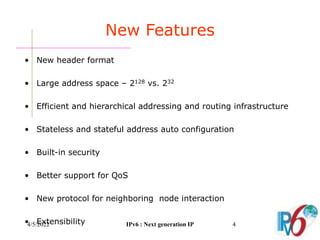
New Features
• New header format
• Large address space – 2128 vs. 232
• Efficient and hierarchical addressing and routing infrastructure
• Stateless and stateful address auto configuration
• Built-in security
• Better support for QoS
• New protocol for neighboring node interaction
• Extensibility
4/5/2022 IPv6 : Next generation IP 5
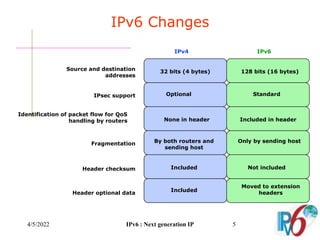
IPv6 Changes
Source and destination
addresses
32 bits (4 bytes) 128 bits (16 bytes)
IPsec support Optional Standard
Identification of packet flow for QoS
handling by routers None in header Included in header
IPv4 IPv6
Fragmentation By both routers and
sending host
Only by sending host
Header checksum Included Not included
Header optional data
Included
Moved to extension
headers
4/5/2022 IPv6 : Next generation IP 6
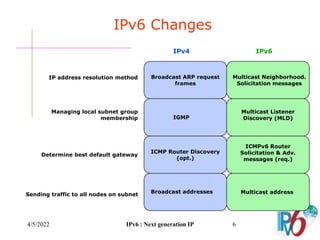
IPv6 Changes
IPv4 IPv6
IP address resolution method Broadcast ARP request
frames
Multicast Neighborhood.
Solicitation messages
Managing local subnet group
membership IGMP
Multicast Listener
Discovery (MLD)
Determine best default gateway
ICMP Router Discovery
(opt.)
ICMPv6 Router
Solicitation & Adv.
messages (req.)
Sending traffic to all nodes on subnet Broadcast addresses Multicast address
4/5/2022 IPv6 : Next generation IP 7
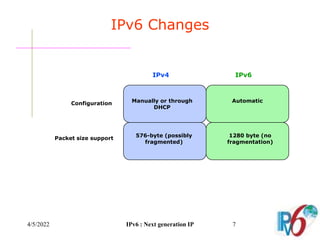
IPv6 Changes
IPv4 IPv6
Manually or through
DHCP
Automatic
1280 byte (no
fragmentation)
Configuration
Packet size support
576-byte (possibly
fragmented)
4/5/2022 IPv6 : Next generation IP 8
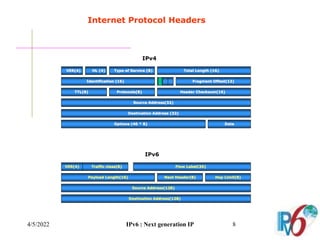
VER(4) Traffic class(8) Flow Label(20)
Payload Length(16) Next Header(8) Hop Limit(8)
Source Address(128)
Destination Address(128)
IPv6
VER(4) HL (4) Type of Service (8) Total Length (16)
Identification (16) Fragment Offset(13)
TTL(8) Protocols(8) Header Checksum(16)
Source Address(32)
Destination Address (32)
Options (40 * 8) Data
IPv4
Internet Protocol Headers
4/5/2022 IPv6 : Next generation IP 9
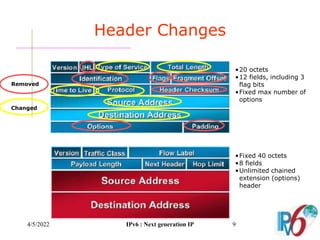
Header Changes
•20 octets
•12 fields, including 3
flag bits
•Fixed max number of
options
•Fixed 40 octets
•8 fields
•Unlimited chained
extension (options)
header
Removed
Changed
4/5/2022 IPv6 : Next generation IP 10
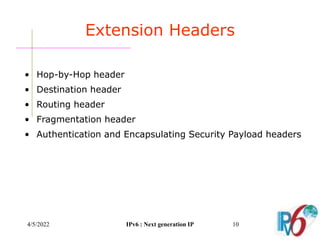
• Hop-by-Hop header
• Destination header
• Routing header
• Fragmentation header
• Authentication and Encapsulating Security Payload headers
Extension Headers
4/5/2022 IPv6 : Next generation IP 11
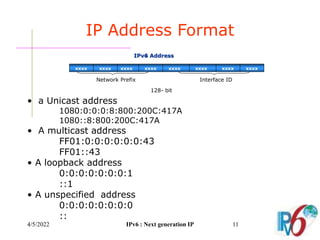
IP Address Format
xxxx xxxx xxxx xxxx
Host + Network ID (32-bit)
IPv4 Address
xxxx xxxx xxxx xxxx xxxx xxxx xxxx xxxx
Network Prefix Interface ID
128- bit
IPv6 Address
• a Unicast address
1080:0:0:0:8:800:200C:417A
1080::8:800:200C:417A
• A multicast address
FF01:0:0:0:0:0:0:43
FF01::43
• A loopback address
0:0:0:0:0:0:0:1
::1
• A unspecified address
0:0:0:0:0:0:0:0
::
4/5/2022 IPv6 : Next generation IP 12
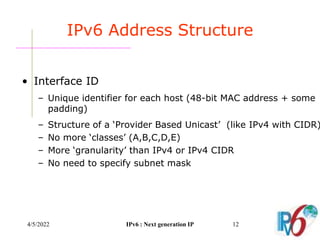
IPv6 Address Structure
• Interface ID
– Unique identifier for each host (48-bit MAC address + some
padding)
– Structure of a ‘Provider Based Unicast’ (like IPv4 with CIDR)
– No more ‘classes’ (A,B,C,D,E)
– More ‘granularity’ than IPv4 or IPv4 CIDR
– No need to specify subnet mask
4/5/2022 IPv6 : Next generation IP 13
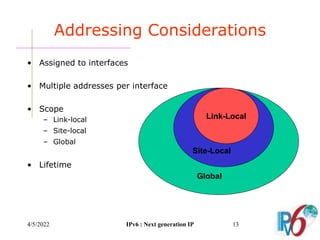
Addressing Considerations
• Assigned to interfaces
• Multiple addresses per interface
• Scope
– Link-local
– Site-local
– Global
• Lifetime
Link-Local
Site-Local
Global
4/5/2022 IPv6 : Next generation IP 14
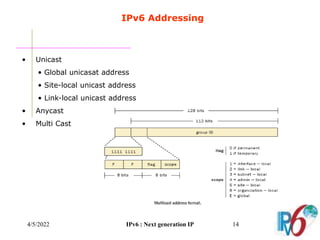
IPv6 Addressing
• Unicast
• Global unicasat address
• Site-local unicast address
• Link-local unicast address
• Anycast
• Multi Cast
4/5/2022 IPv6 : Next generation IP 15
IPv6 Operations
• Neighbor discovery
• Router discovery
• Stateless autoconfiguration and renumbering of IPv6 address
• Path Maximum Transfer Unit(MTU)
• DHCPv6 and Domain Name Server(DNS)
4/5/2022 IPv6 : Next generation IP 16
IPv6 Deployment
• Dual-stack backbone
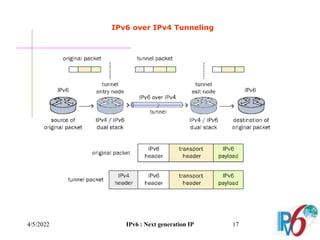
• IPv6 over IPv4 tunnelling
• Manually configured tunnels
• GRE( Generic Routing Encapsulation)
• IPv4-compatible tunnels or 6over4 tunnels
• 6to4 tunnels
4/5/2022 IPv6 : Next generation IP 17
IPv6 over IPv4 Tunneling
4/5/2022 IPv6 : Next generation IP 18
Deployment Benefits
• Plug and play autoconfiguration for nodes
• Always-on solutions (3G requirement) enable self-
provisioned “push services” to customers
• Peer-to-peer apps (e.g., video-conferencing) better
supported by QoS built-in flow specs
• IPsec specs built-in for greater efficiency
• Unique addresses for all network devices
4/5/2022 IPv6 : Next generation IP 19
Transition Concerns and Issues
• Product support for both IPv6 and IPv4
• Selection of transition mechanisms
• Cost
• Asia and Europe migrate ahead of U.S.
4/5/2022 IPv6 : Next generation IP 20
Transition Goals
 Incremental upgrade: upgrade IPv4 devices to IPv6
any time without dependencies on other devices
 Incremental deployment: new IPv6 devices installed
any time without prerequisites (except upgrading
DNS)
 Easy addressing: existing addressing used for
upgraded devices
 Low start-up costs: little prep work needed
4/5/2022 IPv6 : Next generation IP 21
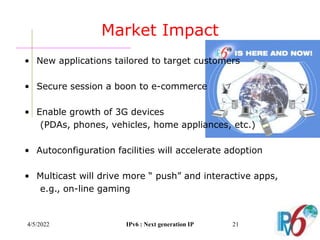
Market Impact
• New applications tailored to target customers
• Secure session a boon to e-commerce
• Enable growth of 3G devices
(PDAs, phones, vehicles, home appliances, etc.)
• Autoconfiguration facilities will accelerate adoption
• Multicast will drive more “ push” and interactive apps,
e.g., on-line gaming
4/5/2022 IPv6 : Next generation IP 22
IPv6 Barriers
• No date when IPv4 addresses will dry up
• No killer app
• Reluctance to upgrade
– Class A & B address owners are satisfied
– What is really broken?
– Cost to train IT staff
– Nobody wants to be first
4/5/2022 IPv6 : Next generation IP 23
What it Means
• Simplified header
– Faster router processing
– Less overhead
• Efficient option processing
• No fragmentation
– Reduced load on routers
– Easier to implement in hardware
– Easy Layer 3 switching of IP
• Minimum link MTU is 1280 bytes
4/5/2022 IPv6 : Next generation IP 24
Impact of New Address Structure
• Separation of “who you are” from “where you
are connected to”
– Prefix depends on routing topology
– Interface ID identifies a node
• Anycast is ready
• Broadcast disappears
4/5/2022 IPv6 : Next generation IP 25
Global Deployment Status
• European Commission for Enterprise and Information Society
endorses IPv6 native deployment
– 6NET
– Euro6IX – Pan-European IPv6 Exchanges Backbone
– 6Link – IPv6 Projects United
• Japan
– Commercialized operations
– New applications
• National deployment in Korea
• India – development & deployment strategies started
4/5/2022 IPv6 : Next generation IP 26
Is IPv6 Finally gained Ground
• Low adoption level
• Early Vendor support
• Lack of user support
• Factors Holding back Adoption
– Cost and effort
– IPv6 shortcomings
– Who needs IPv6
• Future
– Wireless : IPv6’s killers app?
4/5/2022 IPv6 : Next generation IP 27
Vendor and Operator Position
• Operator support: BT, DT, Telia, NTT
• Government support: Japan, Korea, European Union, Canada
• Many vendors have IPv6 product road map
• Support in current software releases
– Microsoft XP
– Cisco 12.0xT
– Sun Solaris 8 and 9
– Linux
– Others
4/5/2022 IPv6 : Next generation IP 28
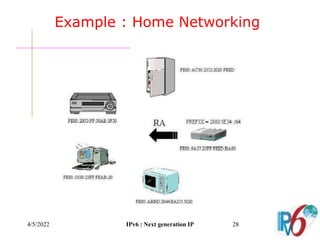
Example : Home Networking
4/5/2022 IPv6 : Next generation IP 29
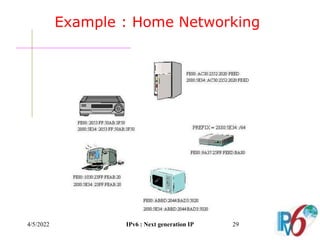
Example : Home Networking
4/5/2022 IPv6 : Next generation IP 30
THANK YOU
4/5/2022 IPv6 : Next generation IP 31
Queries …?

14121725(1).ppt

  • 1.
    4/5/2022 IPv6 :Next generation IP 1 IPv6 Next generation IP N Ranjith Kumar Seminar Presentation
  • 2.
    4/5/2022 IPv6 :Next generation IP 2 Network Problems • Communication Problem • Identification Problem • Identification of Networks Logical Addressing system • Identification of system with in the network Physical Addressing system • Identification of the process with in the system Service point addressing system • Connection Problem
  • 3.
    4/5/2022 IPv6 :Next generation IP 3 IPv6 Myths • IPv6 is a patch to IPv4 with more addresses • Flag Day for IPv6 activation to be announced • The drive for IPv6 starts in the backbone/Telco • IPv6 is too complex, it can break IPv4 networks
  • 4.
    4/5/2022 IPv6 :Next generation IP 4 New Features • New header format • Large address space – 2128 vs. 232 • Efficient and hierarchical addressing and routing infrastructure • Stateless and stateful address auto configuration • Built-in security • Better support for QoS • New protocol for neighboring node interaction • Extensibility
  • 5.
    4/5/2022 IPv6 :Next generation IP 5 IPv6 Changes Source and destination addresses 32 bits (4 bytes) 128 bits (16 bytes) IPsec support Optional Standard Identification of packet flow for QoS handling by routers None in header Included in header IPv4 IPv6 Fragmentation By both routers and sending host Only by sending host Header checksum Included Not included Header optional data Included Moved to extension headers
  • 6.
    4/5/2022 IPv6 :Next generation IP 6 IPv6 Changes IPv4 IPv6 IP address resolution method Broadcast ARP request frames Multicast Neighborhood. Solicitation messages Managing local subnet group membership IGMP Multicast Listener Discovery (MLD) Determine best default gateway ICMP Router Discovery (opt.) ICMPv6 Router Solicitation & Adv. messages (req.) Sending traffic to all nodes on subnet Broadcast addresses Multicast address
  • 7.
    4/5/2022 IPv6 :Next generation IP 7 IPv6 Changes IPv4 IPv6 Manually or through DHCP Automatic 1280 byte (no fragmentation) Configuration Packet size support 576-byte (possibly fragmented)
  • 8.
    4/5/2022 IPv6 :Next generation IP 8 VER(4) Traffic class(8) Flow Label(20) Payload Length(16) Next Header(8) Hop Limit(8) Source Address(128) Destination Address(128) IPv6 VER(4) HL (4) Type of Service (8) Total Length (16) Identification (16) Fragment Offset(13) TTL(8) Protocols(8) Header Checksum(16) Source Address(32) Destination Address (32) Options (40 * 8) Data IPv4 Internet Protocol Headers
  • 9.
    4/5/2022 IPv6 :Next generation IP 9 Header Changes •20 octets •12 fields, including 3 flag bits •Fixed max number of options •Fixed 40 octets •8 fields •Unlimited chained extension (options) header Removed Changed
  • 10.
    4/5/2022 IPv6 :Next generation IP 10 • Hop-by-Hop header • Destination header • Routing header • Fragmentation header • Authentication and Encapsulating Security Payload headers Extension Headers
  • 11.
    4/5/2022 IPv6 :Next generation IP 11 IP Address Format xxxx xxxx xxxx xxxx Host + Network ID (32-bit) IPv4 Address xxxx xxxx xxxx xxxx xxxx xxxx xxxx xxxx Network Prefix Interface ID 128- bit IPv6 Address • a Unicast address 1080:0:0:0:8:800:200C:417A 1080::8:800:200C:417A • A multicast address FF01:0:0:0:0:0:0:43 FF01::43 • A loopback address 0:0:0:0:0:0:0:1 ::1 • A unspecified address 0:0:0:0:0:0:0:0 ::
  • 12.
    4/5/2022 IPv6 :Next generation IP 12 IPv6 Address Structure • Interface ID – Unique identifier for each host (48-bit MAC address + some padding) – Structure of a ‘Provider Based Unicast’ (like IPv4 with CIDR) – No more ‘classes’ (A,B,C,D,E) – More ‘granularity’ than IPv4 or IPv4 CIDR – No need to specify subnet mask
  • 13.
    4/5/2022 IPv6 :Next generation IP 13 Addressing Considerations • Assigned to interfaces • Multiple addresses per interface • Scope – Link-local – Site-local – Global • Lifetime Link-Local Site-Local Global
  • 14.
    4/5/2022 IPv6 :Next generation IP 14 IPv6 Addressing • Unicast • Global unicasat address • Site-local unicast address • Link-local unicast address • Anycast • Multi Cast
  • 15.
    4/5/2022 IPv6 :Next generation IP 15 IPv6 Operations • Neighbor discovery • Router discovery • Stateless autoconfiguration and renumbering of IPv6 address • Path Maximum Transfer Unit(MTU) • DHCPv6 and Domain Name Server(DNS)
  • 16.
    4/5/2022 IPv6 :Next generation IP 16 IPv6 Deployment • Dual-stack backbone • IPv6 over IPv4 tunnelling • Manually configured tunnels • GRE( Generic Routing Encapsulation) • IPv4-compatible tunnels or 6over4 tunnels • 6to4 tunnels
  • 17.
    4/5/2022 IPv6 :Next generation IP 17 IPv6 over IPv4 Tunneling
  • 18.
    4/5/2022 IPv6 :Next generation IP 18 Deployment Benefits • Plug and play autoconfiguration for nodes • Always-on solutions (3G requirement) enable self- provisioned “push services” to customers • Peer-to-peer apps (e.g., video-conferencing) better supported by QoS built-in flow specs • IPsec specs built-in for greater efficiency • Unique addresses for all network devices
  • 19.
    4/5/2022 IPv6 :Next generation IP 19 Transition Concerns and Issues • Product support for both IPv6 and IPv4 • Selection of transition mechanisms • Cost • Asia and Europe migrate ahead of U.S.
  • 20.
    4/5/2022 IPv6 :Next generation IP 20 Transition Goals  Incremental upgrade: upgrade IPv4 devices to IPv6 any time without dependencies on other devices  Incremental deployment: new IPv6 devices installed any time without prerequisites (except upgrading DNS)  Easy addressing: existing addressing used for upgraded devices  Low start-up costs: little prep work needed
  • 21.
    4/5/2022 IPv6 :Next generation IP 21 Market Impact • New applications tailored to target customers • Secure session a boon to e-commerce • Enable growth of 3G devices (PDAs, phones, vehicles, home appliances, etc.) • Autoconfiguration facilities will accelerate adoption • Multicast will drive more “ push” and interactive apps, e.g., on-line gaming
  • 22.
    4/5/2022 IPv6 :Next generation IP 22 IPv6 Barriers • No date when IPv4 addresses will dry up • No killer app • Reluctance to upgrade – Class A & B address owners are satisfied – What is really broken? – Cost to train IT staff – Nobody wants to be first
  • 23.
    4/5/2022 IPv6 :Next generation IP 23 What it Means • Simplified header – Faster router processing – Less overhead • Efficient option processing • No fragmentation – Reduced load on routers – Easier to implement in hardware – Easy Layer 3 switching of IP • Minimum link MTU is 1280 bytes
  • 24.
    4/5/2022 IPv6 :Next generation IP 24 Impact of New Address Structure • Separation of “who you are” from “where you are connected to” – Prefix depends on routing topology – Interface ID identifies a node • Anycast is ready • Broadcast disappears
  • 25.
    4/5/2022 IPv6 :Next generation IP 25 Global Deployment Status • European Commission for Enterprise and Information Society endorses IPv6 native deployment – 6NET – Euro6IX – Pan-European IPv6 Exchanges Backbone – 6Link – IPv6 Projects United • Japan – Commercialized operations – New applications • National deployment in Korea • India – development & deployment strategies started
  • 26.
    4/5/2022 IPv6 :Next generation IP 26 Is IPv6 Finally gained Ground • Low adoption level • Early Vendor support • Lack of user support • Factors Holding back Adoption – Cost and effort – IPv6 shortcomings – Who needs IPv6 • Future – Wireless : IPv6’s killers app?
  • 27.
    4/5/2022 IPv6 :Next generation IP 27 Vendor and Operator Position • Operator support: BT, DT, Telia, NTT • Government support: Japan, Korea, European Union, Canada • Many vendors have IPv6 product road map • Support in current software releases – Microsoft XP – Cisco 12.0xT – Sun Solaris 8 and 9 – Linux – Others
  • 28.
    4/5/2022 IPv6 :Next generation IP 28 Example : Home Networking
  • 29.
    4/5/2022 IPv6 :Next generation IP 29 Example : Home Networking
  • 30.
    4/5/2022 IPv6 :Next generation IP 30 THANK YOU
  • 31.
    4/5/2022 IPv6 :Next generation IP 31 Queries …?