Computability
&
Complexity
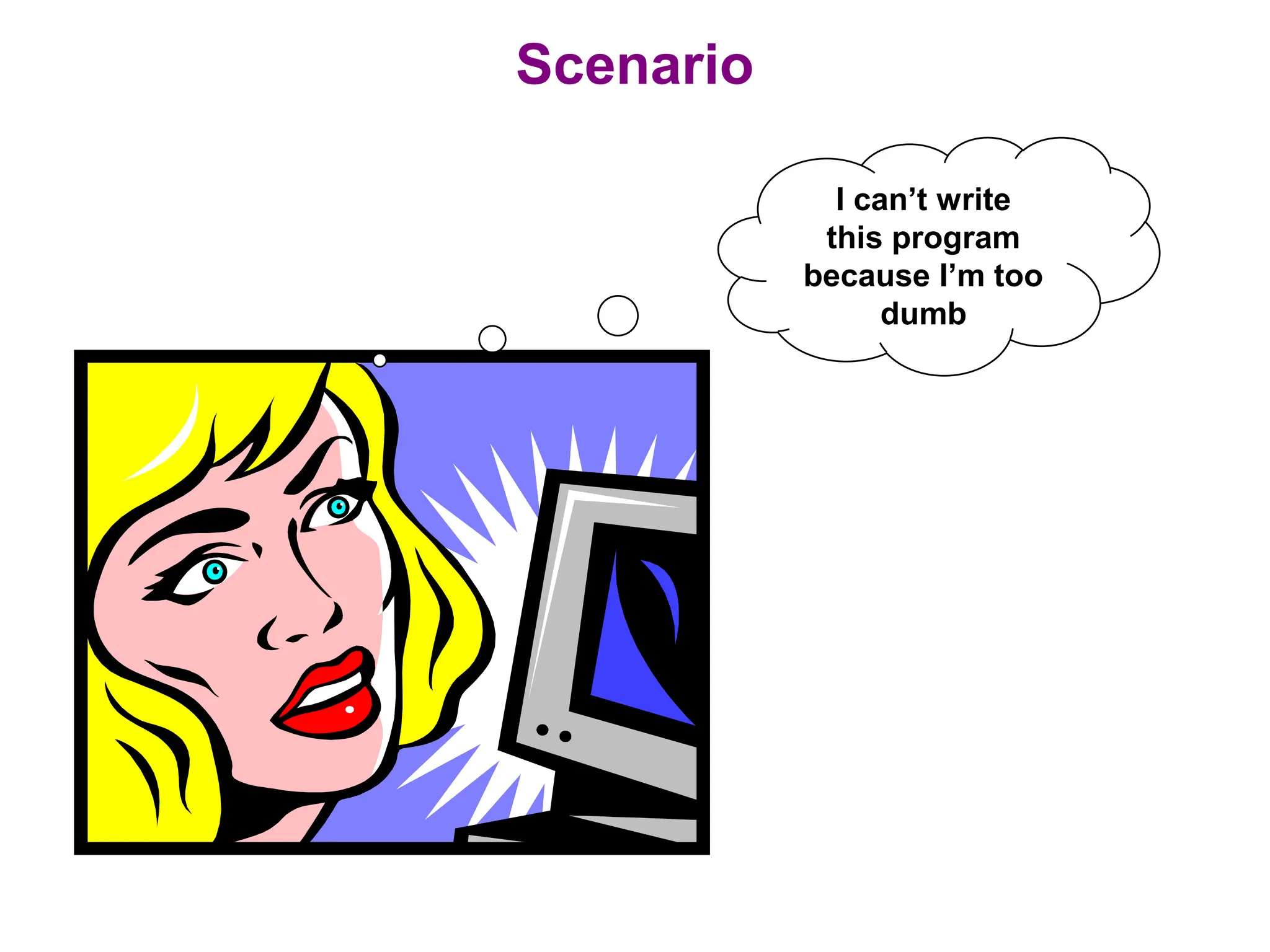
Scenario
I can’t write
this program
because I’m too
dumb
Better scenario
I can’t write this
program because
it’s provably
impossible
Another possible scenario
I can’t write this
program but
neither can all
these famous
people
Limitations of computer science
Major reasons useful calculations cannot be done:
 Execution time of program is too long
 problem can take years or centuries to finish
 Problem is not computable
 no computer program can solve the problem
 We do not know how to write a program to solve the
problem
 problems that can conceivably be solved
 includes many problems in artificial intelligence and
computer vision, such as understanding language,
object recognition, tracking, prediction
What problems can be solved by computers?
 Equivalent to: “What decision problems can be solved?”
 Decision problem
 problem where the answer is always YES/NO
 Arbitrary problem can always be reduced to a decision
problem
 There are decision problems for which algorithms do not
exist
 there are more different decision problems than there
are different programs
 if there are more decision problems than programs,
then it must be the case that some decision problems
cannot be solved by programs
Function evaluation
 A decision problem is a question with a YES/NO answer:
 Is 613511 a prime number?
 Is my birthday on a Sunday next year?
 Did I pass the CPS1 final exam?
 Sometimes a particular answer from a set of possible
solutions is required
 What is the smallest prime factor of 613511?
 On what day of the week is my birthday next year?
 What grade will I get on the CPS1 final exam?
 The process of answering questions where a particular
answer is uniquely determined from the given information
can be viewed as the evaluation of a function
Functions
 A function is a correspondence between a collection of
possible input values and a collection of output values
such that each possible input is assigned a unique output
 Example: the addition function
 inputs are value pairs, outputs are values representing
the sum of each input pair
 output is unique, exactly one value for each input pair
 Process of determining output for given input is called
computing or evaluating the function
 The ability to evaluate functions gives us the ability to
solve problems
 to solve the addition problem we must evaluate the
addition function
Computable functions
 Algorithms are the means by which we formally express
the evaluation of a function
 Can we design algorithms to evaluate all functions?
 No!
 Exist functions so complex that there is no well-defined
step-by-step process for determining their output based
on their input values
 The evaluation of these functions lies beyond the
capabilities of any algorithmic system
 These functions are said to be noncomputable
 Functions whose output values can be determined
algorithmically from their input values are said to be
computable
 functions having an algorithm that solves them
Limitations of machines
 Machines can only perform computations described by
algorithms
 the study of computable functions is the study of the
ultimate capabilities of machines
 If we can build a machine with the capabilities to evaluate
the entire set of computable functions, then the machines
we build are as powerful as we can make them
 On the other hand …
 if we discover that the solutions to a problem requires
the evaluation of a noncomputable function, we know
the solution to that problem lies beyond the capabilities
of machines
“Does extraterrestrial life exist?”
 Q: Is it possible to write a Java program to answer the
following question: Does extraterrestrial life exist?
 A: Yes!
 The question is answered either by a program that returns
“yes” or by a program that returns “no
 We just don’t know which program is correct
Is a problem computable?
 Suppose we create a list of all programs for evaluating
computable problems
 To ask whether a problem is computable is to ask if there
is a program in the list to solve the problem
 This is not the same as actually identifying the program in
the list that solves the problem
 There are many computable problems whose solutions
have not yet been identified
Abstract model of computation
 The first abstract model of computation
was defined by Alan Turing in 1936
 The Turing machine
 A Turing machine is a purely theoretical
device, developed well before technology
was capable of providing the machines
we know as “computers” today
 Model to study the capabilities and limitations of
computational processes and computing machinery
 Provide a context in which solutions to all things
computable can be expressed
 Provide a standard to which the power of other
computational systems can be compared
Turing machine fundamentals
 A tape divided into adjacent cells
 each cell is inscribed with symbol from a finite alphabet
 alphabet contains blank symbol and at least one other symbol
 tape is arbitrarily extendible to the left and to the right
 cells that have not been written to before are assumed to be filled
with the empty symbol.
 A head to read & write symbols on the tape and move left & right
 A finite number of states
 TM must be in exactly one state at any point in computation
 computation begins in start state and ceases in halt state
 An action table tells TM what symbol to write, how to move the head
and what its new state will be given the symbol it has just read on the
tape and the state it is currently in
 if there is no entry in the table for the current combination of
symbol and state then the machine will halt
A Turing machine
0 0 0
0
1 1 1
1
1
0
1
The tape is an infinite sequence of cells
Each cell contains a symbol (possibly blank)
R/W head moves left and right along the tape
The number displayed represents its current state,
which can change at it computes
Turing computable
 Is this really enough to compute everything?
 TM is theoretical device
 infinite amount of memory
 computation time is irrelevant
 can represent data however we choose, provided the
set of symbols is finite
 All attempts to characterize computation have turned out
to be equivalent
 Functions that can be computed by a Turing machine are
said to be Turing computable
Church-Turing Thesis
Every effective computation can be carried out
by a Turing machine
Turing-computable  computable
 A function is computable if it can be computed by a
Turing machine
 or, a function is computable of a program exists that
can compute it
 or, a function is computable if there is an effective
algorithm for evaluating the function which, given any
input values for which the function is defined, produces
the correct result and halts in a finite amount of time
 Q: Is there anything a Turing machine cannot do?
 A: Yes!
Noncomputability
 A function is noncomputable if there exists no Turing
machine that could compute it
 or, a noncomputable function is any function that cannot
be computed by any program
 many more functions then there are programs
 not possible to have a program for every function
A noncomputable problem
 Problem: List all subroutines that input an integer and
return an integer
 here is one short subroutine:
 and here is another:
 Can make infinitely many such subroutines
int sub1(int x)
{
return 1;
}
int sub2(int x)
{
return 2;
}
Halting
 Programs that run forever do not halt
 programA
 programs with infinite loops
 Programs may halt on some inputs but not on others
 programB
 Programs with no loops always halt
 programs composed of assignment statements, if statements
and the return statement
int programA( int x )
{
while( x == x )
x = x;
return x;
}
int programB( int x )
{
while( x > 10 )
x = x;
return x;
}
Halt or not?
 Will the following code eventually terminate?
 What if x is 8? How about 9?
while(x > 1)
{
if(x > 2)
x = x - 2;
else
x = x + 2;
}
Halt or not?
 Will the following code eventually terminate?
 What if x is 8? How about 7? How about any number > 0?
while(x > 1)
{
if( x % 2 == 0)
x = x / 2;
else
x = 3*x + 1;
}
The halting problem
 Q: Is it possible to write a Java program to answer the
following question
Does a given program halt on all inputs?
 It would be useful if we could write a program or compiler
to test if a given source program contains an infinite loop
 If we had such a program,
then we would never
execute a program
with an infinite loop
 This problem is known
as the halting problem
start
does this
program halt?
halt
yes
no
The halting problem is noncomputable
 There is no single finite program that will answer the
halting question for all programs
No finite program can be written that will check other
programs and halt in a finite time giving a solution to the
halting problem
start
does this
program halt?
halt
yes
no
Proof by contradiction
 How did Turing prove that such a program is theoretically
impossible?
 Proof by contradiction:
 Assume there is an algorithm DoesHalt(P,I) that
returns “yes” if program P halts when given input I and
“no” otherwise
 Show that this assumption leads to a contradictory
situation
 Conclude that our initial assumption – the existence of
a program to tell if another program halts – must be
false
 Great Ideas, pages 438-440
Programs that read programs
 Almost every problem related to the behavior of programs
is noncomputable
 programs to check for property X in the behavior of all
other programs
 halting, equivalence, printing, correctness
 We can write programs to check almost any syntactic
feature of programs
 a compiler is a program that reads programs
 we can measure the length of programs, number of
statements, characters, arithmetic expressions
Program input
Program
output
Computable or noncomputable?
1. Write a program that inputs a sequence of characters
and returns true if it is a legal Java program
2. Write a program that inputs a sequence of characters
and returns true if any permutation of these characters is
a legal Java program
3. Write a program that inputs a program in any
programming language and returns true if the characters
can be rearranged to form a legal Java program
4. Write a program that inputs a Java program and returns
true if the program computes the sum of its inputs
5. Write a program that inputs two Java programs and
returns true if both programs always produce the same
output
Computable or noncomputable?
1. Computable
2. Computable
3. Computable
4. Noncomputable
5. Noncomputable
Not impossible, but impractical
 Towers of Hanoi
 how long to move n disks?
 What combination of switches turns the light on?
 try all combinations, how many are there?
Program execution time
 How long a program takes to perform computations on
large inputs
 Computable problems are basically divided into two
classes
 Computations that can be completed in a reasonable time
period are called tractable
 a computation is tractable if its running time on N
inputs is logarithmic or polynomial in N
 Intractable computations are those that cannot be
realistically completed except for small examples
 a computation is intractable if its running time on N
inputs is exponential in N
Examples
 Tractable problems
 searching or sorting N inputs
 computing the sum of positive integers  N
 finding the largest element in a NN array
 counting the number of characters in a Java program
 Intractable problems
 computing all permutations of N inputs
 Towers of Hanoi
 Traveling salesperson
 Bin packing
 Graph coloring
Tractable or intractable?
1. Write a program that inputs a sequence of characters
and returns true if it is a legal Java program
 tractable
2. Write a program that inputs a sequence of characters
and returns true if any permutation of these characters is
a legal Java program
 intractable
3. Write a program that inputs a program in any
programming language and returns true if the characters
can be rearranged to form a legal Java program
 intractable
Traveling salesperson
 A traveling salesperson
must visit each of some
number of cities before
returning home
 knows the distance
between each of the
cities
 wants to minimize the
total distance traveled
while visiting all of the
cities
 In what order should the
salesperson visit the cities?
Try all paths, from
every starting point --
how long does this take?
{a, b, c, d, e, f, g},
{b, a, c, d, e, f, g}, …
a
d
g
f
e
b
c
Bin packing
 Pack a given set of items having different sizes into a
minimum number of equal-sized bins
 Example:
 Pack trucks with barrels using the smallest possible
number of trucks
 Ideas?
Graph coloring
 Color the vertices of a graph such that no edge connects
two identically colored vertices using the minimum
number of colors
Complexity classifications
 Class P
 consists of all decision problems that can be solved on
a deterministic sequential machine in time polynomial
in the size of the input
 Class NP
 non-deterministic, polynomial time
 consists of all decision problems whose positive
solutions can be verified in polynomial time, or
 solution can be found in polynomial time on a non-
deterministic machine
 Biggest open question in computer science:
Is P = NP?
Are hard problems easy?
 Easy problems are in P, hard problems are in NP
 P = NP? Rich or famous?
 If the answer is yes, the whole class of hard problems can
be solved efficiently
 TSP and bin packing are “equally hard”
 one problem is reducible to the other
 If no, none of the hard problems can be solved efficiently
 Widely conjectured that the answer is no
 P versus NP: CMI Millennium Prize Problem
 first person to solve will be awarded $1,000,000
 http://www.claymath.org/millennium/P_vs_NP

compatibility and complexity in the IS.ppt

  • 1.
  • 2.
    Scenario I can’t write thisprogram because I’m too dumb
  • 3.
    Better scenario I can’twrite this program because it’s provably impossible
  • 4.
    Another possible scenario Ican’t write this program but neither can all these famous people
  • 5.
    Limitations of computerscience Major reasons useful calculations cannot be done:  Execution time of program is too long  problem can take years or centuries to finish  Problem is not computable  no computer program can solve the problem  We do not know how to write a program to solve the problem  problems that can conceivably be solved  includes many problems in artificial intelligence and computer vision, such as understanding language, object recognition, tracking, prediction
  • 6.
    What problems canbe solved by computers?  Equivalent to: “What decision problems can be solved?”  Decision problem  problem where the answer is always YES/NO  Arbitrary problem can always be reduced to a decision problem  There are decision problems for which algorithms do not exist  there are more different decision problems than there are different programs  if there are more decision problems than programs, then it must be the case that some decision problems cannot be solved by programs
  • 7.
    Function evaluation  Adecision problem is a question with a YES/NO answer:  Is 613511 a prime number?  Is my birthday on a Sunday next year?  Did I pass the CPS1 final exam?  Sometimes a particular answer from a set of possible solutions is required  What is the smallest prime factor of 613511?  On what day of the week is my birthday next year?  What grade will I get on the CPS1 final exam?  The process of answering questions where a particular answer is uniquely determined from the given information can be viewed as the evaluation of a function
  • 8.
    Functions  A functionis a correspondence between a collection of possible input values and a collection of output values such that each possible input is assigned a unique output  Example: the addition function  inputs are value pairs, outputs are values representing the sum of each input pair  output is unique, exactly one value for each input pair  Process of determining output for given input is called computing or evaluating the function  The ability to evaluate functions gives us the ability to solve problems  to solve the addition problem we must evaluate the addition function
  • 9.
    Computable functions  Algorithmsare the means by which we formally express the evaluation of a function  Can we design algorithms to evaluate all functions?  No!  Exist functions so complex that there is no well-defined step-by-step process for determining their output based on their input values  The evaluation of these functions lies beyond the capabilities of any algorithmic system  These functions are said to be noncomputable  Functions whose output values can be determined algorithmically from their input values are said to be computable  functions having an algorithm that solves them
  • 10.
    Limitations of machines Machines can only perform computations described by algorithms  the study of computable functions is the study of the ultimate capabilities of machines  If we can build a machine with the capabilities to evaluate the entire set of computable functions, then the machines we build are as powerful as we can make them  On the other hand …  if we discover that the solutions to a problem requires the evaluation of a noncomputable function, we know the solution to that problem lies beyond the capabilities of machines
  • 11.
    “Does extraterrestrial lifeexist?”  Q: Is it possible to write a Java program to answer the following question: Does extraterrestrial life exist?  A: Yes!  The question is answered either by a program that returns “yes” or by a program that returns “no  We just don’t know which program is correct
  • 12.
    Is a problemcomputable?  Suppose we create a list of all programs for evaluating computable problems  To ask whether a problem is computable is to ask if there is a program in the list to solve the problem  This is not the same as actually identifying the program in the list that solves the problem  There are many computable problems whose solutions have not yet been identified
  • 13.
    Abstract model ofcomputation  The first abstract model of computation was defined by Alan Turing in 1936  The Turing machine  A Turing machine is a purely theoretical device, developed well before technology was capable of providing the machines we know as “computers” today  Model to study the capabilities and limitations of computational processes and computing machinery  Provide a context in which solutions to all things computable can be expressed  Provide a standard to which the power of other computational systems can be compared
  • 14.
    Turing machine fundamentals A tape divided into adjacent cells  each cell is inscribed with symbol from a finite alphabet  alphabet contains blank symbol and at least one other symbol  tape is arbitrarily extendible to the left and to the right  cells that have not been written to before are assumed to be filled with the empty symbol.  A head to read & write symbols on the tape and move left & right  A finite number of states  TM must be in exactly one state at any point in computation  computation begins in start state and ceases in halt state  An action table tells TM what symbol to write, how to move the head and what its new state will be given the symbol it has just read on the tape and the state it is currently in  if there is no entry in the table for the current combination of symbol and state then the machine will halt
  • 15.
    A Turing machine 00 0 0 1 1 1 1 1 0 1 The tape is an infinite sequence of cells Each cell contains a symbol (possibly blank) R/W head moves left and right along the tape The number displayed represents its current state, which can change at it computes
  • 16.
    Turing computable  Isthis really enough to compute everything?  TM is theoretical device  infinite amount of memory  computation time is irrelevant  can represent data however we choose, provided the set of symbols is finite  All attempts to characterize computation have turned out to be equivalent  Functions that can be computed by a Turing machine are said to be Turing computable
  • 17.
    Church-Turing Thesis Every effectivecomputation can be carried out by a Turing machine
  • 18.
    Turing-computable  computable A function is computable if it can be computed by a Turing machine  or, a function is computable of a program exists that can compute it  or, a function is computable if there is an effective algorithm for evaluating the function which, given any input values for which the function is defined, produces the correct result and halts in a finite amount of time  Q: Is there anything a Turing machine cannot do?  A: Yes!
  • 19.
    Noncomputability  A functionis noncomputable if there exists no Turing machine that could compute it  or, a noncomputable function is any function that cannot be computed by any program  many more functions then there are programs  not possible to have a program for every function
  • 20.
    A noncomputable problem Problem: List all subroutines that input an integer and return an integer  here is one short subroutine:  and here is another:  Can make infinitely many such subroutines int sub1(int x) { return 1; } int sub2(int x) { return 2; }
  • 21.
    Halting  Programs thatrun forever do not halt  programA  programs with infinite loops  Programs may halt on some inputs but not on others  programB  Programs with no loops always halt  programs composed of assignment statements, if statements and the return statement int programA( int x ) { while( x == x ) x = x; return x; } int programB( int x ) { while( x > 10 ) x = x; return x; }
  • 22.
    Halt or not? Will the following code eventually terminate?  What if x is 8? How about 9? while(x > 1) { if(x > 2) x = x - 2; else x = x + 2; }
  • 23.
    Halt or not? Will the following code eventually terminate?  What if x is 8? How about 7? How about any number > 0? while(x > 1) { if( x % 2 == 0) x = x / 2; else x = 3*x + 1; }
  • 24.
    The halting problem Q: Is it possible to write a Java program to answer the following question Does a given program halt on all inputs?  It would be useful if we could write a program or compiler to test if a given source program contains an infinite loop  If we had such a program, then we would never execute a program with an infinite loop  This problem is known as the halting problem start does this program halt? halt yes no
  • 25.
    The halting problemis noncomputable  There is no single finite program that will answer the halting question for all programs No finite program can be written that will check other programs and halt in a finite time giving a solution to the halting problem start does this program halt? halt yes no
  • 26.
    Proof by contradiction How did Turing prove that such a program is theoretically impossible?  Proof by contradiction:  Assume there is an algorithm DoesHalt(P,I) that returns “yes” if program P halts when given input I and “no” otherwise  Show that this assumption leads to a contradictory situation  Conclude that our initial assumption – the existence of a program to tell if another program halts – must be false  Great Ideas, pages 438-440
  • 27.
    Programs that readprograms  Almost every problem related to the behavior of programs is noncomputable  programs to check for property X in the behavior of all other programs  halting, equivalence, printing, correctness  We can write programs to check almost any syntactic feature of programs  a compiler is a program that reads programs  we can measure the length of programs, number of statements, characters, arithmetic expressions Program input Program output
  • 28.
    Computable or noncomputable? 1.Write a program that inputs a sequence of characters and returns true if it is a legal Java program 2. Write a program that inputs a sequence of characters and returns true if any permutation of these characters is a legal Java program 3. Write a program that inputs a program in any programming language and returns true if the characters can be rearranged to form a legal Java program 4. Write a program that inputs a Java program and returns true if the program computes the sum of its inputs 5. Write a program that inputs two Java programs and returns true if both programs always produce the same output
  • 29.
    Computable or noncomputable? 1.Computable 2. Computable 3. Computable 4. Noncomputable 5. Noncomputable
  • 30.
    Not impossible, butimpractical  Towers of Hanoi  how long to move n disks?  What combination of switches turns the light on?  try all combinations, how many are there?
  • 31.
    Program execution time How long a program takes to perform computations on large inputs  Computable problems are basically divided into two classes  Computations that can be completed in a reasonable time period are called tractable  a computation is tractable if its running time on N inputs is logarithmic or polynomial in N  Intractable computations are those that cannot be realistically completed except for small examples  a computation is intractable if its running time on N inputs is exponential in N
  • 32.
    Examples  Tractable problems searching or sorting N inputs  computing the sum of positive integers  N  finding the largest element in a NN array  counting the number of characters in a Java program  Intractable problems  computing all permutations of N inputs  Towers of Hanoi  Traveling salesperson  Bin packing  Graph coloring
  • 33.
    Tractable or intractable? 1.Write a program that inputs a sequence of characters and returns true if it is a legal Java program  tractable 2. Write a program that inputs a sequence of characters and returns true if any permutation of these characters is a legal Java program  intractable 3. Write a program that inputs a program in any programming language and returns true if the characters can be rearranged to form a legal Java program  intractable
  • 34.
    Traveling salesperson  Atraveling salesperson must visit each of some number of cities before returning home  knows the distance between each of the cities  wants to minimize the total distance traveled while visiting all of the cities  In what order should the salesperson visit the cities? Try all paths, from every starting point -- how long does this take? {a, b, c, d, e, f, g}, {b, a, c, d, e, f, g}, … a d g f e b c
  • 35.
    Bin packing  Packa given set of items having different sizes into a minimum number of equal-sized bins  Example:  Pack trucks with barrels using the smallest possible number of trucks  Ideas?
  • 36.
    Graph coloring  Colorthe vertices of a graph such that no edge connects two identically colored vertices using the minimum number of colors
  • 37.
    Complexity classifications  ClassP  consists of all decision problems that can be solved on a deterministic sequential machine in time polynomial in the size of the input  Class NP  non-deterministic, polynomial time  consists of all decision problems whose positive solutions can be verified in polynomial time, or  solution can be found in polynomial time on a non- deterministic machine  Biggest open question in computer science: Is P = NP?
  • 38.
    Are hard problemseasy?  Easy problems are in P, hard problems are in NP  P = NP? Rich or famous?  If the answer is yes, the whole class of hard problems can be solved efficiently  TSP and bin packing are “equally hard”  one problem is reducible to the other  If no, none of the hard problems can be solved efficiently  Widely conjectured that the answer is no  P versus NP: CMI Millennium Prize Problem  first person to solve will be awarded $1,000,000  http://www.claymath.org/millennium/P_vs_NP