Privacy and cybersecurity
GPD
Purpose of this webinar
• To discuss the meaning of privacy in a cyber
security and human rights frame
• To explore how the notion and realization of
privacy is changed by the internet
• To identify the factors shaping the way that
privacy is being affected online
• What could different stakeholders do to
respect privacy online
What is privacy
• Privacy has different meanings in different
contexts and societies.
• Linked to security and to control of immediate
environment - what is known or can be known
about us.
• Exact definitions are elusive – national and
international courts have refused to provide clear
definitions of privacy.
• There can be tensions between freedom of
expression rights and privacy rights.
Privacy is not data protection
• Data protection rules are designed to address
the systematic collection of data about
individuals and the rules apply to all
personally identifying data held by designated
“data controllers”.
• Privacy is more fluid concept applying to
information about which a person may have a
reasonable expectation of privacy.
Meaning of privacy changes
• Personal integrity lies at the heart of privacy.
• Privacy in a communal village or modern city very
different.
• Emergence of generalized private property ( single
households) has shaped notions of privacy.
• Also shaped by technology, e.g. modern notions
growing from debate about newspaper photographs.
• No exact boundary, a dramatic technological change
like the Internet will inevitably re shape understandings
of privacy.
• Contrast between what people say about privacy and
the internet and how they behave.
The internet
• Enables the collection of new types of personal
information
• Facilitates (and economically demands) the
collection and location of personal information
• Creates new capacities for government and
private actors to access and analyse personal
information
• Creates new opportunities for commercial use of
personal data
• Creates new challenges for regulation given the
transnational nature of the internet.
Internet services redefine privacy
environment dramatically
• Cloud computing (raises questions of security,
data breaches and ownership),
• Search engines (systematically track and monitor
our behaviour),
• Social networks (depend on a company led
exchange and analysis of data provided by users),
• The mobile internet (ties internet use to geo-
located devices);
• Internet of things connecting all potential objects
which together convey a complete picture of our
lives
Government use of data
• E-government - governments moving to digital
platform and provision of services.
• Government increasingly seen as a digital platform.
• Some governments have designated e-identities that
allow services, banking, voting, health monitoring etc.
• With the sheer volumes of data available it is difficult
to conceive that governments won’t seek to access it.
• How to balance the provision of e services (much
cheaper than human services) with security and
personal privacy.
Internet technologies and government
• Governments have become increasingly concerned about
security issues online – for legitimate and illegitimate reasons.
• All govs are attempting to access information online
(Snowden) with concerns are about
– Scope of surveillance (who are the targets and how big is
the net)
– Legal framework of surveillance
– Use of mass metadata searches excluded from legal
accountability
– Weakness of oversight
– Absence of legislative competence
Internet is built and operated by the private
sector not a public utility
• Provision of internet services based on a business model
based on advertising.
• We trade or cede our privacy in exchange for free services.
• Such service models either directly depend upon exposing
private information (Facebook).
• Or intrude on privacy to create efficiencies (tools that
optimize searches based on tracking user preferences).
• Generally little real public pressure or incentives to
challenge this model.
• Informed consent to data use for users online is
complicated by range of different applications, complexity
of terms of use, and apparent public indifference.
Economic growth and internet
• New emphasis on economic growth and internet
development
• Increasing pressures for data sharing, cross
border transfers of data
• But a business environment that depends on
people feeling secure and that categories of
information – financial, health etc. need to have
guaranteed confidentiality
• Cybersecurity – understood as providing privacy –
is essential to internet based economy
Cross border data transfers
• Cross border transfers of personal data now common in utility
provision, financial services, education, e-commerce and health
research;
• Cross-border internet traffic grew 18-fold between 2005 and 2012
(McKinsey);
• Growing digital trade and new technologies such as 3D printing
could see global flows of capital, data, goods and services more
than triple from the $26tn recorded in 2012 to an estimated $85tn
by 2025;
• Key question: how to protect privacy and individual liberties while
enabling the free flows of personal data and maintaining security of
personal data
Privacy offline and online
• Privacy online should be protected as privacy offline –
what does this mean in practice?
• Need to understand what is new about the
environment and how to tackle it.
• Next generation of innovation – internet of things,
wearable technologies, AI and robotics, 3D printing are
all critical to society, to economic growth and will
provide further challenges to and reshaping of notions
of privacy.
• All will depend upon strong security both technically –
encryption – and normatively – legal rules governing
access to and use of personal information.
Two related issues to consider
• Implications of developments in private sector
and where the technologies and markets are
leading.
• The use of personal data by governments – not
just security surveillance but wider recasting of
citizen/government relationship digitally – tax,
health, etc.
• How to balance tackling crime and terrorism with
the free-flow of information and anonymised
identities fall?
What is the privacy agenda?
• At the heart of the notion of privacy lies sense of
personal integrity and dignity whatever the social
context. At the core of this is sense of ownership and
control, i.e. consent to use of information (basis of data
protection system) and what can be known.
• Current business models require us to hand over
ownership of our data to companies in exchange for
benefits -use of that data is loosely regulated if at all.
How do we control this?
• Government access to data, however intrusive, at least in
most democracies operates in some kind of legal
framework. How can this be strengthened to respect
privacy in the broadest sense.
Governments should:
• Commit to ensuring user security and privacy as a policy goal
• Commit to freedom of expression, aware of the need to
balance both rights
• Understand cyber security as embracing users interests
• Be transparent about the rationale and scope of surveillance
or other measures violating privacy
• Ensure that rules governing surveillance and privacy violations
are grounded in law, consistent with international principles
and subject to supervision by independent courts
• Regulate effectively e.g.by having technical skills on regulatory
bodies
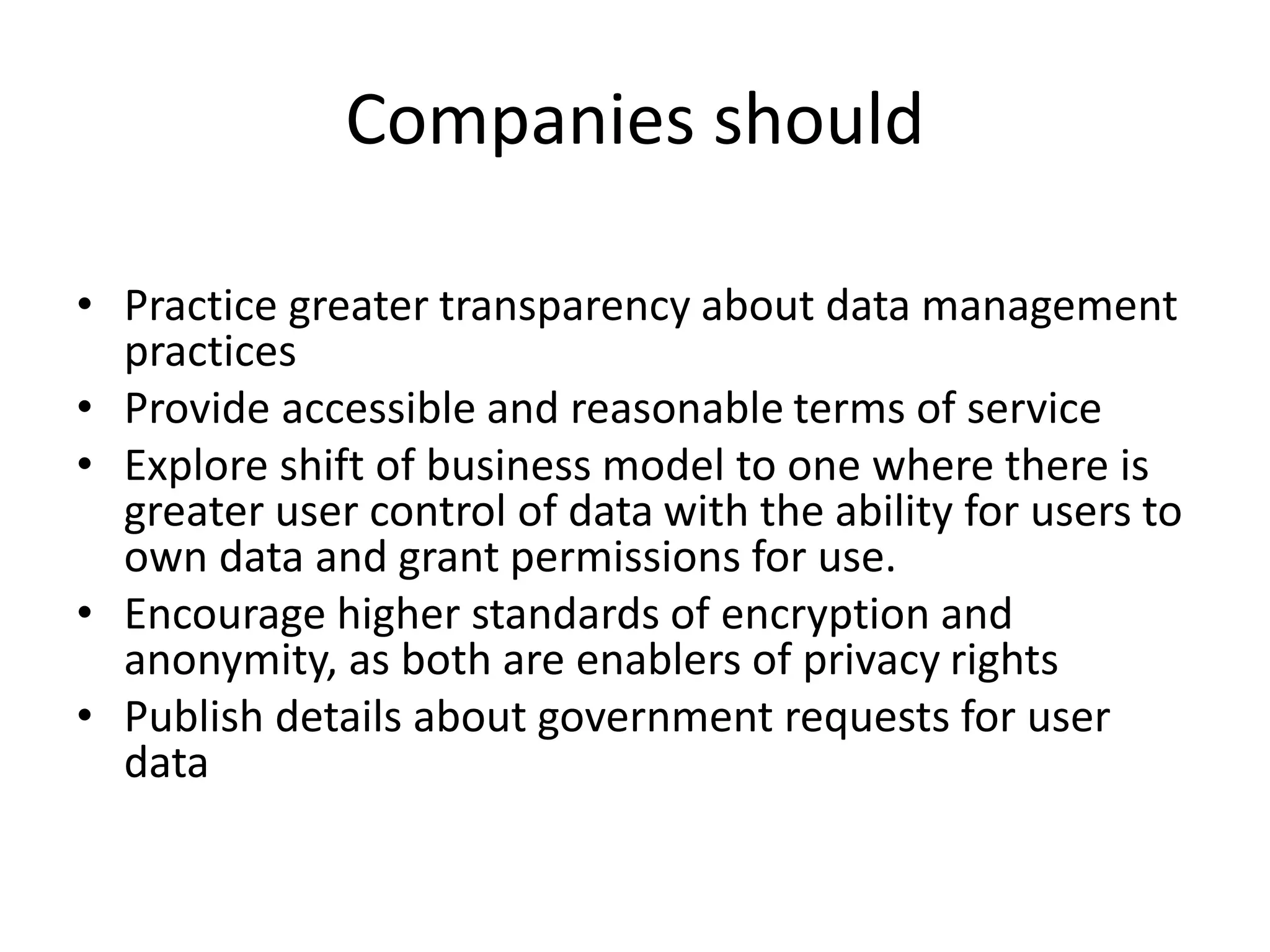
Companies should
• Practice greater transparency about data management
practices
• Provide accessible and reasonable terms of service
• Explore shift of business model to one where there is
greater user control of data with the ability for users to
own data and grant permissions for use.
• Encourage higher standards of encryption and
anonymity, as both are enablers of privacy rights
• Publish details about government requests for user
data
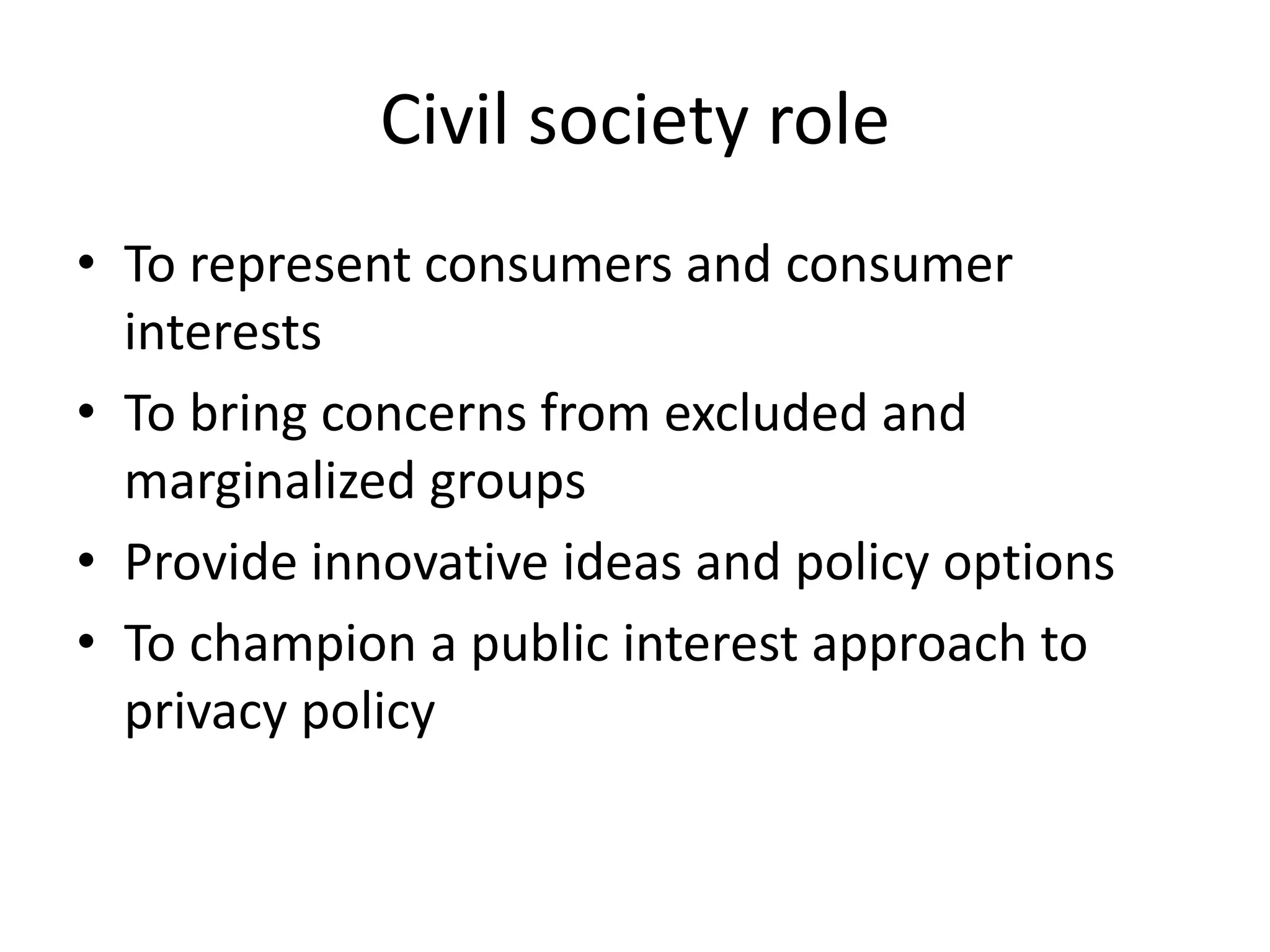
Civil society role
• To represent consumers and consumer
interests
• To bring concerns from excluded and
marginalized groups
• Provide innovative ideas and policy options
• To champion a public interest approach to
privacy policy
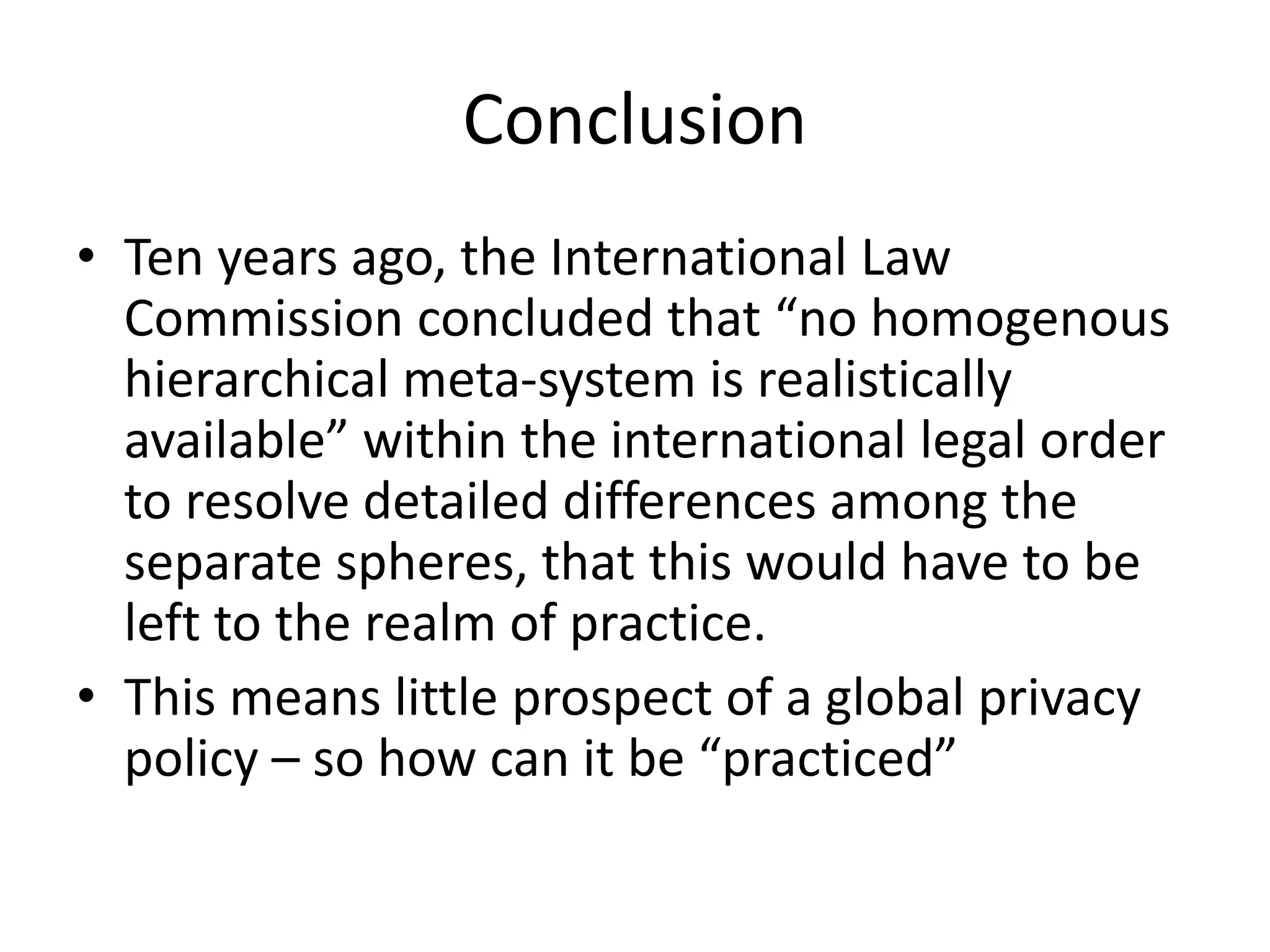
Conclusion
• Ten years ago, the International Law
Commission concluded that “no homogenous
hierarchical meta-system is realistically
available” within the international legal order
to resolve detailed differences among the
separate spheres, that this would have to be
left to the realm of practice.
• This means little prospect of a global privacy
policy – so how can it be “practiced”
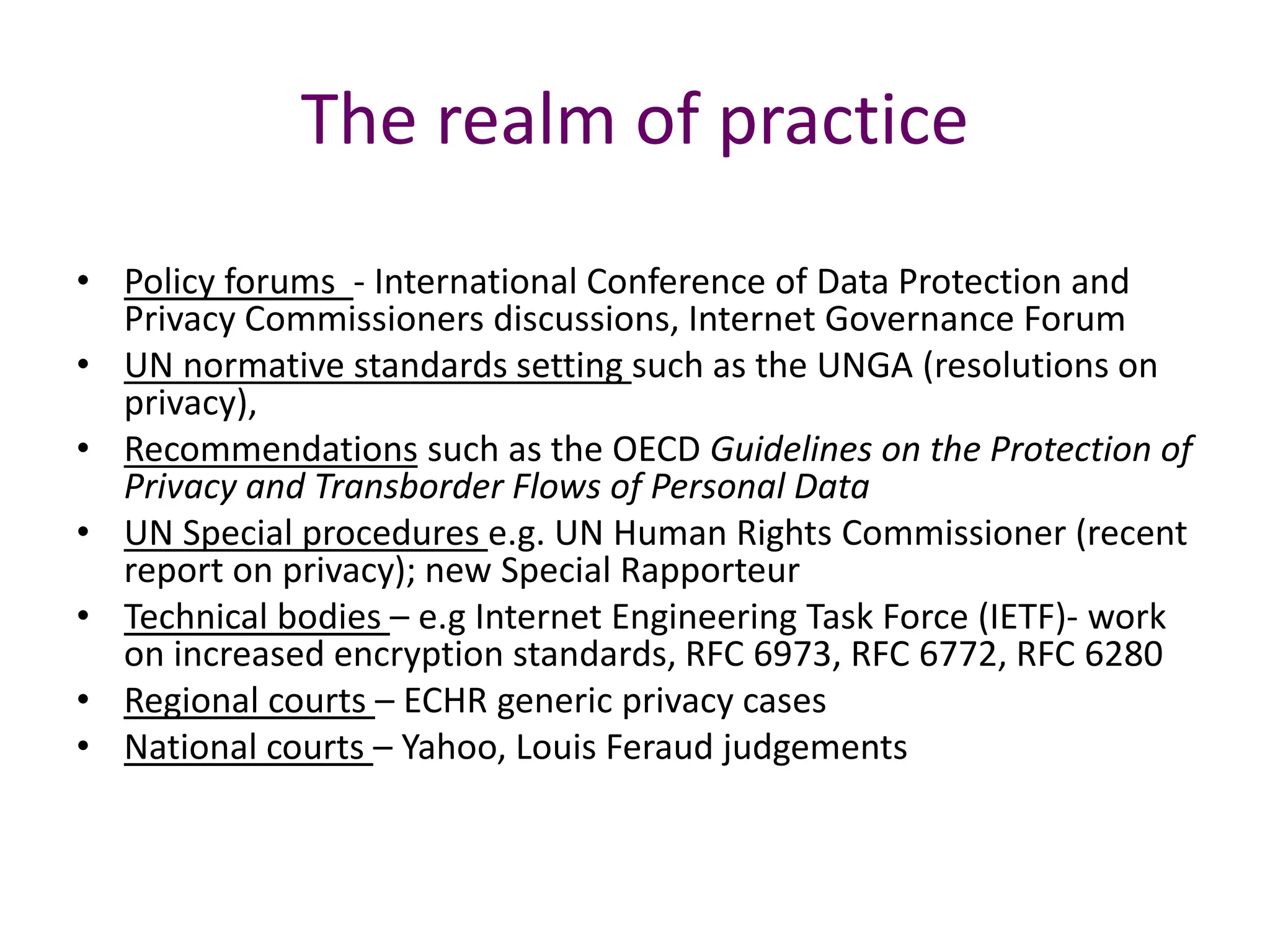
The realm of practice
• Policy forums - International Conference of Data Protection and
Privacy Commissioners discussions, Internet Governance Forum
• UN normative standards setting such as the UNGA (resolutions on
privacy),
• Recommendations such as the OECD Guidelines on the Protection of
Privacy and Transborder Flows of Personal Data
• UN Special procedures e.g. UN Human Rights Commissioner (recent
report on privacy); new Special Rapporteur
• Technical bodies – e.g Internet Engineering Task Force (IETF)- work
on increased encryption standards, RFC 6973, RFC 6772, RFC 6280
• Regional courts – ECHR generic privacy cases
• National courts – Yahoo, Louis Feraud judgements
The practice of privacy
• Promote business models that provide for user data
ownership
• Look for consensus-based, consumer friendly norms
which incorporate international standards for data
protection and internet security across boundaries
• Encourage transnational co-regulatory initiatives;
• Promote voluntary co-operation among stakeholders;
• Set appropriate regional or multi-lateral standards;
• Set appropriate national regulation
• Anticipate future privacy challenges and how to meet
them.

GCCS-privacy-PP-final presentation-3-1.pptx

  • 1.
  • 2.
    Purpose of thiswebinar • To discuss the meaning of privacy in a cyber security and human rights frame • To explore how the notion and realization of privacy is changed by the internet • To identify the factors shaping the way that privacy is being affected online • What could different stakeholders do to respect privacy online
  • 3.
    What is privacy •Privacy has different meanings in different contexts and societies. • Linked to security and to control of immediate environment - what is known or can be known about us. • Exact definitions are elusive – national and international courts have refused to provide clear definitions of privacy. • There can be tensions between freedom of expression rights and privacy rights.
  • 4.
    Privacy is notdata protection • Data protection rules are designed to address the systematic collection of data about individuals and the rules apply to all personally identifying data held by designated “data controllers”. • Privacy is more fluid concept applying to information about which a person may have a reasonable expectation of privacy.
  • 5.
    Meaning of privacychanges • Personal integrity lies at the heart of privacy. • Privacy in a communal village or modern city very different. • Emergence of generalized private property ( single households) has shaped notions of privacy. • Also shaped by technology, e.g. modern notions growing from debate about newspaper photographs. • No exact boundary, a dramatic technological change like the Internet will inevitably re shape understandings of privacy. • Contrast between what people say about privacy and the internet and how they behave.
  • 6.
    The internet • Enablesthe collection of new types of personal information • Facilitates (and economically demands) the collection and location of personal information • Creates new capacities for government and private actors to access and analyse personal information • Creates new opportunities for commercial use of personal data • Creates new challenges for regulation given the transnational nature of the internet.
  • 7.
    Internet services redefineprivacy environment dramatically • Cloud computing (raises questions of security, data breaches and ownership), • Search engines (systematically track and monitor our behaviour), • Social networks (depend on a company led exchange and analysis of data provided by users), • The mobile internet (ties internet use to geo- located devices); • Internet of things connecting all potential objects which together convey a complete picture of our lives
  • 8.
    Government use ofdata • E-government - governments moving to digital platform and provision of services. • Government increasingly seen as a digital platform. • Some governments have designated e-identities that allow services, banking, voting, health monitoring etc. • With the sheer volumes of data available it is difficult to conceive that governments won’t seek to access it. • How to balance the provision of e services (much cheaper than human services) with security and personal privacy.
  • 9.
    Internet technologies andgovernment • Governments have become increasingly concerned about security issues online – for legitimate and illegitimate reasons. • All govs are attempting to access information online (Snowden) with concerns are about – Scope of surveillance (who are the targets and how big is the net) – Legal framework of surveillance – Use of mass metadata searches excluded from legal accountability – Weakness of oversight – Absence of legislative competence
  • 10.
    Internet is builtand operated by the private sector not a public utility • Provision of internet services based on a business model based on advertising. • We trade or cede our privacy in exchange for free services. • Such service models either directly depend upon exposing private information (Facebook). • Or intrude on privacy to create efficiencies (tools that optimize searches based on tracking user preferences). • Generally little real public pressure or incentives to challenge this model. • Informed consent to data use for users online is complicated by range of different applications, complexity of terms of use, and apparent public indifference.
  • 11.
    Economic growth andinternet • New emphasis on economic growth and internet development • Increasing pressures for data sharing, cross border transfers of data • But a business environment that depends on people feeling secure and that categories of information – financial, health etc. need to have guaranteed confidentiality • Cybersecurity – understood as providing privacy – is essential to internet based economy
  • 12.
    Cross border datatransfers • Cross border transfers of personal data now common in utility provision, financial services, education, e-commerce and health research; • Cross-border internet traffic grew 18-fold between 2005 and 2012 (McKinsey); • Growing digital trade and new technologies such as 3D printing could see global flows of capital, data, goods and services more than triple from the $26tn recorded in 2012 to an estimated $85tn by 2025; • Key question: how to protect privacy and individual liberties while enabling the free flows of personal data and maintaining security of personal data
  • 13.
    Privacy offline andonline • Privacy online should be protected as privacy offline – what does this mean in practice? • Need to understand what is new about the environment and how to tackle it. • Next generation of innovation – internet of things, wearable technologies, AI and robotics, 3D printing are all critical to society, to economic growth and will provide further challenges to and reshaping of notions of privacy. • All will depend upon strong security both technically – encryption – and normatively – legal rules governing access to and use of personal information.
  • 14.
    Two related issuesto consider • Implications of developments in private sector and where the technologies and markets are leading. • The use of personal data by governments – not just security surveillance but wider recasting of citizen/government relationship digitally – tax, health, etc. • How to balance tackling crime and terrorism with the free-flow of information and anonymised identities fall?
  • 15.
    What is theprivacy agenda? • At the heart of the notion of privacy lies sense of personal integrity and dignity whatever the social context. At the core of this is sense of ownership and control, i.e. consent to use of information (basis of data protection system) and what can be known. • Current business models require us to hand over ownership of our data to companies in exchange for benefits -use of that data is loosely regulated if at all. How do we control this? • Government access to data, however intrusive, at least in most democracies operates in some kind of legal framework. How can this be strengthened to respect privacy in the broadest sense.
  • 16.
    Governments should: • Committo ensuring user security and privacy as a policy goal • Commit to freedom of expression, aware of the need to balance both rights • Understand cyber security as embracing users interests • Be transparent about the rationale and scope of surveillance or other measures violating privacy • Ensure that rules governing surveillance and privacy violations are grounded in law, consistent with international principles and subject to supervision by independent courts • Regulate effectively e.g.by having technical skills on regulatory bodies
  • 17.
    Companies should • Practicegreater transparency about data management practices • Provide accessible and reasonable terms of service • Explore shift of business model to one where there is greater user control of data with the ability for users to own data and grant permissions for use. • Encourage higher standards of encryption and anonymity, as both are enablers of privacy rights • Publish details about government requests for user data
  • 18.
    Civil society role •To represent consumers and consumer interests • To bring concerns from excluded and marginalized groups • Provide innovative ideas and policy options • To champion a public interest approach to privacy policy
  • 19.
    Conclusion • Ten yearsago, the International Law Commission concluded that “no homogenous hierarchical meta-system is realistically available” within the international legal order to resolve detailed differences among the separate spheres, that this would have to be left to the realm of practice. • This means little prospect of a global privacy policy – so how can it be “practiced”
  • 20.
    The realm ofpractice • Policy forums - International Conference of Data Protection and Privacy Commissioners discussions, Internet Governance Forum • UN normative standards setting such as the UNGA (resolutions on privacy), • Recommendations such as the OECD Guidelines on the Protection of Privacy and Transborder Flows of Personal Data • UN Special procedures e.g. UN Human Rights Commissioner (recent report on privacy); new Special Rapporteur • Technical bodies – e.g Internet Engineering Task Force (IETF)- work on increased encryption standards, RFC 6973, RFC 6772, RFC 6280 • Regional courts – ECHR generic privacy cases • National courts – Yahoo, Louis Feraud judgements
  • 21.
    The practice ofprivacy • Promote business models that provide for user data ownership • Look for consensus-based, consumer friendly norms which incorporate international standards for data protection and internet security across boundaries • Encourage transnational co-regulatory initiatives; • Promote voluntary co-operation among stakeholders; • Set appropriate regional or multi-lateral standards; • Set appropriate national regulation • Anticipate future privacy challenges and how to meet them.

Editor's Notes

  • #4 European Court “the Court does not consider it possible or necessary to attempt an exhaustive definition of the notion of a private life” FoE tension with privacy particularly around the role of the media and the extent to which public figures have an expectation of privacy and who comprises a public figure
  • #6 Warren and Brandeis paper on “The Right to Privacy” 1890 drafted when newspapers were first publishing photographs defined the right as “the right to be left alone” which is different to internet debate which is more about control over information held on us. So be careful about making grand statements about privacy and what it means So Westin defines ;privacy as “the claim of individuals, groups or institutions to determine for themselves when, how and to what extent information about them is communicated to others” – but do institutions have rights???
  • #7 Examples might include bio metric data eg facial recognition, eye scans, fingerprint scans etc – with wearable health technology, this will grow Unique IP address for each device, mining of personal data by companies Increased computing power means vast quantities of information eg metadata can be accessed and analyzed algorithmically Advertising markets now dependent upon data analysis of users bahaviours
  • #8 Provision of national search engines in say China and Russia gives rise to real internet privacy concerns Social networks like Facebook retain the right to change their terms of service unilaterally without further user consent
  • #10 Specific issues arising from the allegations by Edward Snowden and other practices comprehensive access information about users to the limit of their technical ability, not just internet service companies but telecoms. Mass interception of traffic through various “backdoors” including physical tapping of cables on land and undersea; large scale surveillance of non citizens with little or no legal redress; programmes that involve the weaponising of computer viruses to break into legitimate systems to test defences such as airline reservation systems; placing requirements on companies not to disclose intercept requests (very common with telecomms) No oversight bodies have access to technical expertise. Nor do judges and legislatures are seriously underpowered when looking at potential legislation
  • #11 Does the violation of privacy increase the effectiveness of search?