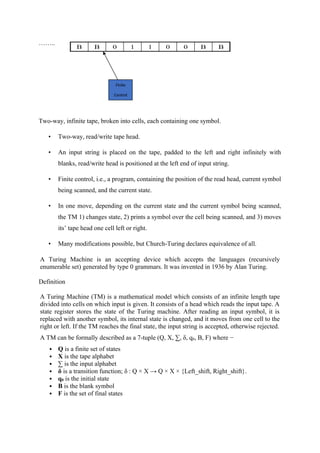
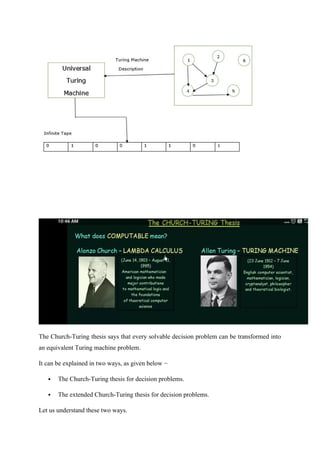
This document discusses Turing machines, their definitions, types (deterministic, non-deterministic), and their role in modeling computation, highlighting the Church-Turing thesis which states that every solvable decision problem can be modeled by a Turing machine. It also explains the components of a Turing machine and introduces the concept of the universal Turing machine, which can simulate any other machine. The document emphasizes the significance of recursively enumerable and context-sensitive languages, as well as time and space complexity in relation to Turing machines.