Supply Chain
Management and Cloud
Security
This chapter explores the essential concepts of supply chain
management and the application of risk management and risk
assessment policies to supply chain security. It then provides an overview
of cloud computing, including the key services, deployment models, and
security considerations for cloud service customers. The chapter also
covers best practices for information management and protecting
sensitive physical information.
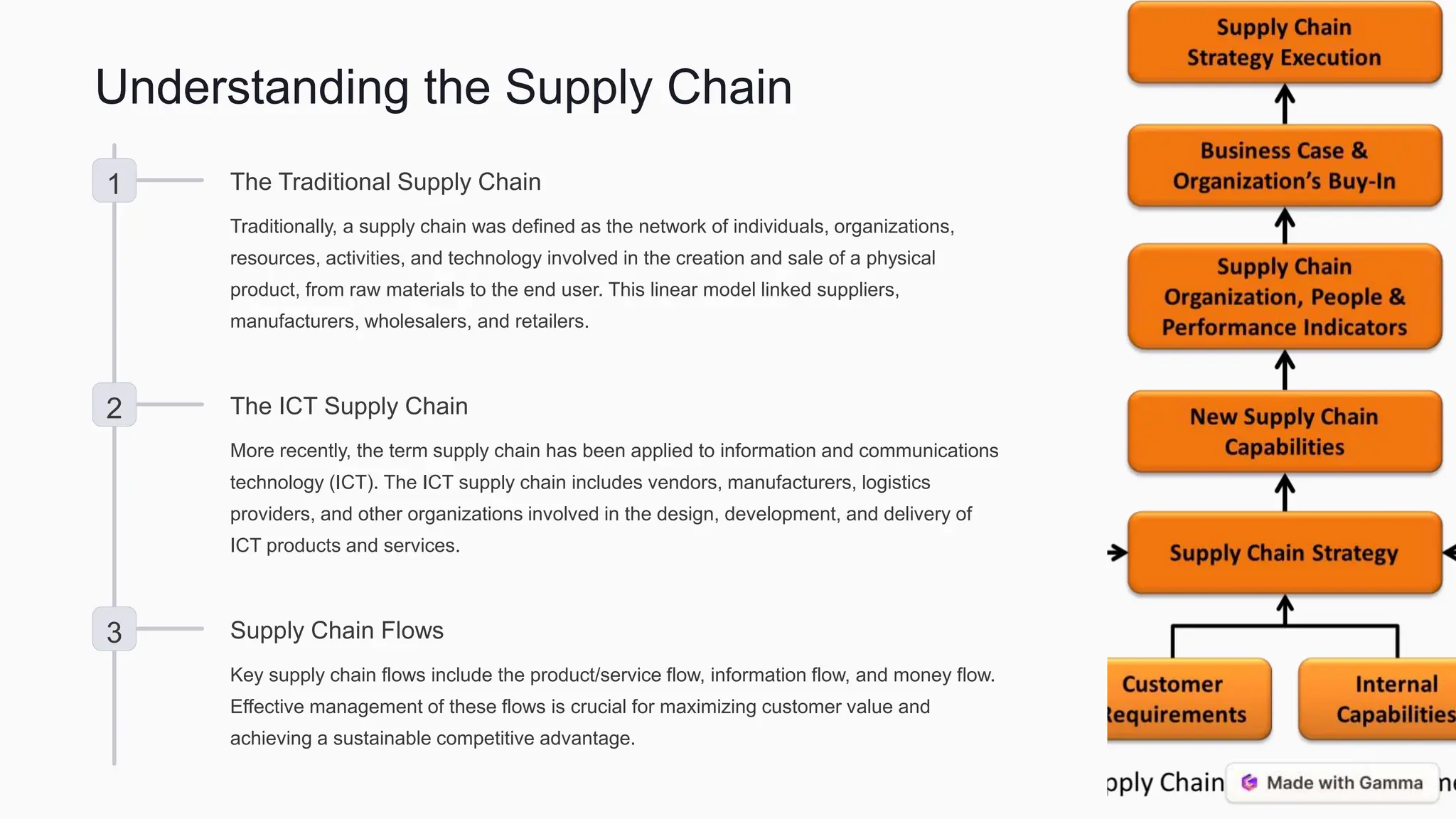
Understanding the Supply Chain
1 The Traditional Supply Chain
Traditionally, a supply chain was defined as the network of individuals, organizations,
resources, activities, and technology involved in the creation and sale of a physical
product, from raw materials to the end user. This linear model linked suppliers,
manufacturers, wholesalers, and retailers.
2 The ICT Supply Chain
More recently, the term supply chain has been applied to information and communications
technology (ICT). The ICT supply chain includes vendors, manufacturers, logistics
providers, and other organizations involved in the design, development, and delivery of
ICT products and services.
3 Supply Chain Flows
Key supply chain flows include the product/service flow, information flow, and money flow.
Effective management of these flows is crucial for maximizing customer value and
achieving a sustainable competitive advantage.
Supply Chain Management Essentials
Key Elements
Supply chain management
involves demand
management, supplier
qualification, sourcing and
procurement, logistics and
inventory control, and supplier
performance monitoring.
These elements work
together to ensure the
efficient and effective flow of
goods, services, and
information.
Supplier Relationships
Effective supply chain
management requires close
collaboration with suppliers.
This includes qualifying
suppliers, negotiating
contracts, and continuously
monitoring their performance
to ensure they meet quality
and security requirements.
Risk Management
Supply chain risk
management applies risk
assessment techniques to
identify and mitigate threats
and vulnerabilities throughout
the supply chain. This helps
ensure supply chain
continuity and profitability.
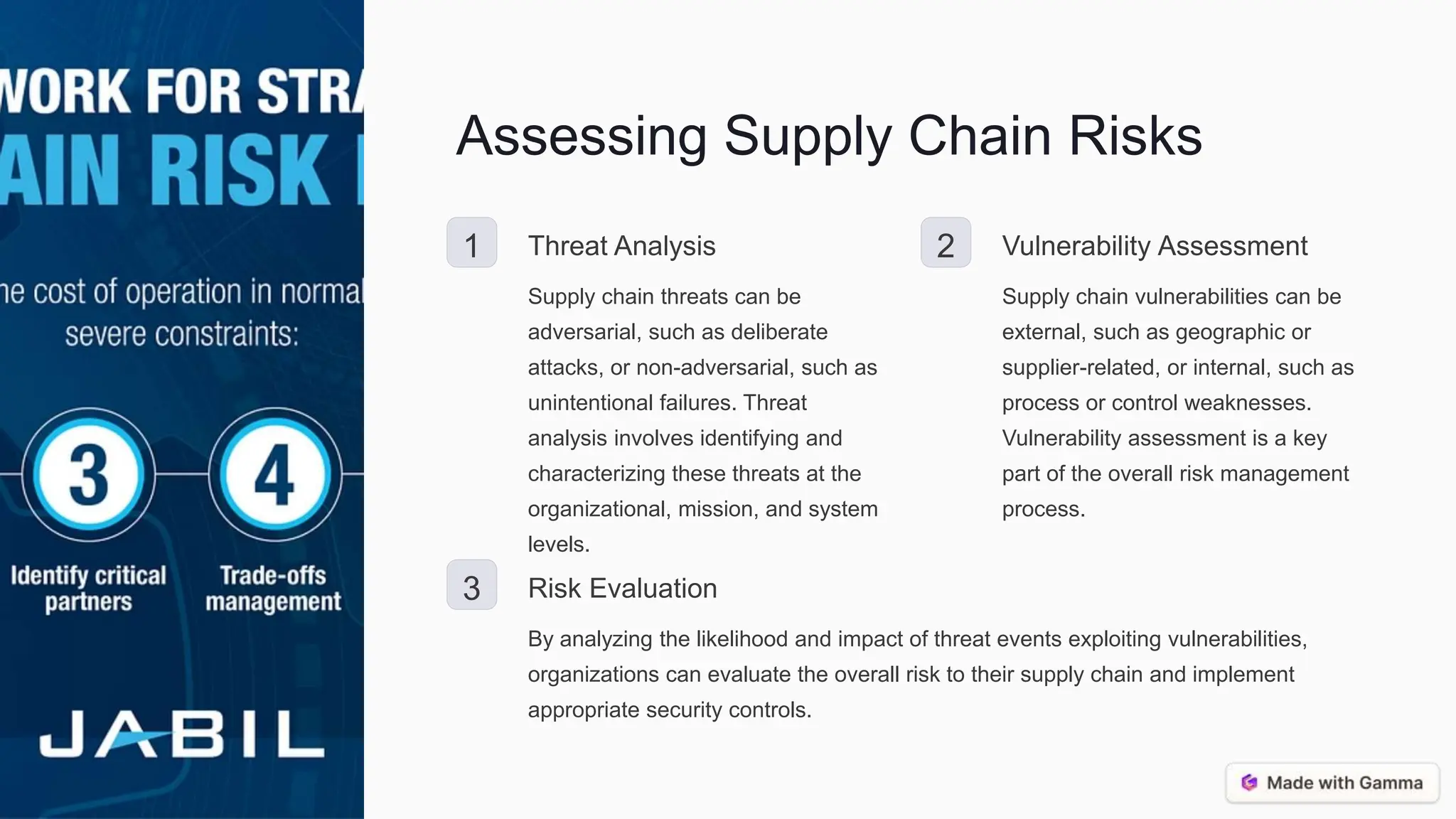
Assessing Supply Chain Risks
1 Threat Analysis
Supply chain threats can be
adversarial, such as deliberate
attacks, or non-adversarial, such as
unintentional failures. Threat
analysis involves identifying and
characterizing these threats at the
organizational, mission, and system
levels.
2 Vulnerability Assessment
Supply chain vulnerabilities can be
external, such as geographic or
supplier-related, or internal, such as
process or control weaknesses.
Vulnerability assessment is a key
part of the overall risk management
process.
3 Risk Evaluation
By analyzing the likelihood and impact of threat events exploiting vulnerabilities,
organizations can evaluate the overall risk to their supply chain and implement
appropriate security controls.
Cloud Computing Fundamentals
Essential Characteristics
Cloud computing is defined by its essential
characteristics, including on-demand self-
service, broad network access, rapid
elasticity, and measured service. These
features enable the flexible and efficient
delivery of computing resources.
Service Models
The three cloud service models are Software
as a Service (SaaS), Platform as a Service
(PaaS), and Infrastructure as a Service
(IaaS). These models provide different levels
of abstraction and control for cloud
consumers.
Deployment Models
Cloud computing can be deployed as a
public, private, community, or hybrid cloud.
The deployment model determines factors
like control, security, and ownership of the
cloud infrastructure.
Reference Architecture
The NIST cloud computing reference
architecture defines the key actors and their
roles, including cloud consumers, providers,
auditors, brokers, and carriers, and how they
interact.
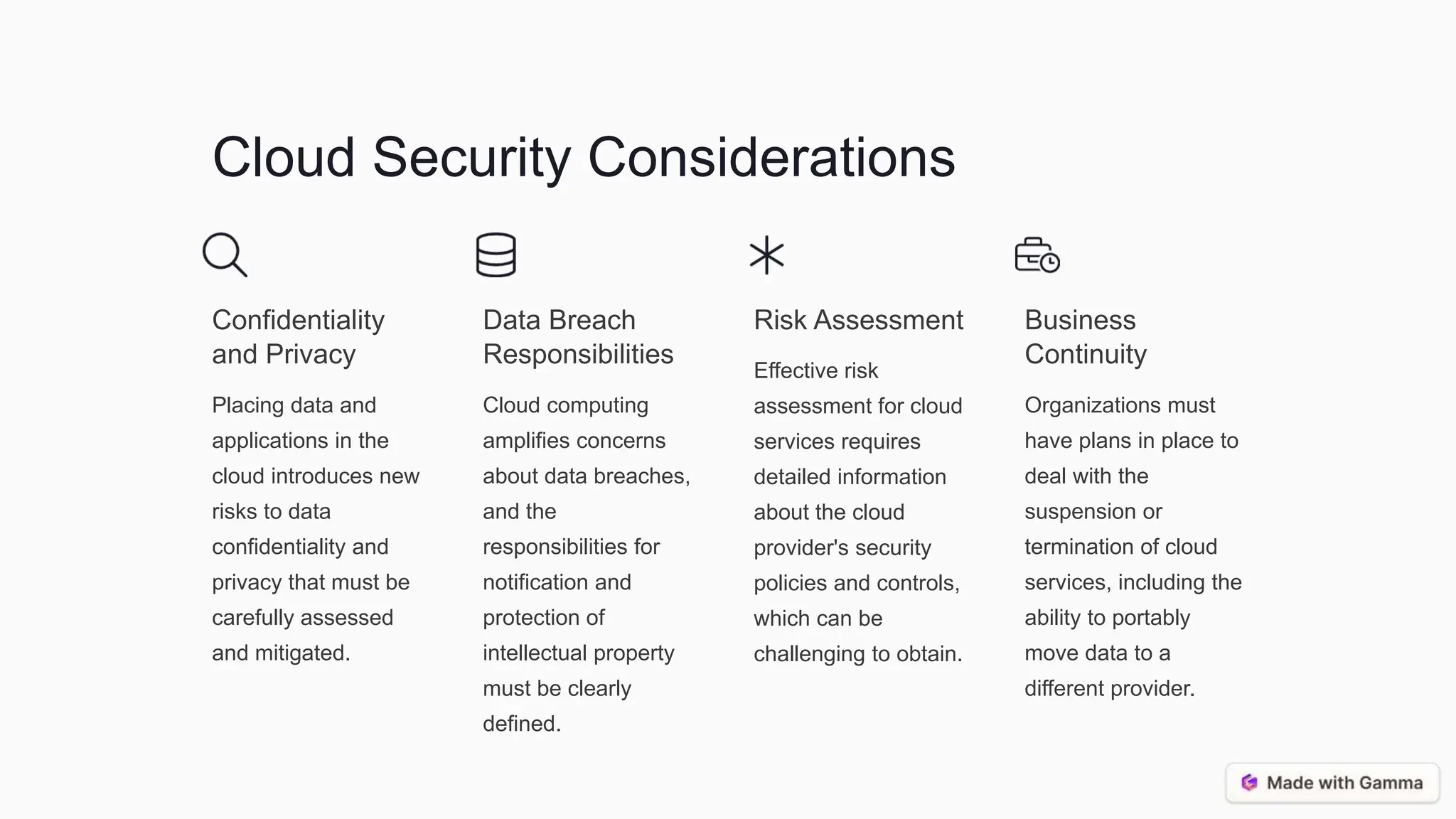
Cloud Security Considerations
Confidentiality
and Privacy
Placing data and
applications in the
cloud introduces new
risks to data
confidentiality and
privacy that must be
carefully assessed
and mitigated.
Data Breach
Responsibilities
Cloud computing
amplifies concerns
about data breaches,
and the
responsibilities for
notification and
protection of
intellectual property
must be clearly
defined.
Risk Assessment
Effective risk
assessment for cloud
services requires
detailed information
about the cloud
provider's security
policies and controls,
which can be
challenging to obtain.
Business
Continuity
Organizations must
have plans in place to
deal with the
suspension or
termination of cloud
services, including the
ability to portably
move data to a
different provider.
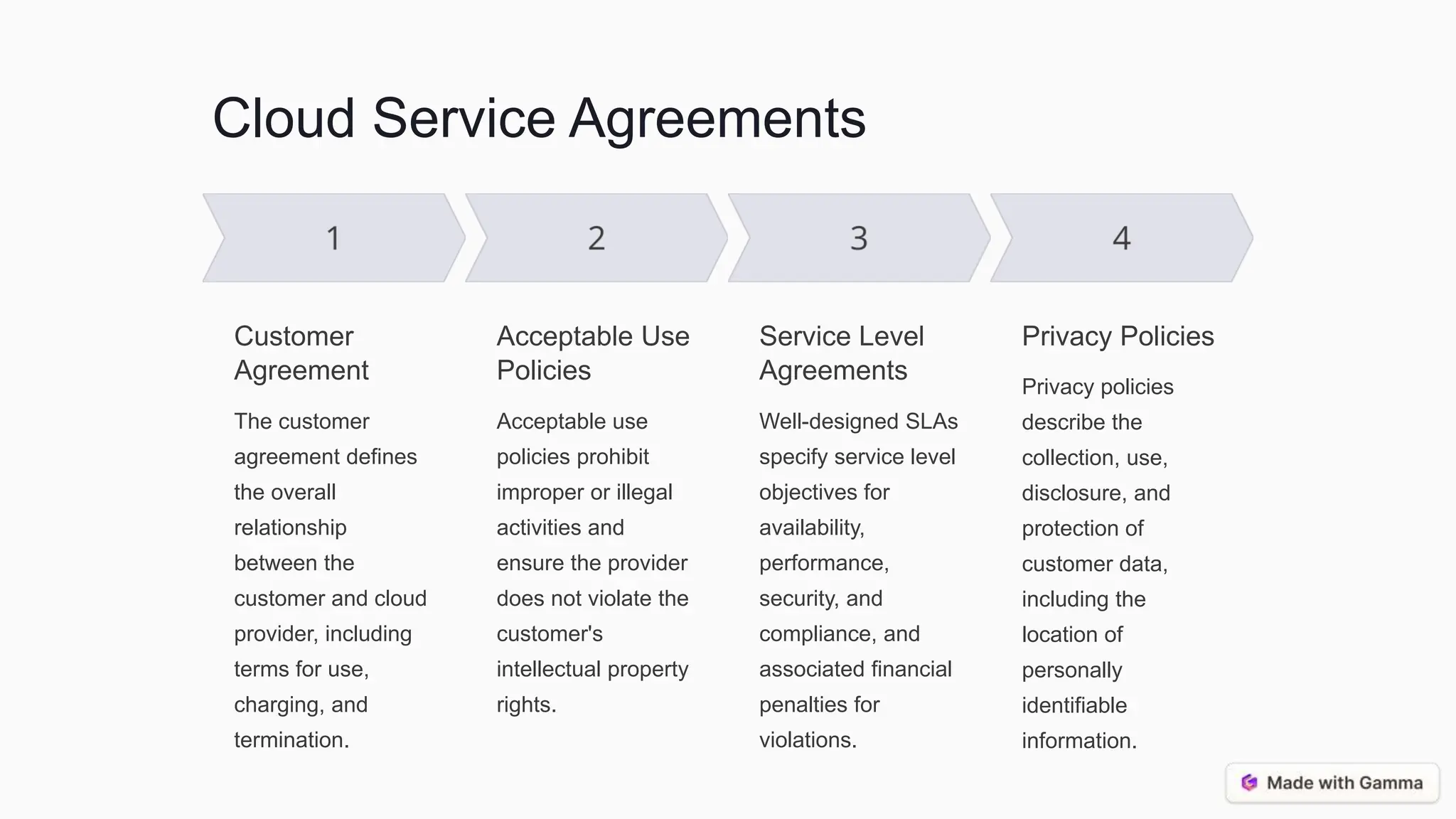
Cloud Service Agreements
Customer
Agreement
The customer
agreement defines
the overall
relationship
between the
customer and cloud
provider, including
terms for use,
charging, and
termination.
Acceptable Use
Policies
Acceptable use
policies prohibit
improper or illegal
activities and
ensure the provider
does not violate the
customer's
intellectual property
rights.
Service Level
Agreements
Well-designed SLAs
specify service level
objectives for
availability,
performance,
security, and
compliance, and
associated financial
penalties for
violations.
Privacy Policies
Privacy policies
describe the
collection, use,
disclosure, and
protection of
customer data,
including the
location of
personally
identifiable
information.
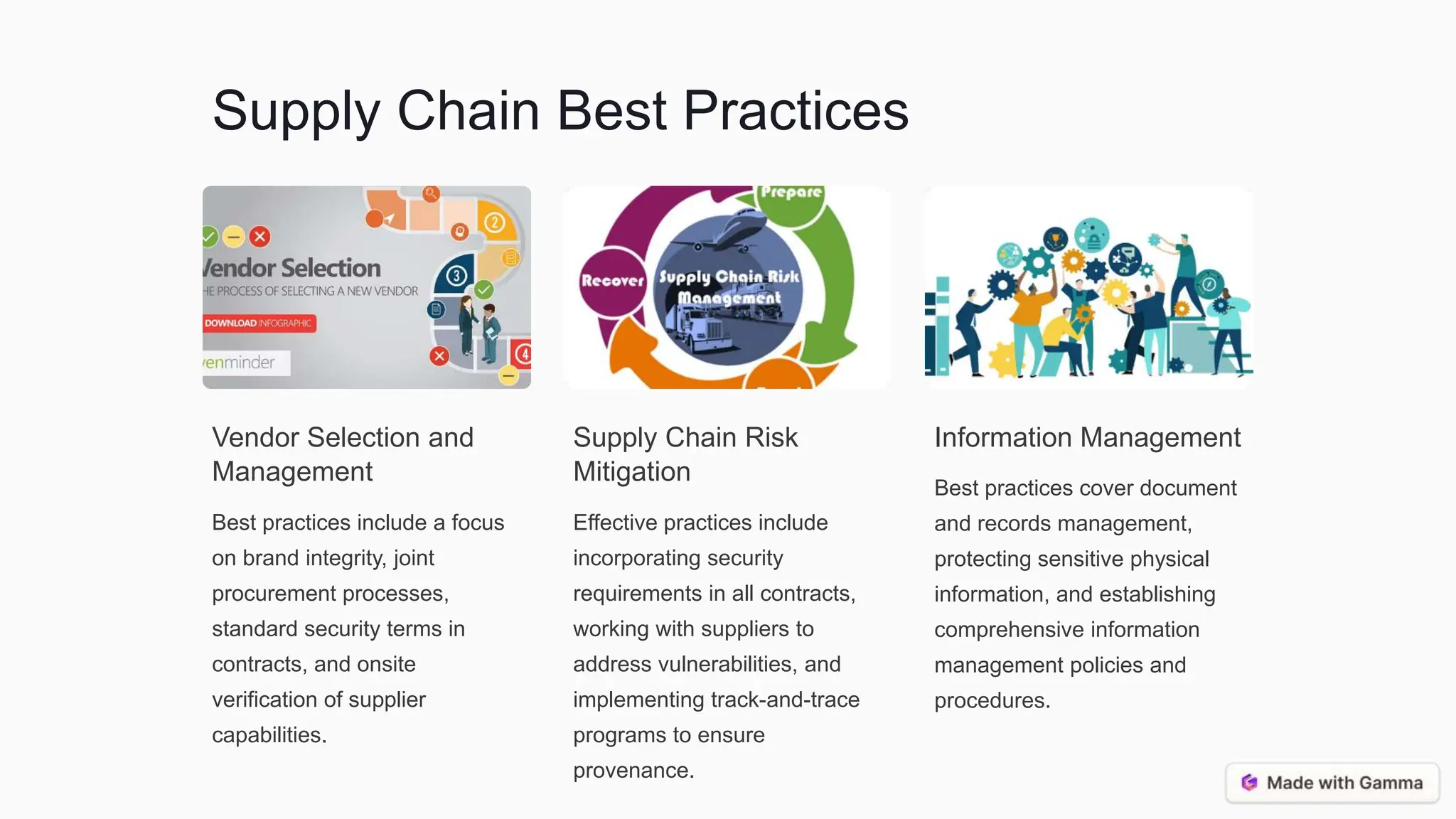
Supply Chain Best Practices
Vendor Selection and
Management
Best practices include a focus
on brand integrity, joint
procurement processes,
standard security terms in
contracts, and onsite
verification of supplier
capabilities.
Supply Chain Risk
Mitigation
Effective practices include
incorporating security
requirements in all contracts,
working with suppliers to
address vulnerabilities, and
implementing track-and-trace
programs to ensure
provenance.
Information Management
Best practices cover document
and records management,
protecting sensitive physical
information, and establishing
comprehensive information
management policies and
procedures.
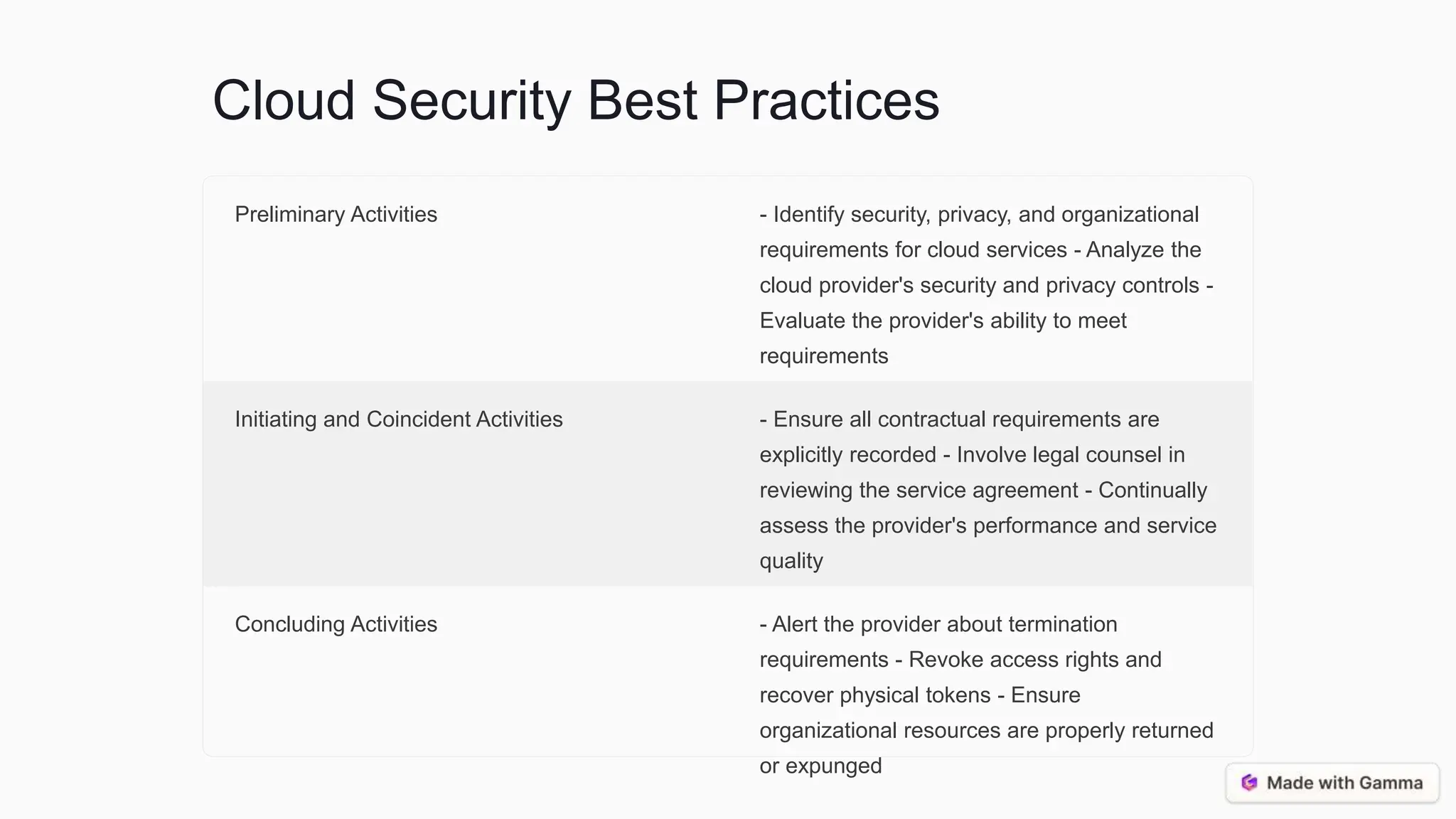
Cloud Security Best Practices
Preliminary Activities - Identify security, privacy, and organizational
requirements for cloud services - Analyze the
cloud provider's security and privacy controls -
Evaluate the provider's ability to meet
requirements
Initiating and Coincident Activities - Ensure all contractual requirements are
explicitly recorded - Involve legal counsel in
reviewing the service agreement - Continually
assess the provider's performance and service
quality
Concluding Activities - Alert the provider about termination
requirements - Revoke access rights and
recover physical tokens - Ensure
organizational resources are properly returned
or expunged
Conclusion
Integrated Approach
Effective management of supply chain
and cloud security risks requires an
integrated, enterprise-wide approach.
Security must be embedded throughout
the supply chain and cloud service
lifecycle, from vendor selection to
service termination.
Continuous Monitoring
Ongoing monitoring and assessment of
suppliers, cloud providers, and the
overall security posture is essential.
Organizations must be prepared to
quickly adapt to changing threats and
vulnerabilities in these dynamic
environments.
Collaboration and Transparency
Successful supply chain and cloud security relies on close collaboration and
transparency between organizations, their suppliers, and cloud providers. Clearly
defined roles, responsibilities, and communication channels are critical.

Supply-Chain-Management-and-Cloud-Security.pptx

  • 1.
    Supply Chain Management andCloud Security This chapter explores the essential concepts of supply chain management and the application of risk management and risk assessment policies to supply chain security. It then provides an overview of cloud computing, including the key services, deployment models, and security considerations for cloud service customers. The chapter also covers best practices for information management and protecting sensitive physical information.
  • 2.
    Understanding the SupplyChain 1 The Traditional Supply Chain Traditionally, a supply chain was defined as the network of individuals, organizations, resources, activities, and technology involved in the creation and sale of a physical product, from raw materials to the end user. This linear model linked suppliers, manufacturers, wholesalers, and retailers. 2 The ICT Supply Chain More recently, the term supply chain has been applied to information and communications technology (ICT). The ICT supply chain includes vendors, manufacturers, logistics providers, and other organizations involved in the design, development, and delivery of ICT products and services. 3 Supply Chain Flows Key supply chain flows include the product/service flow, information flow, and money flow. Effective management of these flows is crucial for maximizing customer value and achieving a sustainable competitive advantage.
  • 3.
    Supply Chain ManagementEssentials Key Elements Supply chain management involves demand management, supplier qualification, sourcing and procurement, logistics and inventory control, and supplier performance monitoring. These elements work together to ensure the efficient and effective flow of goods, services, and information. Supplier Relationships Effective supply chain management requires close collaboration with suppliers. This includes qualifying suppliers, negotiating contracts, and continuously monitoring their performance to ensure they meet quality and security requirements. Risk Management Supply chain risk management applies risk assessment techniques to identify and mitigate threats and vulnerabilities throughout the supply chain. This helps ensure supply chain continuity and profitability.
  • 4.
    Assessing Supply ChainRisks 1 Threat Analysis Supply chain threats can be adversarial, such as deliberate attacks, or non-adversarial, such as unintentional failures. Threat analysis involves identifying and characterizing these threats at the organizational, mission, and system levels. 2 Vulnerability Assessment Supply chain vulnerabilities can be external, such as geographic or supplier-related, or internal, such as process or control weaknesses. Vulnerability assessment is a key part of the overall risk management process. 3 Risk Evaluation By analyzing the likelihood and impact of threat events exploiting vulnerabilities, organizations can evaluate the overall risk to their supply chain and implement appropriate security controls.
  • 5.
    Cloud Computing Fundamentals EssentialCharacteristics Cloud computing is defined by its essential characteristics, including on-demand self- service, broad network access, rapid elasticity, and measured service. These features enable the flexible and efficient delivery of computing resources. Service Models The three cloud service models are Software as a Service (SaaS), Platform as a Service (PaaS), and Infrastructure as a Service (IaaS). These models provide different levels of abstraction and control for cloud consumers. Deployment Models Cloud computing can be deployed as a public, private, community, or hybrid cloud. The deployment model determines factors like control, security, and ownership of the cloud infrastructure. Reference Architecture The NIST cloud computing reference architecture defines the key actors and their roles, including cloud consumers, providers, auditors, brokers, and carriers, and how they interact.
  • 6.
    Cloud Security Considerations Confidentiality andPrivacy Placing data and applications in the cloud introduces new risks to data confidentiality and privacy that must be carefully assessed and mitigated. Data Breach Responsibilities Cloud computing amplifies concerns about data breaches, and the responsibilities for notification and protection of intellectual property must be clearly defined. Risk Assessment Effective risk assessment for cloud services requires detailed information about the cloud provider's security policies and controls, which can be challenging to obtain. Business Continuity Organizations must have plans in place to deal with the suspension or termination of cloud services, including the ability to portably move data to a different provider.
  • 7.
    Cloud Service Agreements Customer Agreement Thecustomer agreement defines the overall relationship between the customer and cloud provider, including terms for use, charging, and termination. Acceptable Use Policies Acceptable use policies prohibit improper or illegal activities and ensure the provider does not violate the customer's intellectual property rights. Service Level Agreements Well-designed SLAs specify service level objectives for availability, performance, security, and compliance, and associated financial penalties for violations. Privacy Policies Privacy policies describe the collection, use, disclosure, and protection of customer data, including the location of personally identifiable information.
  • 8.
    Supply Chain BestPractices Vendor Selection and Management Best practices include a focus on brand integrity, joint procurement processes, standard security terms in contracts, and onsite verification of supplier capabilities. Supply Chain Risk Mitigation Effective practices include incorporating security requirements in all contracts, working with suppliers to address vulnerabilities, and implementing track-and-trace programs to ensure provenance. Information Management Best practices cover document and records management, protecting sensitive physical information, and establishing comprehensive information management policies and procedures.
  • 9.
    Cloud Security BestPractices Preliminary Activities - Identify security, privacy, and organizational requirements for cloud services - Analyze the cloud provider's security and privacy controls - Evaluate the provider's ability to meet requirements Initiating and Coincident Activities - Ensure all contractual requirements are explicitly recorded - Involve legal counsel in reviewing the service agreement - Continually assess the provider's performance and service quality Concluding Activities - Alert the provider about termination requirements - Revoke access rights and recover physical tokens - Ensure organizational resources are properly returned or expunged
  • 10.
    Conclusion Integrated Approach Effective managementof supply chain and cloud security risks requires an integrated, enterprise-wide approach. Security must be embedded throughout the supply chain and cloud service lifecycle, from vendor selection to service termination. Continuous Monitoring Ongoing monitoring and assessment of suppliers, cloud providers, and the overall security posture is essential. Organizations must be prepared to quickly adapt to changing threats and vulnerabilities in these dynamic environments. Collaboration and Transparency Successful supply chain and cloud security relies on close collaboration and transparency between organizations, their suppliers, and cloud providers. Clearly defined roles, responsibilities, and communication channels are critical.