Implementing RSA Encryption
in Java
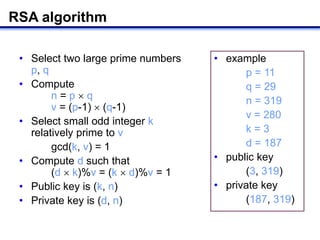
RSA algorithm
• Select two large prime numbers
p, q
• Compute
n = p  q
v = (p-1)  (q-1)
• Select small odd integer k
relatively prime to v
gcd(k, v) = 1
• Compute d such that
(d  k)%v = (k  d)%v = 1
• Public key is (k, n)
• Private key is (d, n)
• example
p = 11
q = 29
n = 319
v = 280
k = 3
d = 187
• public key
(3, 319)
• private key
(187, 319)
Encryption and decryption
• Alice and Bob would like to communicate in private
• Alice uses RSA algorithm to generate her public and
private keys
– Alice makes key (k, n) publicly available to Bob and
anyone else wanting to send her private messages
• Bob uses Alice’s public key (k, n) to encrypt message M:
– compute E(M) =(Mk)%n
– Bob sends encrypted message E(M) to Alice
• Alice receives E(M) and uses private key (d, n) to
decrypt it:
– compute D(M) = (E(M)d)%n
– decrypted message D(M) is original message M
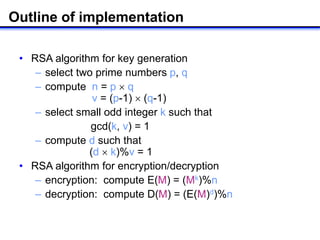
Outline of implementation
• RSA algorithm for key generation
– select two prime numbers p, q
– compute n = p  q
v = (p-1)  (q-1)
– select small odd integer k such that
gcd(k, v) = 1
– compute d such that
(d  k)%v = 1
• RSA algorithm for encryption/decryption
– encryption: compute E(M) = (Mk)%n
– decryption: compute D(M) = (E(M)d)%n
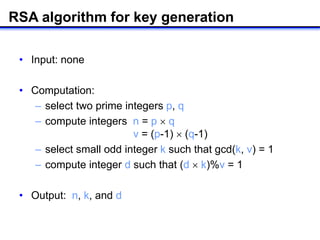
RSA algorithm for key generation
• Input: none
• Computation:
– select two prime integers p, q
– compute integers n = p  q
v = (p-1)  (q-1)
– select small odd integer k such that gcd(k, v) = 1
– compute integer d such that (d  k)%v = 1
• Output: n, k, and d
RSA algorithm for encryption
• Input: integers k, n, M
– M is integer representation of plaintext message
• Computation:
– let C be integer representation of ciphertext
C = (Mk)%n
• Output: integer C
– ciphertext or encrypted message
RSA algorithm for decryption
• Input: integers d, n, C
– C is integer representation of ciphertext message
• Computation:
– let D be integer representation of decrypted ciphertext
D = (Cd)%n
• Output: integer D
– decrypted message
This seems hard …
• How to find big primes?
• How to find mod inverse?
• How to compute greatest common divisor?
• How to translate text input to numeric values?
• Most importantly: RSA manipulates big numbers
– Java integers are of limited size
– how can we handle this?
• Two key items make the implementation easier
– understanding the math
– Java’s BigInteger class
What is a BigInteger?
• Java class to represent and perform operations on
integers of arbitrary precision
• Provides analogues to Java’s primitive integer
operations, e.g.
– addition and subtraction
– multiplication and division
• Along with operations for
– modular arithmetic
– gcd calculation
– generation of primes
• http://java.sun.com/j2se/1.4.2/docs/api/
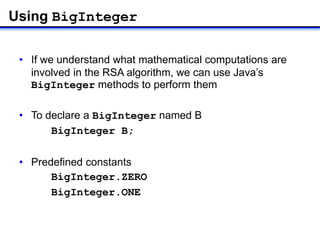
Using BigInteger
• If we understand what mathematical computations are
involved in the RSA algorithm, we can use Java’s
BigInteger methods to perform them
• To declare a BigInteger named B
BigInteger B;
• Predefined constants
BigInteger.ZERO
BigInteger.ONE
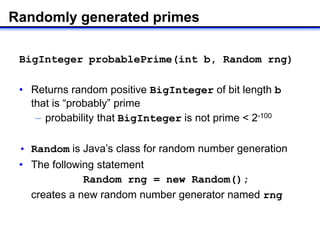
Randomly generated primes
BigInteger probablePrime(int b, Random rng)
• Returns random positive BigInteger of bit length b
that is “probably” prime
– probability that BigInteger is not prime < 2-100
• Random is Java’s class for random number generation
• The following statement
Random rng = new Random();
creates a new random number generator named rng
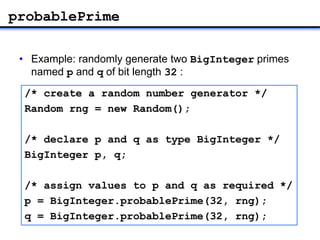
probablePrime
• Example: randomly generate two BigInteger primes
named p and q of bit length 32 :
/* create a random number generator */
Random rng = new Random();
/* declare p and q as type BigInteger */
BigInteger p, q;
/* assign values to p and q as required */
p = BigInteger.probablePrime(32, rng);
q = BigInteger.probablePrime(32, rng);
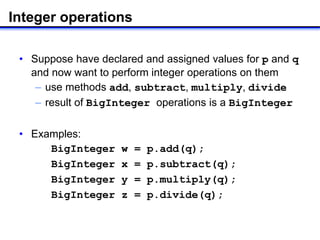
Integer operations
• Suppose have declared and assigned values for p and q
and now want to perform integer operations on them
– use methods add, subtract, multiply, divide
– result of BigInteger operations is a BigInteger
• Examples:
BigInteger w = p.add(q);
BigInteger x = p.subtract(q);
BigInteger y = p.multiply(q);
BigInteger z = p.divide(q);
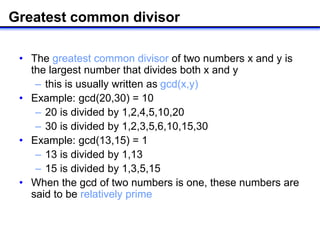
Greatest common divisor
• The greatest common divisor of two numbers x and y is
the largest number that divides both x and y
– this is usually written as gcd(x,y)
• Example: gcd(20,30) = 10
– 20 is divided by 1,2,4,5,10,20
– 30 is divided by 1,2,3,5,6,10,15,30
• Example: gcd(13,15) = 1
– 13 is divided by 1,13
– 15 is divided by 1,3,5,15
• When the gcd of two numbers is one, these numbers are
said to be relatively prime
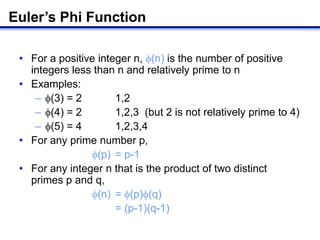
Euler’s Phi Function
• For a positive integer n, (n) is the number of positive
integers less than n and relatively prime to n
• Examples:
– (3) = 2 1,2
– (4) = 2 1,2,3 (but 2 is not relatively prime to 4)
– (5) = 4 1,2,3,4
• For any prime number p,
(p) = p-1
• For any integer n that is the product of two distinct
primes p and q,
(n) = (p)(q)
= (p-1)(q-1)
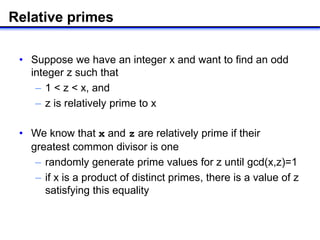
Relative primes
• Suppose we have an integer x and want to find an odd
integer z such that
– 1 < z < x, and
– z is relatively prime to x
• We know that x and z are relatively prime if their
greatest common divisor is one
– randomly generate prime values for z until gcd(x,z)=1
– if x is a product of distinct primes, there is a value of z
satisfying this equality
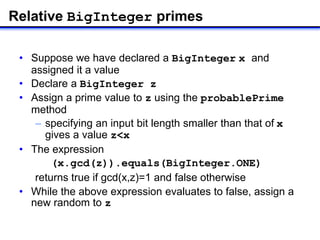
Relative BigInteger primes
• Suppose we have declared a BigInteger x and
assigned it a value
• Declare a BigInteger z
• Assign a prime value to z using the probablePrime
method
– specifying an input bit length smaller than that of x
gives a value z<x
• The expression
(x.gcd(z)).equals(BigInteger.ONE)
returns true if gcd(x,z)=1 and false otherwise
• While the above expression evaluates to false, assign a
new random to z
Multiplicative identities and inverses
• The multiplicative identity is the element e such that
e  x = x  e = x
for all elements xX
• The multiplicative inverse of x is the element x-1 such that
x  x-1 = x-1  x = 1
• The multiplicative inverse of x mod n is the element x-1
such that
(x  x-1) mod n = (x-1  x ) mod n = 1
– x and x-1 are inverses only in multiplication mod n
modInverse
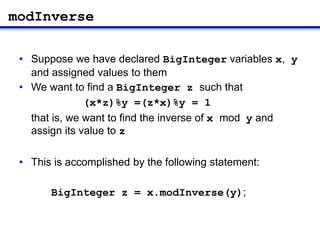
• Suppose we have declared BigInteger variables x, y
and assigned values to them
• We want to find a BigInteger z such that
(x*z)%y =(z*x)%y = 1
that is, we want to find the inverse of x mod y and
assign its value to z
• This is accomplished by the following statement:
BigInteger z = x.modInverse(y);
Implementing RSA key generation
• We know have everything we need to implement the
RSA key generation algorithm in Java, so let’s get
started …

implementing the encryption in the JAVA.ppt

  • 1.
  • 2.
    RSA algorithm • Selecttwo large prime numbers p, q • Compute n = p  q v = (p-1)  (q-1) • Select small odd integer k relatively prime to v gcd(k, v) = 1 • Compute d such that (d  k)%v = (k  d)%v = 1 • Public key is (k, n) • Private key is (d, n) • example p = 11 q = 29 n = 319 v = 280 k = 3 d = 187 • public key (3, 319) • private key (187, 319)
  • 3.
    Encryption and decryption •Alice and Bob would like to communicate in private • Alice uses RSA algorithm to generate her public and private keys – Alice makes key (k, n) publicly available to Bob and anyone else wanting to send her private messages • Bob uses Alice’s public key (k, n) to encrypt message M: – compute E(M) =(Mk)%n – Bob sends encrypted message E(M) to Alice • Alice receives E(M) and uses private key (d, n) to decrypt it: – compute D(M) = (E(M)d)%n – decrypted message D(M) is original message M
  • 4.
    Outline of implementation •RSA algorithm for key generation – select two prime numbers p, q – compute n = p  q v = (p-1)  (q-1) – select small odd integer k such that gcd(k, v) = 1 – compute d such that (d  k)%v = 1 • RSA algorithm for encryption/decryption – encryption: compute E(M) = (Mk)%n – decryption: compute D(M) = (E(M)d)%n
  • 5.
    RSA algorithm forkey generation • Input: none • Computation: – select two prime integers p, q – compute integers n = p  q v = (p-1)  (q-1) – select small odd integer k such that gcd(k, v) = 1 – compute integer d such that (d  k)%v = 1 • Output: n, k, and d
  • 6.
    RSA algorithm forencryption • Input: integers k, n, M – M is integer representation of plaintext message • Computation: – let C be integer representation of ciphertext C = (Mk)%n • Output: integer C – ciphertext or encrypted message
  • 7.
    RSA algorithm fordecryption • Input: integers d, n, C – C is integer representation of ciphertext message • Computation: – let D be integer representation of decrypted ciphertext D = (Cd)%n • Output: integer D – decrypted message
  • 8.
    This seems hard… • How to find big primes? • How to find mod inverse? • How to compute greatest common divisor? • How to translate text input to numeric values? • Most importantly: RSA manipulates big numbers – Java integers are of limited size – how can we handle this? • Two key items make the implementation easier – understanding the math – Java’s BigInteger class
  • 9.
    What is aBigInteger? • Java class to represent and perform operations on integers of arbitrary precision • Provides analogues to Java’s primitive integer operations, e.g. – addition and subtraction – multiplication and division • Along with operations for – modular arithmetic – gcd calculation – generation of primes • http://java.sun.com/j2se/1.4.2/docs/api/
  • 10.
    Using BigInteger • Ifwe understand what mathematical computations are involved in the RSA algorithm, we can use Java’s BigInteger methods to perform them • To declare a BigInteger named B BigInteger B; • Predefined constants BigInteger.ZERO BigInteger.ONE
  • 11.
    Randomly generated primes BigIntegerprobablePrime(int b, Random rng) • Returns random positive BigInteger of bit length b that is “probably” prime – probability that BigInteger is not prime < 2-100 • Random is Java’s class for random number generation • The following statement Random rng = new Random(); creates a new random number generator named rng
  • 12.
    probablePrime • Example: randomlygenerate two BigInteger primes named p and q of bit length 32 : /* create a random number generator */ Random rng = new Random(); /* declare p and q as type BigInteger */ BigInteger p, q; /* assign values to p and q as required */ p = BigInteger.probablePrime(32, rng); q = BigInteger.probablePrime(32, rng);
  • 13.
    Integer operations • Supposehave declared and assigned values for p and q and now want to perform integer operations on them – use methods add, subtract, multiply, divide – result of BigInteger operations is a BigInteger • Examples: BigInteger w = p.add(q); BigInteger x = p.subtract(q); BigInteger y = p.multiply(q); BigInteger z = p.divide(q);
  • 14.
    Greatest common divisor •The greatest common divisor of two numbers x and y is the largest number that divides both x and y – this is usually written as gcd(x,y) • Example: gcd(20,30) = 10 – 20 is divided by 1,2,4,5,10,20 – 30 is divided by 1,2,3,5,6,10,15,30 • Example: gcd(13,15) = 1 – 13 is divided by 1,13 – 15 is divided by 1,3,5,15 • When the gcd of two numbers is one, these numbers are said to be relatively prime
  • 15.
    Euler’s Phi Function •For a positive integer n, (n) is the number of positive integers less than n and relatively prime to n • Examples: – (3) = 2 1,2 – (4) = 2 1,2,3 (but 2 is not relatively prime to 4) – (5) = 4 1,2,3,4 • For any prime number p, (p) = p-1 • For any integer n that is the product of two distinct primes p and q, (n) = (p)(q) = (p-1)(q-1)
  • 16.
    Relative primes • Supposewe have an integer x and want to find an odd integer z such that – 1 < z < x, and – z is relatively prime to x • We know that x and z are relatively prime if their greatest common divisor is one – randomly generate prime values for z until gcd(x,z)=1 – if x is a product of distinct primes, there is a value of z satisfying this equality
  • 17.
    Relative BigInteger primes •Suppose we have declared a BigInteger x and assigned it a value • Declare a BigInteger z • Assign a prime value to z using the probablePrime method – specifying an input bit length smaller than that of x gives a value z<x • The expression (x.gcd(z)).equals(BigInteger.ONE) returns true if gcd(x,z)=1 and false otherwise • While the above expression evaluates to false, assign a new random to z
  • 18.
    Multiplicative identities andinverses • The multiplicative identity is the element e such that e  x = x  e = x for all elements xX • The multiplicative inverse of x is the element x-1 such that x  x-1 = x-1  x = 1 • The multiplicative inverse of x mod n is the element x-1 such that (x  x-1) mod n = (x-1  x ) mod n = 1 – x and x-1 are inverses only in multiplication mod n
  • 19.
    modInverse • Suppose wehave declared BigInteger variables x, y and assigned values to them • We want to find a BigInteger z such that (x*z)%y =(z*x)%y = 1 that is, we want to find the inverse of x mod y and assign its value to z • This is accomplished by the following statement: BigInteger z = x.modInverse(y);
  • 20.
    Implementing RSA keygeneration • We know have everything we need to implement the RSA key generation algorithm in Java, so let’s get started …