Can computers think ? Krishnan GTC talk Sept. 18,2011
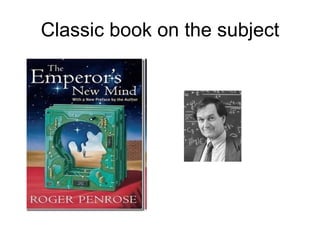
Classic book on the subject
Machines vs. Humans Machinery outperforms us in physical ways Cars outrun us Planes can fly, we cant This doesn’t disturb us Is thinking a human prerogative ? Can mechanical devices out think us
What can computers do better ? Computations on large numbers E.g. Multiplying two 100 digit numbers Play chess (and other games) Answer natural language questions IBM Watson House cleaning robots ? But does this mean they are intelligent ?
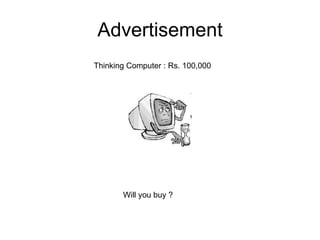
Advertisement Will you buy ? Thinking Computer : Rs. 100,000
What is intelligence ? Newell and Simon - the use and manipulation of various symbol systems, such as those featured in mathematics or logic Large debate in the AI, Psychology, Philosophy community
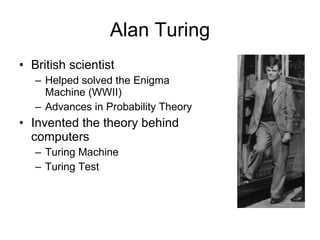
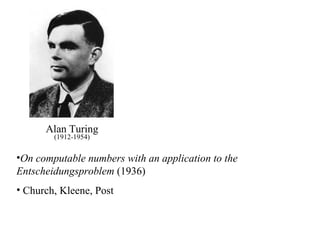
Alan Turing British scientist Helped solved the Enigma Machine (WWII) Advances in Probability Theory Invented the theory behind computers Turing Machine Turing Test
The imitation game Proposed by Alan Turing in 1950 It is played with three people, a man (A), a woman (B), and an interrogator (C) who may be of either sex. The interrogator stays in a room apart from the other two.  The object of the game for the interrogator is to determine which of the other two is the man and which is the woman. He knows them by labels X and Y, and at the end of the game he says either ‘‘X is A and Y is B’’ or ‘’X is B and Y is A.
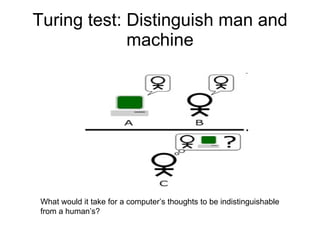
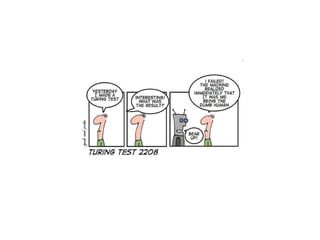
Turing test: Distinguish man and machine What would it take for a computer’s thoughts to be indistinguishable from a human’s?
 
Chinese Room The system comprises: a human, who only understands English a rule book, written in English two stacks of paper.  One stack of paper is blank.  The other has indecipherable symbols on them. In computing terms  the human is the CPU the rule book is the program  the two stacks of paper are storage devices. The system is housed in a room that is totally sealed with the exception of a small opening.
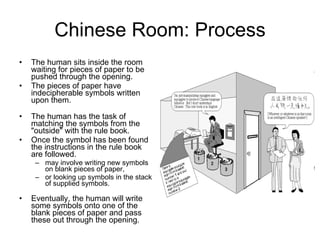
Chinese Room: Process The human sits inside the room waiting for pieces of paper to be pushed through the opening.  The pieces of paper have indecipherable symbols written upon them. The human has the task of matching the symbols from the "outside" with the rule book.  Once the symbol has been found the instructions in the rule book are followed.  may involve writing new symbols on blank pieces of paper, or looking up symbols in the stack of supplied symbols. Eventually, the human will write some symbols onto one of the blank pieces of paper and pass these out through the opening.
Chinese Room: Summary Simple Rule processing system but in which the “rule processor” happens to be intelligent but has no understanding of the rules The set of rules might be very large But this is philosophy and so ignore the practical issues
Searle’s Claim We have a system that is capable of passing the Turing Test and is therefore intelligent according to Turing.  But the system does not understand Chinese as it just comprises a rule book and stacks of paper which do not understand Chinese. Therefore, running the right program does not necessarily generate understanding.
Strong AI Strong AI  is artificial intelligence that matches or exceeds human intelligence The intelligence of a machine can successfully perform any intellectual task that a human being can  Advocates of "Strong AI" believe that computers are capable of true intelligence They argue that what intelligence is strictly algorithmic, i.e., a program running in a complex, but predictable, system of electro-chemical components (neurons).
Strong AI Many supporters of strong AI believe that  the computer and the brain  have equivalent computing power With sufficient technology, it will someday be possible to create machines that have the same type of capabilities as humans However, Strong AI's reduction of consciousness into an algorithm is difficult for many to accept Proponents are: Ray Kurzweil, Marvin Minsky etc.
Weak AI The  Weak AI  thesis claims that machines, even if they  appear  intelligent, can only  simulate  intelligence  They will never actually be aware of what they are doing Some weak AI proponents believe that human intelligence results from a superior computing mechanism which, while exercised in the brain, will never be present in a Turing-equivalent computer Roger Penrose is a proponent of Weak AI
What can a computer compute ? Hardware – circuits, gates, wires Software – Program that runs on the hardware Turings remarkable discovery – All computing machines are equivalent in what they can do Though speeds may differ All computers are equivalent to a Universal Turing machine
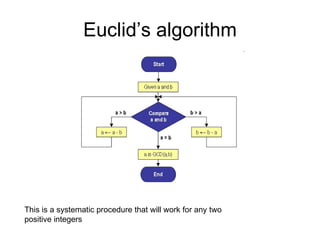
Algorithms The word comes from the Persian mathematician Abu Jafar Mohammed ibn Musa al Khowarizm He wrote a book Kitab Al-jabr wal-muqabala Example algorithm Euclids algorithm for highest common factor of two numbers
Euclid’s algorithm This is a systematic procedure that will work for any two positive integers
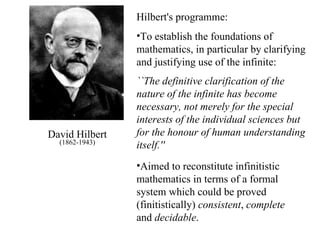
David Hilbert (1862-1943) Hilbert's programme: To establish the foundations of mathematics, in particular by clarifying and justifying use of the infinite: ``The definitive clarification of the nature of the infinite has become necessary, not merely for the special interests of the individual sciences but for the honour of human understanding itself.''   Aimed to reconstitute infinitistic mathematics in terms of a formal system which could be proved (finitistically)  consistent ,  complete  and  decidable .
Consistent : It should be impossible to derive a contradiction (such as 1=2). Complete : All true statements should be provable. Decidable : There should be a (definite, finitary, terminating) procedure for deciding whether or not an arbitrary statement is provable. (The  Entscheidungsproblem ) There is the problem. Seek its solution. You can find it by pure reason, for in mathematics there is no ignorabimus. Wir müssen wissen, wir werden wissen
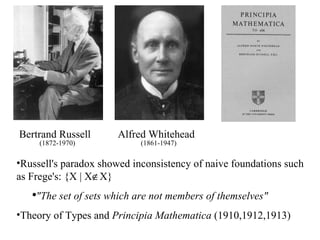
Bertrand Russell (1872-1970) Alfred Whitehead (1861-1947) Russell's paradox showed inconsistency of naive foundations such as Frege's: {X | X  X} "The set of sets which are not members of themselves" Theory of Types and  Principia Mathematica  (1910,1912,1913)
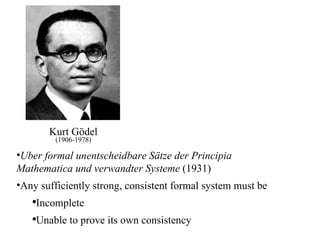
Kurt Gödel (1906-1978) Uber formal unentscheidbare Sätze der Principia Mathematica und verwandter Systeme  (1931) Any sufficiently strong, consistent formal system must be Incomplete Unable to prove its own consistency
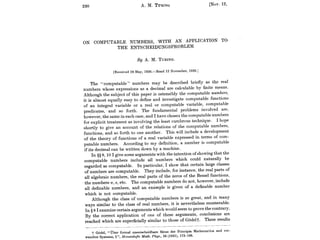
Alan Turing (1912-1954) On computable numbers with an application to the Entscheidungsproblem  (1936) Church, Kleene, Post
 
Turing machine Imagine a device for carrying out a computational procedure (like Euclid’s algorithm) What is the general form such a machine can take ? Machine should have discrete states (large but finite in number) Input/Output of unrestricted size Finite number of states implies cannot internalize the data
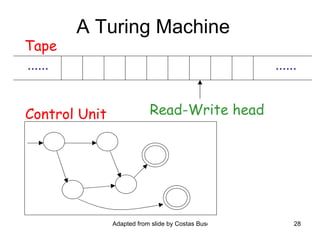
A Turing Machine ...... ...... Tape Read-Write head Control Unit
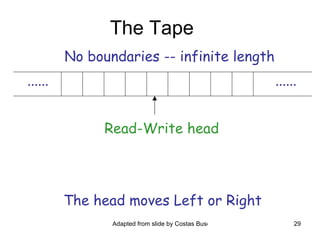
The Tape ...... ...... Read-Write head No boundaries -- infinite length The head moves Left or Right
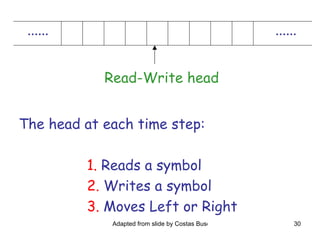
...... ...... Read-Write head The head at each time step: 1.  Reads a symbol 2.  Writes a symbol 3.  Moves Left or Right
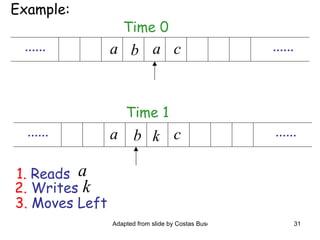
...... ...... Example: Time 0 ...... ...... Time 1 1.  Reads 2.  Writes  3.  Moves Left
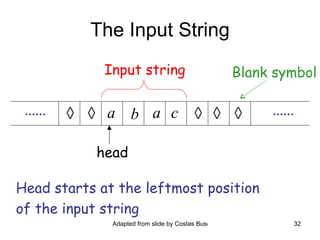
The Input String ...... ...... Blank symbol head Head starts at the leftmost position of the input string Input string
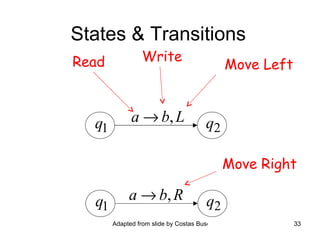
States & Transitions Read Write Move Left Move Right
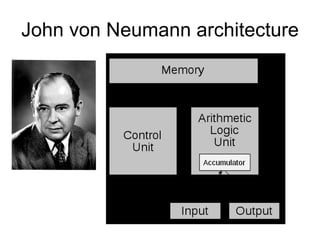
John von Neumann architecture
Ways that the brain differs from a conventional computer: Very few cycles available to make decisions Massively parallel: 100 trillion interneuronal connections Combines digital & analog phenomena at every level Nonlinear dynamics can be modeled using digital computation to any desired degree of accuracy Benefits of modeling using transistors in their analog native mode
Ways that the brain differs from a conventional computer: The brain is self-organizing at every level Great deal of stochastic (random within controlled constraints) process in every aspect Self-organizing, stochastic techniques are routinely used in pattern recognition Information storage is holographic in its properties
The brain’s design is a level of complexity we can manage Only about 20 megabytes of compressed design information about the brain in the genome A brain has ~ billion times more information than the genome that describes its design The brain’s design is a probabilistic fractal We’ve already created simulations of ~ 20 regions (out of several hundred) of the brain
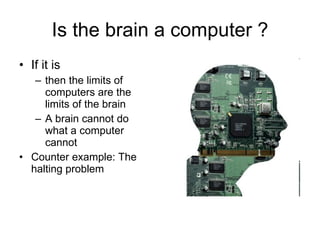
Is the brain a computer ? If it is then the limits of computers are the limits of the brain A brain cannot do what a computer cannot Counter example: The halting problem
What computers cannot do: The halting problem An example of something that is not computable. Created by Turing in 1936 to define a problem which no algorithmic procedure can solve. Can we write a program that will take in a user's program and inputs and decide whether  it will  eventually stop , or it will run infinitely in some  infinite loop  ? The answer is No; there is no procedural method for answering the halting problem Human beings can do this by inspection Does this imply human  brain can perform non-computational procedures ? If so what is the mechanism ?
Penrose’s belief There is some part of conscious thinking that cannot be simulated on a computer What is it in the physics of the world that cannot be controlled computationally ? Is quantum mechanics the answer ? In quantum mechanics, a particle can be in two places at the same time Quantum wave function collapse happens when the particle is observed
How are new ideas formed Physical brain activity—rapid trials of combinations of growing and contracting dendritic spines, which stretch out to the synapses that separate a nerve cell from its neighbor  These take place below one graviton (particles that transmit gravity)
How are new ideas formed ? How is a final dendrite construction settled on when our mind grasps a concept or glimpses a new symphonic work?  Microtubules in brain orchestrate collapse of the quantum wave function
Further readings http://www.brainpickings.org/index.php/2010/09/07/what-does-it-mean-to-be-human/

Can computers think

  • 1.
    Can computers think? Krishnan GTC talk Sept. 18,2011
  • 2.
    Classic book onthe subject
  • 3.
    Machines vs. HumansMachinery outperforms us in physical ways Cars outrun us Planes can fly, we cant This doesn’t disturb us Is thinking a human prerogative ? Can mechanical devices out think us
  • 4.
    What can computersdo better ? Computations on large numbers E.g. Multiplying two 100 digit numbers Play chess (and other games) Answer natural language questions IBM Watson House cleaning robots ? But does this mean they are intelligent ?
  • 5.
    Advertisement Will youbuy ? Thinking Computer : Rs. 100,000
  • 6.
    What is intelligence? Newell and Simon - the use and manipulation of various symbol systems, such as those featured in mathematics or logic Large debate in the AI, Psychology, Philosophy community
  • 7.
    Alan Turing Britishscientist Helped solved the Enigma Machine (WWII) Advances in Probability Theory Invented the theory behind computers Turing Machine Turing Test
  • 8.
    The imitation gameProposed by Alan Turing in 1950 It is played with three people, a man (A), a woman (B), and an interrogator (C) who may be of either sex. The interrogator stays in a room apart from the other two. The object of the game for the interrogator is to determine which of the other two is the man and which is the woman. He knows them by labels X and Y, and at the end of the game he says either ‘‘X is A and Y is B’’ or ‘’X is B and Y is A.
  • 9.
    Turing test: Distinguishman and machine What would it take for a computer’s thoughts to be indistinguishable from a human’s?
  • 10.
  • 11.
    Chinese Room Thesystem comprises: a human, who only understands English a rule book, written in English two stacks of paper. One stack of paper is blank. The other has indecipherable symbols on them. In computing terms the human is the CPU the rule book is the program the two stacks of paper are storage devices. The system is housed in a room that is totally sealed with the exception of a small opening.
  • 12.
    Chinese Room: ProcessThe human sits inside the room waiting for pieces of paper to be pushed through the opening. The pieces of paper have indecipherable symbols written upon them. The human has the task of matching the symbols from the "outside" with the rule book. Once the symbol has been found the instructions in the rule book are followed. may involve writing new symbols on blank pieces of paper, or looking up symbols in the stack of supplied symbols. Eventually, the human will write some symbols onto one of the blank pieces of paper and pass these out through the opening.
  • 13.
    Chinese Room: SummarySimple Rule processing system but in which the “rule processor” happens to be intelligent but has no understanding of the rules The set of rules might be very large But this is philosophy and so ignore the practical issues
  • 14.
    Searle’s Claim Wehave a system that is capable of passing the Turing Test and is therefore intelligent according to Turing. But the system does not understand Chinese as it just comprises a rule book and stacks of paper which do not understand Chinese. Therefore, running the right program does not necessarily generate understanding.
  • 15.
    Strong AI StrongAI is artificial intelligence that matches or exceeds human intelligence The intelligence of a machine can successfully perform any intellectual task that a human being can Advocates of "Strong AI" believe that computers are capable of true intelligence They argue that what intelligence is strictly algorithmic, i.e., a program running in a complex, but predictable, system of electro-chemical components (neurons).
  • 16.
    Strong AI Manysupporters of strong AI believe that the computer and the brain have equivalent computing power With sufficient technology, it will someday be possible to create machines that have the same type of capabilities as humans However, Strong AI's reduction of consciousness into an algorithm is difficult for many to accept Proponents are: Ray Kurzweil, Marvin Minsky etc.
  • 17.
    Weak AI The Weak AI thesis claims that machines, even if they appear intelligent, can only simulate intelligence They will never actually be aware of what they are doing Some weak AI proponents believe that human intelligence results from a superior computing mechanism which, while exercised in the brain, will never be present in a Turing-equivalent computer Roger Penrose is a proponent of Weak AI
  • 18.
    What can acomputer compute ? Hardware – circuits, gates, wires Software – Program that runs on the hardware Turings remarkable discovery – All computing machines are equivalent in what they can do Though speeds may differ All computers are equivalent to a Universal Turing machine
  • 19.
    Algorithms The wordcomes from the Persian mathematician Abu Jafar Mohammed ibn Musa al Khowarizm He wrote a book Kitab Al-jabr wal-muqabala Example algorithm Euclids algorithm for highest common factor of two numbers
  • 20.
    Euclid’s algorithm Thisis a systematic procedure that will work for any two positive integers
  • 21.
    David Hilbert (1862-1943)Hilbert's programme: To establish the foundations of mathematics, in particular by clarifying and justifying use of the infinite: ``The definitive clarification of the nature of the infinite has become necessary, not merely for the special interests of the individual sciences but for the honour of human understanding itself.'' Aimed to reconstitute infinitistic mathematics in terms of a formal system which could be proved (finitistically) consistent , complete and decidable .
  • 22.
    Consistent : Itshould be impossible to derive a contradiction (such as 1=2). Complete : All true statements should be provable. Decidable : There should be a (definite, finitary, terminating) procedure for deciding whether or not an arbitrary statement is provable. (The Entscheidungsproblem ) There is the problem. Seek its solution. You can find it by pure reason, for in mathematics there is no ignorabimus. Wir müssen wissen, wir werden wissen
  • 23.
    Bertrand Russell (1872-1970)Alfred Whitehead (1861-1947) Russell's paradox showed inconsistency of naive foundations such as Frege's: {X | X  X} "The set of sets which are not members of themselves" Theory of Types and Principia Mathematica (1910,1912,1913)
  • 24.
    Kurt Gödel (1906-1978)Uber formal unentscheidbare Sätze der Principia Mathematica und verwandter Systeme (1931) Any sufficiently strong, consistent formal system must be Incomplete Unable to prove its own consistency
  • 25.
    Alan Turing (1912-1954)On computable numbers with an application to the Entscheidungsproblem (1936) Church, Kleene, Post
  • 26.
  • 27.
    Turing machine Imaginea device for carrying out a computational procedure (like Euclid’s algorithm) What is the general form such a machine can take ? Machine should have discrete states (large but finite in number) Input/Output of unrestricted size Finite number of states implies cannot internalize the data
  • 28.
    A Turing Machine...... ...... Tape Read-Write head Control Unit
  • 29.
    The Tape ............ Read-Write head No boundaries -- infinite length The head moves Left or Right
  • 30.
    ...... ...... Read-Writehead The head at each time step: 1. Reads a symbol 2. Writes a symbol 3. Moves Left or Right
  • 31.
    ...... ...... Example:Time 0 ...... ...... Time 1 1. Reads 2. Writes 3. Moves Left
  • 32.
    The Input String...... ...... Blank symbol head Head starts at the leftmost position of the input string Input string
  • 33.
    States & TransitionsRead Write Move Left Move Right
  • 34.
    John von Neumannarchitecture
  • 35.
    Ways that thebrain differs from a conventional computer: Very few cycles available to make decisions Massively parallel: 100 trillion interneuronal connections Combines digital & analog phenomena at every level Nonlinear dynamics can be modeled using digital computation to any desired degree of accuracy Benefits of modeling using transistors in their analog native mode
  • 36.
    Ways that thebrain differs from a conventional computer: The brain is self-organizing at every level Great deal of stochastic (random within controlled constraints) process in every aspect Self-organizing, stochastic techniques are routinely used in pattern recognition Information storage is holographic in its properties
  • 37.
    The brain’s designis a level of complexity we can manage Only about 20 megabytes of compressed design information about the brain in the genome A brain has ~ billion times more information than the genome that describes its design The brain’s design is a probabilistic fractal We’ve already created simulations of ~ 20 regions (out of several hundred) of the brain
  • 38.
    Is the braina computer ? If it is then the limits of computers are the limits of the brain A brain cannot do what a computer cannot Counter example: The halting problem
  • 39.
    What computers cannotdo: The halting problem An example of something that is not computable. Created by Turing in 1936 to define a problem which no algorithmic procedure can solve. Can we write a program that will take in a user's program and inputs and decide whether it will eventually stop , or it will run infinitely in some infinite loop ? The answer is No; there is no procedural method for answering the halting problem Human beings can do this by inspection Does this imply human brain can perform non-computational procedures ? If so what is the mechanism ?
  • 40.
    Penrose’s belief Thereis some part of conscious thinking that cannot be simulated on a computer What is it in the physics of the world that cannot be controlled computationally ? Is quantum mechanics the answer ? In quantum mechanics, a particle can be in two places at the same time Quantum wave function collapse happens when the particle is observed
  • 41.
    How are newideas formed Physical brain activity—rapid trials of combinations of growing and contracting dendritic spines, which stretch out to the synapses that separate a nerve cell from its neighbor These take place below one graviton (particles that transmit gravity)
  • 42.
    How are newideas formed ? How is a final dendrite construction settled on when our mind grasps a concept or glimpses a new symphonic work? Microtubules in brain orchestrate collapse of the quantum wave function
  • 43.

Editor's Notes

  • #22 One of the greats. Prof. at Gottingen. Significant contributions to geometry, functional analysis, algebra, mathematical physics 1900 speech to International Congress of Mathematicians in Paris was a landmark - 23 problems for the new century, had a great impact on the subsequent development of the field. (e.g. decision procedure for solvability of Diophantine equations resolved negatively in 1970)
  • #23 Hilbert was confident that his program was achievable. Wished to tame the inifinite by concentrating on proofs (which are inherently finite)
  • #24 Philosopher, logician, essayist, social activist. Dismissed from Trinity after being convicted of anti-war activities and from City College, New York after public protest and a judgement that he was "morally unfit" for the post. Logicism - the theorems of mathematics are all reducible to those of logic. re. PM,it's a monumental achievement. Russell remarks that his intellect "never quite recovered from the strain of writing it" - "I have been ever since definitely less capable of dealing with difficult abstractions than before“ ‘ next to Aristotle’s Organon, it is the most influential book on logic ever written’ Some disagreement with Hilbert about the precise axioms used (esp. axiom of infinity) Theory of types leads to important ideas in modern logic and programming language design Another approach was that of the intuitionists (constructivists) such as Brouwer, who took a much harder line on the validity of proofs based on infinity and the law of the excluded middle. Although intuitionism is not a popular philosophy amongst mathematicians, it has tremendous importance in computer science.
  • #25 Born Brno, worked Vienna then Princeton. This was a significant blow to Hilbert’s programme, but still left open the question of decidability We’ll come back to Godel’s proof later Starved himself to death after becoming convinced that he was being poisoned.
  • #26 Kings undergraduate and then fellow Computability theory (this talk) Artificial intelligence (famous 1950 paper in Mind, Computing Machinery and Intelligence , the Turing test) Code breaking at Bletchley (Enigma) Early computers (Bombe,ACE) Morphogenesis (forerunner of modern non-linear dynamics pdes for growth and form) Also a world-class distance runner: 2hr46min marathon Suicide after official persecution (arrest, hormone treatment, loss of clearance) for his homosexuality
  • #27 In fact, Turing was just beaten to publication by Church – the editors made him revise the paper to cite Church (with whom he went to work at Princeton soon after). Church’s work uses an apparently completely different formulation of computation (actually, the one with which I work…)