GRADES 1 to12
DAILY LESSON LOG
School: Grade Level: IV
Teacher: Learning Area: SCIENCE
Teaching Dates and Time: (Week 5-6) Quarter: 1st
Quarter
MONDAY TUESDAY WEDNESDAY THURSDAY FRIDAY
A. Content Standards The learners demonstrate understanding of changes that materials undergo when exposed to certain conditions.
B. Performance Objective The learners should be able to evaluate whether changes in materials are useful or harmful to one’s environment
C. Learning Competencies
(Write the LC code for
each)
Describe changes in properties
of materials when exposed to
certain conditions such as
temperature or when mixed with
other materials.
S4MT-Ig-h-6
Describe changes in properties of
materials when exposed to
certain conditions such as
temperature or when mixed with
other materials.
S4MT-Ig-h-6
Describe changes in properties of
materials when exposed to certain
conditions such as temperature or
when mixed with other materials.
S4MT-Ig-h-6
Describe changes in properties
of materials when exposed to
certain conditions such as
temperature or when mixed with
other materials.
S4MT-Ig-h-6
Describe changes in properties
of materials when exposed to
certain conditions such as
temperature or when mixed with
other materials.
S4MT-Ig-h-6
I.CONTENT
(Subject Matter)
Changes in the Properties of
Materials when Exposed to
Different Temperatures
MELC 3
Changes in the Properties of
Materials when Exposed to
Different Temperatures
MELC 3
Changes in the Properties of
Materials when Exposed to
Different Temperatures
MELC 3
Changes in the Properties of
Materials when Exposed to
Different Temperatures
MELC 3
Changes in the Properties of
Materials when Exposed to
Different Temperatures
MELC 3
II.LEARNING RESOURCES
A. References
1. Teachers Guide pages Quarter 1 Module 3 Science Quarter 1 Module 3 Science Quarter 1 Module 3Science Quarter 1 Module 3 Science Quarter 1 Module 3 Science
2. Learners Material
Pages
Science 4 PIVOT Learner’s
Material
Science 4 PIVOT Learner’s
Material
Science 4 PIVOT Learner’s
Material
Science 4 PIVOT Learner’s
Material
Science 4 PIVOT Learner’s
Material
3. Textbook pages
4. Additional Materials
from LRDMS
B. Other Learning
Resources
III.PROCEDURES
A. Reviewing past lesson
or Presenting the new
NEW LESSON
Begin with classroom routine:
Identify what changes will happen
to the materials when exposed to
certain conditions.
Read each word in the circle. If
the material is solid, color it red if
not color it blue. Write your
Examine the pictures below.
Identify the process that causes
Administer Summative Test
2.
lesson (Drill/Review/
Unlocking ofDifficulties)
a. Prayer
b. Reminder of the classroom
health and safety protocols
c. Checking of attendance
d. Quick “kumustahan”
Ask:
1. Why do Solid materials
change in texture from smooth
form, it become rough when
hammered
2. Why do Solids differ in
physical compositions
3. Why do Solids differ in
physical compositions?
______________1. Ice placed on
top of the table.
______________2. Oil is placed
inside the cooler.
______________3. Butter is
placed in a heated pan.
______________4. Water is
placed inside the freezer.
______________5. Melted
chocolate is placed inside the
refrigerator.
answers in your Science
notebook.
the materials to change.
B. Establishing a purpose
of the new lesson
(Motivation)
Recall what happened to ice
cubes when they were exposed
to heat. The ice cubes melted.
What made the ice cube melt?
Effect of heating in the phase of
materials
Have you noticed why cooking oil
turns solid during cold weather?
Have you wondered why butter
should always be kept in cool
places like refrigerator or cooler?
(Act out) Sip some iced tea or
cold water What did you feel?
Don`t you know that cold water
has more dissolved oxygen that`s
why it feels better to sip cold
drinks than a non-cold drinks?
Recall what happened to ice
cubes/tubes when they were
exposed to heat. The ice
cubes/tubes melted. What made
the ice cube/tube melted?
Write the change in the state of
matter/materials in the above
pictures.
1. __________________ 2.
__________________ 3.
__________________
4. __________________ 5.
__________________
Tell what type of mixtures are
formed when these materials are
mixed.
1. salt dissolved in water
2. mixed toys in the room
3. paper clips and pins
4. soy sauce
5. halo-halo
3.
C. Presenting Examples/
instancesof the new
lesson/ Presentation)
What do you see in the pictures?
What do you see in the pictures?
What do you see in the pictures?
“It’s getting Hot… It’s getting
Cold…. What will I turn Into?”
What to Do:
1.Observe carefully the pictures
below then answer the following
questions that follow.
Given the following materials
study what will happen to these
materials when heated or cooled.
Underline the correct word/s that
will best describe in each
statement. Write your answers in
your notebook.
• chocolate
• butter/margarine
• crayon
1. The crayon when heated
(melted, hardened, remained the
same).
2. The chocolate when heated
(melted, hardened, remained the
same).
3. The margarine when heated
(melted, hardened, remained the
same).
4. When the crayon was heated,
there was a change in (size only,
shape only, texture only, all
forms).
5. When the chocolate was
heated, there was a change in
(size only, shape only, texture
only, all forms).
6.When the butter/margarine was
heated, there was a change in
(size only, shape only, texture
only, all forms).
7.When the crayon was cooled
4.
after it hasmelted, there was a
change in (size only, shape only,
texture only, all forms).
8.When the chocolate was
cooled after it has melted, there
was a change in (size only,
shape only, texture only, all
forms).
9.When the butter/margarine was
cooled after it has melted, there
was a change in (size only,
shape only, texture only, all
forms).
10. When chocolate,
butter/margarine and crayon are
heated there is a (physical
change only, chemical change
only, physical, and chemical
change).
D. Discussing new
concepts and practicing
new skills no.1.
(Modeling)
Generally, an increase in the
temperature turns solids into
liquids (melting), liquid to solid
(freezing), liquid into gases
(evaporation), solid into gas
(sublimation), and boils water at
certain point (boiling).
When materials reached its
melting point, solid materials
changed into liquid. The
temperature at which the liquid
will change back to solid is called
its freezing point. The melting
Metals expand when heated and
contracts when cooled. They
resulted in changes in size. Some
materials when exposed to heat
or different conditions of
temperature resulted in chemical
changes. Burning of woods and
matchsticks turned the materials
into ashes.
Combustion of engines results in
burning of fuels that causes the
cars and airplanes to move or run
its functions. Combustion, also
Mixed materials can be classified
depending on the appearance of
the resulting mixture. When solid
materials are mixed with solid
materials, each of the combined/
mixed materials can be easily
identified/ distinguished from one
another. These mixtures are
called heterogenous mixtures.
Some solid materials when mixed
with other solid materials cannot
be distinguished from each other.
The resulting mixture looked the
Guide Questions:
1. What happened to each
material (crayon, chocolate bar,
margarine / butter, and candle)
when heated and cooled? Why?
2. Are there changes in the
appearance of the materials?
3. What are the changes that
took place in each material?
Guide Questions:
1.Based on the activities above,
are there changes in size, shape,
texture, other forms/ appearance
of the materials?
2. What are the changes that
took place in each material?
5.
point of iceis 00C, this is also the
freeing point of water. The boiling
point, or the temperature at
which water boils, and turned into
gas is 100 0
C. Amazing! That is
why water exists in three phases
depending on the condition by
which it’s exposed to different
temperature. If the change is
from gas to liquid as the
temperature falls below it, it is the
condensation point.
known as burning, is the basic
chemical process of releasing
energy from a fuel and air
mixture. In an internal combustion
engine (ICE), the ignition and
combustion of the fuel occurs
within the engine itself. The
engine then partially converts the
energy from the combustion to
work.
same all throughout. When sugar
is dissolved in water, you cannot
distinguish sugar in the solution.
This kind of mixture is called
homogenous mixture.
E. Discussing new
concepts and practicing
new skills no.2 (Guided
Practice)
Draw a heart ( ) when the
material involve a change in
shape, circle ( ) when it
changes its size and a star ( )
when it changes both the shape
and size. _______1. molding clay
_______2. folding clothes
_______3. cutting of wood
_______4. bending of wire
_______5. tearing of paper
Identify the material involves a
change in shape, size, or both
shape and size.
_______1. hammering of chalk
_______2. cutting of string beans
_______3. stretching of rubber
band
_______4. crumpling of plastic
cups
_______5. bending the body of
the dancer
Using the pictures below, identify
what actions should be taken to
change the size and shape of the
given materials in the pictures.
Identify what action done to
change the size and shape of
the objects below.
Give examples of
materials/activities that involve
changing the size and shape of
objects.
F. Developing Mastery
(Leads to Formative
Assessment 3.)
(Independent
Practice)
Find me!
Directions: Find and encircle the
different ways of changing the
appearance of solid materials.
Write your answer on the right
column.
Identify what properties of
materials are changed when
Can you draw me?
Directions:
1. Get 2 pieces of a chocolate bar.
2. Place it under the heat of the
Put a check ( ) in the
̸
space provided for the
material identified if it
returns to its original shape
Just be cool!
Directions: Use color if there is a
change in shape, YELLOW if
there is a change in size,
6.
heated? sun for5 minutes.
3. Observe what happens to the
chocolate bar after it
has been exposed to the heat
of the sun.
4. After 5 minutes of being
exposed to the sun, transfer the
chocolate bars inside the
refrigerator for 5 minutes.
Draw in the box below the
appearance of the chocolate bars
before they are exposed to the
sun and after they were exposed
to the sun.
and size after heat is
applied. Write (X) if not.
_____1. Monoblock Chair
_____2. Cooked rice
_____3. Electric stove
_____4. Hot water
_____5. Chocolate bar
_____6. Margarine
_____7. Powdered milk
_____8. Pencil
_____9. Ice cream
_____10. Table
VIOLET if there is no change and
BLACK if there a change in both
the size and shape.red
1. Candle to melted candle-
2. Chocolate bar to bent
chocolate bar-
3. Candle wrapper to torn
wrapper-
4. Tin can to hammered tin can-
5. Modelling clay to pressed-
G. Finding practical
application of concepts
and skills in daily living
(Application/Valuing)
Do the steps below. Write your
observation in the chart. Based
on your observations, answer the
guide questions.
Materials:
spoon, margarine, butter Steps:
1. Heat the spoon in a lit candle.
(Seek help from elders.)
2. Put some margarine in the
spoon.
Do the activity below. Answer the
guide questions after doing the
task.
Materials:
Mixed solution of
sugar/condensed milk, water and
bits of mango (or any fruit that is
available at home)
Steps: 1. Use a funnel to pour in
the ice candy plastic the mixed
Fill in the blank with the correct
answer.
When some solid materials are
heated, it absorbs heat. The heat
absorbed/added to the material
caused the material to change its
form from 1.________ to
2._________. The materials also
changed its 3._________,
4._________ and
Read the situation and answer
the questions briefly. Write your
answer in your Science
notebook.
Your father wants to prepare a
coffee. If you are the one who
will prepare it, what will you use
to dissolve coffee powder and
sugar faster? Will you use cold
water or hot water? Why?
Choose the right word for the
following statements. Answers
can be repeated. Write your
answers in your Science
notebook.
I learned that:
When materials are heated, they
change in 1. _______, shape,
form and texture. There is an
7.
3. Heat thespoon with the
margarine on it.
4. Observe what happens. 5.
Wait for 5 minutes when the
margarine cools off. Observe
what happens.
6. Place the margarine in a cool
place. If you have a refrigerator,
place it in the chiller.
7. Observe what happened to the
margarine.
8. Repeat the same procedure,
this time using butter.
9. Record your observation in the
table below.
Guide Questions:
1. Describe the changes that
happened to the margarine and
the butter after heating?
2. What causes them to change
from solid to liquid?
3. How would you describe the
changes that happened to the
materials when heated?
4. What happens to the material
when cooled? Why?
5. What type of change happens
in the material when cooled?
6. Describe the changes in the
solution of sugar/condensed milk,
water and bits of mango.
2. Place it in the freezer
overnight.
3. Observe what happens to the
mixed solution.
4. Describe the changes that
happened to the mixed solution
when placed inside the
freezer/refrigerator.
Guide Questions:
1. What changes happened to the
mixed solution placed in the
freezer overnight?
2. What causes them to change
from liquid to solid?
3. What type of mixture was made
by mixing sugar/condensed milk
in water? sugar solution with bits
of mango?
4. Describe the changes in the
properties of the materials when
they are heated and cooled.
5.___________, when heated.
When some materials are cooled,
it removed/released heat. The
heat removed/released from the
materials caused the materials to
change its form from
6.__________ to 7.__________.
The material also changed its
8.__________, 9.__________
and 10.__________, when
cooled.
increase in the 2. _________.
When heated, they change from
solid to 3. ________. The
materials melt. When 4.
_______, they change from liquid
to solid. The materials return to
its solid form again. There is a 5.
_______ in temperature.
8.
properties of thematerials when
they are heated and cooled.
H. Making Generalizations
and abstraction about
the lesson
(Generalization)
Properties of materials when
exposed to different
temperatures.
When materials are heated, they
change in size, shape, form and
texture. There is an increase in
the temperature.
When heated, they change from
solid to liquid. The materials melt.
When cooled, they change from
liquid to solid. The materials
return to its solid form again.
There is a decrease in
temperature.
Properties of materials when
exposed to different
temperatures.
When materials are heated, they
change in size, shape, form and
texture. There is an increase in
the temperature.
When heated, they change from
solid to liquid. The materials melt.
When cooled, they change from
liquid to solid. The materials
return to its solid form again.
There is a decrease in
temperature.
Properties of materials when
exposed to different temperatures.
When materials are heated, they
change in size, shape, form and
texture. There is an increase in
the temperature.
When heated, they change from
solid to liquid. The materials melt.
When cooled, they change from
liquid to solid. The materials
return to its solid form again.
There is a decrease in
temperature.
Properties of materials when
exposed to different
temperatures.
When materials are heated, they
change in size, shape, form and
texture. There is an increase in
the temperature.
When heated, they change from
solid to liquid. The materials
melt.
When cooled, they change from
liquid to solid. The materials
return to its solid form again.
There is a decrease in
temperature.
Properties of materials when
exposed to different
temperatures.
When materials are heated, they
change in size, shape, form and
texture. There is an increase in
the temperature.
When heated, they change from
solid to liquid. The materials melt.
When cooled, they change from
liquid to solid. The materials
return to its solid form again.
There is a decrease in
temperature.
I. Evaluating learning Underline the appropriate word
that will make the statement
correct. Write your answers on
your Science notebook.
1. Water when placed inside the
freezer will become (solid, liquid,
gas).
2. Fat when placed on top of a
hot pan (will change, will not
change) in shape and size.
3. Melted crayon when cooled
will become (soft, hard, gas).
4. The butter will (harden, melt,
remain the same) when heated.
5. Soft drinks when placed inside
Read each question carefully.
Choose the letter of the best
answer.
1. Mico heated the chocolate bar
to make a chocolate syrup. Which
of the following best describes
what changes happened to the
chocolate bar when heated? The
chocolate bar changed
its_________.
a. size and shape
b. taste and odor
c. texture and odor
d. odor and texture
2. What will you do to dissolve
Below are the group of words
related to your previous activities
and lessons. Select the words that
are related to the words written
inside the box. Do this in your
Science notebook.
softened melted hardened
turned liquid turned solid
Choose the letter of the best
answer.
1. When a material was cooled,
what happens to its
temperature?
a. disappear
b. remain the same
c. increased
d. decreased
2. Mark heated a chocolate bar
to make chocolate syrup. Which
of the following described the
changes that happened in the
property of the chocolate bar
when it is heated?
Multiple Choice. Choose the
letter of the best answer. Write
the chosen letter on a separate
sheet of paper.
1. Flour when mixed in cold
water will____________.
a. dissolve completely
b. dissolve partially
c. not dissolve at all
2. Salt when added to boiling
water will ___________.
a. dissolve evenly
b. dissolve partially
c. not dissolve at all
3. Sugar and water will mix faster
9.
the freezer willbecome (solid,
liquid, gas).
6. Floor wax when placed inside
the heated can will become
(solid, liquid, gas).
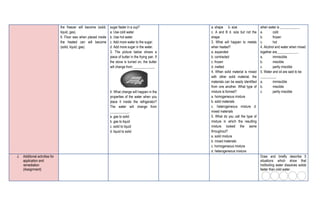
sugar faster in a cup?
a. Use cold water.
b. Use hot water.
c. Add more water to the sugar.
d. Add more sugar in the water.
3. The picture below shows a
piece of butter in the frying pan. If
the stove is turned on, the butter
will change from ____________,
4. What change will happen in the
properties of the water when you
place it inside the refrigerator?
The water will change from
___________.
a. gas to solid
b. gas to liquid
c. solid to liquid
d. liquid to solid
a. shape b. size
c. A and B d. size but not the
shape
3. What will happen to metals
when heated?
a. expanded
b. contracted
c. frozen
d. melted
4. When solid material is mixed
with other solid material, the
materials can be easily identified
from one another. What type of
mixture is formed?
a. homogeneous mixture
b. solid materials
c. heterogeneous mixture d.
mixed materials
5. What do you call the type of
mixture in which the resulting
mixture looked the same
throughout?
a. solid mixture
b. mixed materials
c. homogeneous mixture
d. heterogeneous mixture
when water is ___________.
a. cold
b. frozen
c. hot
4. Alcohol and water when mixed
together are____________.
a. immiscible
b. miscible
c. partly miscible
5. Water and oil are said to be
_________.
a. immiscible
b. miscible
c. partly miscible
J. Additional activities for
application and
remediation
(Assignment)
Draw and briefly describe 5
situations which show that
hot/boiling water dissolves solids
faster than cold water.
10.
IV.REMARKS
V.EFLECTION
A. No. oflearners who earned
80%
___ of Learners who earned 80%
above
___ of Learners who earned 80%
above
___ of Learners who earned 80%
above
___ of Learners who earned
80% above
___ of Learners who earned 80%
above
B . No. of learners who scored
below 80% (needs remediation)
___ of Learners who require
additional activities for
remediation
___ of Learners who require
additional activities for
remediation
___ of Learners who require
additional activities for
remediation
___ of Learners who require
additional activities for
remediation
___ of Learners who require
additional activities for
remediation
C. No. of learners who have
caught up with the lesson
___Yes ___No
____ of Learners who caught up
with the lesson
___Yes ___No
____ of Learners who caught up
the lesson
___Yes ___No
____ of Learners who caught up
the lesson
___Yes ___No
____ of Learners who caught up
the lesson
___Yes ___No
____ of Learners who caught up
the lesson
D. No of learners who continue to
require remediation
___ of Learners who continue to
require remediation
___ of Learners who continue to
require remediation
___ of Learners who continue to
require remediation
___ of Learners who continue to
require remediation
___ of Learners who continue to
require remediation
E. Which of my teaching
strategies works well? Why?
Strategies used that work well:
__Group collaboration
__Games
__Power Point Presentation
__Answering preliminary
__activities/exercises
__Discussion
__Think-Pair-Share
Strategies used that work well:
__Group collaboration
__Games
__Power Point Presentation
__Answering preliminary
__activities/exercises
__Discussion
__Think-Pair-Share
Strategies used that work well:
__Group collaboration
__Games
__Power Point Presentation
__Answering preliminary
__activities/exercises
__Discussion
__Think-Pair-Share
Strategies used that work well:
__Group collaboration
__Games
__Power Point Presentation
__Answering preliminary
__activities/exercises
__Discussion
__Think-Pair-Share
Strategies used that work well:
__Group collaboration
__Games
__Power Point Presentation
__Answering preliminary
__activities/exercises
__Discussion
__Think-Pair-Share
F. What difficulties did I
encounter that my principal
/supervisor can help me solve?
__Comprehension
__Lack of Interest of pupils
__Comprehension
__Lack of Interest of pupils
__Comprehension
__Lack of Interest of pupils
__Comprehension
__Lack of Interest of pupils
__Comprehension
__Lack of Interest of pupils
G. What innovation or localized
materials did I use/discover that I
wish to share w/other teachers?
Planned Innovations:
__Fashcards
__Pictures
__Learning Activity Sheets
__Math Module
Planned Innovations:
__Fashcards
__Pictures
__Learning Activity Sheets
__Math Module
Planned Innovations:
__Fashcards
__Pictures
__Learning Activity Sheets
__Math Module
Planned Innovations:
__Fashcards
__Pictures
__Learning Activity Sheets
__Math Module
Planned Innovations:
__Fashcards
__Pictures
__Learning Activity Sheets
__Math Module