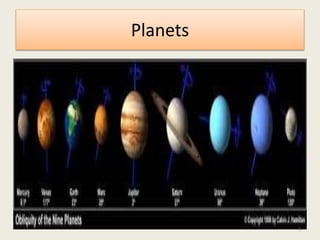
Planets
1
Ch.8 Lesson 6
Planets
• ( Objectives )
• The student be able to :
• 1-Explore and make a model of an
orbit.
• 2-Discuss that planets in our solar
system orbit the Sun at different rates
• 3-Understand that each planet has
unique characteristics.
• 4-Discuss various methods of space
exploration that are used by scientists
(Vocabulary):
Solar System
Planets
2
Ch.8 Lesson 6
Planets
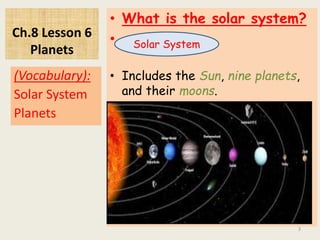
• What is the solar system?
•
• Includes the Sun, nine planets,
and their moons.
(Vocabulary):
Solar System
Planets
3
Solar System
Ch.8 Lesson 6
Planets
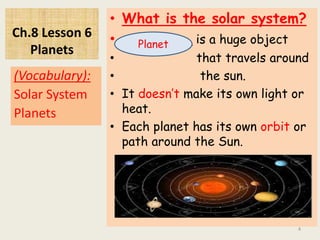
• What is the solar system?
• is a huge object
• that travels around
• the sun.
• It doesn’t make its own light or
heat.
• Each planet has its own orbit or
path around the Sun.
(Vocabulary):
Solar System
Planets
4
Planet
Ch.8 Lesson 6
Planets
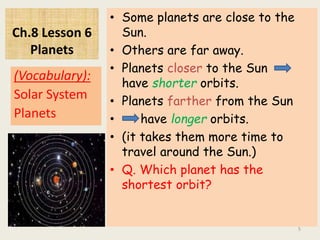
• Some planets are close to the
Sun.
• Others are far away.
• Planets closer to the Sun
have shorter orbits.
• Planets farther from the Sun
• have longer orbits.
• (it takes them more time to
travel around the Sun.)
• Q. Which planet has the
shortest orbit?
(Vocabulary):
Solar System
Planets
5
Ch.8 Lesson 6
Planets
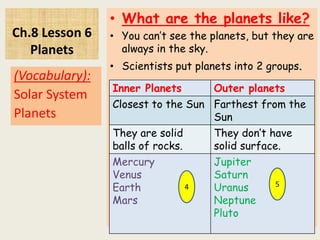
• What are the planets like?
• You can’t see the planets, but they are
always in the sky.
• Scientists put planets into 2 groups.
•
(Vocabulary):
Solar System
Planets
6
Inner Planets Outer planets
Closest to the Sun Farthest from the
Sun
They are solid
balls of rocks.
They don’t have
solid surface.
Mercury
Venus
Earth
Mars
Jupiter
Saturn
Uranus
Neptune
Pluto
4 5
Ch.8 Lesson 6
Planets
•
(Vocabulary):
Solar System
Planets
7
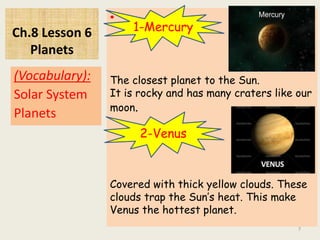
1-Mercury
The closest planet to the Sun.
It is rocky and has many craters like our
moon.
2-Venus
Covered with thick yellow clouds. These
clouds trap the Sun’s heat. This make
Venus the hottest planet.
Ch.8 Lesson 6
Planets
•
(Vocabulary):
Solar System
Planets
8
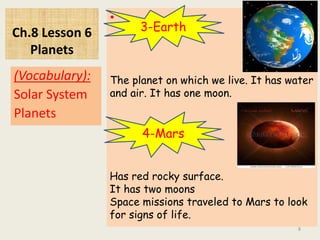
3-Earth
The planet on which we live. It has water
and air. It has one moon.
4-Mars
Has red rocky surface.
It has two moons
Space missions traveled to Mars to look
for signs of life.
Ch.8 Lesson 6
Planets
•
(Vocabulary):
Solar System
Planets
9
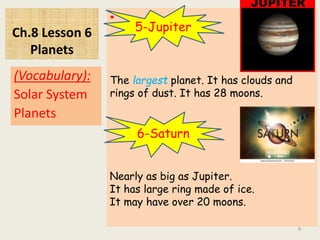
5-Jupiter
The largest planet. It has clouds and
rings of dust. It has 28 moons.
6-Saturn
Nearly as big as Jupiter.
It has large ring made of ice.
It may have over 20 moons.
Ch.8 Lesson 6
Planets
•
(Vocabulary):
Solar System
Planets
10
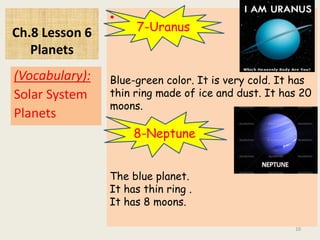
7-Uranus
Blue-green color. It is very cold. It has
thin ring made of ice and dust. It has 20
moons.
8-Neptune
The blue planet.
It has thin ring .
It has 8 moons.
Ch.8 Lesson 6
Planets
•
• Q. How are the inner planets
alike?
(Vocabulary):
Solar System
Planets
11
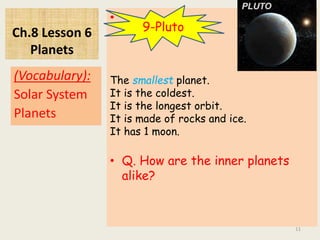
9-Pluto
The smallest planet.
It is the coldest.
It is the longest orbit.
It is made of rocks and ice.
It has 1 moon.
Ch.8 Lesson 6
Planets
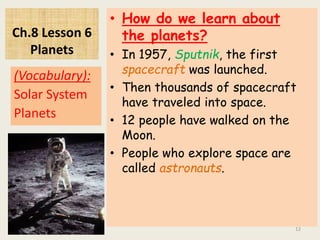
• How do we learn about
the planets?
• In 1957, Sputnik, the first
spacecraft was launched.
• Then thousands of spacecraft
have traveled into space.
• 12 people have walked on the
Moon.
• People who explore space are
called astronauts.
(Vocabulary):
Solar System
Planets
12
Ch.8 Lesson 6
Planets
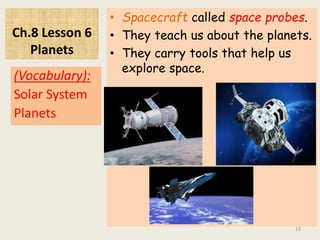
• Spacecraft called space probes.
• They teach us about the planets.
• They carry tools that help us
explore space.
(Vocabulary):
Solar System
Planets
13
Ch.8 Lesson 6
Planets
( Check for understanding)
1-How many planets are there in
our solar system?
2-Which planet has the shortest
orbit? The longest orbit?
3-What are some ways to learn
about space ?
(Vocabulary):
Solar System
Planets
14

Planets g2

  • 1.
  • 2.
    Ch.8 Lesson 6 Planets •( Objectives ) • The student be able to : • 1-Explore and make a model of an orbit. • 2-Discuss that planets in our solar system orbit the Sun at different rates • 3-Understand that each planet has unique characteristics. • 4-Discuss various methods of space exploration that are used by scientists (Vocabulary): Solar System Planets 2
  • 3.
    Ch.8 Lesson 6 Planets •What is the solar system? • • Includes the Sun, nine planets, and their moons. (Vocabulary): Solar System Planets 3 Solar System
  • 4.
    Ch.8 Lesson 6 Planets •What is the solar system? • is a huge object • that travels around • the sun. • It doesn’t make its own light or heat. • Each planet has its own orbit or path around the Sun. (Vocabulary): Solar System Planets 4 Planet
  • 5.
    Ch.8 Lesson 6 Planets •Some planets are close to the Sun. • Others are far away. • Planets closer to the Sun have shorter orbits. • Planets farther from the Sun • have longer orbits. • (it takes them more time to travel around the Sun.) • Q. Which planet has the shortest orbit? (Vocabulary): Solar System Planets 5
  • 6.
    Ch.8 Lesson 6 Planets •What are the planets like? • You can’t see the planets, but they are always in the sky. • Scientists put planets into 2 groups. • (Vocabulary): Solar System Planets 6 Inner Planets Outer planets Closest to the Sun Farthest from the Sun They are solid balls of rocks. They don’t have solid surface. Mercury Venus Earth Mars Jupiter Saturn Uranus Neptune Pluto 4 5
  • 7.
    Ch.8 Lesson 6 Planets • (Vocabulary): SolarSystem Planets 7 1-Mercury The closest planet to the Sun. It is rocky and has many craters like our moon. 2-Venus Covered with thick yellow clouds. These clouds trap the Sun’s heat. This make Venus the hottest planet.
  • 8.
    Ch.8 Lesson 6 Planets • (Vocabulary): SolarSystem Planets 8 3-Earth The planet on which we live. It has water and air. It has one moon. 4-Mars Has red rocky surface. It has two moons Space missions traveled to Mars to look for signs of life.
  • 9.
    Ch.8 Lesson 6 Planets • (Vocabulary): SolarSystem Planets 9 5-Jupiter The largest planet. It has clouds and rings of dust. It has 28 moons. 6-Saturn Nearly as big as Jupiter. It has large ring made of ice. It may have over 20 moons.
  • 10.
    Ch.8 Lesson 6 Planets • (Vocabulary): SolarSystem Planets 10 7-Uranus Blue-green color. It is very cold. It has thin ring made of ice and dust. It has 20 moons. 8-Neptune The blue planet. It has thin ring . It has 8 moons.
  • 11.
    Ch.8 Lesson 6 Planets • •Q. How are the inner planets alike? (Vocabulary): Solar System Planets 11 9-Pluto The smallest planet. It is the coldest. It is the longest orbit. It is made of rocks and ice. It has 1 moon.
  • 12.
    Ch.8 Lesson 6 Planets •How do we learn about the planets? • In 1957, Sputnik, the first spacecraft was launched. • Then thousands of spacecraft have traveled into space. • 12 people have walked on the Moon. • People who explore space are called astronauts. (Vocabulary): Solar System Planets 12
  • 13.
    Ch.8 Lesson 6 Planets •Spacecraft called space probes. • They teach us about the planets. • They carry tools that help us explore space. (Vocabulary): Solar System Planets 13
  • 14.
    Ch.8 Lesson 6 Planets (Check for understanding) 1-How many planets are there in our solar system? 2-Which planet has the shortest orbit? The longest orbit? 3-What are some ways to learn about space ? (Vocabulary): Solar System Planets 14