Changes affected by
temperature
Matter can be solid, liquid and gas. Matter is made
up of very small particles called molecules.
These molecules are always moving because they
contain energy.
Molecules are the smallest particles that make up matter.
Energy is the ability to cause or to do work.
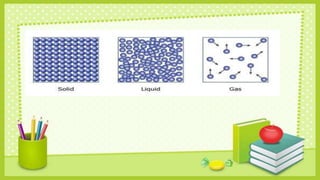
The molecules of a solid are close together and are held
tightly bound to one another. They cannot move freely
and can only vibrate. This is why solids have a definite
shape.
(to vibrate is to move continuously and rapidly to and
fro.)
Liquid molecules have some spaces between them. They
move more freely and are spaced farther apart compared
with the molecules in a solid. They take the shape of their
container.
Gas molecules are spaced even farther apart and move
more freely in any direction compared with liquid
molecules. They take the shape of their container as well.
A change in state occur when there is an increase or decrease in
temperature.
Increase of temperature(heat): the molecules move faster and the
space between the molecules becomes bigger. That is the time
the molecules of the object become farther apart.
Matter change from liquid state to
a gas state.
Decrease of temperature: the molecules move slower. The space
between molecules become smaller and the molecules become
closer together. These change are observed when matter
experiences lower temperatures. Energy is lost and matter
changes from liquid state to a solid state. The same occur when
matter changes from gas state to liquid state.
1. Melting
2. Evaporation
3. Sublimation
4. Condensation
5. Freezing
Melting
Melting occurs when matter changes from solid to
liquid.
Changes affected by temperature

Changes affected by temperature

  • 1.
  • 2.
    Matter can besolid, liquid and gas. Matter is made up of very small particles called molecules. These molecules are always moving because they contain energy.
  • 3.
    Molecules are thesmallest particles that make up matter. Energy is the ability to cause or to do work.
  • 5.
    The molecules ofa solid are close together and are held tightly bound to one another. They cannot move freely and can only vibrate. This is why solids have a definite shape. (to vibrate is to move continuously and rapidly to and fro.)
  • 6.
    Liquid molecules havesome spaces between them. They move more freely and are spaced farther apart compared with the molecules in a solid. They take the shape of their container.
  • 7.
    Gas molecules arespaced even farther apart and move more freely in any direction compared with liquid molecules. They take the shape of their container as well.
  • 8.
    A change instate occur when there is an increase or decrease in temperature. Increase of temperature(heat): the molecules move faster and the space between the molecules becomes bigger. That is the time the molecules of the object become farther apart. Matter change from liquid state to a gas state.
  • 9.
    Decrease of temperature:the molecules move slower. The space between molecules become smaller and the molecules become closer together. These change are observed when matter experiences lower temperatures. Energy is lost and matter changes from liquid state to a solid state. The same occur when matter changes from gas state to liquid state.
  • 10.
    1. Melting 2. Evaporation 3.Sublimation 4. Condensation 5. Freezing
  • 11.
    Melting Melting occurs whenmatter changes from solid to liquid.