Lesson: States of Matter
Content: Science
Grade Level: 2nd
Instructor: Rachael Vigder
April 12, 2009
Main Menu
             Content


             Posttest


            End Show


            Credit Page
Curriculum Objectives 1.1
• COMPETENCY GOAL 3: The learner will
  observe and conduct investigations to build an
  understanding of changes in properties.
 ▫ 3.01: Identify three states of matter.
    Solid
    Liquid
    Gas
                   North Carolina Standard
                       Course of Study


                  North Carolina Standards:
                   Second Grade Science
Curriculum Objectives 1.2
• COMPETENCY GOAL 3: The learner will observe and
  conduct investigations to build an understanding of
  changes in properties.
  ▫ 3.02: Observe changes in state due to heating and
    cooling of common materials.
  ▫ 3.04: Show that solids, liquids and gases can be
    characterized by their properties.
  ▫ 3.05 Investigate and observe how mixtures can be
    made by combining solids, liquids or gases and how
    they can be separated again.
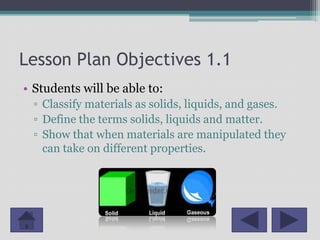
Lesson Plan Objectives 1.1
• Students will be able to:
  ▫ Classify materials as solids, liquids, and gases.
  ▫ Define the terms solids, liquids and matter.
  ▫ Show that when materials are manipulated they
    can take on different properties.
Lesson Plan: Introduction: Matter
• Ask students to write down things they think are
  solids, liquids and gases.
• Ask them to define each of these three things.
• Discuss in groups, or at their table, what they
  have written on their lists.
• The teacher will ask individuals for an example
  from their list and the teacher will confirm or
  deny their categorization.
Lesson Plan: Involvement: Matter
• Each table/group will approach a table to find
  things that are solid and liquid items.
• They will observe the items through touch, look
  and smell.
• On a chart, they will write down what each item
  was and what matter it consisted of.
• They will return to their teams and then be
  asked again, to name solids and liquids.
Lesson Plan: Observation: Matter
• The students have now discovered the difference between liquids and
  solids. Now, they need to experience with gases.
• There will be two items sitting on a particular table, a candle and a balloon.
  (Note: Hands-on is eliminated from this portion due to fire use).
• The candle will be lit by the teacher and she will ask what they expect will
  happen to it.
• A balloon will be blown up with human air and she will ask the students
  what went into it.
• The students should observe the materials and what is happening to the
  materials.
• Students will record observation to their ability and return to seats
What did they learn?
• Solids:
  ▫ Tends to keep its form rather than moving freely,
    molecules are compound, firm and compact.
     Examples: ice cubs, blocks, wood, soap bars, flowers
• Gases:
  ▫ Fluid form of a substance which can expand and fill a
    space. It is not a liquid or solid, but more of a vapor.
     Examples: air, carbon dioxide, heat, steam
• Liquids:
  ▫ Readily flowing, fluid, molecules move freely
    throughout a substance.
     Examples: water, other sources of drinks
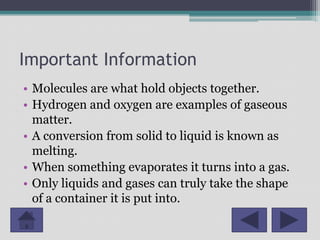
Important Information
• Molecules are what hold objects together.
• Hydrogen and oxygen are examples of gaseous
  matter.
• A conversion from solid to liquid is known as
  melting.
• When something evaporates it turns into a gas.
• Only liquids and gases can truly take the shape
  of a container it is put into.
Let’s try an interactive video!


            Click here to try out the
                video on matter!
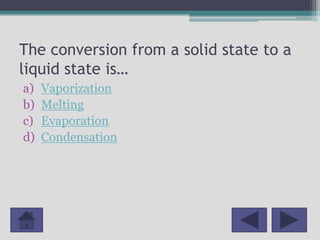
The conversion from a solid state to a
liquid state is…
a)   Vaporization
b)   Melting
c)   Evaporation
d)   Condensation
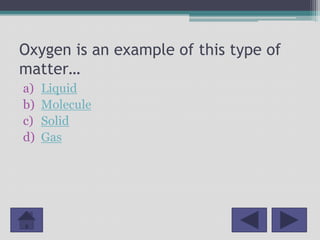
Oxygen is an example of this type of
matter…
a)   Liquid
b)   Molecule
c)   Solid
d)   Gas
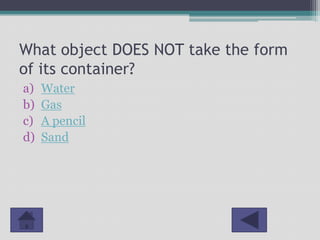
What object DOES NOT take the form
of its container?
a)   Water
b)   Gas
c)   A pencil
d)   Sand
Credit/Works Cited
• Google Images
  ▫ http://www.images.google.com
• Hot Chalk’s Lesson Plans (Solids, Liquids, Gases)
  ▫ http://www.lessonplanspage.com/ScienceDistinguishSolidLiquidAndGa
     s24.htm
• North Carolina Standard Course of Study
  ▫ http://www.ncpublicschools.org/curriculum/
• Second Grade Lesson Plans
  ▫ http://westlakees.wcpss.net/secondgradelinksandlessonplans.htm#matt
     er
• States of Matter Quiz
  ▫ http://dimdima.com/science/quiz/show_quiz.asp?q_aid=13&q_title=St
     ates%20of%20Matter

Power Point

  • 1.
    Lesson: States ofMatter Content: Science Grade Level: 2nd Instructor: Rachael Vigder April 12, 2009
  • 2.
    Main Menu Content Posttest End Show Credit Page
  • 3.
    Curriculum Objectives 1.1 •COMPETENCY GOAL 3: The learner will observe and conduct investigations to build an understanding of changes in properties. ▫ 3.01: Identify three states of matter.  Solid  Liquid  Gas North Carolina Standard Course of Study North Carolina Standards: Second Grade Science
  • 4.
    Curriculum Objectives 1.2 •COMPETENCY GOAL 3: The learner will observe and conduct investigations to build an understanding of changes in properties. ▫ 3.02: Observe changes in state due to heating and cooling of common materials. ▫ 3.04: Show that solids, liquids and gases can be characterized by their properties. ▫ 3.05 Investigate and observe how mixtures can be made by combining solids, liquids or gases and how they can be separated again.
  • 5.
    Lesson Plan Objectives1.1 • Students will be able to: ▫ Classify materials as solids, liquids, and gases. ▫ Define the terms solids, liquids and matter. ▫ Show that when materials are manipulated they can take on different properties.
  • 6.
    Lesson Plan: Introduction:Matter • Ask students to write down things they think are solids, liquids and gases. • Ask them to define each of these three things. • Discuss in groups, or at their table, what they have written on their lists. • The teacher will ask individuals for an example from their list and the teacher will confirm or deny their categorization.
  • 7.
    Lesson Plan: Involvement:Matter • Each table/group will approach a table to find things that are solid and liquid items. • They will observe the items through touch, look and smell. • On a chart, they will write down what each item was and what matter it consisted of. • They will return to their teams and then be asked again, to name solids and liquids.
  • 8.
    Lesson Plan: Observation:Matter • The students have now discovered the difference between liquids and solids. Now, they need to experience with gases. • There will be two items sitting on a particular table, a candle and a balloon. (Note: Hands-on is eliminated from this portion due to fire use). • The candle will be lit by the teacher and she will ask what they expect will happen to it. • A balloon will be blown up with human air and she will ask the students what went into it. • The students should observe the materials and what is happening to the materials. • Students will record observation to their ability and return to seats
  • 9.
    What did theylearn? • Solids: ▫ Tends to keep its form rather than moving freely, molecules are compound, firm and compact.  Examples: ice cubs, blocks, wood, soap bars, flowers • Gases: ▫ Fluid form of a substance which can expand and fill a space. It is not a liquid or solid, but more of a vapor.  Examples: air, carbon dioxide, heat, steam • Liquids: ▫ Readily flowing, fluid, molecules move freely throughout a substance.  Examples: water, other sources of drinks
  • 10.
    Important Information • Moleculesare what hold objects together. • Hydrogen and oxygen are examples of gaseous matter. • A conversion from solid to liquid is known as melting. • When something evaporates it turns into a gas. • Only liquids and gases can truly take the shape of a container it is put into.
  • 11.
    Let’s try aninteractive video! Click here to try out the video on matter!
  • 12.
    The conversion froma solid state to a liquid state is… a) Vaporization b) Melting c) Evaporation d) Condensation
  • 13.
    Oxygen is anexample of this type of matter… a) Liquid b) Molecule c) Solid d) Gas
  • 14.
    What object DOESNOT take the form of its container? a) Water b) Gas c) A pencil d) Sand
  • 17.
    Credit/Works Cited • GoogleImages ▫ http://www.images.google.com • Hot Chalk’s Lesson Plans (Solids, Liquids, Gases) ▫ http://www.lessonplanspage.com/ScienceDistinguishSolidLiquidAndGa s24.htm • North Carolina Standard Course of Study ▫ http://www.ncpublicschools.org/curriculum/ • Second Grade Lesson Plans ▫ http://westlakees.wcpss.net/secondgradelinksandlessonplans.htm#matt er • States of Matter Quiz ▫ http://dimdima.com/science/quiz/show_quiz.asp?q_aid=13&q_title=St ates%20of%20Matter