COMPARATIVE
EDUCATIONAL
SYSTEM
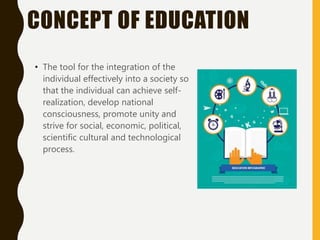
CONCEPT OF EDUCATION
• The tool for the integration of the
individual effectively into a society so
that the individual can achieve self-
realization, develop national
consciousness, promote unity and
strive for social, economic, political,
scientific cultural and technological
process.
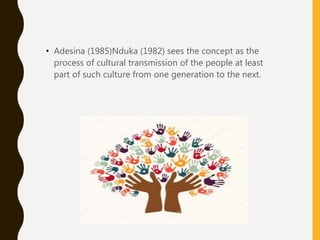
• Adesina (1985)Nduka (1982) sees the concept as the
process of cultural transmission of the people at least
part of such culture from one generation to the next.
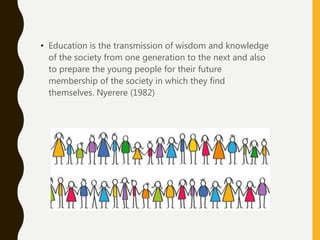
• Education is the transmission of wisdom and knowledge
of the society from one generation to the next and also
to prepare the young people for their future
membership of the society in which they find
themselves. Nyerere (1982)
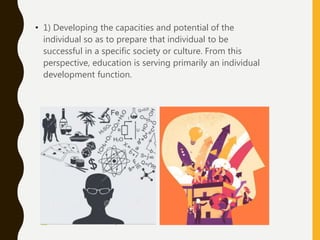
• 1) Developing the capacities and potential of the
individual so as to prepare that individual to be
successful in a specific society or culture. From this
perspective, education is serving primarily an individual
development function.
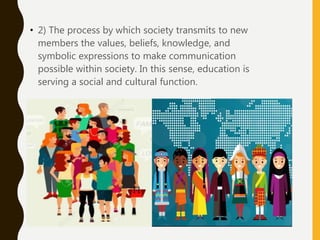
• 2) The process by which society transmits to new
members the values, beliefs, knowledge, and
symbolic expressions to make communication
possible within society. In this sense, education is
serving a social and cultural function.
What is
Comparative
Education?
ADEYINKA (1994) GIVES THE FOLLOWING
DEFINITIONS FOR THE CONCEPT:
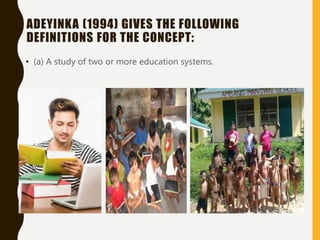
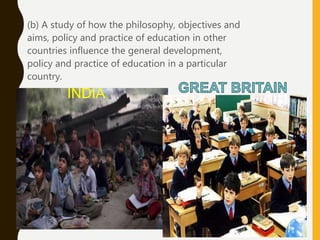
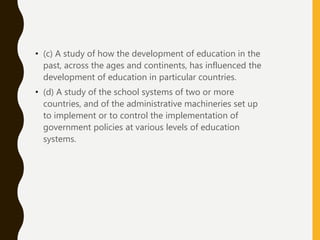
• (a) A study of two or more education systems.
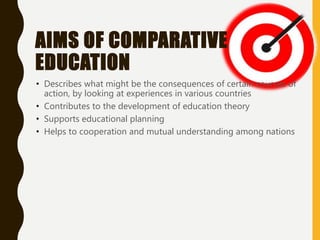
• (b) A study of how the philosophy, objectives and
aims, policy and practice of education in other
countries influence the general development,
policy and practice of education in a particular
country.
INDIA
• (c) A study of how the development of education in the
past, across the ages and continents, has influenced the
development of education in particular countries.
• (d) A study of the school systems of two or more
countries, and of the administrative machineries set up
to implement or to control the implementation of
government policies at various levels of education
systems.
AIMS OF COMPARATIVE
EDUCATION
• Describes what might be the consequences of certain courses of
action, by looking at experiences in various countries
• Contributes to the development of education theory
• Supports educational planning
• Helps to cooperation and mutual understanding among nations
CONCEPT OF COMPARATIVE
EDUCATION
• Comparative Education according to Good (1962) is a field of
study dealing with the comparison of current educational theory
and practice in different countries for the purpose of
broadening and deepening understanding of educational
problems beyond the boundaries of one's own country.
Comparative education goes beyond the comparison of
education philosophies but also includes the comparison of the
real education practices.
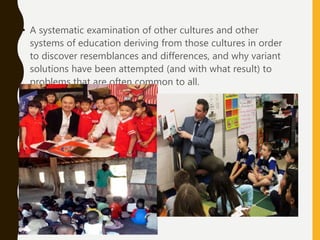
• A systematic examination of other cultures and other
systems of education deriving from those cultures in order
to discover resemblances and differences, and why variant
solutions have been attempted (and with what result) to
problems that are often common to all.
• Mallinson (1975)Adejumobi (1994) defines the concept as a
critical study of educational similarities and differences
prevailing with a particular society or culture or among various
societies and cultures.
THE SCOPE OF
COMPARATIVE EDUCATION
• The term "scope" according to Longman dictionary of
contemporary English could mean:Space or chance for actions
or thought.Subjects from where Comparative Education draws
its contents include the following:(a) History of Education (b)
Philosophy of Education (c) Sociology of Education
• (d) Anthropology
• (e) Economics
• (f) Geography
• (g) Psychology
• (h) Statistics
• (i) Literature
• (j) Political geography
• (k) Political science and
• (l) The International relations.
THE PURPOSE OF
COMPARATIVE EDUCATION
• Hans (1992) concludes that:The analytical study of these factors
from historical perspective and the comparison of attempted
solution of resultant problems are the main purpose of
comparative education.
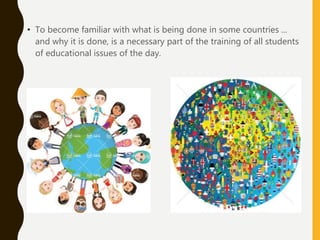
• To become familiar with what is being done in some countries ...
and why it is done, is a necessary part of the training of all students
of educational issues of the day.
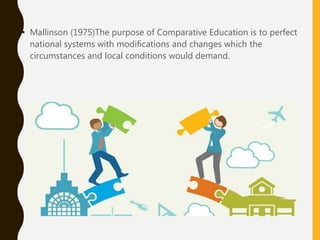
• Mallinson (1975)The purpose of Comparative Education is to perfect
national systems with modifications and changes which the
circumstances and local conditions would demand.
REASONS FOR STUDYING
COMPARATIVE EDUCATION
• (a) To assist in the understanding of one's educational
institutions as well as educational practices.
• (b) To assist in the understanding of the factors that are
responsible for various educational changes.
• (c) To educate the students and teachers on the
procedure through which educational changes occur.
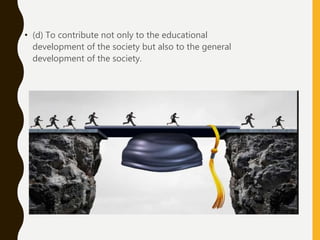
• (d) To contribute not only to the educational
development of the society but also to the general
development of the society.
• (e) To serve as an academic discipline.
• (f) To assist in solving one's educational problems.
• (g) To open one's eyes to the educational philosophies,
theories and practices of other countries.
• (h) To assist both the students and teachers of discipline
in gathering reliable information concerning educational
system.
• (i) To assist in the Promotion of international
relationship.
• (j) To contribute to the formulation of a country's
educational systems.
ASSIGNMENTS
• Analyse the concept of Education according to various
definitions provided and develop your own definition of
Education.
• Also justify any definition that mostly appeals to you. Critically
evaluate the concept of Comparative Education in light of
various authors.
• Present purposes of Comparative Education (Oral
Presentation with the support of arguments)
• Present various reasons of studying comparative
education (Oral presentation with the support of
arguments)

Comparative educational system

  • 1.
  • 2.
    CONCEPT OF EDUCATION •The tool for the integration of the individual effectively into a society so that the individual can achieve self- realization, develop national consciousness, promote unity and strive for social, economic, political, scientific cultural and technological process.
  • 3.
    • Adesina (1985)Nduka(1982) sees the concept as the process of cultural transmission of the people at least part of such culture from one generation to the next.
  • 4.
    • Education isthe transmission of wisdom and knowledge of the society from one generation to the next and also to prepare the young people for their future membership of the society in which they find themselves. Nyerere (1982)
  • 5.
    • 1) Developingthe capacities and potential of the individual so as to prepare that individual to be successful in a specific society or culture. From this perspective, education is serving primarily an individual development function.
  • 6.
    • 2) Theprocess by which society transmits to new members the values, beliefs, knowledge, and symbolic expressions to make communication possible within society. In this sense, education is serving a social and cultural function.
  • 7.
  • 8.
    ADEYINKA (1994) GIVESTHE FOLLOWING DEFINITIONS FOR THE CONCEPT: • (a) A study of two or more education systems.
  • 9.
    • (b) Astudy of how the philosophy, objectives and aims, policy and practice of education in other countries influence the general development, policy and practice of education in a particular country. INDIA
  • 10.
    • (c) Astudy of how the development of education in the past, across the ages and continents, has influenced the development of education in particular countries. • (d) A study of the school systems of two or more countries, and of the administrative machineries set up to implement or to control the implementation of government policies at various levels of education systems.
  • 11.
    AIMS OF COMPARATIVE EDUCATION •Describes what might be the consequences of certain courses of action, by looking at experiences in various countries • Contributes to the development of education theory • Supports educational planning • Helps to cooperation and mutual understanding among nations
  • 12.
    CONCEPT OF COMPARATIVE EDUCATION •Comparative Education according to Good (1962) is a field of study dealing with the comparison of current educational theory and practice in different countries for the purpose of broadening and deepening understanding of educational problems beyond the boundaries of one's own country. Comparative education goes beyond the comparison of education philosophies but also includes the comparison of the real education practices.
  • 13.
    • A systematicexamination of other cultures and other systems of education deriving from those cultures in order to discover resemblances and differences, and why variant solutions have been attempted (and with what result) to problems that are often common to all.
  • 14.
    • Mallinson (1975)Adejumobi(1994) defines the concept as a critical study of educational similarities and differences prevailing with a particular society or culture or among various societies and cultures.
  • 15.
    THE SCOPE OF COMPARATIVEEDUCATION • The term "scope" according to Longman dictionary of contemporary English could mean:Space or chance for actions or thought.Subjects from where Comparative Education draws its contents include the following:(a) History of Education (b) Philosophy of Education (c) Sociology of Education
  • 16.
    • (d) Anthropology •(e) Economics • (f) Geography • (g) Psychology • (h) Statistics • (i) Literature • (j) Political geography • (k) Political science and • (l) The International relations.
  • 17.
    THE PURPOSE OF COMPARATIVEEDUCATION • Hans (1992) concludes that:The analytical study of these factors from historical perspective and the comparison of attempted solution of resultant problems are the main purpose of comparative education.
  • 18.
    • To becomefamiliar with what is being done in some countries ... and why it is done, is a necessary part of the training of all students of educational issues of the day.
  • 19.
    • Mallinson (1975)Thepurpose of Comparative Education is to perfect national systems with modifications and changes which the circumstances and local conditions would demand.
  • 20.
    REASONS FOR STUDYING COMPARATIVEEDUCATION • (a) To assist in the understanding of one's educational institutions as well as educational practices. • (b) To assist in the understanding of the factors that are responsible for various educational changes.
  • 21.
    • (c) Toeducate the students and teachers on the procedure through which educational changes occur.
  • 22.
    • (d) Tocontribute not only to the educational development of the society but also to the general development of the society.
  • 23.
    • (e) Toserve as an academic discipline. • (f) To assist in solving one's educational problems. • (g) To open one's eyes to the educational philosophies, theories and practices of other countries.
  • 24.
    • (h) Toassist both the students and teachers of discipline in gathering reliable information concerning educational system. • (i) To assist in the Promotion of international relationship. • (j) To contribute to the formulation of a country's educational systems.
  • 25.
    ASSIGNMENTS • Analyse theconcept of Education according to various definitions provided and develop your own definition of Education. • Also justify any definition that mostly appeals to you. Critically evaluate the concept of Comparative Education in light of various authors.
  • 26.
    • Present purposesof Comparative Education (Oral Presentation with the support of arguments) • Present various reasons of studying comparative education (Oral presentation with the support of arguments)