Comparative Education,
Its History and Scope
Presented By T
ahira Rafiq
What is Comparative Education?
⚫ Comparative Education is the comparison of various
philosophies of education based not only on
theories but the actual practices which prevail
(Isaac Kandel 1957).
⚫ Comparative Education is a field of study dealing
with the comparison ofcurrent educational theory
and practice in different countries for the purposeof
broadening and deepening understanding of
educational problemsbeyond the boundaries of
one's own country (Carter Good 1962).
Professionals in this area of endeavor are
absorbed in advancing evocative terminologies
and guidelines for education worldwide,
enhancing educational structures and producing a
context to which the success and effectively of
education programs and initiatives can be
assessed
History of Comparative Education
⚫ Harold J. Noah (1925- January 2019) was
an American educator, whose research and writing
have focused on comparative education
and economics of education.
⚫ In studies of Soviet education in the 1960s and 1970s
Noah dealt primarily with the economic and public
finance aspects of schools and higher education in
that country.
⚫ In his teaching he espoused the use of what were at
the time increasingly accepted concepts of human
capital and rates of return to examine the nature and
extent of private and public investments in education
and training, in both market and command
economies.
⚫ From the mid-1960s onward, Noah advocated
the use of empirical social science methods
in comparative education. Much of this work
was done in collaboration with his long-standing
coauthor, Max A. Eckstein.
⚫ This collaboration began with “Toward A
Science of Comparative Education”, which
described and critiqued the development over
time of methods of comparing national systems
of education.
Noah’s Notable Work
⚫ ”Financing Soviet Schools” (1966). This was
his PhD dissertation. A major finding was that,
contrary to general belief in the West, the
Soviet government was more financially
supportive of general secondary education
than of specialist vocational education.
⚫ ”The Economics of Education in the U.S.S.R.”
(1969). Translation of a collection of
conference papers presented in 1964 at the
Lenin Pedagogical Institute, Moscow. The
Soviet editor was Professor V.A. Zhamin,
rector of the Institute.
⚫ “Toward a Science of Comparative Education”
(1969), and the companion book, “Scientific
Investigations in Comparative Education” (1969).
Both books coauthored with Max A. Eckstein. The
two books opened a vigorous debate among
scholars and researchers in comparative
education about the merits and demerits of the
approach advocated. This is a debate far from
settled.
⚫ ”The National Case Study: An Empirical
Comparative Study of Twenty-One Educational
Systems. International Studies in Evaluation VII”
(1976). Coauthored with A.H. Passow, Max A.
Eckstein and John Mallea). Based upon data
collected by the International Association for the
Evaluation of Educational Achievement (IEA).
⚫ ”Secondary School Examinations: International
Perspectives on Policies and Practice” (1993).
Coauthored with Max A. Eckstein. Describes,
analyses, and critiques secondary school leaving
examinations in eight major countries. Suggests
some lessons for future United States practise.
Advocates a positive though cautious approach
to a nationwide system of examinations.
⚫ ”Doing Comparative Education: Three Decades of
Collaboration” (1998). Coauthored with Max A.
Eckstein. Brings together selections from Noah’s
and Eckstein’s published works. Contains a
foreword by Philip Foster, who locates the
coauthors in the development of comparative
education and subjects their work to a friendly,
yet searching review
⚫ ”Fraud and Education: The Worm in the
Apple” (2001). Coauthored with Max A.
Eckstein. This study employs data from many
countries to describe the nature, extent, and
possible consequences of dishonest conduct
in and around schooling, higher education,
and scientific research. It suggests some
remedies, while cautioning that continuing
advances in the ease of electronic
communication and an increasingly
competitive social ethos all militate against
easy solutions to the problems raised by
cheating, professional misconduct and
falsification of research findings.
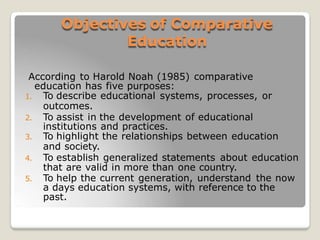
Objectives of Comparative
Education
According to Harold Noah (1985) comparative
education has five purposes:
1. To describe educational systems, processes, or
outcomes.
2. To assist in the development of educational
institutions and practices.
3. To highlight the relationships between education
and society.
4. To establish generalized statements about education
that are valid in more than one country.
5. To help the current generation, understand the now
a days education systems, with reference to the
past.
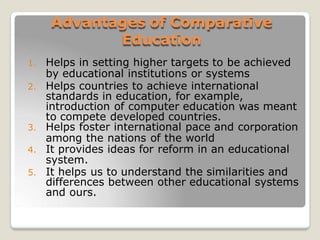
1. Helps in setting higher targets to be achieved
by educational institutions or systems
2. Helps countries to achieve international
standards in education, for example,
introduction of computer education was meant
to compete developed countries.
3. Helps foster international pace and corporation
among the nations of the world
4. It provides ideas for reform in an educational
system.
5. It helps us to understand the similarities and
differences between other educational systems
and ours.
Advantages of Comparative
Education

Noah and Eckstein Scientific Method

  • 1.
    Comparative Education, Its Historyand Scope Presented By T ahira Rafiq
  • 2.
    What is ComparativeEducation? ⚫ Comparative Education is the comparison of various philosophies of education based not only on theories but the actual practices which prevail (Isaac Kandel 1957). ⚫ Comparative Education is a field of study dealing with the comparison ofcurrent educational theory and practice in different countries for the purposeof broadening and deepening understanding of educational problemsbeyond the boundaries of one's own country (Carter Good 1962).
  • 3.
    Professionals in thisarea of endeavor are absorbed in advancing evocative terminologies and guidelines for education worldwide, enhancing educational structures and producing a context to which the success and effectively of education programs and initiatives can be assessed
  • 4.
    History of ComparativeEducation ⚫ Harold J. Noah (1925- January 2019) was an American educator, whose research and writing have focused on comparative education and economics of education. ⚫ In studies of Soviet education in the 1960s and 1970s Noah dealt primarily with the economic and public finance aspects of schools and higher education in that country. ⚫ In his teaching he espoused the use of what were at the time increasingly accepted concepts of human capital and rates of return to examine the nature and extent of private and public investments in education and training, in both market and command economies.
  • 5.
    ⚫ From themid-1960s onward, Noah advocated the use of empirical social science methods in comparative education. Much of this work was done in collaboration with his long-standing coauthor, Max A. Eckstein. ⚫ This collaboration began with “Toward A Science of Comparative Education”, which described and critiqued the development over time of methods of comparing national systems of education.
  • 6.
    Noah’s Notable Work ⚫”Financing Soviet Schools” (1966). This was his PhD dissertation. A major finding was that, contrary to general belief in the West, the Soviet government was more financially supportive of general secondary education than of specialist vocational education. ⚫ ”The Economics of Education in the U.S.S.R.” (1969). Translation of a collection of conference papers presented in 1964 at the Lenin Pedagogical Institute, Moscow. The Soviet editor was Professor V.A. Zhamin, rector of the Institute.
  • 7.
    ⚫ “Toward aScience of Comparative Education” (1969), and the companion book, “Scientific Investigations in Comparative Education” (1969). Both books coauthored with Max A. Eckstein. The two books opened a vigorous debate among scholars and researchers in comparative education about the merits and demerits of the approach advocated. This is a debate far from settled. ⚫ ”The National Case Study: An Empirical Comparative Study of Twenty-One Educational Systems. International Studies in Evaluation VII” (1976). Coauthored with A.H. Passow, Max A. Eckstein and John Mallea). Based upon data collected by the International Association for the Evaluation of Educational Achievement (IEA).
  • 8.
    ⚫ ”Secondary SchoolExaminations: International Perspectives on Policies and Practice” (1993). Coauthored with Max A. Eckstein. Describes, analyses, and critiques secondary school leaving examinations in eight major countries. Suggests some lessons for future United States practise. Advocates a positive though cautious approach to a nationwide system of examinations. ⚫ ”Doing Comparative Education: Three Decades of Collaboration” (1998). Coauthored with Max A. Eckstein. Brings together selections from Noah’s and Eckstein’s published works. Contains a foreword by Philip Foster, who locates the coauthors in the development of comparative education and subjects their work to a friendly, yet searching review
  • 9.
    ⚫ ”Fraud andEducation: The Worm in the Apple” (2001). Coauthored with Max A. Eckstein. This study employs data from many countries to describe the nature, extent, and possible consequences of dishonest conduct in and around schooling, higher education, and scientific research. It suggests some remedies, while cautioning that continuing advances in the ease of electronic communication and an increasingly competitive social ethos all militate against easy solutions to the problems raised by cheating, professional misconduct and falsification of research findings.
  • 10.
    Objectives of Comparative Education Accordingto Harold Noah (1985) comparative education has five purposes: 1. To describe educational systems, processes, or outcomes. 2. To assist in the development of educational institutions and practices. 3. To highlight the relationships between education and society. 4. To establish generalized statements about education that are valid in more than one country. 5. To help the current generation, understand the now a days education systems, with reference to the past.
  • 11.
    1. Helps insetting higher targets to be achieved by educational institutions or systems 2. Helps countries to achieve international standards in education, for example, introduction of computer education was meant to compete developed countries. 3. Helps foster international pace and corporation among the nations of the world 4. It provides ideas for reform in an educational system. 5. It helps us to understand the similarities and differences between other educational systems and ours. Advantages of Comparative Education