

How to Identify an area of research?
Selecting Area:
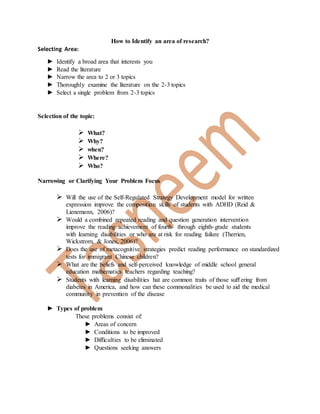
► Identify a broad area that interests you
► Read the literature
► Narrow the area to 2 or 3 topics
► Thoroughly examine the literature on the 2-3 topics
► Select a single problem from 2-3 topics
Selection of the topic:
 What?
 Why?
 when?
 Where?
 Who?
Narrowing or Clarifying Your Problem Focus
 Will the use of the Self-Regulated Strategy Development model for written
expression improve the composition skills of students with ADHD (Reid &
Lienemann, 2006)?
 Would a combined repeated reading and question generation intervention
improve the reading achievement of fourth- through eighth-grade students
with learning disabilities or who are at risk for reading failure (Therrien,
Wickstrom, & Jones, 2006)?
 Does the use of metacognitive strategies predict reading performance on standardized
tests for immigrant Chinese children?
 What are the beliefs and self-perceived knowledge of middle school general
education mathematics teachers regarding teaching?
 Students with learning disabilities hat are common traits of those suffering from
diabetes in America, and how can these commonalities be used to aid the medical
community in prevention of the disease
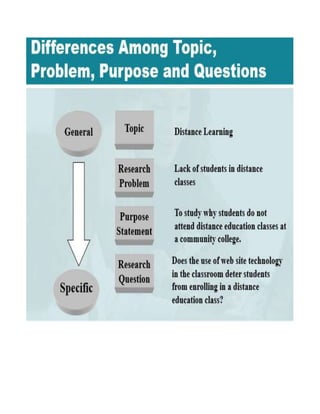
► Types of problem
These problems consist of:
► Areas of concern
► Conditions to be improved
► Difficulties to be eliminated
► Questions seeking answers
Types of question:
Conceptualize that a research study can ask these types of question:
 Descriptive question
 Relationship question
 Difference question
 Exploratory
 Descriptive
 Explanatory
 Predictive
 Evaluative
These sentence stems will support your thinking:
• I would like to improve…
• I am perplexed by…
• Some people are unhappy about…
• I’m really curious about…
• I want to learn more about….
• An idea I would like to try out is…..
• Something I think would really make a difference is….
• Something I would like to change is….
• some areas I am particularly interested in are…
How to identify a problem/topic for research? (https://youtu.be/r8Qj5D38GQU)

How to identify a problem/topic for research? (https://youtu.be/r8Qj5D38GQU)

  • 1.
    How to Identifyan area of research? Selecting Area: ► Identify a broad area that interests you ► Read the literature ► Narrow the area to 2 or 3 topics ► Thoroughly examine the literature on the 2-3 topics ► Select a single problem from 2-3 topics Selection of the topic:  What?  Why?  when?  Where?  Who? Narrowing or Clarifying Your Problem Focus  Will the use of the Self-Regulated Strategy Development model for written expression improve the composition skills of students with ADHD (Reid & Lienemann, 2006)?  Would a combined repeated reading and question generation intervention improve the reading achievement of fourth- through eighth-grade students with learning disabilities or who are at risk for reading failure (Therrien, Wickstrom, & Jones, 2006)?  Does the use of metacognitive strategies predict reading performance on standardized tests for immigrant Chinese children?  What are the beliefs and self-perceived knowledge of middle school general education mathematics teachers regarding teaching?  Students with learning disabilities hat are common traits of those suffering from diabetes in America, and how can these commonalities be used to aid the medical community in prevention of the disease ► Types of problem These problems consist of: ► Areas of concern ► Conditions to be improved ► Difficulties to be eliminated ► Questions seeking answers
  • 2.
    Types of question: Conceptualizethat a research study can ask these types of question:  Descriptive question  Relationship question  Difference question  Exploratory  Descriptive  Explanatory  Predictive  Evaluative These sentence stems will support your thinking: • I would like to improve… • I am perplexed by… • Some people are unhappy about… • I’m really curious about… • I want to learn more about…. • An idea I would like to try out is….. • Something I think would really make a difference is…. • Something I would like to change is…. • some areas I am particularly interested in are…