What is compaction?
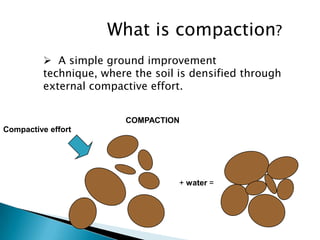
           A simple ground improvement
          technique, where the soil is densified through
          external compactive effort.


                         COMPACTION
Compactive effort


                                    + water =
   There are three method in field compaction

   Rolling
   Ramming
   Vibration
   Rolling - a heavy cylinder is rolled over the
    surface of the soil. Commonly used on sports
    pitches. Roller-compactors are often fitted
    with vibratory devices to enhance their ability.
   Different types of rollers are used for
    Compaction. which are depend on following
    factors
   Contact pressure
   Number of passes(normally 5 to 15)
   Layer thickness (less than 15 cm)
   Speed of roller
   A hand operated rammer consist of a block of
    iron,about 3 to 5 kg in mass,attached to a wooden
    rod.the rammer is lifted for about 0.30 m and dropped
    on the soil to be compacted

   A mechanical rammer is operated by compressed air or
    gasoline power.it is much heavier about 30 to 150 kg.
    mechanical rammers have been used up to a mass of
    1000 kg in some special cases.


   Tampers are used to compact soil adjecent to
    existing structures or confined area as
    trenches,within plinth of building.
   Vibration are induced in the soil during compaction.the
    compactors are available in a variety of forms.when the
    vibrator is mounted on adrum,it is called a vibratory roller.
    these rollers are available both as pneumatic type and the
    smooth wheel type.in a smooth wheel type, a separate motor
    drives an arrangement of eccentric weights to create high
    frequency,low-amplitude,up and down osicillations of the
    drum.
   These rollers are suitable for compacting granular soils.
   Another form of vibratory compactor is a vibrating plate
    compactor. hand operated vibrating plates are also available.
Instrument of Filed Compaction

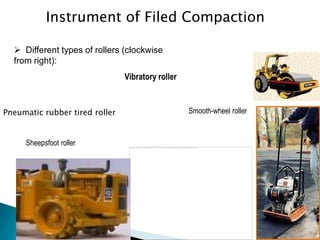
   Different types of rollers (clockwise
  from right):
                               Vibratory roller


Pneumatic rubber tired roller                     Smooth-wheel roller


     Sheepsfoot roller
Smooth Wheeled Roller


             Compacts effectively only to 200-300 mm;
               therefore, place the soil in shallow
               layers (lifts)
Vibrating Plates


    for compacting very small areas

    effective for granular soils
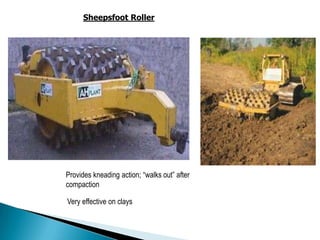
Sheepsfoot Roller


   Provides kneading action; “walks out” after
    compaction

    Very effective on clays
Impact Roller


   Provides deeper (2-3m) compaction. e.g., air
    field
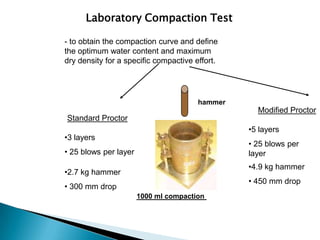
Laboratory Compaction Test

- to obtain the compaction curve and define
the optimum water content and maximum
dry density for a specific compactive effort.


                                       hammer
                                                    Modified Proctor
Standard Proctor
                                                  •5 layers
•3 layers
                                                  • 25 blows per
• 25 blows per layer                              layer
                                                  •4.9 kg hammer
•2.7 kg hammer
                                                  • 450 mm drop
• 300 mm drop
                       1000 ml compaction mould

Compactionfield method and interpretation of lab method

  • 1.
    What is compaction?  A simple ground improvement technique, where the soil is densified through external compactive effort. COMPACTION Compactive effort + water =
  • 2.
    There are three method in field compaction  Rolling  Ramming  Vibration
  • 3.
    Rolling - a heavy cylinder is rolled over the surface of the soil. Commonly used on sports pitches. Roller-compactors are often fitted with vibratory devices to enhance their ability.  Different types of rollers are used for Compaction. which are depend on following factors  Contact pressure  Number of passes(normally 5 to 15)  Layer thickness (less than 15 cm)  Speed of roller
  • 4.
    A hand operated rammer consist of a block of iron,about 3 to 5 kg in mass,attached to a wooden rod.the rammer is lifted for about 0.30 m and dropped on the soil to be compacted  A mechanical rammer is operated by compressed air or gasoline power.it is much heavier about 30 to 150 kg. mechanical rammers have been used up to a mass of 1000 kg in some special cases.  Tampers are used to compact soil adjecent to existing structures or confined area as trenches,within plinth of building.
  • 5.
    Vibration are induced in the soil during compaction.the compactors are available in a variety of forms.when the vibrator is mounted on adrum,it is called a vibratory roller. these rollers are available both as pneumatic type and the smooth wheel type.in a smooth wheel type, a separate motor drives an arrangement of eccentric weights to create high frequency,low-amplitude,up and down osicillations of the drum.  These rollers are suitable for compacting granular soils.  Another form of vibratory compactor is a vibrating plate compactor. hand operated vibrating plates are also available.
  • 6.
    Instrument of FiledCompaction  Different types of rollers (clockwise from right):  Vibratory roller Pneumatic rubber tired roller  Smooth-wheel roller  Sheepsfoot roller
  • 7.
    Smooth Wheeled Roller Compacts effectively only to 200-300 mm; therefore, place the soil in shallow layers (lifts)
  • 8.
    Vibrating Plates  for compacting very small areas effective for granular soils
  • 9.
    Sheepsfoot Roller  Provides kneading action; “walks out” after compaction Very effective on clays
  • 10.
    Impact Roller  Provides deeper (2-3m) compaction. e.g., air field
  • 11.
    Laboratory Compaction Test -to obtain the compaction curve and define the optimum water content and maximum dry density for a specific compactive effort. hammer Modified Proctor Standard Proctor •5 layers •3 layers • 25 blows per • 25 blows per layer layer •4.9 kg hammer •2.7 kg hammer • 450 mm drop • 300 mm drop 1000 ml compaction mould