Introduction of International
              Business Environment
                Domestic v/s International Business
                  Liberalization, Privatization and
                            Globalization

Saturday, December 08, 2012    Dr. S. Jain            1
Concept of International Business
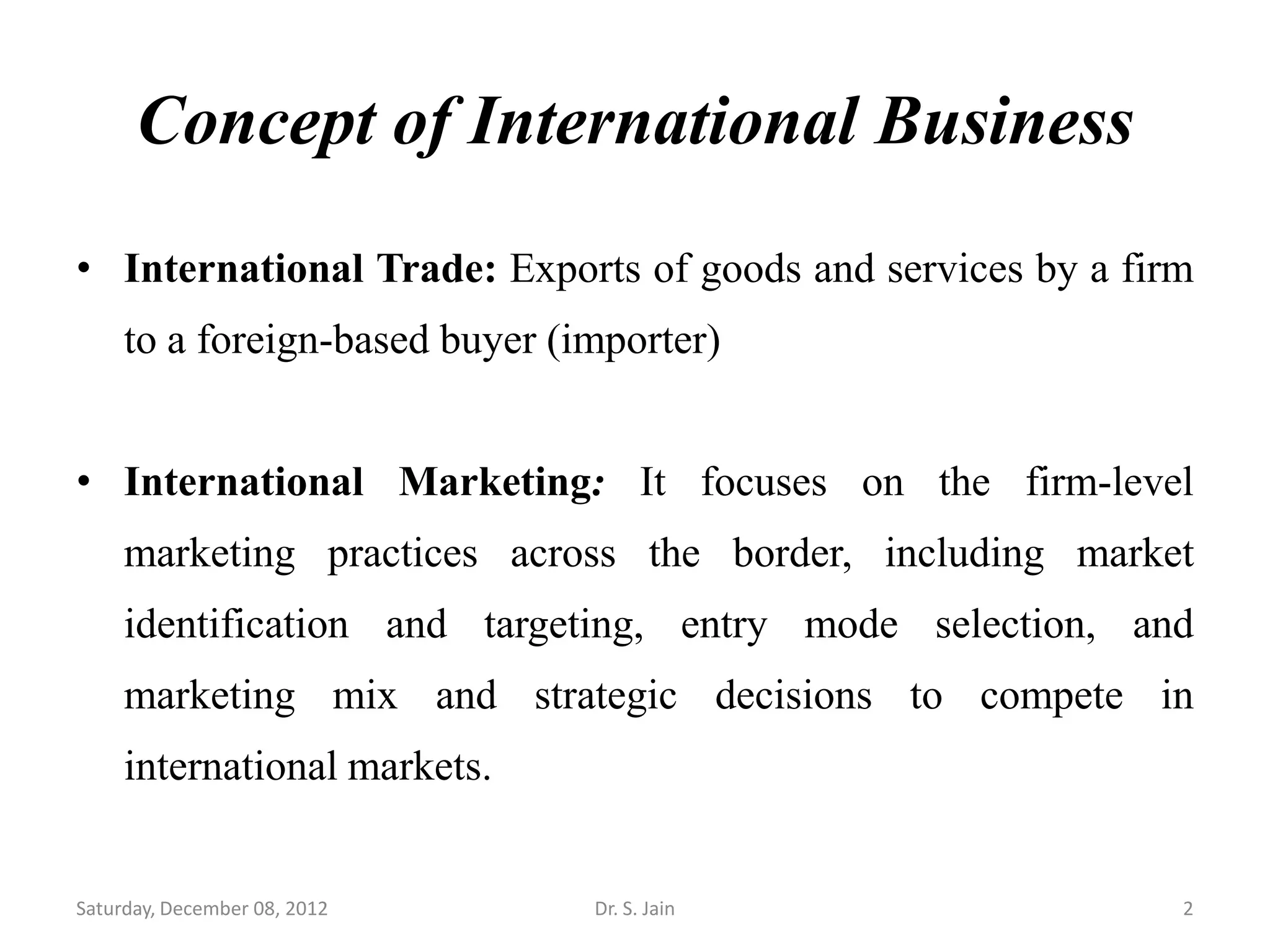
• International Trade: Exports of goods and services by a firm
     to a foreign-based buyer (importer)


• International Marketing: It focuses on the firm-level
     marketing practices across the border, including market
     identification and targeting, entry mode selection, and
     marketing mix and strategic decisions to compete in
     international markets.


Saturday, December 08, 2012     Dr. S. Jain                  2
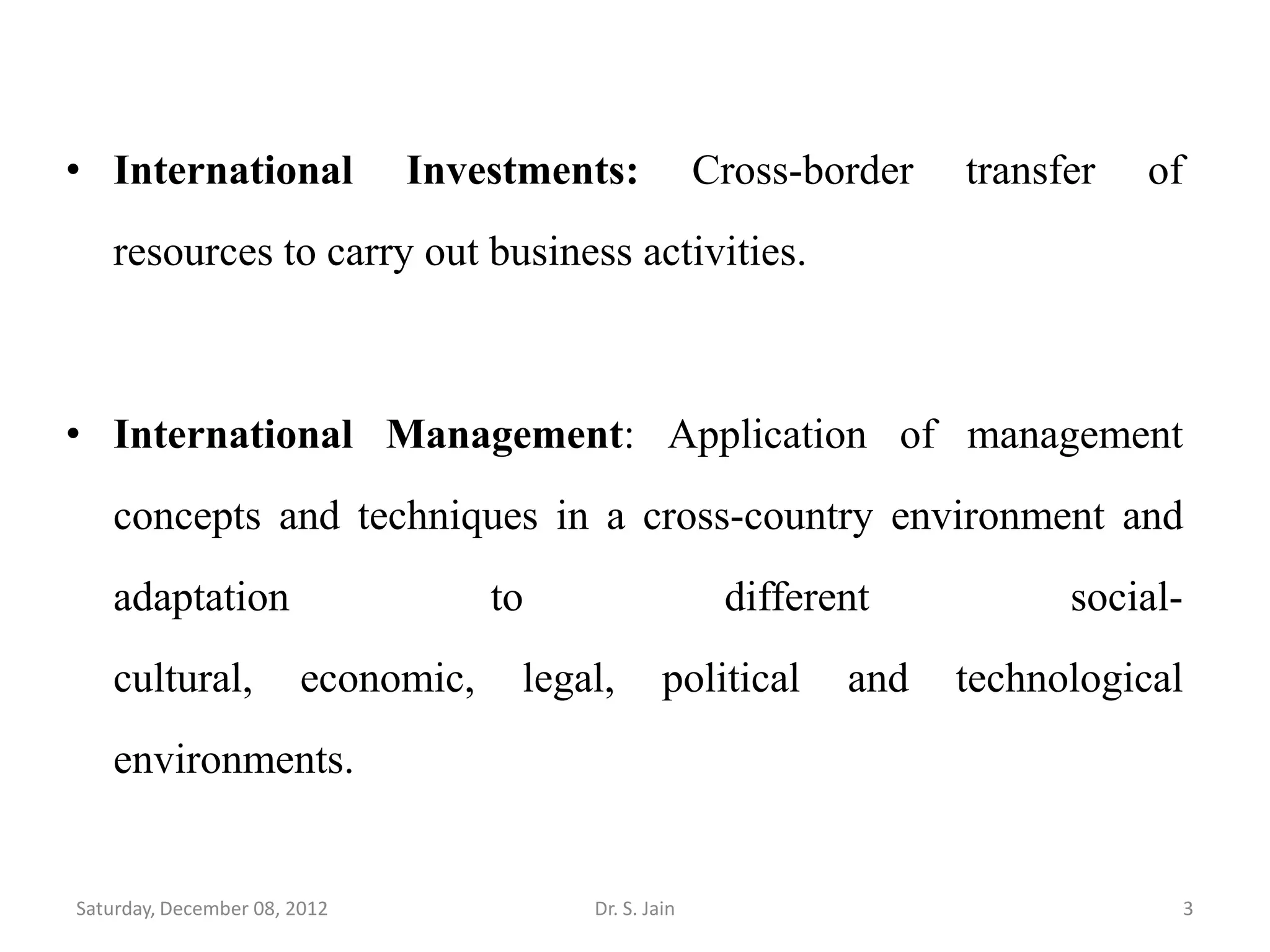
• International               Investments:            Cross-border   transfer   of
   resources to carry out business activities.


• International Management: Application of management
   concepts and techniques in a cross-country environment and
   adaptation                      to                  different           social-
   cultural,           economic,    legal,       political    and    technological
   environments.


Saturday, December 08, 2012             Dr. S. Jain                              3
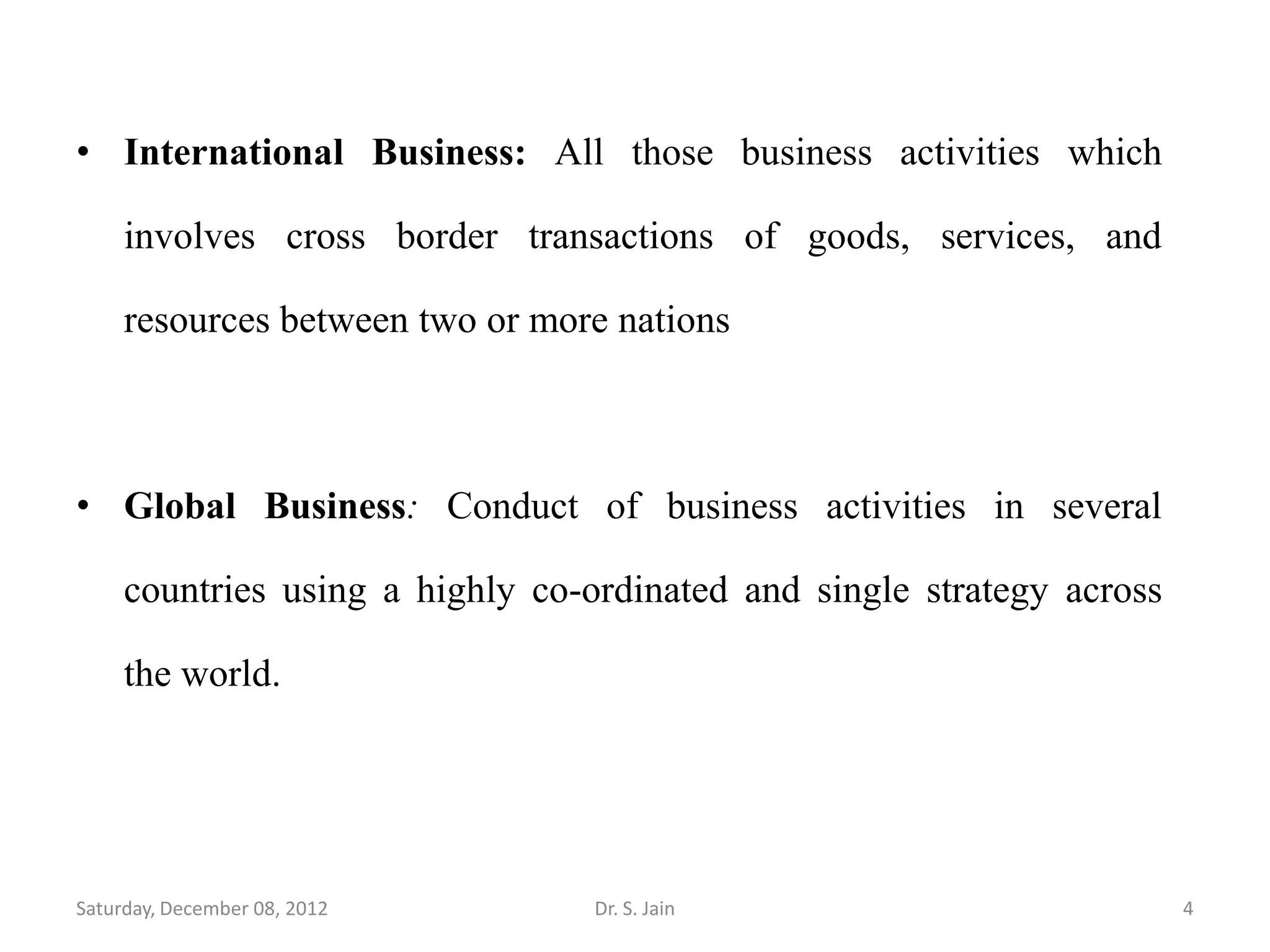
• International Business: All those business activities which

     involves cross border transactions of goods, services, and

     resources between two or more nations


• Global Business: Conduct of business activities in several

     countries using a highly co-ordinated and single strategy across

     the world.


Saturday, December 08, 2012       Dr. S. Jain                           4
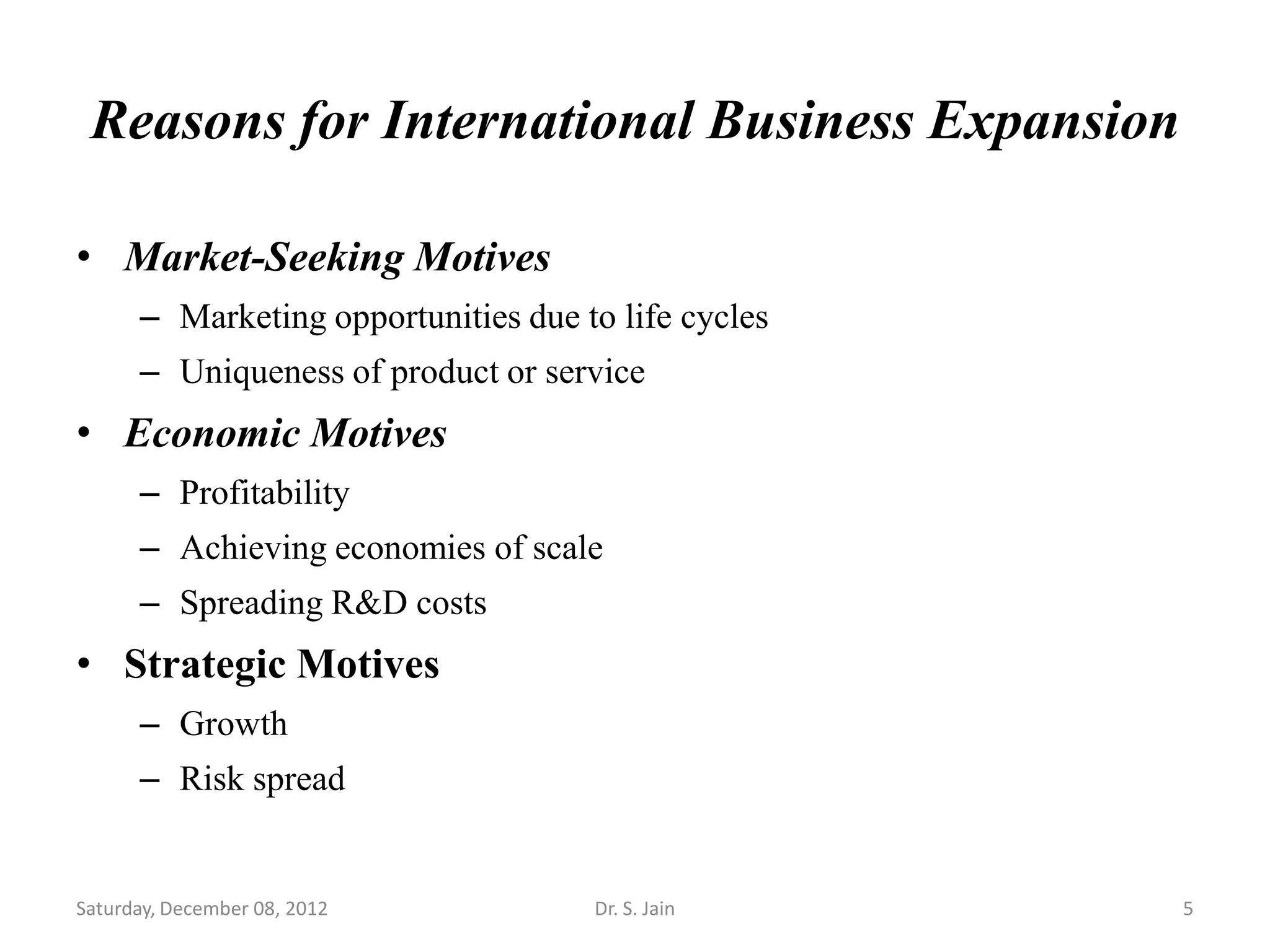
Reasons for International Business Expansion

• Market-Seeking Motives
      – Marketing opportunities due to life cycles
      – Uniqueness of product or service
• Economic Motives
      – Profitability
      – Achieving economies of scale
      – Spreading R&D costs
• Strategic Motives
      – Growth
      – Risk spread


Saturday, December 08, 2012          Dr. S. Jain     5
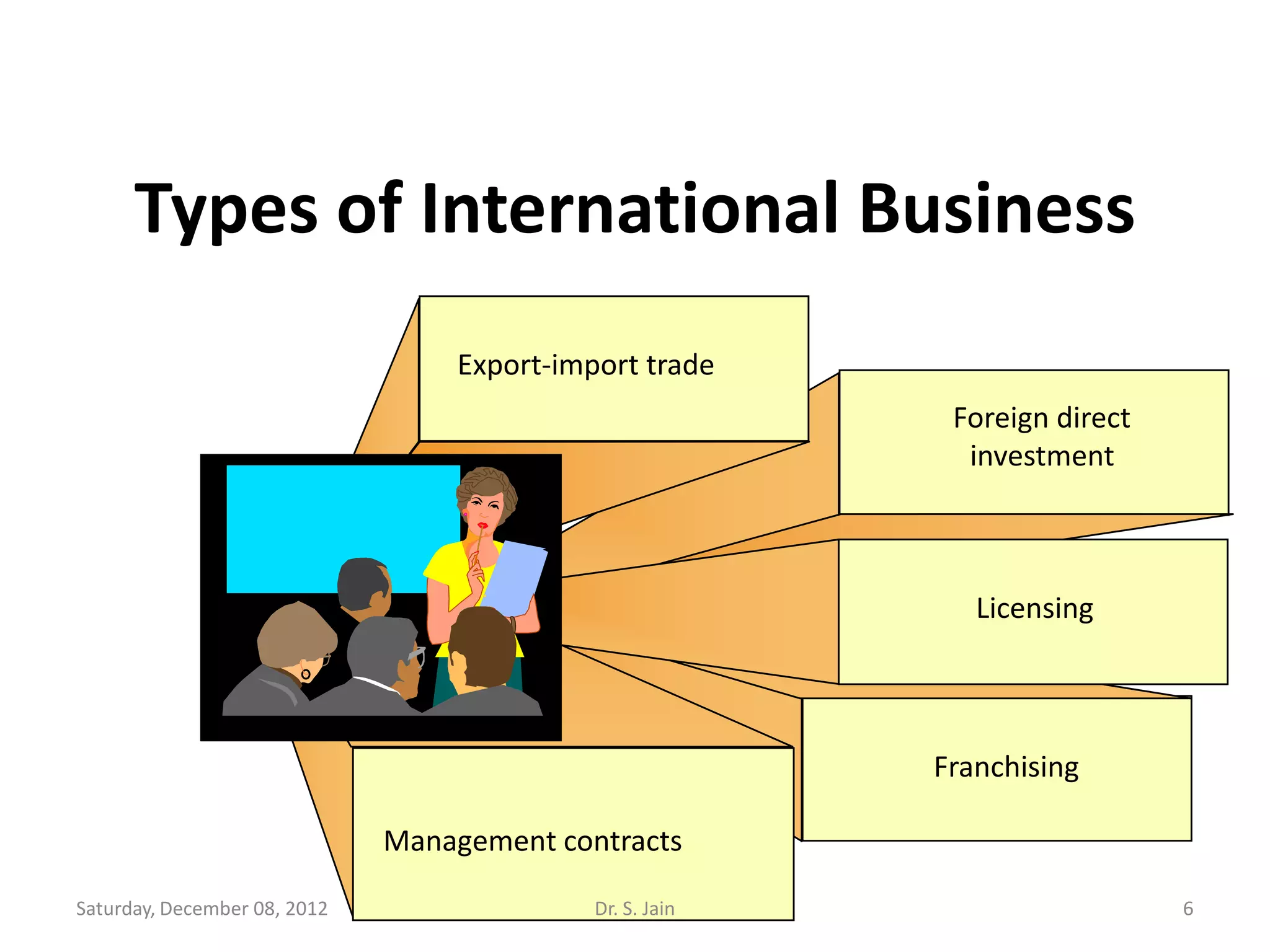
Types of International Business
                                  Export-import trade
                                                           Foreign direct
                                                            investment


                                                             Licensing


                                                          Franchising

                              Management contracts

Saturday, December 08, 2012                 Dr. S. Jain                     6
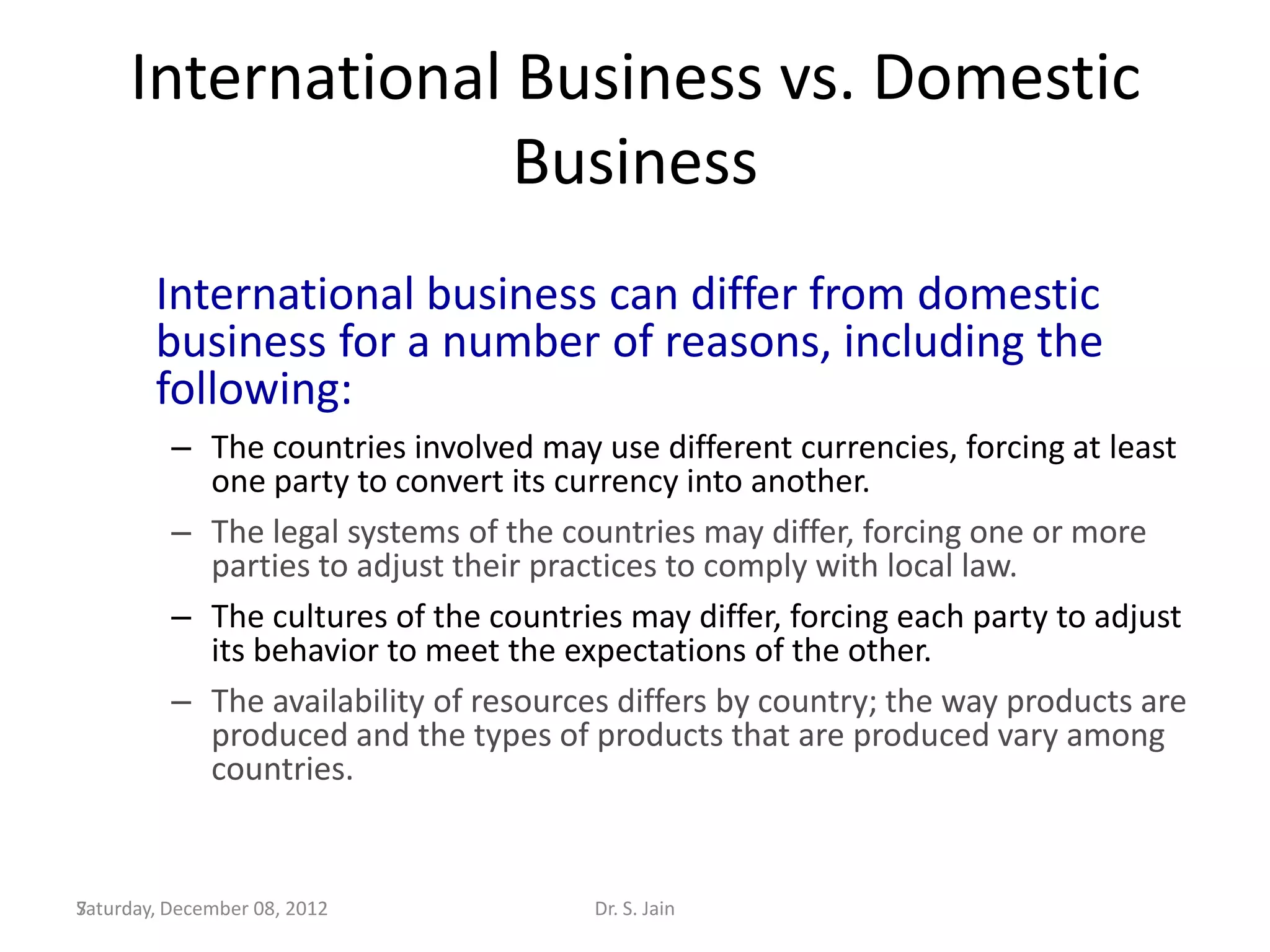
International Business vs. Domestic
                   Business
        International business can differ from domestic
        business for a number of reasons, including the
        following:
          – The countries involved may use different currencies, forcing at least
            one party to convert its currency into another.
          – The legal systems of the countries may differ, forcing one or more
            parties to adjust their practices to comply with local law.
          – The cultures of the countries may differ, forcing each party to adjust
            its behavior to meet the expectations of the other.
          – The availability of resources differs by country; the way products are
            produced and the types of products that are produced vary among
            countries.


Saturday, December 08, 2012
7                                      Dr. S. Jain
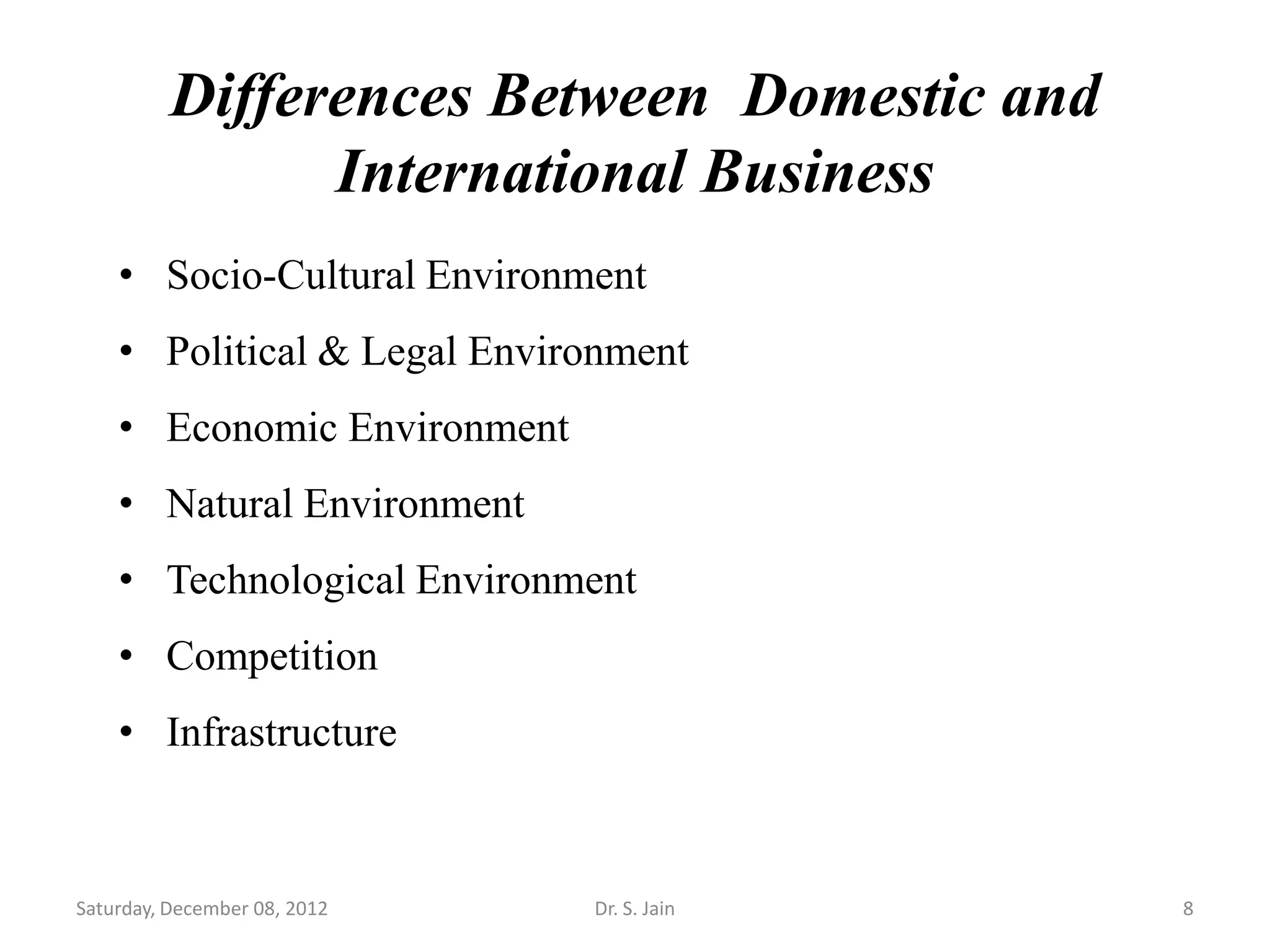
Differences Between Domestic and
                International Business
    • Socio-Cultural Environment
    • Political & Legal Environment
    • Economic Environment
    • Natural Environment
    • Technological Environment
    • Competition
    • Infrastructure


Saturday, December 08, 2012   Dr. S. Jain    8
DIFFERENCE BETWEEN DB AND IB

 COUNTRY-SPECIFIC FACTORS: cheap labour, what else?
 CULTURE, INSTITUTIONS, LANGUAGE, .. --> NOT A SERIOUS FACTOR IN DB

 IMPLICATIONS
 -in international marketing, consumer behaviour may differ from DB
 -in production, HRM may differ from DB
 -standard of living/cost/wages may differ,
 but note:
 NOT ALL FDI GOES TO LOW WAGE COUNTRIES.


 -Competent firms are able to take advantage of the above differences by turning
 them into expanded new opportunities not available from domestic sources.


Saturday, December 08, 2012             Dr. S. Jain                                9
Liberalization -
  In general, Liberalization refers to relaxation(s) of government
  restrictions, usually in areas of social or economic policy. In
  some contexts this process or concept is often, but not
  always, referred to as deregulation.
  Most often, the term is used to refer to economic
  liberalization, especially trade liberalization or capital market
  liberalization. Although economic liberalization is often
  associated with privatization, the two can be quite separate
  processes.
  The economic liberalization in India refers to ongoing
  economic reforms in India that started on 24 July 1991.


Saturday, December 08, 2012     Dr. S. Jain                       10
Privatization -
• Privatization means transfer of ownership and/or
  management of an enterprise from the public sector
  to the private sector. It also means the withdrawal of
  the State from an industry or sector, partially or fully.
  Another dimension of privatization is opening up of
  an industry that has been reserved for the public
  sector to the private sector.


Saturday, December 08, 2012   Dr. S. Jain                 11
Ways of Privatisation
• There are different ways of achieving privatisation.
• One of the important ways of privatisation is
  divestiture, or privatisation of ownership, through
  the sale of equity.
• Another way of privatisation is contracting.
• Another option for the government is to withdraw
  from the provision of certain goods and services
  leaving them wholly or partly to the private sector.
• Privatisation may also take the form of privatisation
  of management, using leases and management
  contracts.

Saturday, December 08, 2012            Dr. S. Jain    12
• The important ways of privatisation are the
   following:
1. Divestiture
2. Denationalisation
3. Contracting
4. Franchising
5. Government withdrawing
6. Privatisation of management
7. Liquidation


Saturday, December 08, 2012   Dr. S. Jain       13
Benefits of Privatisation

• Privatisation benefits the society in several ways.
   Some of them are
1. reduces the fiscal burden
2. enables the government to mop up funds
3. result in better management of the enterprises
4. encourage entrepreneurship


Saturday, December 08, 2012          Dr. S. Jain        14
Managing Business in the
                       Globalization Era
 Global strategies adopted by business enterprises may
 include:

 • Global conception of markets

 •Multi-regional integration strategy

 •Changes in external organisation of multinational firms

 •Changes in internal organisation


Saturday, December 08, 2012    Dr. S. Jain                  15
GLOBALISATION-MEANING


         Globalisation of the economy means reduction of import
         duties, removal of Non-Tariff Barriers on trade such as
         Exchange control, import licensing etc., allowing FDI and
         FPI, allowing companies to raise capital abroad and grow
         beyond national boundaries and encourage exports. Both
         Foreign Trade and Foreign investment volume have grown
         rapidly over the last few years.


Saturday, December 08, 2012        Dr. S. Jain                   17
• The IMF defines globalizations as “the growing
  economic interdependence of countries worldwide
  through increasing volume and variety of cross
  border transactions in goods and services and of
  international capital flows, and also through the
  more rapid and widespread diffusion of technology.”


Saturday, December 08, 2012   Dr. S. Jain          18
TRADE LIBERALISATION AND
                    GLOBALISATION

    • First, When Tariffs are lowered and QRs are
      removed, relative prices change and resources are
      reallocated to production activities that may raise output.
      However, increased import of manufactured products will
      have adverse impact on domestic production.
    • Second, larger long run benefits due to the free flow of
      technology and new production structures.
    • Exports and Imports - most dynamic factors in the process
      of economic growth after 1995.


Saturday, December 08, 2012    Dr. S. Jain                      19
2 VIEWS on Globalisation

    • Those stress the Virtues of Import Substitution and limited
         openness ie, View against Free Trade and Globalisation


    • Those emphasise the importance of Free Trade.
         Arguments a) Achieve International Competitiveness b)
         Reduce the price level c)More choice for consumers


Saturday, December 08, 2012      Dr. S. Jain                      20
GLOBALISATION - PHASES


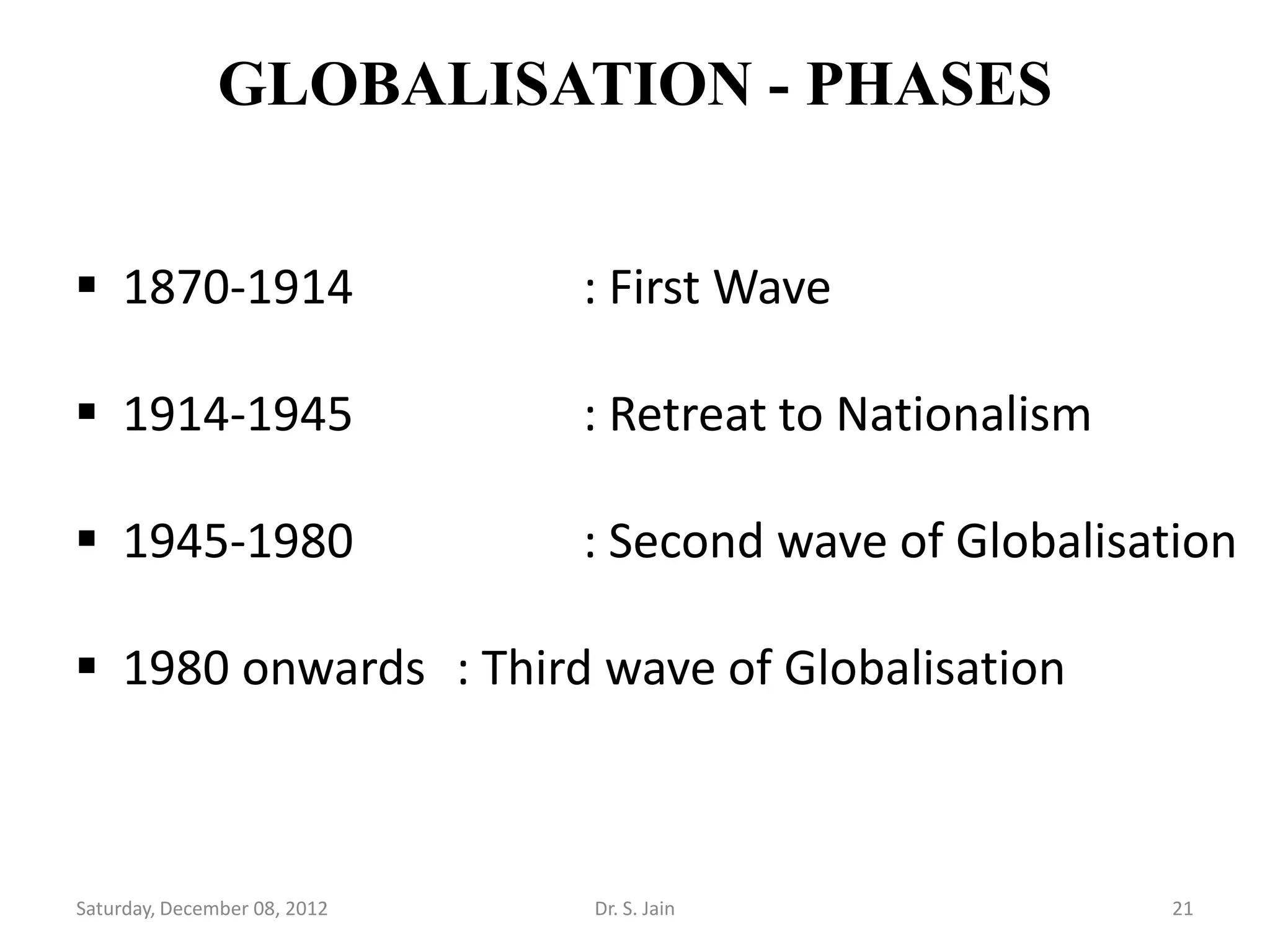
ď‚§ 1870-1914                   : First Wave

ď‚§ 1914-1945                   : Retreat to Nationalism

ď‚§ 1945-1980                   : Second wave of Globalisation

ď‚§ 1980 onwards : Third wave of Globalisation


Saturday, December 08, 2012   Dr. S. Jain                21
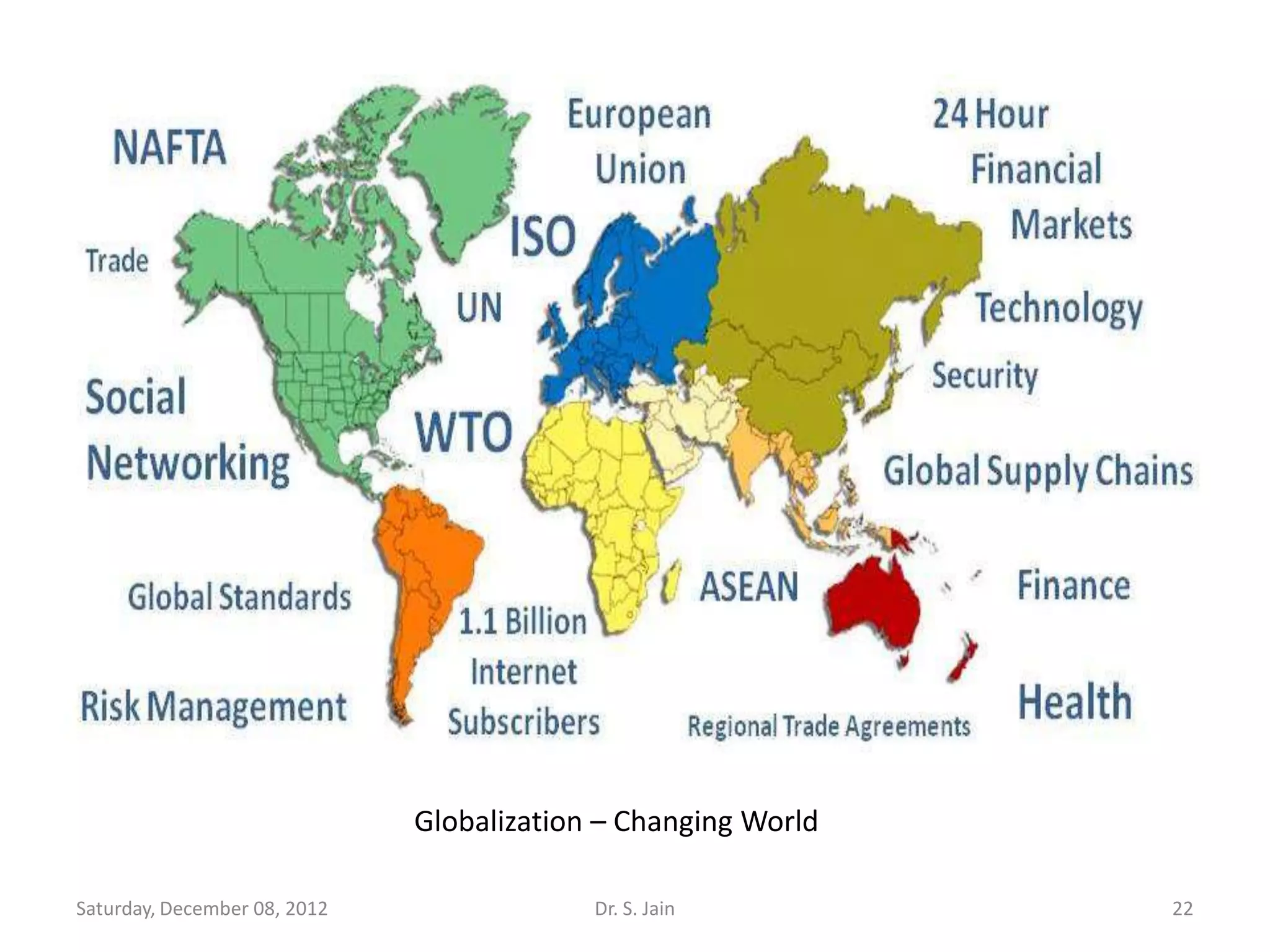
Globalization – Changing World

Saturday, December 08, 2012                Dr. S. Jain         22
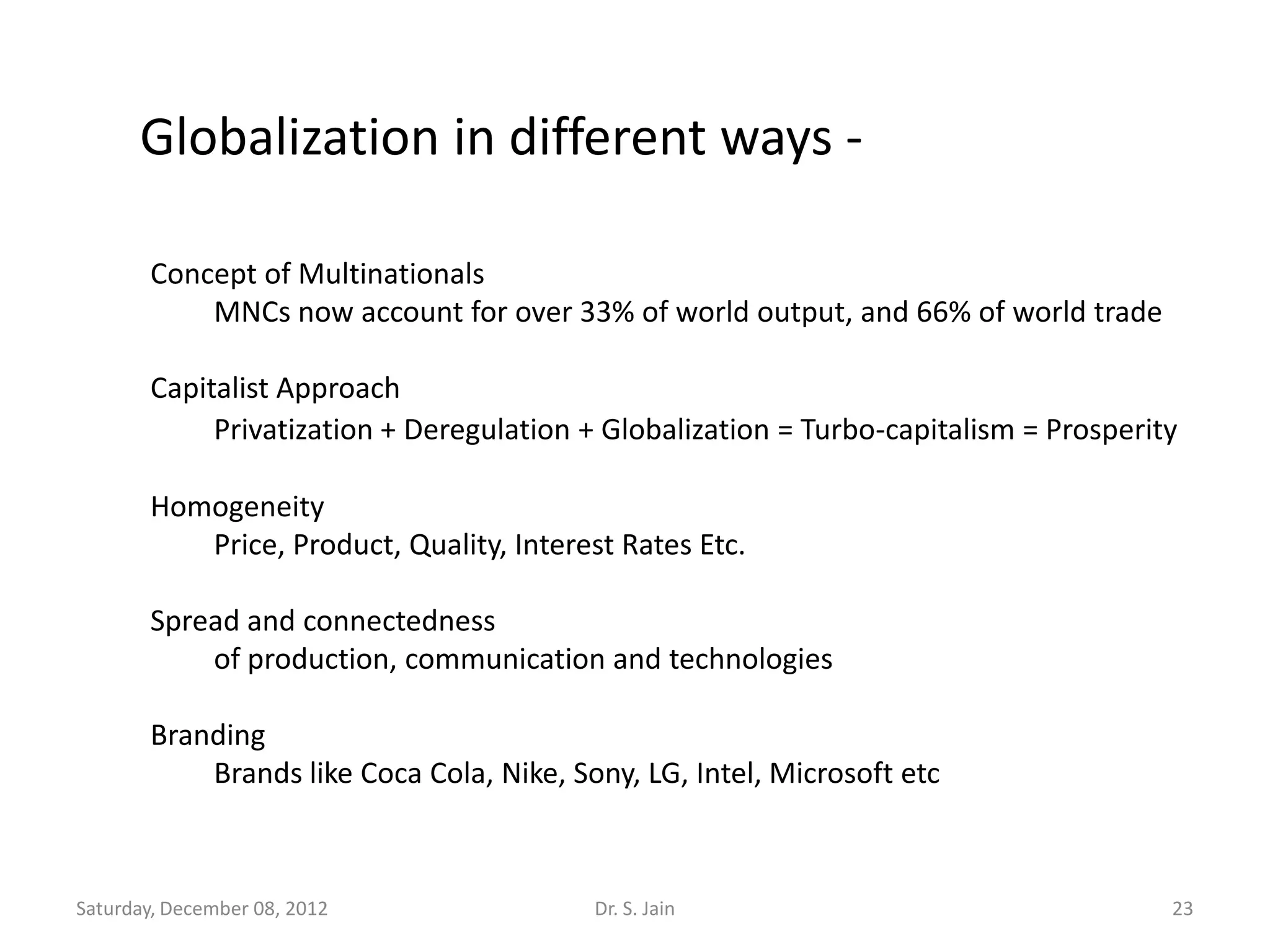
Globalization in different ways -

       Concept of Multinationals
           MNCs now account for over 33% of world output, and 66% of world trade

       Capitalist Approach
            Privatization + Deregulation + Globalization = Turbo-capitalism = Prosperity

       Homogeneity
          Price, Product, Quality, Interest Rates Etc.

       Spread and connectedness
           of production, communication and technologies

       Branding
           Brands like Coca Cola, Nike, Sony, LG, Intel, Microsoft etc


Saturday, December 08, 2012               Dr. S. Jain                                  23
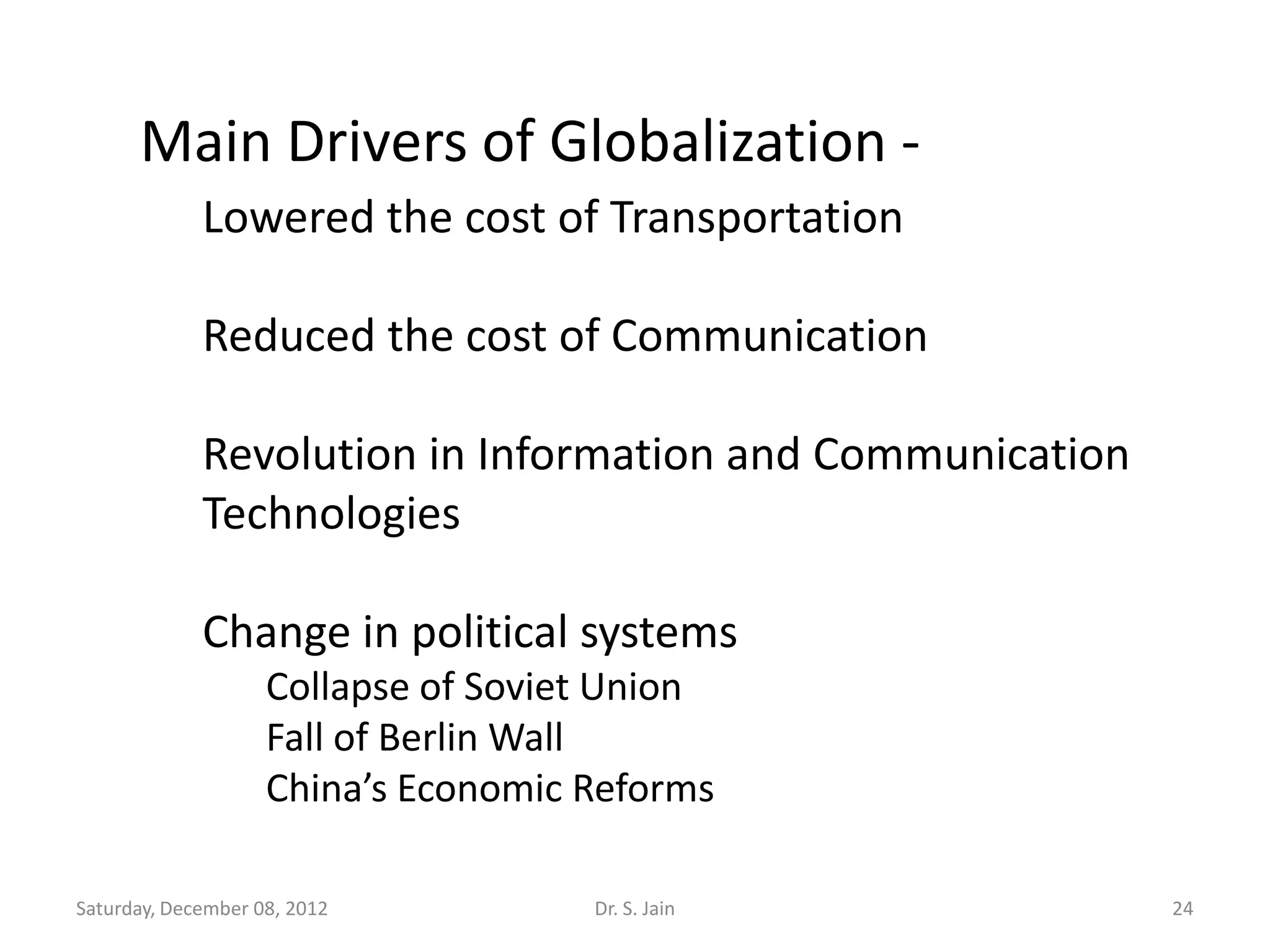
Main Drivers of Globalization -
             Lowered the cost of Transportation

             Reduced the cost of Communication

             Revolution in Information and Communication
             Technologies

             Change in political systems
                    Collapse of Soviet Union
                    Fall of Berlin Wall
                    China’s Economic Reforms

Saturday, December 08, 2012          Dr. S. Jain           24
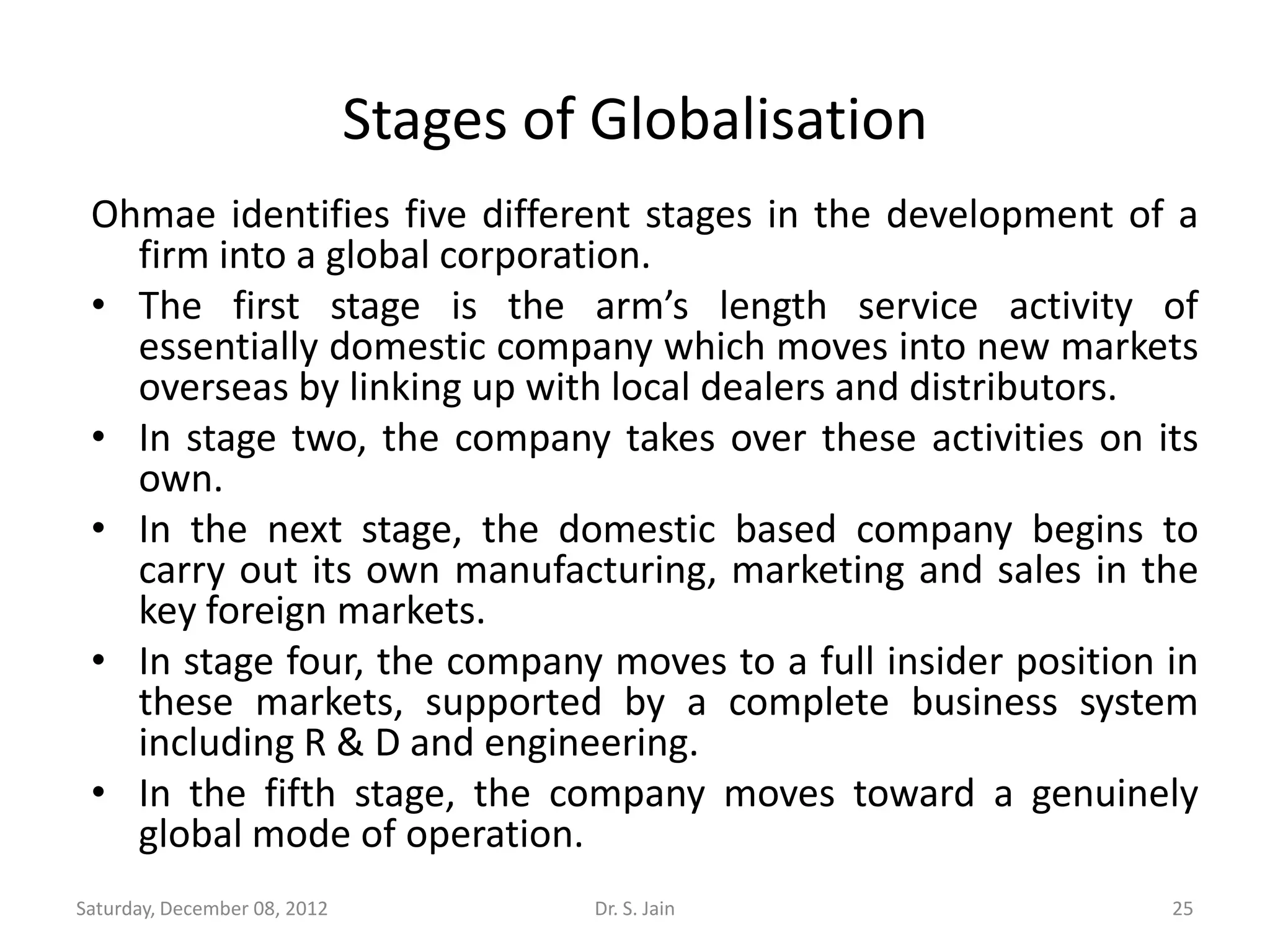
Stages of Globalisation
 Ohmae identifies five different stages in the development of a
   firm into a global corporation.
 • The first stage is the arm’s length service activity of
   essentially domestic company which moves into new markets
   overseas by linking up with local dealers and distributors.
 • In stage two, the company takes over these activities on its
   own.
 • In the next stage, the domestic based company begins to
   carry out its own manufacturing, marketing and sales in the
   key foreign markets.
 • In stage four, the company moves to a full insider position in
   these markets, supported by a complete business system
   including R & D and engineering.
 • In the fifth stage, the company moves toward a genuinely
   global mode of operation.
Saturday, December 08, 2012            Dr. S. Jain             25
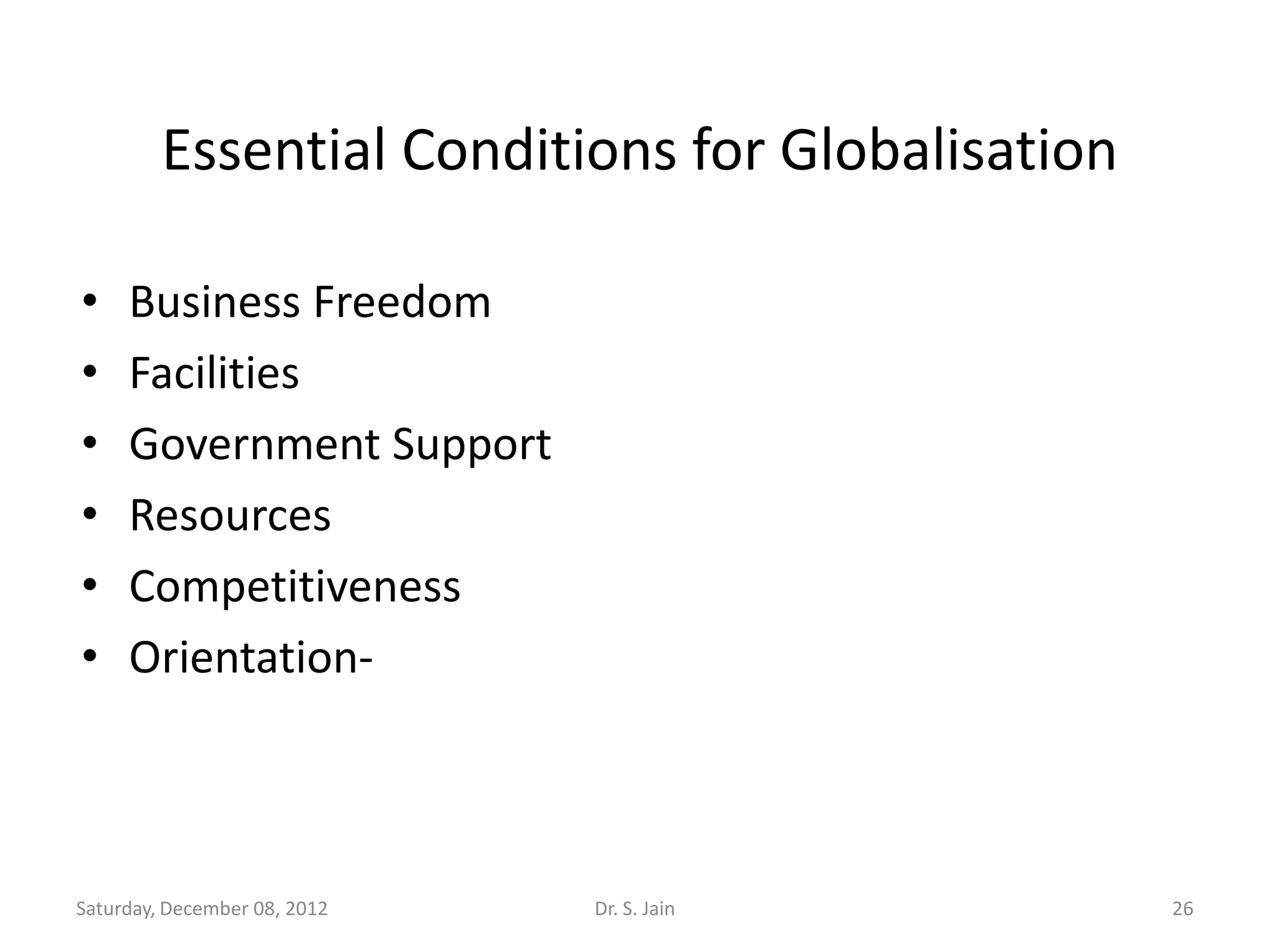
Essential Conditions for Globalisation

•    Business Freedom
•    Facilities
•    Government Support
•    Resources
•    Competitiveness
•    Orientation-


Saturday, December 08, 2012   Dr. S. Jain         26
While Globalisation has Several Benefits, it has a Number
                       of Problems.
• Global competition and imports keep a lid on prices, so inflation is less likely
  to derail economic growth.
• An open economy spurs innovation with fresh ideas from abroad.
• Export jobs often pay more than other jobs.
• Unfettered capital flows give the US access to foreign investment and keep
  interest rates low.
• The adverse effects of globalisation according to the survey are:
• Millions of Americans have lost jobs due to imports or production shifts
  abroad. Most find new jobs that pay less.
• Millions of others fear losing their jobs, especially at those companies
  operating under competitive pressure.
• Workers face pay cut demands from employers, which often threaten to
  export jobs.
• Service and white collar jobs are increasingly vulnerable to operations moving
  offshore.
• U S employees can lose their comparative advantage when companies build
  advanced factories in low-wage countries, making them as productive as
  those at home.

 Saturday, December 08, 2012          Dr. S. Jain                              27
Globalisation of Indian Business
• India’s economic integration with the rest of the world
  was very limited because of the restrictive economic
  policies followed until 1991. Indian firms confined
  themselves, by and large, to the home market. Foreign
  investment by Indian firms was very insignificant.
• With the new economic policy ushered in 1991, there
  has, however, been a change. Globalisation has in fact
  become a buzz-word with Indian firms now, and many
  are expanding their overseas business by different
  strategies.


Saturday, December 08, 2012       Dr. S. Jain           28
Factors Favouring Globalisation
•    Human Resources
•    Wide Base
•    Growing Entrepreneurship
•    Growing Domestic Market
•    Niche Markets
•    Expanding Markets
•    Transnationalisation of World Economy
•    NRIs
•    Economic Liberalisation
•    Competition


Saturday, December 08, 2012   Dr. S. Jain         29
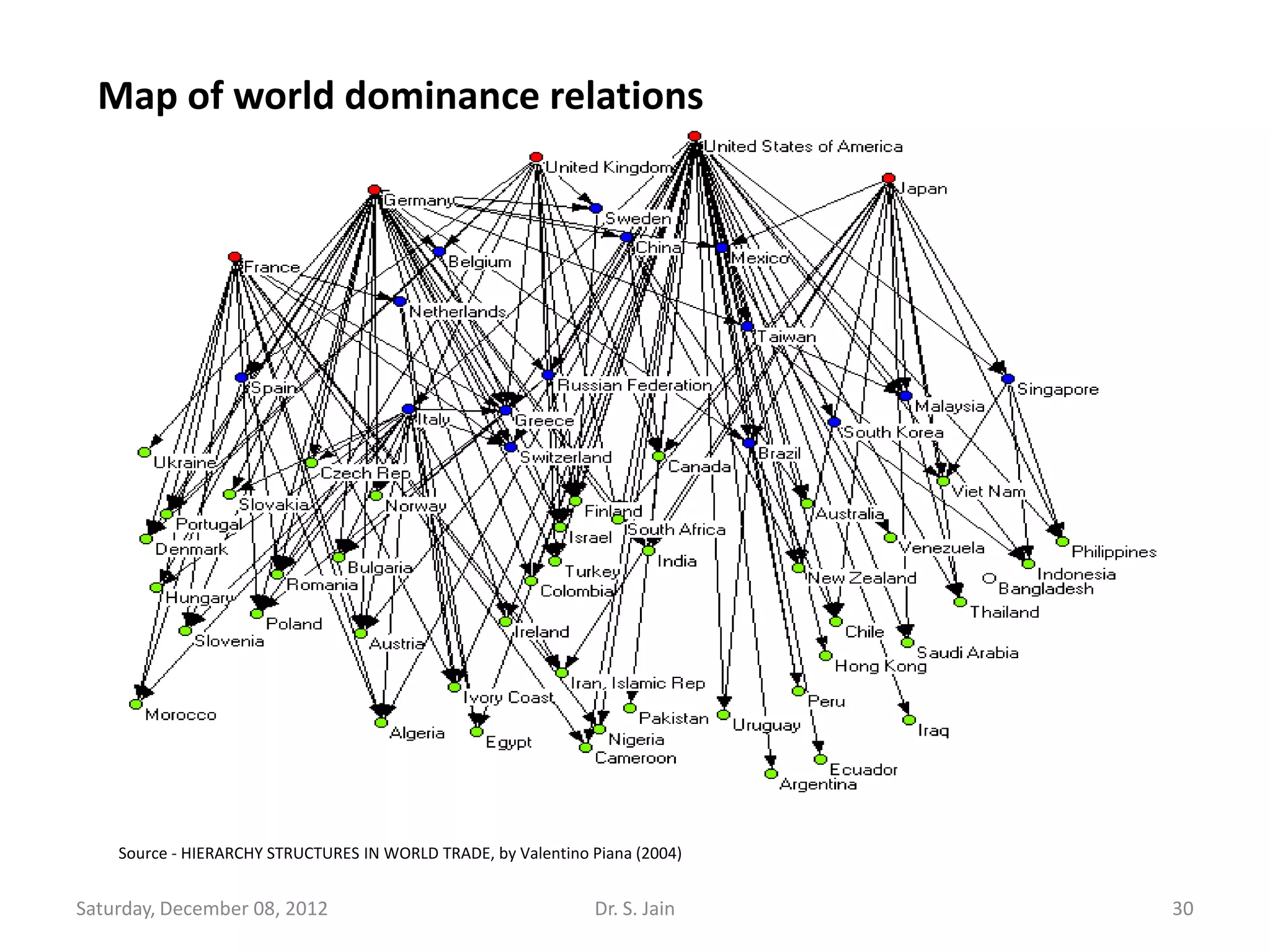
Map of world dominance relations


    Source - HIERARCHY STRUCTURES IN WORLD TRADE, by Valentino Piana (2004)


Saturday, December 08, 2012                                    Dr. S. Jain    30

1 2 introduction of international business environment

  • 1.
    Introduction of International Business Environment Domestic v/s International Business Liberalization, Privatization and Globalization Saturday, December 08, 2012 Dr. S. Jain 1
  • 2.
    Concept of InternationalBusiness • International Trade: Exports of goods and services by a firm to a foreign-based buyer (importer) • International Marketing: It focuses on the firm-level marketing practices across the border, including market identification and targeting, entry mode selection, and marketing mix and strategic decisions to compete in international markets. Saturday, December 08, 2012 Dr. S. Jain 2
  • 3.
    • International Investments: Cross-border transfer of resources to carry out business activities. • International Management: Application of management concepts and techniques in a cross-country environment and adaptation to different social- cultural, economic, legal, political and technological environments. Saturday, December 08, 2012 Dr. S. Jain 3
  • 4.
    • International Business:All those business activities which involves cross border transactions of goods, services, and resources between two or more nations • Global Business: Conduct of business activities in several countries using a highly co-ordinated and single strategy across the world. Saturday, December 08, 2012 Dr. S. Jain 4
  • 5.
    Reasons for InternationalBusiness Expansion • Market-Seeking Motives – Marketing opportunities due to life cycles – Uniqueness of product or service • Economic Motives – Profitability – Achieving economies of scale – Spreading R&D costs • Strategic Motives – Growth – Risk spread Saturday, December 08, 2012 Dr. S. Jain 5
  • 6.
    Types of InternationalBusiness Export-import trade Foreign direct investment Licensing Franchising Management contracts Saturday, December 08, 2012 Dr. S. Jain 6
  • 7.
    International Business vs.Domestic Business International business can differ from domestic business for a number of reasons, including the following: – The countries involved may use different currencies, forcing at least one party to convert its currency into another. – The legal systems of the countries may differ, forcing one or more parties to adjust their practices to comply with local law. – The cultures of the countries may differ, forcing each party to adjust its behavior to meet the expectations of the other. – The availability of resources differs by country; the way products are produced and the types of products that are produced vary among countries. Saturday, December 08, 2012 7 Dr. S. Jain
  • 8.
    Differences Between Domesticand International Business • Socio-Cultural Environment • Political & Legal Environment • Economic Environment • Natural Environment • Technological Environment • Competition • Infrastructure Saturday, December 08, 2012 Dr. S. Jain 8
  • 9.
    DIFFERENCE BETWEEN DBAND IB COUNTRY-SPECIFIC FACTORS: cheap labour, what else? CULTURE, INSTITUTIONS, LANGUAGE, .. --> NOT A SERIOUS FACTOR IN DB IMPLICATIONS -in international marketing, consumer behaviour may differ from DB -in production, HRM may differ from DB -standard of living/cost/wages may differ, but note: NOT ALL FDI GOES TO LOW WAGE COUNTRIES. -Competent firms are able to take advantage of the above differences by turning them into expanded new opportunities not available from domestic sources. Saturday, December 08, 2012 Dr. S. Jain 9
  • 10.
    Liberalization - In general, Liberalization refers to relaxation(s) of government restrictions, usually in areas of social or economic policy. In some contexts this process or concept is often, but not always, referred to as deregulation. Most often, the term is used to refer to economic liberalization, especially trade liberalization or capital market liberalization. Although economic liberalization is often associated with privatization, the two can be quite separate processes. The economic liberalization in India refers to ongoing economic reforms in India that started on 24 July 1991. Saturday, December 08, 2012 Dr. S. Jain 10
  • 11.
    Privatization - • Privatizationmeans transfer of ownership and/or management of an enterprise from the public sector to the private sector. It also means the withdrawal of the State from an industry or sector, partially or fully. Another dimension of privatization is opening up of an industry that has been reserved for the public sector to the private sector. Saturday, December 08, 2012 Dr. S. Jain 11
  • 12.
    Ways of Privatisation •There are different ways of achieving privatisation. • One of the important ways of privatisation is divestiture, or privatisation of ownership, through the sale of equity. • Another way of privatisation is contracting. • Another option for the government is to withdraw from the provision of certain goods and services leaving them wholly or partly to the private sector. • Privatisation may also take the form of privatisation of management, using leases and management contracts. Saturday, December 08, 2012 Dr. S. Jain 12
  • 13.
    • The importantways of privatisation are the following: 1. Divestiture 2. Denationalisation 3. Contracting 4. Franchising 5. Government withdrawing 6. Privatisation of management 7. Liquidation Saturday, December 08, 2012 Dr. S. Jain 13
  • 14.
    Benefits of Privatisation •Privatisation benefits the society in several ways. Some of them are 1. reduces the fiscal burden 2. enables the government to mop up funds 3. result in better management of the enterprises 4. encourage entrepreneurship Saturday, December 08, 2012 Dr. S. Jain 14
  • 15.
    Managing Business inthe Globalization Era Global strategies adopted by business enterprises may include: • Global conception of markets •Multi-regional integration strategy •Changes in external organisation of multinational firms •Changes in internal organisation Saturday, December 08, 2012 Dr. S. Jain 15
  • 16.
    GLOBALISATION-MEANING Globalisation of the economy means reduction of import duties, removal of Non-Tariff Barriers on trade such as Exchange control, import licensing etc., allowing FDI and FPI, allowing companies to raise capital abroad and grow beyond national boundaries and encourage exports. Both Foreign Trade and Foreign investment volume have grown rapidly over the last few years. Saturday, December 08, 2012 Dr. S. Jain 17
  • 17.
    • The IMFdefines globalizations as “the growing economic interdependence of countries worldwide through increasing volume and variety of cross border transactions in goods and services and of international capital flows, and also through the more rapid and widespread diffusion of technology.” Saturday, December 08, 2012 Dr. S. Jain 18
  • 18.
    TRADE LIBERALISATION AND GLOBALISATION • First, When Tariffs are lowered and QRs are removed, relative prices change and resources are reallocated to production activities that may raise output. However, increased import of manufactured products will have adverse impact on domestic production. • Second, larger long run benefits due to the free flow of technology and new production structures. • Exports and Imports - most dynamic factors in the process of economic growth after 1995. Saturday, December 08, 2012 Dr. S. Jain 19
  • 19.
    2 VIEWS onGlobalisation • Those stress the Virtues of Import Substitution and limited openness ie, View against Free Trade and Globalisation • Those emphasise the importance of Free Trade. Arguments a) Achieve International Competitiveness b) Reduce the price level c)More choice for consumers Saturday, December 08, 2012 Dr. S. Jain 20
  • 20.
    GLOBALISATION - PHASES ď‚§1870-1914 : First Wave ď‚§ 1914-1945 : Retreat to Nationalism ď‚§ 1945-1980 : Second wave of Globalisation ď‚§ 1980 onwards : Third wave of Globalisation Saturday, December 08, 2012 Dr. S. Jain 21
  • 21.
    Globalization – ChangingWorld Saturday, December 08, 2012 Dr. S. Jain 22
  • 22.
    Globalization in differentways - Concept of Multinationals MNCs now account for over 33% of world output, and 66% of world trade Capitalist Approach Privatization + Deregulation + Globalization = Turbo-capitalism = Prosperity Homogeneity Price, Product, Quality, Interest Rates Etc. Spread and connectedness of production, communication and technologies Branding Brands like Coca Cola, Nike, Sony, LG, Intel, Microsoft etc Saturday, December 08, 2012 Dr. S. Jain 23
  • 23.
    Main Drivers ofGlobalization - Lowered the cost of Transportation Reduced the cost of Communication Revolution in Information and Communication Technologies Change in political systems Collapse of Soviet Union Fall of Berlin Wall China’s Economic Reforms Saturday, December 08, 2012 Dr. S. Jain 24
  • 24.
    Stages of Globalisation Ohmae identifies five different stages in the development of a firm into a global corporation. • The first stage is the arm’s length service activity of essentially domestic company which moves into new markets overseas by linking up with local dealers and distributors. • In stage two, the company takes over these activities on its own. • In the next stage, the domestic based company begins to carry out its own manufacturing, marketing and sales in the key foreign markets. • In stage four, the company moves to a full insider position in these markets, supported by a complete business system including R & D and engineering. • In the fifth stage, the company moves toward a genuinely global mode of operation. Saturday, December 08, 2012 Dr. S. Jain 25
  • 25.
    Essential Conditions forGlobalisation • Business Freedom • Facilities • Government Support • Resources • Competitiveness • Orientation- Saturday, December 08, 2012 Dr. S. Jain 26
  • 26.
    While Globalisation hasSeveral Benefits, it has a Number of Problems. • Global competition and imports keep a lid on prices, so inflation is less likely to derail economic growth. • An open economy spurs innovation with fresh ideas from abroad. • Export jobs often pay more than other jobs. • Unfettered capital flows give the US access to foreign investment and keep interest rates low. • The adverse effects of globalisation according to the survey are: • Millions of Americans have lost jobs due to imports or production shifts abroad. Most find new jobs that pay less. • Millions of others fear losing their jobs, especially at those companies operating under competitive pressure. • Workers face pay cut demands from employers, which often threaten to export jobs. • Service and white collar jobs are increasingly vulnerable to operations moving offshore. • U S employees can lose their comparative advantage when companies build advanced factories in low-wage countries, making them as productive as those at home. Saturday, December 08, 2012 Dr. S. Jain 27
  • 27.
    Globalisation of IndianBusiness • India’s economic integration with the rest of the world was very limited because of the restrictive economic policies followed until 1991. Indian firms confined themselves, by and large, to the home market. Foreign investment by Indian firms was very insignificant. • With the new economic policy ushered in 1991, there has, however, been a change. Globalisation has in fact become a buzz-word with Indian firms now, and many are expanding their overseas business by different strategies. Saturday, December 08, 2012 Dr. S. Jain 28
  • 28.
    Factors Favouring Globalisation • Human Resources • Wide Base • Growing Entrepreneurship • Growing Domestic Market • Niche Markets • Expanding Markets • Transnationalisation of World Economy • NRIs • Economic Liberalisation • Competition Saturday, December 08, 2012 Dr. S. Jain 29
  • 29.
    Map of worlddominance relations Source - HIERARCHY STRUCTURES IN WORLD TRADE, by Valentino Piana (2004) Saturday, December 08, 2012 Dr. S. Jain 30