Creating Writers: all students
writing and writing well
Comox	
  Valley	
  
Nov.	
  21,	
  Feb.	
  6.,	
  Apr.	
  17,	
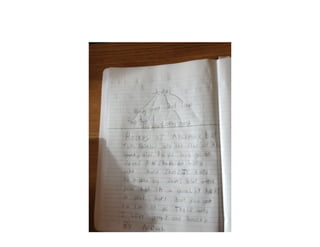
  2013	
  
Faye	
  Brownlie	
  
www.slideshare.net	
  
•  What	
  did	
  you	
  try?	
  	
  Find	
  another	
  person	
  to	
  talk	
  
to,	
  not	
  at	
  your	
  table,	
  and	
  chat	
  for	
  4-­‐5	
  minutes	
  
–	
  what	
  did	
  you	
  try?	
  	
  How	
  did	
  it	
  go?	
  	
  What	
  will	
  
you	
  do	
  next	
  Nme?	
  
•  Meet	
  with	
  another	
  and	
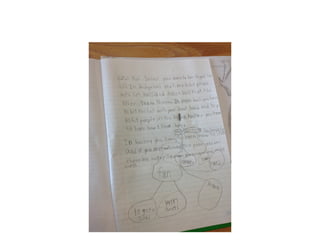
  tell	
  what	
  you	
  learned.	
  
What	
  are	
  the	
  narraNves	
  of	
  self	
  that	
  our	
  
learners	
  are	
  developing?	
  What	
  is	
  the	
  
story	
  they	
  tell	
  about	
  themselves	
  as	
  
writers?	
  	
  
•  Our	
  language	
  and	
  our	
  acNons	
  are	
  immensely	
  
powerful	
  in	
  helping	
  to	
  narrate	
  the	
  ‘self’	
  that	
  
our	
  learners	
  are	
  becoming.	
  
Do	
  your	
  students	
  receive	
  feedback	
  
from	
  you	
  in	
  every	
  wriNng	
  
opportunity?	
  
Powerful	
  feedback	
  to	
  build	
  a	
  sense	
  of	
  
agency	
  
•  I	
  see	
  you	
  know	
  how	
  to	
  write	
  the	
  beginning	
  of	
  
that	
  word….	
  
•  Can	
  you	
  show	
  me	
  a	
  word	
  you	
  took	
  a	
  risk	
  at	
  
spelling/using?	
  
•  What	
  are	
  you	
  doing	
  as	
  a	
  writer	
  today?	
  	
  
•  I	
  bet	
  you’re	
  proud	
  of	
  yourself.	
  
•  Which	
  part	
  are	
  you	
  sure	
  about,	
  and	
  which	
  part	
  
are	
  you	
  not	
  sure	
  about?	
  
– Choice	
  Words:	
  Peter	
  H.	
  Johnston	
  
“The	
  most	
  powerful	
  single	
  influence	
  enhancing	
  
achievement	
  is	
  feedback”	
  
•  Quality	
  feedback	
  is	
  needed,	
  not	
  just	
  more	
  feedback	
  
•  Students	
  with	
  a	
  Growth	
  Mindset	
  welcome	
  feedback	
  
and	
  are	
  more	
  likely	
  to	
  use	
  it	
  to	
  improve	
  their	
  
performance	
  
•  Oral	
  feedback	
  is	
  much	
  more	
  effecNve	
  than	
  wricen	
  
•  The	
  most	
  powerful	
  feedback	
  is	
  provided	
  from	
  the	
  
student	
  to	
  the	
  teacher	
  
Power Paragraphs
•  Choose	
  a	
  topic	
  
•  Choose	
  3	
  key	
  details	
  about	
  the	
  topic	
  
•  Under	
  each	
  key	
  detail,	
  choose	
  2	
  further	
  
details,	
  examples,	
  support	
  
•  Write	
  one	
  introductory	
  sentence	
  (topic)	
  and	
  
one	
  sentence	
  each	
  for	
  each	
  key	
  detail	
  and	
  its	
  
supporNng	
  informaNon	
  
•  With	
  	
  Comox	
  Valley	
  
Power Paragraphs
•  Choose	
  a	
  topic	
  
•  Choose	
  3	
  key	
  details	
  about	
  the	
  topic	
  
•  Under	
  each	
  key	
  detail,	
  choose	
  2	
  further	
  
details,	
  examples,	
  support	
  
•  Write	
  one	
  introductory	
  sentence	
  (topic)	
  and	
  
one	
  sentence	
  each	
  for	
  each	
  key	
  detail	
  and	
  its	
  
supporNng	
  informaNon	
  
•  With	
  Ken	
  Porter	
  and	
  Kelly	
  Zimmer,	
  Mundy	
  
Road	
  –	
  in	
  class	
  support	
  for	
  students	
  at	
  risk	
  
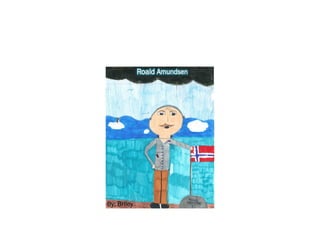
Explorer	
  Trading	
  Cards	
  –	
  Ken	
  Porter,	
  
Coquitlam	
  
•  Built	
  from	
  power	
  paragraphs	
  
Power Paragraphs
•  Model:	
  build	
  together	
  
•  Same	
  topic	
  and	
  one	
  ‘2nd’	
  power	
  
•  Students	
  choose	
  2	
  ‘2nd’	
  powers	
  from	
  the	
  brainstormed	
  
list	
  
•  Walk	
  and	
  talk	
  about	
  what	
  you	
  will	
  say	
  
•  Co-­‐construct	
  the	
  power	
  structure	
  
•  Write	
  together	
  
•  Share	
  
•  PracNce	
  in	
  similar	
  way	
  for	
  3	
  more	
  days	
  
•  With	
  Stephanie	
  Perko,	
  Mundy	
  Road,	
  gr.	
  2/3	
  
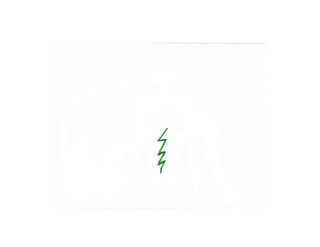
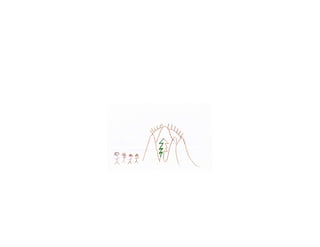
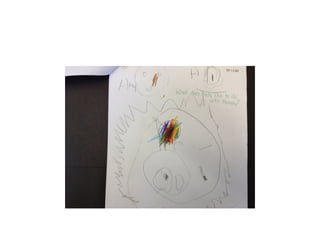
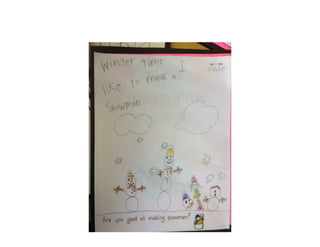
Squiggles
•  Draw a line on the board
•  Encourage students to transform this into a
picture, talking as they do so
•  Have several students demonstrate
•  Students draw the same squiggle in their
writers’ notebook and write in response to the
squiggle
•  Ideas are meant to be shared!
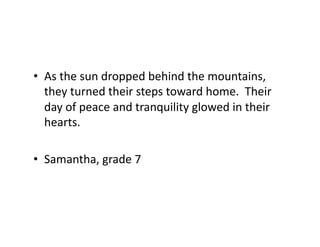
•  As	
  the	
  sun	
  dropped	
  behind	
  the	
  mountains,	
  
they	
  turned	
  their	
  steps	
  toward	
  home.	
  	
  Their	
  
day	
  of	
  peace	
  and	
  tranquility	
  glowed	
  in	
  their	
  
hearts.	
  
•  Samantha,	
  grade	
  7	
  
Online literacy videos
•  Literacy	
  Videos	
  
•  Clustering	
  from	
  Text	
  
•  Squiggles	
  
www.sd72.bc.ca/districtadmin/
edcentrelearningresources/literacyvideos/
Pages/default.aspx	
  
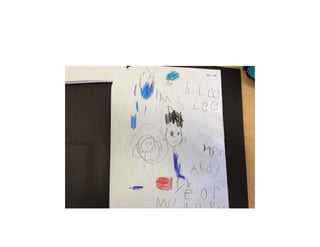
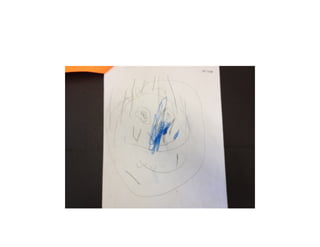
K Writing
•  Once	
  a	
  week	
  
•  Cindy	
  Lee,	
  K	
  teacher,	
  and	
  Catherine	
  Feniak,	
  
Principal,	
  Vancouver	
  
•  All	
  ELL	
  students	
  
•  Group	
  lesson	
  to	
  build	
  language	
  and	
  knowledge	
  
•  Conference	
  with	
  each	
  student	
  as	
  he/she	
  writes	
  
and	
  draws	
  
•  Extend	
  the	
  language	
  and	
  the	
  thinking	
  
A Sample Lesson
Gr. 6/7 with Fred Weil
•  Field	
  trip	
  
•  5	
  minute	
  free	
  write	
  
•  Reread	
  3	
  Nmes:	
  	
  word	
  count,	
  structure/grammar,	
  PS	
  
•  Powerful	
  sentence	
  
•  Rewrite	
  from	
  prose	
  to	
  poetry	
  (model	
  &	
  coach)	
  
•  Whip	
  around	
  -­‐	
  dran	
  found	
  poem	
  
•  Establish	
  criteria	
  for	
  personal	
  poem	
  
•  Dran	
  own	
  found	
  poem	
  
•  In	
  teams,	
  revise/edit	
  class	
  found	
  poem	
  
•  Revise/edit	
  personal	
  poems	
  with	
  partner	
  and	
  publish	
  
–  Me	
  and	
  my	
  class	
  went	
  to	
  UBC,	
  and	
  into	
  the	
  Nitobe	
  Gardens	
  on	
  Jan.	
  16.	
  	
  The	
  
Garden	
  looks	
  nice,	
  and	
  everything	
  has	
  a	
  meaning.	
  	
  The	
  more	
  red	
  there	
  is,	
  the	
  
more	
  danger.	
  	
  There	
  are	
  also	
  bridges	
  and	
  lanterns.	
  	
  My	
  favorite	
  bridge	
  is	
  the	
  	
  
zig-­‐zag	
  bridge.	
  	
  They	
  say	
  when	
  you	
  become	
  an	
  adult,	
  you	
  walk	
  past	
  it	
  so	
  the	
  
devil	
  leaves	
  you.	
  	
  They	
  believe	
  the	
  devil	
  can	
  only	
  walk	
  in	
  a	
  straight	
  line.	
  	
  The	
  
lanterns	
  also	
  have	
  meaning.	
  	
  The	
  father	
  lantern,	
  mother	
  lantern.	
  They	
  are	
  all	
  
stages	
  you	
  will	
  cross	
  in	
  life.	
  	
  When	
  we	
  entered	
  the	
  Nitobe	
  Gardens,	
  we	
  walked	
  
towards	
  the	
  right	
  because	
  it	
  is	
  the	
  side	
  of	
  the	
  moon.	
  	
  There	
  are	
  also	
  benches,	
  
just	
  like	
  Mr.	
  Weil	
  said.	
  	
  You	
  sit	
  on	
  the	
  bench	
  to	
  look	
  at	
  the	
  garden	
  and	
  see	
  what	
  
you	
  have	
  done	
  in	
  life.	
  	
  There	
  is	
  a	
  bridge	
  in	
  the	
  begining	
  and	
  the	
  end.	
  
–  Devon	
  -­‐	
  139	
  
•  When	
  you	
  enter	
  the	
  Nitobe	
  Memorial	
  Garden	
  you	
  turn	
  to	
  the	
  right.	
  	
  The	
  
Nitobe	
  Garden	
  was	
  built	
  in	
  the	
  memory	
  of	
  a	
  Japanese	
  man	
  named	
  Nitobe	
  
who	
  wanted	
  to	
  be	
  the	
  bridge	
  between	
  Japan	
  and	
  Canada.	
  	
  In	
  the	
  garden	
  you	
  
follow	
  the	
  forest	
  path	
  of	
  “infancy”	
  and	
  pass	
  the	
  “father”	
  and	
  the	
  “mother”	
  
lanterns.	
  	
  You	
  can	
  choose	
  the	
  path	
  of	
  the	
  easygoing	
  child	
  or	
  the	
  path	
  of	
  the	
  
struggling	
  child.	
  	
  Aner	
  that	
  you	
  enter	
  the	
  wide	
  open	
  space	
  of	
  childhood.	
  	
  
There	
  is	
  a	
  pond	
  close	
  to	
  the	
  path	
  with	
  koi	
  fish	
  in	
  that	
  represent	
  virtues.	
  	
  Soon	
  
you	
  come	
  to	
  the	
  77	
  log	
  bridge	
  which	
  was	
  built	
  in	
  memory	
  of	
  Nitobe.	
  
•  Timmy	
  -­‐	
  112	
  
From	
  prose	
  to	
  poetry	
  
•  “Enter	
  the	
  island,	
  the	
  shape	
  of	
  a	
  turtle.	
  	
  The	
  
turtle	
  will	
  shower	
  you	
  with	
  good	
  luck.”	
  
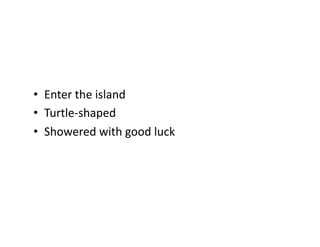
•  Enter	
  the	
  island	
  
•  Turtle-­‐shaped	
  
•  Showered	
  with	
  good	
  luck	
  
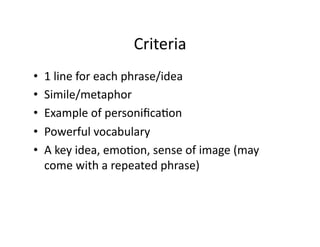
Criteria	
  
•  1	
  line	
  for	
  each	
  phrase/idea	
  
•  Simile/metaphor	
  
•  Example	
  of	
  personificaNon	
  
•  Powerful	
  vocabulary	
  
•  A	
  key	
  idea,	
  emoNon,	
  sense	
  of	
  image	
  (may	
  
come	
  with	
  a	
  repeated	
  phrase)	
  
The	
  Zig-­‐Zag	
  Bridge	
  
Walk	
  through	
  in	
  adulthood	
  
The	
  Devil	
  will	
  leave	
  you	
  
He	
  walks	
  in	
  straight	
  lines	
  
So	
  he	
  cannot	
  follow	
  you.	
  
The	
  Devil	
  is	
  unbearable,	
  
But	
  now	
  in	
  	
  adulthood,	
  
The	
  Devil	
  cannot	
  see	
  you	
  
Repent	
  
And	
  walk	
  through	
  the	
  bridge,	
  
The	
  zig-­‐zag	
  bridge.	
  
The	
  Devil	
  will	
  leave	
  you	
  
For	
  he	
  can	
  no	
  longer	
  see	
  you	
  
He	
  walks	
  in	
  straight	
  lines,	
  
So	
  he	
  cannot	
  follow	
  you.	
  
Devin	
  
The	
  garden	
  
built	
  in	
  memory	
  of	
  Nitobe	
  
bridge	
  across	
  the	
  Pacific	
  
Enter	
  to	
  the	
  right	
  
along	
  the	
  forest	
  path	
  
struggle	
  or	
  be	
  content	
  
in	
  your	
  early	
  life	
  
Along	
  the	
  way	
  of	
  childhood	
  
koi	
  fish,	
  virtue,	
  will,	
  grace	
  
as	
  long	
  as	
  the	
  mother	
  lights	
  your	
  path	
  
consequences	
  will	
  bring	
  early	
  marriage	
  and	
  late	
  marriage	
  
or	
  back	
  from	
  teen	
  rebellion	
  
	
  the	
  bamboo	
  fence	
  will	
  bring	
  you	
  	
  
through	
  the	
  pavilion	
  
Raise	
  your	
  family	
  with	
  pride	
  
when	
  you	
  get	
  to	
  the	
  final	
  bench	
  
rest,	
  reflect,	
  and	
  be	
  graNfied	
  
Timmy	
  
The	
  Garden	
  -­‐	
  by	
  Timmy	
  
The	
  garden	
  
Built	
  in	
  memory	
  of	
  Nitobe	
  
Bridge	
  across	
  the	
  Pacific	
  
Enter	
  to	
  the	
  right	
  
Along	
  the	
  forest	
  path	
  
Struggle	
  or	
  be	
  content	
  
In	
  your	
  early	
  life	
  
Along	
  the	
  way	
  of	
  childhood	
  	
  
Koi	
  fish	
  virtue	
  will	
  grant	
  
As	
  long	
  as	
  the	
  mother	
  lantern	
  lights	
  your	
  path	
  
The	
  Devil	
  Is	
  Gone	
  
Only	
  walks	
  in	
  straight	
  lines	
  
Bad	
  luck	
  
Zig	
  zag	
  bridge	
  
Middle	
  of	
  your	
  life	
  
Fall	
  if	
  he	
  tries	
  
Leave	
  the	
  devil	
  behind	
  
No	
  more	
  bad	
  luck	
  
The	
  devil	
  is	
  gone	


By:	
  	
  Devin	
  
•  Gr.	
  7	
  Quick	
  Scale:	
  	
  WriNng	
  Poems	
  
•  Meaning	
  
•  Style	
  
•  Form	
  	
  
•  ConvenNons	
  

Comox.april.2013.writing#3

  • 1.
    Creating Writers: allstudents writing and writing well Comox  Valley   Nov.  21,  Feb.  6.,  Apr.  17,  2013   Faye  Brownlie   www.slideshare.net  
  • 4.
    •  What  did  you  try?    Find  another  person  to  talk   to,  not  at  your  table,  and  chat  for  4-­‐5  minutes   –  what  did  you  try?    How  did  it  go?    What  will   you  do  next  Nme?   •  Meet  with  another  and  tell  what  you  learned.  
  • 5.
    What  are  the  narraNves  of  self  that  our   learners  are  developing?  What  is  the   story  they  tell  about  themselves  as   writers?     •  Our  language  and  our  acNons  are  immensely   powerful  in  helping  to  narrate  the  ‘self’  that   our  learners  are  becoming.  
  • 6.
    Do  your  students  receive  feedback   from  you  in  every  wriNng   opportunity?  
  • 7.
    Powerful  feedback  to  build  a  sense  of   agency   •  I  see  you  know  how  to  write  the  beginning  of   that  word….   •  Can  you  show  me  a  word  you  took  a  risk  at   spelling/using?   •  What  are  you  doing  as  a  writer  today?     •  I  bet  you’re  proud  of  yourself.   •  Which  part  are  you  sure  about,  and  which  part   are  you  not  sure  about?   – Choice  Words:  Peter  H.  Johnston  
  • 8.
    “The  most  powerful  single  influence  enhancing   achievement  is  feedback”   •  Quality  feedback  is  needed,  not  just  more  feedback   •  Students  with  a  Growth  Mindset  welcome  feedback   and  are  more  likely  to  use  it  to  improve  their   performance   •  Oral  feedback  is  much  more  effecNve  than  wricen   •  The  most  powerful  feedback  is  provided  from  the   student  to  the  teacher  
  • 10.
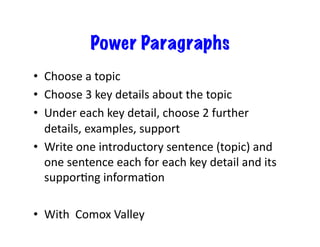
    Power Paragraphs •  Choose  a  topic   •  Choose  3  key  details  about  the  topic   •  Under  each  key  detail,  choose  2  further   details,  examples,  support   •  Write  one  introductory  sentence  (topic)  and   one  sentence  each  for  each  key  detail  and  its   supporNng  informaNon   •  With    Comox  Valley  
  • 17.
    Power Paragraphs •  Choose  a  topic   •  Choose  3  key  details  about  the  topic   •  Under  each  key  detail,  choose  2  further   details,  examples,  support   •  Write  one  introductory  sentence  (topic)  and   one  sentence  each  for  each  key  detail  and  its   supporNng  informaNon   •  With  Ken  Porter  and  Kelly  Zimmer,  Mundy   Road  –  in  class  support  for  students  at  risk  
  • 20.
    Explorer  Trading  Cards  –  Ken  Porter,   Coquitlam   •  Built  from  power  paragraphs  
  • 25.
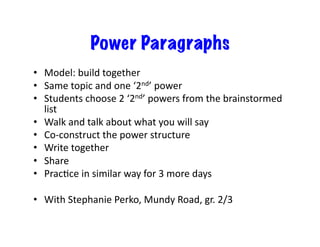
    Power Paragraphs •  Model:  build  together   •  Same  topic  and  one  ‘2nd’  power   •  Students  choose  2  ‘2nd’  powers  from  the  brainstormed   list   •  Walk  and  talk  about  what  you  will  say   •  Co-­‐construct  the  power  structure   •  Write  together   •  Share   •  PracNce  in  similar  way  for  3  more  days   •  With  Stephanie  Perko,  Mundy  Road,  gr.  2/3  
  • 32.
    Squiggles •  Draw aline on the board •  Encourage students to transform this into a picture, talking as they do so •  Have several students demonstrate •  Students draw the same squiggle in their writers’ notebook and write in response to the squiggle •  Ideas are meant to be shared!
  • 35.
    •  As  the  sun  dropped  behind  the  mountains,   they  turned  their  steps  toward  home.    Their   day  of  peace  and  tranquility  glowed  in  their   hearts.   •  Samantha,  grade  7  
  • 36.
    Online literacy videos • Literacy  Videos   •  Clustering  from  Text   •  Squiggles   www.sd72.bc.ca/districtadmin/ edcentrelearningresources/literacyvideos/ Pages/default.aspx  
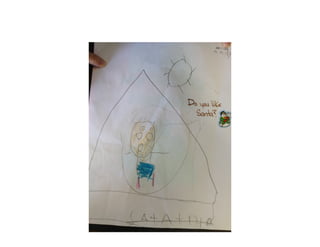
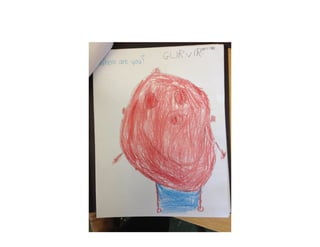
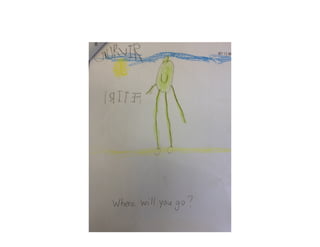
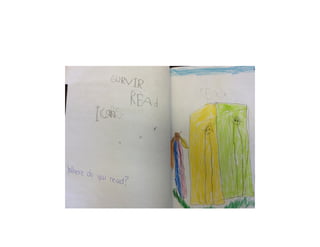
  • 37.
    K Writing •  Once  a  week   •  Cindy  Lee,  K  teacher,  and  Catherine  Feniak,   Principal,  Vancouver   •  All  ELL  students   •  Group  lesson  to  build  language  and  knowledge   •  Conference  with  each  student  as  he/she  writes   and  draws   •  Extend  the  language  and  the  thinking  
  • 51.
    A Sample Lesson Gr.6/7 with Fred Weil •  Field  trip   •  5  minute  free  write   •  Reread  3  Nmes:    word  count,  structure/grammar,  PS   •  Powerful  sentence   •  Rewrite  from  prose  to  poetry  (model  &  coach)   •  Whip  around  -­‐  dran  found  poem   •  Establish  criteria  for  personal  poem   •  Dran  own  found  poem   •  In  teams,  revise/edit  class  found  poem   •  Revise/edit  personal  poems  with  partner  and  publish  
  • 52.
    –  Me  and  my  class  went  to  UBC,  and  into  the  Nitobe  Gardens  on  Jan.  16.    The   Garden  looks  nice,  and  everything  has  a  meaning.    The  more  red  there  is,  the   more  danger.    There  are  also  bridges  and  lanterns.    My  favorite  bridge  is  the     zig-­‐zag  bridge.    They  say  when  you  become  an  adult,  you  walk  past  it  so  the   devil  leaves  you.    They  believe  the  devil  can  only  walk  in  a  straight  line.    The   lanterns  also  have  meaning.    The  father  lantern,  mother  lantern.  They  are  all   stages  you  will  cross  in  life.    When  we  entered  the  Nitobe  Gardens,  we  walked   towards  the  right  because  it  is  the  side  of  the  moon.    There  are  also  benches,   just  like  Mr.  Weil  said.    You  sit  on  the  bench  to  look  at  the  garden  and  see  what   you  have  done  in  life.    There  is  a  bridge  in  the  begining  and  the  end.   –  Devon  -­‐  139  
  • 53.
    •  When  you  enter  the  Nitobe  Memorial  Garden  you  turn  to  the  right.    The   Nitobe  Garden  was  built  in  the  memory  of  a  Japanese  man  named  Nitobe   who  wanted  to  be  the  bridge  between  Japan  and  Canada.    In  the  garden  you   follow  the  forest  path  of  “infancy”  and  pass  the  “father”  and  the  “mother”   lanterns.    You  can  choose  the  path  of  the  easygoing  child  or  the  path  of  the   struggling  child.    Aner  that  you  enter  the  wide  open  space  of  childhood.     There  is  a  pond  close  to  the  path  with  koi  fish  in  that  represent  virtues.    Soon   you  come  to  the  77  log  bridge  which  was  built  in  memory  of  Nitobe.   •  Timmy  -­‐  112  
  • 54.
    From  prose  to  poetry   •  “Enter  the  island,  the  shape  of  a  turtle.    The   turtle  will  shower  you  with  good  luck.”  
  • 55.
    •  Enter  the  island   •  Turtle-­‐shaped   •  Showered  with  good  luck  
  • 56.
    Criteria   •  1  line  for  each  phrase/idea   •  Simile/metaphor   •  Example  of  personificaNon   •  Powerful  vocabulary   •  A  key  idea,  emoNon,  sense  of  image  (may   come  with  a  repeated  phrase)  
  • 57.
    The  Zig-­‐Zag  Bridge   Walk  through  in  adulthood   The  Devil  will  leave  you   He  walks  in  straight  lines   So  he  cannot  follow  you.   The  Devil  is  unbearable,   But  now  in    adulthood,   The  Devil  cannot  see  you   Repent   And  walk  through  the  bridge,   The  zig-­‐zag  bridge.   The  Devil  will  leave  you   For  he  can  no  longer  see  you   He  walks  in  straight  lines,   So  he  cannot  follow  you.   Devin  
  • 58.
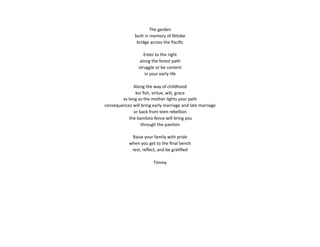
    The  garden   built  in  memory  of  Nitobe   bridge  across  the  Pacific   Enter  to  the  right   along  the  forest  path   struggle  or  be  content   in  your  early  life   Along  the  way  of  childhood   koi  fish,  virtue,  will,  grace   as  long  as  the  mother  lights  your  path   consequences  will  bring  early  marriage  and  late  marriage   or  back  from  teen  rebellion    the  bamboo  fence  will  bring  you     through  the  pavilion   Raise  your  family  with  pride   when  you  get  to  the  final  bench   rest,  reflect,  and  be  graNfied   Timmy  
  • 59.
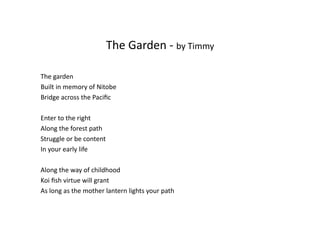
    The  Garden  -­‐  by  Timmy   The  garden   Built  in  memory  of  Nitobe   Bridge  across  the  Pacific   Enter  to  the  right   Along  the  forest  path   Struggle  or  be  content   In  your  early  life   Along  the  way  of  childhood     Koi  fish  virtue  will  grant   As  long  as  the  mother  lantern  lights  your  path  
  • 60.
    The  Devil  Is  Gone   Only  walks  in  straight  lines   Bad  luck   Zig  zag  bridge   Middle  of  your  life   Fall  if  he  tries   Leave  the  devil  behind   No  more  bad  luck   The  devil  is  gone       By:    Devin  
  • 61.
    •  Gr.  7  Quick  Scale:    WriNng  Poems   •  Meaning   •  Style   •  Form     •  ConvenNons