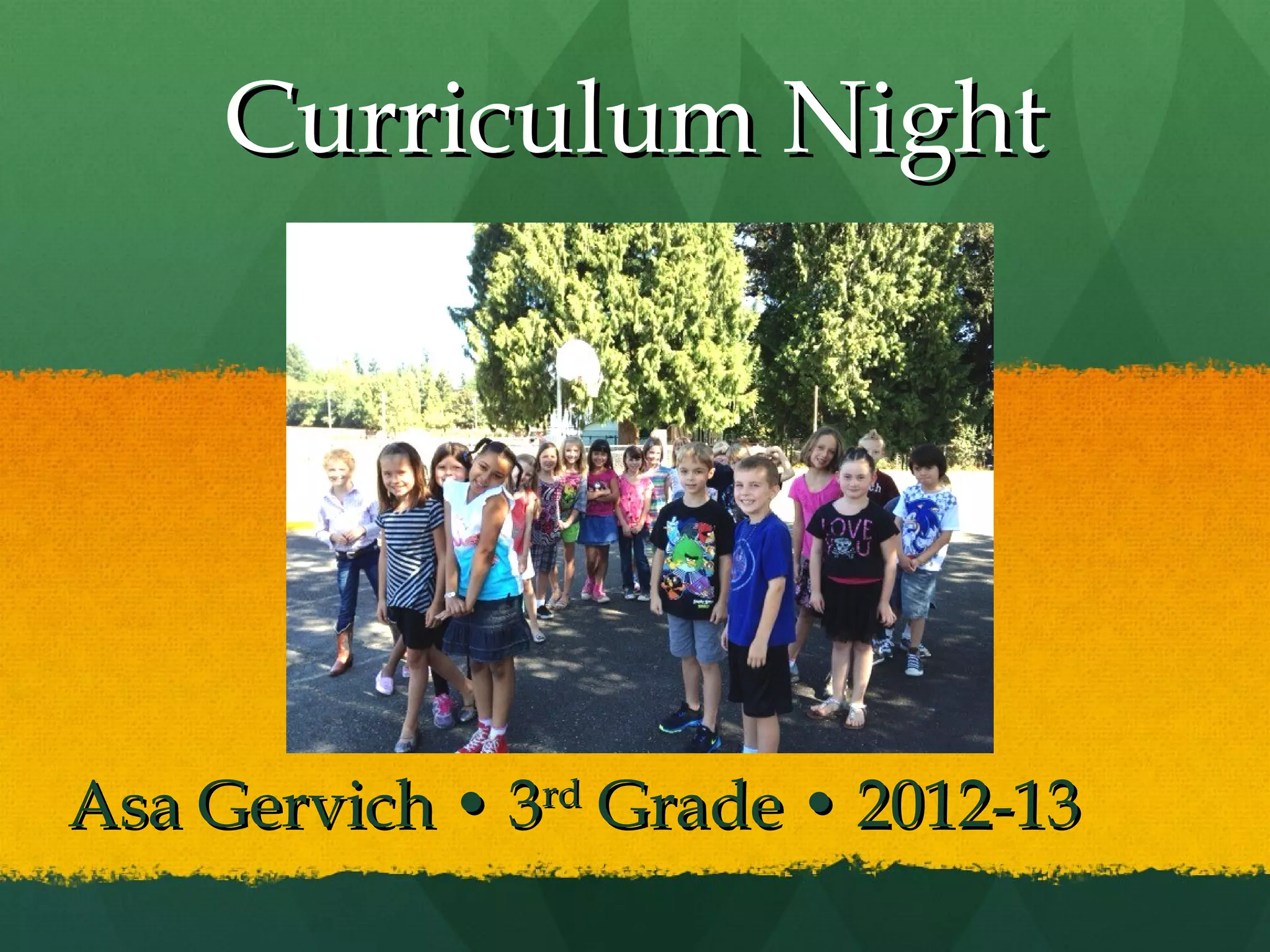
Curriculum Night


Asa Gervich • 3rd Grade • 2012-13
Agenda
 Welcome!
 Third Grade Classroom Blog
 Development of Responsibilities and Accountability
 Homework
 Overview of 3rd Grade Curriculum

• Our Schedule
 Behavior Policy, Classroom Agreement
 Request for Volunteers
 Questions?
teacherasa.blogspot.com
Development of Responsibilities and
         Accountability

  For themselves
   Making appropriate choices, using “I-Messages”,
   responsibility as part of the larger learning
   community

  For their property
   “Cubes”, lunches, desk space, community spaces,
   classroom jobs

  For their assignments
   Best work always, thoroughness, timeliness, neatness.
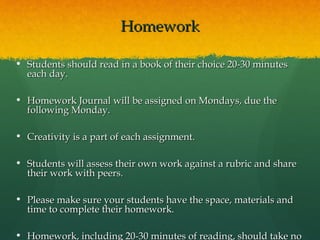
Homework

• Students should read in a book of their choice 20-30 minutes
  each day.

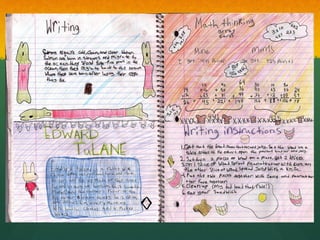
• Homework Journal will be assigned on Mondays, due the
  following Monday.

• Creativity is a part of each assignment.

• Students will assess their own work against a rubric and share
  their work with peers.

• Please make sure your students have the space, materials and
  time to complete their homework.

• Homework, including 20-30 minutes of reading, should take no
Curriculum Highlights for
         3 Grade
          rd

 Northwest Native Americans

 Salmon

 Wapato Park Field Studies

 School Native Plant and Food Gardens

 Rocks & Minerals

 Engineering & Physics of Bridges

 How Do Communities (and Cities) Self-govern?
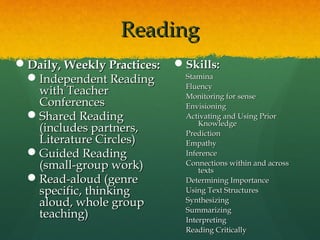
Reading
Daily, Weekly Practices:   Skills:
 Independent Reading         Stamina
                              Fluency
  with Teacher                Monitoring for sense
  Conferences                 Envisioning
 Shared Reading              Activating and Using Prior
                                  Knowledge
  (includes partners,         Prediction
  Literature Circles)         Empathy
 Guided Reading              Inference
  (small-group work)          Connections within and across
                                  texts
 Read-aloud (genre           Determining Importance
  specific, thinking          Using Text Structures
  aloud, whole group          Synthesizing
                              Summarizing
  teaching)                   Interpreting
                              Reading Critically
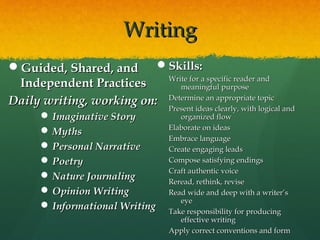
Writing
Guided, Shared, and      Skills:
                           Write for a specific reader and
 Independent Practices        meaningful purpose
Daily writing, working on: Determine an appropriate topic
                           Present ideas clearly, with logical and
                                    Present ideas clearly, with logical and
        Imaginative Story             organized flow
        Myths                      Elaborate on ideas
                                    Embrace language
        Personal Narrative         Create engaging leads
        Poetry                     Compose satisfying endings
                                    Craft authentic voice
        Nature Journaling
                                    Reread, rethink, revise
        Opinion Writing            Read wide and deep with a writer’s
                                       eye
        Informational Writing
                                    Take responsibility for producing
                                       effective writing
                                    Apply correct conventions and form
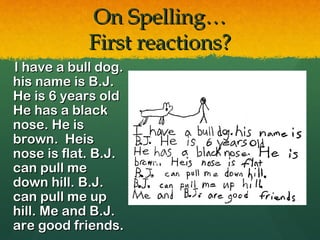
On Spelling…
            First reactions?
I have a bull dog.
his name is B.J.
He is 6 years old
He has a black
nose. He is
brown. Heis
nose is flat. B.J.
can pull me
down hill. B.J.
can pull me up
hill. Me and B.J.
are good friends.
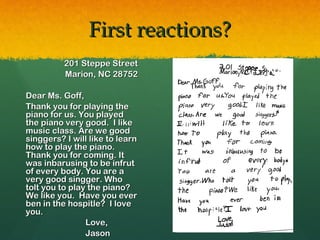
First reactions?
          201 Steppe Street
          Marion, NC 28752

Dear Ms. Goff,
Thank you for playing the
piano for us. You played
the piano very good. I like
music class. Are we good
singgers? I will like to learn
how to play the piano.
Thank you for coming. It
was inbarusing to be infrut
of every body. You are a
very good singger. Who
tolt you to play the piano?
We like you. Have you ever
ben in the hospitle? I love
you.
                Love,
                Jason
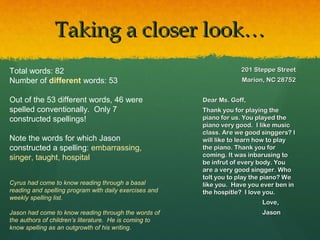
Taking a closer look…
Total words: 82                                                     201 Steppe Street
Number of different words: 53                                       Marion, NC 28752


Out of the 53 different words, 46 were                  Dear Ms. Goff,
spelled conventionally. Only 7                          Thank you for playing the
constructed spellings!                                  piano for us. You played the
                                                        piano very good. I like music
                                                        class. Are we good singgers? I
Note the words for which Jason                          will like to learn how to play
constructed a spelling: embarrassing,                   the piano. Thank you for
singer, taught, hospital                                coming. It was inbarusing to
                                                        be infrut of every body. You
                                                        are a very good singger. Who
                                                        tolt you to play the piano? We
Cyrus had come to know reading through a basal          like you. Have you ever ben in
reading and spelling program with daily exercises and   the hospitle? I love you.
weekly spelling list.
                                                                           Love,
Jason had come to know reading through the words of                        Jason
the authors of children’s literature. He is coming to
know spelling as an outgrowth of his writing.
Spelling

• Not preparing your child to “someday be a writer” –
  rather, allowing he/she to be a writer NOW.

• Word family/phonogram/spelling pattern
  instruction integrated into Writer’s Workshop
  through the teaching of strategies that facilitate
  spelling development and fluent writing.

• Spelling instructional plans are driven by careful
   observation of current student needs - not by linear
   textbooks, worksheets, or prescribed spelling lists.
Spelling
• Spelling integrated across the curriculum
• Ongoing assessment and evaluation through conferencing
• “Invented spellings” can tell us a great deal about what kids know
   about rules, patterns, visual configurations, and origins of
   language
• Students develop a spelling consciousness while writing for
   authentic purposes and audiences
• Students focus on their needs through word studies and
   investigations:
“Making Words” and “Words Their Way”
     developmental approach to teaching phonics and spelling.
     students select letters to build short and long words.
     explores words and letter patterns while increasing vocabularies.
Math: Bridges Curriculum


                        mathlearningcenter.org

Addition/Subtraction Computation, Early Algebraic Thinking, Probability,
Place-value, 2D Geometry, Multiplication Patterns and Concepts,
Money, Fractions, Data Collection and Analysis

 (for more information visit http://www.mathlearningcenter.org/resources/materials/parents
)
Asa’s Behavior Policy*
 Rules in my classsroom are few. I believe as all children
  are different, and all actions and reactions are very
  personal in nature, effective discipline involves a few
  overriding tenets rather than a long list of specific rules.                    The Kids’ Classroom
  Situations are dealt with as they arise with the focus on
  enabling the child to grow and learn from his or her                            Agreement:
  actions.
                                                                                  1.Treat others how you
My guidelines for student behavior                                                would want to be
1. You may engage in any behavior that does not create a                          treated.
   problem for you or anyone else in the world.                                   2.Be responsible with
                                                                                  our things.
2. If you find yourself with a problem, you may solve it by                       3.Do your best work.
   any means that does not create a problem for anyone
   else in the world.                                                             4.Be safe at all times.

3. You may engage in any behavior that does not
   jeopardize the safety or learning of yourself or others.
   Unkind words and actions will not be tolerated.

     *
         adapted from "Teaching With Love and Logic" by Jim Fay and Charles Fay, Ph.D
Classroom Needs
 Monthly Group of Parents to drive and assist a small group of students with
  site monitoring at Wapato Park

 Chaperone other field trips (does not always necessitate driving – we
  take buses for most off-island trips).
 Tutor a child in reading once a week (requires preliminary 10-15 min.
  training from Asa in PPPP tutoring strategy; this can be done in the
  morning, after-school or during lunch by appointment)
 Help children publish their writing once every 4-6 weeks.

  Help during art class on Thursdays.

  Make copies, laminate, staple, sort, etc.

  Organize, mail and distribute the third grade Scholastic book order each
  month
  Organize rotating weekly snack donations for our classroom (rotates
  through different families throughout the year – entails scheduling and
  emailing a reminder to family of the week)
Classroom Needs
 one-time volunteer opportunities…
What questions do you
       have?
 agervich@sauvieislandacademy.org

teacherasa.blogspot.com
          (971) 227-6103

CN_091212

  • 1.
    Curriculum Night Asa Gervich• 3rd Grade • 2012-13
  • 2.
    Agenda  Welcome!  ThirdGrade Classroom Blog  Development of Responsibilities and Accountability  Homework  Overview of 3rd Grade Curriculum • Our Schedule  Behavior Policy, Classroom Agreement  Request for Volunteers  Questions?
  • 3.
  • 4.
    Development of Responsibilitiesand Accountability  For themselves Making appropriate choices, using “I-Messages”, responsibility as part of the larger learning community  For their property “Cubes”, lunches, desk space, community spaces, classroom jobs  For their assignments Best work always, thoroughness, timeliness, neatness.
  • 5.
    Homework • Students shouldread in a book of their choice 20-30 minutes each day. • Homework Journal will be assigned on Mondays, due the following Monday. • Creativity is a part of each assignment. • Students will assess their own work against a rubric and share their work with peers. • Please make sure your students have the space, materials and time to complete their homework. • Homework, including 20-30 minutes of reading, should take no
  • 7.
    Curriculum Highlights for 3 Grade rd  Northwest Native Americans  Salmon  Wapato Park Field Studies  School Native Plant and Food Gardens  Rocks & Minerals  Engineering & Physics of Bridges  How Do Communities (and Cities) Self-govern?
  • 8.
    Reading Daily, Weekly Practices: Skills: Independent Reading Stamina Fluency with Teacher Monitoring for sense Conferences Envisioning Shared Reading Activating and Using Prior Knowledge (includes partners, Prediction Literature Circles) Empathy Guided Reading Inference (small-group work) Connections within and across texts Read-aloud (genre Determining Importance specific, thinking Using Text Structures aloud, whole group Synthesizing Summarizing teaching) Interpreting Reading Critically
  • 9.
    Writing Guided, Shared, and Skills: Write for a specific reader and Independent Practices meaningful purpose Daily writing, working on: Determine an appropriate topic Present ideas clearly, with logical and Present ideas clearly, with logical and  Imaginative Story organized flow  Myths Elaborate on ideas Embrace language  Personal Narrative Create engaging leads  Poetry Compose satisfying endings Craft authentic voice  Nature Journaling Reread, rethink, revise  Opinion Writing Read wide and deep with a writer’s eye  Informational Writing Take responsibility for producing effective writing Apply correct conventions and form
  • 10.
    On Spelling… First reactions? I have a bull dog. his name is B.J. He is 6 years old He has a black nose. He is brown. Heis nose is flat. B.J. can pull me down hill. B.J. can pull me up hill. Me and B.J. are good friends.
  • 11.
    First reactions? 201 Steppe Street Marion, NC 28752 Dear Ms. Goff, Thank you for playing the piano for us. You played the piano very good. I like music class. Are we good singgers? I will like to learn how to play the piano. Thank you for coming. It was inbarusing to be infrut of every body. You are a very good singger. Who tolt you to play the piano? We like you. Have you ever ben in the hospitle? I love you. Love, Jason
  • 12.
    Taking a closerlook… Total words: 82 201 Steppe Street Number of different words: 53 Marion, NC 28752 Out of the 53 different words, 46 were Dear Ms. Goff, spelled conventionally. Only 7 Thank you for playing the constructed spellings! piano for us. You played the piano very good. I like music class. Are we good singgers? I Note the words for which Jason will like to learn how to play constructed a spelling: embarrassing, the piano. Thank you for singer, taught, hospital coming. It was inbarusing to be infrut of every body. You are a very good singger. Who tolt you to play the piano? We Cyrus had come to know reading through a basal like you. Have you ever ben in reading and spelling program with daily exercises and the hospitle? I love you. weekly spelling list. Love, Jason had come to know reading through the words of Jason the authors of children’s literature. He is coming to know spelling as an outgrowth of his writing.
  • 13.
    Spelling • Not preparingyour child to “someday be a writer” – rather, allowing he/she to be a writer NOW. • Word family/phonogram/spelling pattern instruction integrated into Writer’s Workshop through the teaching of strategies that facilitate spelling development and fluent writing. • Spelling instructional plans are driven by careful observation of current student needs - not by linear textbooks, worksheets, or prescribed spelling lists.
  • 14.
    Spelling • Spelling integratedacross the curriculum • Ongoing assessment and evaluation through conferencing • “Invented spellings” can tell us a great deal about what kids know about rules, patterns, visual configurations, and origins of language • Students develop a spelling consciousness while writing for authentic purposes and audiences • Students focus on their needs through word studies and investigations: “Making Words” and “Words Their Way”  developmental approach to teaching phonics and spelling.  students select letters to build short and long words.  explores words and letter patterns while increasing vocabularies.
  • 15.
    Math: Bridges Curriculum mathlearningcenter.org Addition/Subtraction Computation, Early Algebraic Thinking, Probability, Place-value, 2D Geometry, Multiplication Patterns and Concepts, Money, Fractions, Data Collection and Analysis (for more information visit http://www.mathlearningcenter.org/resources/materials/parents )
  • 16.
    Asa’s Behavior Policy* Rules in my classsroom are few. I believe as all children are different, and all actions and reactions are very personal in nature, effective discipline involves a few overriding tenets rather than a long list of specific rules. The Kids’ Classroom Situations are dealt with as they arise with the focus on enabling the child to grow and learn from his or her Agreement: actions. 1.Treat others how you My guidelines for student behavior would want to be 1. You may engage in any behavior that does not create a treated. problem for you or anyone else in the world. 2.Be responsible with our things. 2. If you find yourself with a problem, you may solve it by 3.Do your best work. any means that does not create a problem for anyone else in the world. 4.Be safe at all times. 3. You may engage in any behavior that does not jeopardize the safety or learning of yourself or others. Unkind words and actions will not be tolerated. * adapted from "Teaching With Love and Logic" by Jim Fay and Charles Fay, Ph.D
  • 17.
    Classroom Needs  MonthlyGroup of Parents to drive and assist a small group of students with site monitoring at Wapato Park  Chaperone other field trips (does not always necessitate driving – we take buses for most off-island trips).  Tutor a child in reading once a week (requires preliminary 10-15 min. training from Asa in PPPP tutoring strategy; this can be done in the morning, after-school or during lunch by appointment)  Help children publish their writing once every 4-6 weeks.   Help during art class on Thursdays.   Make copies, laminate, staple, sort, etc.   Organize, mail and distribute the third grade Scholastic book order each month   Organize rotating weekly snack donations for our classroom (rotates through different families throughout the year – entails scheduling and emailing a reminder to family of the week)
  • 18.
    Classroom Needs one-timevolunteer opportunities…
  • 19.
    What questions doyou have? agervich@sauvieislandacademy.org teacherasa.blogspot.com (971) 227-6103