Madhu S M
MPT- CBR
Health care delivery system is the
organization of people, institutions and
resources that deliver health care services
to meet the health needs of the country.
Apart from central government each state
has developed its own system of health
care delivery.
Health care delivery system refers to the
totality of resources that a population or
society distributes in the organisation and
delivery of health population services. It
also includes all personal and public
services performed by individuals or
institutions for the purpose of maintaining
or restoring health
 -
Stanhope(2001)
To improve the health status of population
and clinical outcomes of care.
To improve the experience of care of
patients, families and community.
To reduce the total economic burden of
care and illness.
To improve social justice equity in the
health status of the population.
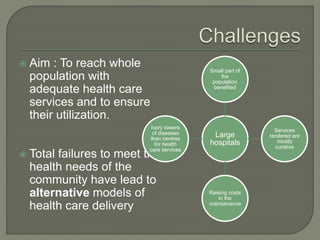
 Aim : To reach whole
population with
adequate health care
services and to ensure
their utilization.
 Total failures to meet the
health needs of the
community have lead to
alternative models of
health care delivery
Large
hospitals
Small part of
the
population
benefited
Services
rendered are
mostly
curative
Raising costs
in the
maintainance
Ivory towers
of diseases
than centres
for health
care services
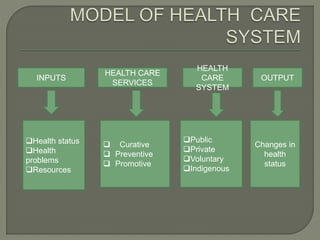
INPUTS
HEALTH CARE
SERVICES
HEALTH
CARE
SYSTEM
OUTPUT
Health status
Health
problems
Resources
 Curative
 Preventive
 Promotive
Public
Private
Voluntary
Indigenous
Changes in
health
status
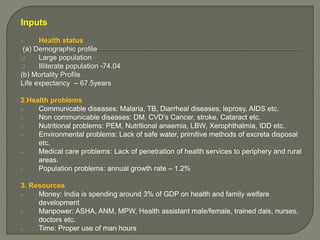
Inputs
1. Health status
(a) Demographic profile
 Large population
 Illiterate population -74.04
(b) Mortality Profile
Life expectancy – 67.5years
2.Health problems
a. Communicable diseases: Malaria, TB, Diarrheal diseases, leprosy, AIDS etc.
b. Non communicable diseases: DM, CVD’s Cancer, stroke, Cataract etc.
c. Nutritional problems: PEM, Nutritional anaemia, LBW, Xerophthalmia, IDD etc.
d. Environmental problems: Lack of safe water, primitive methods of excreta disposal
etc.
e. Medical care problems: Lack of penetration of health services to periphery and rural
areas.
f. Population problems: annual growth rate – 1.2%
3. Resources
a. Money: India is spending around 3% of GDP on health and family welfare
development
b. Manpower: ASHA, ANM, MPW, Health assistant male/female, trained dais, nurses,
doctors etc.
c. Time: Proper use of man hours
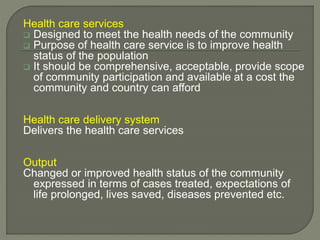
Health care services
 Designed to meet the health needs of the community
 Purpose of health care service is to improve health
status of the population
 It should be comprehensive, acceptable, provide scope
of community participation and available at a cost the
community and country can afford
Health care delivery system
Delivers the health care services
Output
Changed or improved health status of the community
expressed in terms of cases treated, expectations of
life prolonged, lives saved, diseases prevented etc.
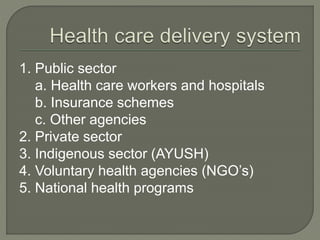
1. Public sector
a. Health care workers and hospitals
b. Insurance schemes
c. Other agencies
2. Private sector
3. Indigenous sector (AYUSH)
4. Voluntary health agencies (NGO’s)
5. National health programs
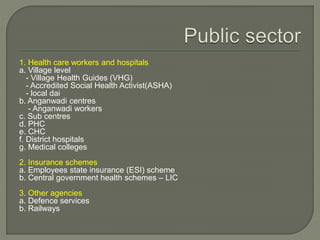
1. Health care workers and hospitals
a. Village level
- Village Health Guides (VHG)
- Accredited Social Health Activist(ASHA)
- local dai
b. Anganwadi centres
- Anganwadi workers
c. Sub centres
d. PHC
e. CHC
f. District hospitals
g. Medical colleges
2. Insurance schemes
a. Employees state insurance (ESI) scheme
b. Central government health schemes – LIC
3. Other agencies
a. Defence services
b. Railways
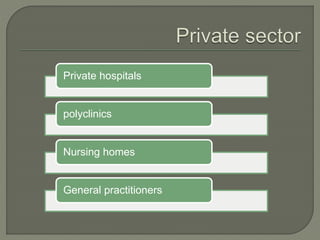
Private hospitals
polyclinics
Nursing homes
General practitioners
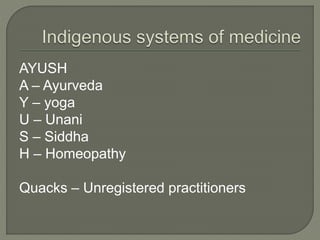
AYUSH
A – Ayurveda
Y – yoga
U – Unani
S – Siddha
H – Homeopathy
Quacks – Unregistered practitioners
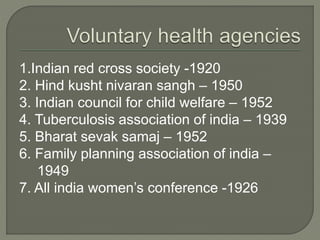
1.Indian red cross society -1920
2. Hind kusht nivaran sangh – 1950
3. Indian council for child welfare – 1952
4. Tuberculosis association of india – 1939
5. Bharat sevak samaj – 1952
6. Family planning association of india –
1949
7. All india women’s conference -1926
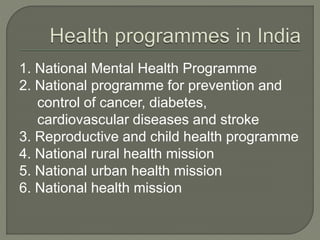
1. National Mental Health Programme
2. National programme for prevention and
control of cancer, diabetes,
cardiovascular diseases and stroke
3. Reproductive and child health programme
4. National rural health mission
5. National urban health mission
6. National health mission
HEALTH CARE DELIVERY SYSTEM.pptx

HEALTH CARE DELIVERY SYSTEM.pptx

  • 1.
  • 2.
    Health care deliverysystem is the organization of people, institutions and resources that deliver health care services to meet the health needs of the country. Apart from central government each state has developed its own system of health care delivery.
  • 3.
    Health care deliverysystem refers to the totality of resources that a population or society distributes in the organisation and delivery of health population services. It also includes all personal and public services performed by individuals or institutions for the purpose of maintaining or restoring health  - Stanhope(2001)
  • 4.
    To improve thehealth status of population and clinical outcomes of care. To improve the experience of care of patients, families and community. To reduce the total economic burden of care and illness. To improve social justice equity in the health status of the population.
  • 5.
     Aim :To reach whole population with adequate health care services and to ensure their utilization.  Total failures to meet the health needs of the community have lead to alternative models of health care delivery Large hospitals Small part of the population benefited Services rendered are mostly curative Raising costs in the maintainance Ivory towers of diseases than centres for health care services
  • 6.
    INPUTS HEALTH CARE SERVICES HEALTH CARE SYSTEM OUTPUT Health status Health problems Resources Curative  Preventive  Promotive Public Private Voluntary Indigenous Changes in health status
  • 7.
    Inputs 1. Health status (a)Demographic profile  Large population  Illiterate population -74.04 (b) Mortality Profile Life expectancy – 67.5years 2.Health problems a. Communicable diseases: Malaria, TB, Diarrheal diseases, leprosy, AIDS etc. b. Non communicable diseases: DM, CVD’s Cancer, stroke, Cataract etc. c. Nutritional problems: PEM, Nutritional anaemia, LBW, Xerophthalmia, IDD etc. d. Environmental problems: Lack of safe water, primitive methods of excreta disposal etc. e. Medical care problems: Lack of penetration of health services to periphery and rural areas. f. Population problems: annual growth rate – 1.2% 3. Resources a. Money: India is spending around 3% of GDP on health and family welfare development b. Manpower: ASHA, ANM, MPW, Health assistant male/female, trained dais, nurses, doctors etc. c. Time: Proper use of man hours
  • 8.
    Health care services Designed to meet the health needs of the community  Purpose of health care service is to improve health status of the population  It should be comprehensive, acceptable, provide scope of community participation and available at a cost the community and country can afford Health care delivery system Delivers the health care services Output Changed or improved health status of the community expressed in terms of cases treated, expectations of life prolonged, lives saved, diseases prevented etc.
  • 9.
    1. Public sector a.Health care workers and hospitals b. Insurance schemes c. Other agencies 2. Private sector 3. Indigenous sector (AYUSH) 4. Voluntary health agencies (NGO’s) 5. National health programs
  • 10.
    1. Health careworkers and hospitals a. Village level - Village Health Guides (VHG) - Accredited Social Health Activist(ASHA) - local dai b. Anganwadi centres - Anganwadi workers c. Sub centres d. PHC e. CHC f. District hospitals g. Medical colleges 2. Insurance schemes a. Employees state insurance (ESI) scheme b. Central government health schemes – LIC 3. Other agencies a. Defence services b. Railways
  • 11.
  • 12.
    AYUSH A – Ayurveda Y– yoga U – Unani S – Siddha H – Homeopathy Quacks – Unregistered practitioners
  • 13.
    1.Indian red crosssociety -1920 2. Hind kusht nivaran sangh – 1950 3. Indian council for child welfare – 1952 4. Tuberculosis association of india – 1939 5. Bharat sevak samaj – 1952 6. Family planning association of india – 1949 7. All india women’s conference -1926
  • 14.
    1. National MentalHealth Programme 2. National programme for prevention and control of cancer, diabetes, cardiovascular diseases and stroke 3. Reproductive and child health programme 4. National rural health mission 5. National urban health mission 6. National health mission