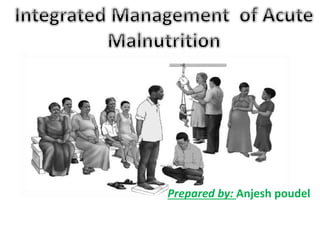
Prepared by: Anjesh poudel
• Overview of malnutrition
• Objectives of IMAM
• Principles of IMAM
• Structure of IMAM
• Components of IMAM
in Nepal
Overview of malnutrition
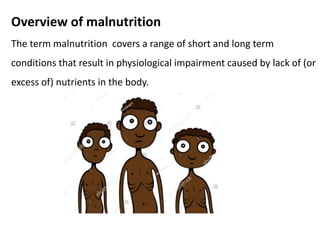
The term malnutrition covers a range of short and long term
conditions that result in physiological impairment caused by lack of (or
excess of) nutrients in the body.
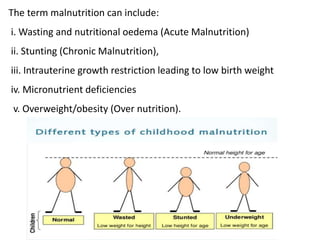
The term malnutrition can include:
i. Wasting and nutritional oedema (Acute Malnutrition)
ii. Stunting (Chronic Malnutrition),
iii. Intrauterine growth restriction leading to low birth weight
iv. Micronutrient deficiencies
v. Overweight/obesity (Over nutrition).
• These conditions may be experienced over a scale of severity
and are usually classified into moderate and severe forms.
• They may occur in isolation within an individual or in
combination.
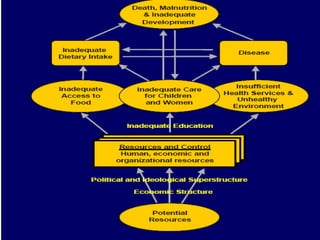
• The causes of under nutrition are multiple and context specific
are summarised in the below conceptual framework .
Contd…
What is acute malnutrition?
• Acute malnutrition (or wasting and/or oedema) occurs
when an individual suffers from severe nutritional
restrictions, a recent bout of illness, inappropriate
childcare practices or a combination of these factors.
• The result is sudden weight loss or the development of
bilateral pitting oedema, which can be reversed with
appropriate treatment.
• Acute malnutrition is diagnosed if a child has inadequate
weight relative to height compared to the WHO reference
population and/or if muscle wasting is present using Mid
Upper Arm Circumference (MUAC) and/or bilateral pitting
oedema.
CONTD…
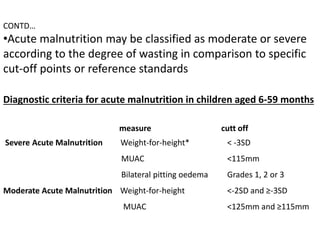
•Acute malnutrition may be classified as moderate or severe
according to the degree of wasting in comparison to specific
cut-off points or reference standards
Diagnostic criteria for acute malnutrition in children aged 6-59 months
measure cutt off
Severe Acute Malnutrition Weight-for-height* < -3SD
MUAC <115mm
Bilateral pitting oedema Grades 1, 2 or 3
Moderate Acute Malnutrition Weight-for-height <-2SD and ≥-3SD
MUAC <125mm and ≥115mm
Objectives of IMAM
The primary objectives of IMAM are:
• To reduce mortality and morbidity risks in children under
five due to acute malnutrition;
• To rehabilitate children with acute malnutrition to a state
of health in which they are able to sustain their nutritional
status upon discharge as cured
•To prevent the condition of children with acute
malnutrition from deteriorating thus requiring ore more
more intensive treatment;
• Contribute to the prevention of acute malnutrition in
young children in the critical 1000 day window
• Prevent micro-nutrient deficiency disorders among under
five year old children associated with acute malnutrition.
Principles of IMAM
• IMAM is a strategy to address acute malnutrition
• It aims to integrate the management of acute malnutrition across
the sectors to ensure that treatment is linked to support for
continued rehabilitation of cases and to wider malnutrition
prevention programmes and services focused on the critical 1000 day
window.
IMAM is based on the following principles :
Maximum coverage and access – IMAM is designed to achieve the
greatest possible coverage by making services accessible and
acceptable to the highest possible proportion of a population in need.
-Timeliness – IMAM prioritises early case-finding and mobilisation so
that most of the cases of acute malnutrition can be treated before
complications develop.
Appropriate care – Provision of simple, effective outpatient
care for those who can be treated at home and clinical care for
those who need inpatient treatment. Less intensive care is
provided for those suffering from MAM.
Care for as long as it is needed - By improving access to
treatment and integrating the service into the existing
structures and health system, IMAM ensures that children can
stay in the programme until they have been cured
Structure of IMAM
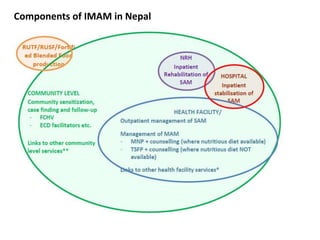
IMAM has four components: Community mobilisation, InpatientTherapeutic
Care (ITC), Outpatient Therapeutic Care (OTC) and Management of MAM.
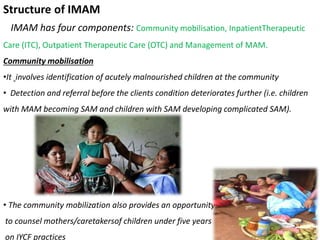
Community mobilisation
•It involves identification of acutely malnourished children at the community
• Detection and referral before the clients condition deteriorates further (i.e. children
with MAM becoming SAM and children with SAM developing complicated SAM).
• The community mobilization also provides an opportunity
to counsel mothers/caretakersof children under five years
on IYCF practices
Contd..
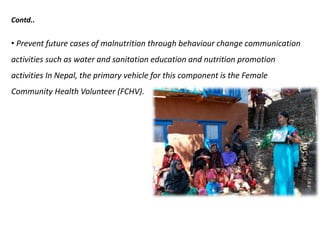
• Prevent future cases of malnutrition through behaviour change communication
activities such as water and sanitation education and nutrition promotion
activities In Nepal, the primary vehicle for this component is the Female
Community Health Volunteer (FCHV).
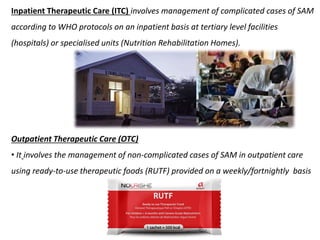
Inpatient Therapeutic Care (ITC) involves management of complicated cases of SAM
according to WHO protocols on an inpatient basis at tertiary level facilities
(hospitals) or specialised units (Nutrition Rehabilitation Homes).
Outpatient Therapeutic Care (OTC)
• It involves the management of non-complicated cases of SAM in outpatient care
using ready-to-use therapeutic foods (RUTF) provided on a weekly/fortnightly basis
CONTD…
• Simple routine medicines, and monitoring and orientation for the
mothers/caretakers.
• Outpatient care is offered through decentralized health structures (e.g. health
posts or sub-health posts).
Management of Moderate Acute Malnutrition (MAM)
It may take two forms depending on the household food security level of the district
including in emergency context. It involves either
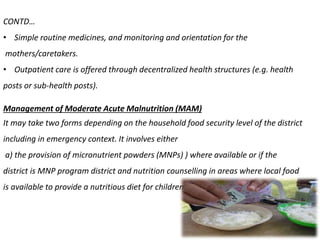
a) the provision of micronutrient powders (MNPs) ) where available or if the
district is MNP program district and nutrition counselling in areas where local food
is available to provide a nutritious diet for children,
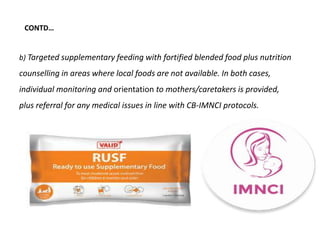
b) Targeted supplementary feeding with fortified blended food plus nutrition
counselling in areas where local foods are not available. In both cases,
individual monitoring and orientation to mothers/caretakers is provided,
plus referral for any medical issues in line with CB-IMNCI protocols.
CONTD…
Components of IMAM in Nepal
IMAM in nepal

IMAM in nepal

  • 1.
  • 2.
    • Overview ofmalnutrition • Objectives of IMAM • Principles of IMAM • Structure of IMAM • Components of IMAM in Nepal
  • 3.
    Overview of malnutrition Theterm malnutrition covers a range of short and long term conditions that result in physiological impairment caused by lack of (or excess of) nutrients in the body.
  • 4.
    The term malnutritioncan include: i. Wasting and nutritional oedema (Acute Malnutrition) ii. Stunting (Chronic Malnutrition), iii. Intrauterine growth restriction leading to low birth weight iv. Micronutrient deficiencies v. Overweight/obesity (Over nutrition).
  • 5.
    • These conditionsmay be experienced over a scale of severity and are usually classified into moderate and severe forms. • They may occur in isolation within an individual or in combination. • The causes of under nutrition are multiple and context specific are summarised in the below conceptual framework . Contd…
  • 7.
    What is acutemalnutrition? • Acute malnutrition (or wasting and/or oedema) occurs when an individual suffers from severe nutritional restrictions, a recent bout of illness, inappropriate childcare practices or a combination of these factors. • The result is sudden weight loss or the development of bilateral pitting oedema, which can be reversed with appropriate treatment. • Acute malnutrition is diagnosed if a child has inadequate weight relative to height compared to the WHO reference population and/or if muscle wasting is present using Mid Upper Arm Circumference (MUAC) and/or bilateral pitting oedema.
  • 8.
    CONTD… •Acute malnutrition maybe classified as moderate or severe according to the degree of wasting in comparison to specific cut-off points or reference standards Diagnostic criteria for acute malnutrition in children aged 6-59 months measure cutt off Severe Acute Malnutrition Weight-for-height* < -3SD MUAC <115mm Bilateral pitting oedema Grades 1, 2 or 3 Moderate Acute Malnutrition Weight-for-height <-2SD and ≥-3SD MUAC <125mm and ≥115mm
  • 9.
    Objectives of IMAM Theprimary objectives of IMAM are: • To reduce mortality and morbidity risks in children under five due to acute malnutrition; • To rehabilitate children with acute malnutrition to a state of health in which they are able to sustain their nutritional status upon discharge as cured
  • 10.
    •To prevent thecondition of children with acute malnutrition from deteriorating thus requiring ore more more intensive treatment; • Contribute to the prevention of acute malnutrition in young children in the critical 1000 day window • Prevent micro-nutrient deficiency disorders among under five year old children associated with acute malnutrition.
  • 11.
    Principles of IMAM •IMAM is a strategy to address acute malnutrition • It aims to integrate the management of acute malnutrition across the sectors to ensure that treatment is linked to support for continued rehabilitation of cases and to wider malnutrition prevention programmes and services focused on the critical 1000 day window.
  • 12.
    IMAM is basedon the following principles : Maximum coverage and access – IMAM is designed to achieve the greatest possible coverage by making services accessible and acceptable to the highest possible proportion of a population in need. -Timeliness – IMAM prioritises early case-finding and mobilisation so that most of the cases of acute malnutrition can be treated before complications develop.
  • 13.
    Appropriate care –Provision of simple, effective outpatient care for those who can be treated at home and clinical care for those who need inpatient treatment. Less intensive care is provided for those suffering from MAM. Care for as long as it is needed - By improving access to treatment and integrating the service into the existing structures and health system, IMAM ensures that children can stay in the programme until they have been cured
  • 14.
    Structure of IMAM IMAMhas four components: Community mobilisation, InpatientTherapeutic Care (ITC), Outpatient Therapeutic Care (OTC) and Management of MAM. Community mobilisation •It involves identification of acutely malnourished children at the community • Detection and referral before the clients condition deteriorates further (i.e. children with MAM becoming SAM and children with SAM developing complicated SAM). • The community mobilization also provides an opportunity to counsel mothers/caretakersof children under five years on IYCF practices
  • 15.
    Contd.. • Prevent futurecases of malnutrition through behaviour change communication activities such as water and sanitation education and nutrition promotion activities In Nepal, the primary vehicle for this component is the Female Community Health Volunteer (FCHV).
  • 16.
    Inpatient Therapeutic Care(ITC) involves management of complicated cases of SAM according to WHO protocols on an inpatient basis at tertiary level facilities (hospitals) or specialised units (Nutrition Rehabilitation Homes). Outpatient Therapeutic Care (OTC) • It involves the management of non-complicated cases of SAM in outpatient care using ready-to-use therapeutic foods (RUTF) provided on a weekly/fortnightly basis
  • 17.
    CONTD… • Simple routinemedicines, and monitoring and orientation for the mothers/caretakers. • Outpatient care is offered through decentralized health structures (e.g. health posts or sub-health posts). Management of Moderate Acute Malnutrition (MAM) It may take two forms depending on the household food security level of the district including in emergency context. It involves either a) the provision of micronutrient powders (MNPs) ) where available or if the district is MNP program district and nutrition counselling in areas where local food is available to provide a nutritious diet for children,
  • 18.
    b) Targeted supplementaryfeeding with fortified blended food plus nutrition counselling in areas where local foods are not available. In both cases, individual monitoring and orientation to mothers/caretakers is provided, plus referral for any medical issues in line with CB-IMNCI protocols. CONTD…
  • 19.