Making Clean Local Energy Accessible Now
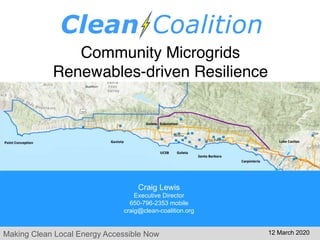
Community Microgrids
Renewables-driven Resilience
Craig Lewis
Executive Director
650-796-2353 mobile
craig@clean-coalition.org
12 March 2020
Making Clean Local Energy Accessible Now 2
Clean Coalition (non-profit)
Mission
To accelerate the transition to renewable
energy and a modern grid through
technical, policy, and project
development expertise.
Renewable Energy End-Game
100% renewable energy; 25% local,
interconnected within the distribution grid
and ensuring resilience without
dependence on the transmission grid; and
75% remote, fully dependent on the
transmission grid for serving loads.
Making Clean Local Energy Accessible Now 3
Community Microgrids are the grid of the future
A Community Microgrid is a new approach for designing and
operating the electric grid, stacked with local renewables and
staged for resilience.
Key features:
• A targeted and coordinated distribution grid area served by one
or more substations – ultimately including a transmission-
distribution substation that sets the stage for Distribution
System Operator (DSO) performance.
• Ability to utilize existing distribution grid infrastructure to serve
the Community Microgrid during broader grid outages
• High penetrations of local renewables and other distributed
energy resources (DER) such as energy storage and demand
response.
• Staged capability for indefinite renewables-driven backup
power for critical community facilities across the grid area –
achieved by 25% local renewables mix.
• A solution that can be readily extended throughout a utility
service territory – and replicated into any utility service territory
around the world.
Making Clean Local Energy Accessible Now 4
Natural gas infrastructure is not resilient
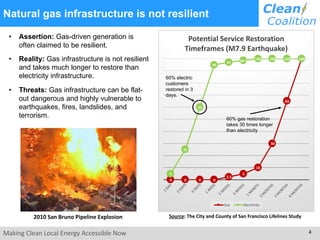
• Assertion: Gas-driven generation is
often claimed to be resilient.
• Reality: Gas infrastructure is not resilient
and takes much longer to restore than
electricity infrastructure.
• Threats: Gas infrastructure can be flat-
out dangerous and highly vulnerable to
earthquakes, fires, landslides, and
terrorism.
0 0 0 0
2.5
5
10
30
65
100
5
25
60
95
97 98.5 100 100 100 100
1
DAY
2
DAYS
3
DAYS
1
W
EEK
2
W
EEKS
3
W
EEKS
1
M
ONTH
2
M
ONTHS
3
M
ONTHS
6
M
ONTHS
Potential Service Restoration
Timeframes (M7.9 Earthquake)
Gas Electricity
60% electric
customers
restored in 3
days.
60% gas restoration
takes 30 times longer
than electricity
Source: The City and County of San Francisco Lifelines Study2010 San Bruno Pipeline Explosion
Making Clean Local Energy Accessible Now 5
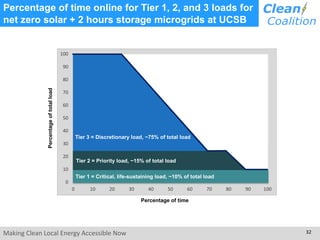
Value of Resilience (VOR) depends on tier of load
• Everyone understands there is significant value to resilience provided by indefinite renewables-
driven backup power
• But, nobody has yet to quantify this value of unparalleled resilience.
• Hence, there is an economic gap for innovative Community Microgrid projects while learning is still is
the early stages.
• The Clean Coalition aims to establish standardized Value of Resilience (VOR) for critical, priority,
and discretionary loads that will help everyone understand that premiums are appropriate for
indefinite renewables-driven backup power of critical loads and almost constant backup power
to priority loads, which yields a configuration that delivers backup power to all loads a lot of
the time
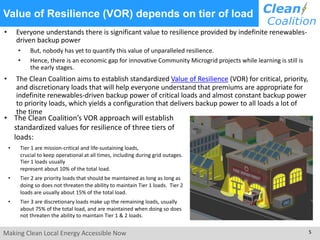
• The Clean Coalition’s VOR approach will establish
standardized values for resilience of three tiers of
loads:
• Tier 1 are mission-critical and life-sustaining loads,
crucial to keep operational at all times, including during grid outages.
Tier 1 loads usually
represent about 10% of the total load.
• Tier 2 are priority loads that should be maintained as long as long as
doing so does not threaten the ability to maintain Tier 1 loads. Tier 2
loads are usually about 15% of the total load.
• Tier 3 are discretionary loads make up the remaining loads, usually
about 75% of the total load, and are maintained when doing so does
not threaten the ability to maintain Tier 1 & 2 loads.
Making Clean Local Energy Accessible Now 6
0
10
20
30
40
50
60
70
80
90
100
0 10 20 30 40 50 60 70 80 90 100
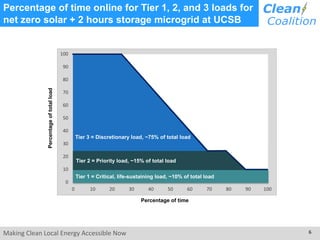
Tier 1 = Critical load, ~10% of total load
Percentageoftotalload
Percentage of time
Tier 3 = Discretionary load, ~75% of total load
Tier 1 = Critical, life-sustaining load, ~10% of total load
Tier 2 = Priority load, ~15% of total load
Percentage of time online for Tier 1, 2, and 3 loads for
net zero solar + 2 hours storage microgrid at UCSB
Making Clean Local Energy Accessible Now 7
Goleta Load Pocket (GLP)
The GLP is the perfect opportunity for a comprehensive Community Microgrid
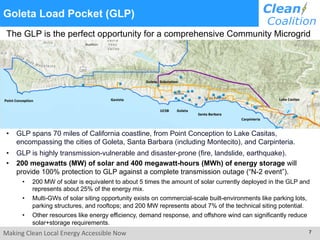
• GLP spans 70 miles of California coastline, from Point Conception to Lake Casitas,
encompassing the cities of Goleta, Santa Barbara (including Montecito), and Carpinteria.
• GLP is highly transmission-vulnerable and disaster-prone (fire, landslide, earthquake).
• 200 megawatts (MW) of solar and 400 megawatt-hours (MWh) of energy storage will
provide 100% protection to GLP against a complete transmission outage (“N-2 event”).
• 200 MW of solar is equivalent to about 5 times the amount of solar currently deployed in the GLP and
represents about 25% of the energy mix.
• Multi-GWs of solar siting opportunity exists on commercial-scale built-environments like parking lots,
parking structures, and rooftops; and 200 MW represents about 7% of the technical siting potential.
• Other resources like energy efficiency, demand response, and offshore wind can significantly reduce
solar+storage requirements.
Making Clean Local Energy Accessible Now 8
SCE-proposed & CPUC-approved energy storage
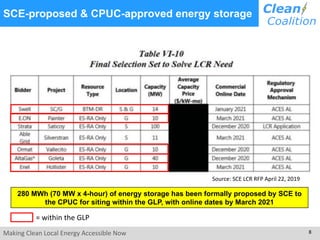
280 MWh (70 MW x 4-hour) of energy storage has been formally proposed by SCE to
the CPUC for siting within the GLP, with online dates by March 2021
Source: SCE LCR RFP April 22, 2019
= within the GLP
Making Clean Local Energy Accessible Now 9
Community Microgrids obviate gas peakers
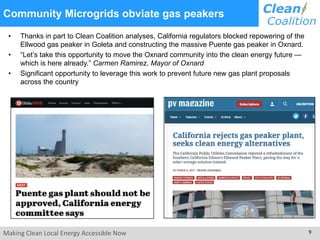
• Thanks in part to Clean Coalition analyses, California regulators blocked repowering of the
Ellwood gas peaker in Goleta and constructing the massive Puente gas peaker in Oxnard.
• “Let’s take this opportunity to move the Oxnard community into the clean energy future —
which is here already.” Carmen Ramirez, Mayor of Oxnard
• Significant opportunity to leverage this work to prevent future new gas plant proposals
across the country
Making Clean Local Energy Accessible Now 10
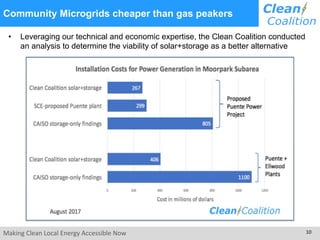
Community Microgrids cheaper than gas peakers
• Leveraging our technical and economic expertise, the Clean Coalition conducted
an analysis to determine the viability of solar+storage as a better alternative
Making Clean Local Energy Accessible Now 11
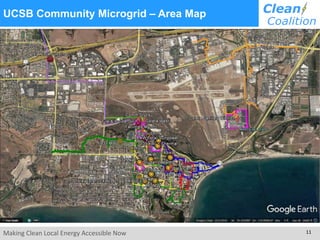
UCSB Community Microgrid – Area Map
Making Clean Local Energy Accessible Now 12
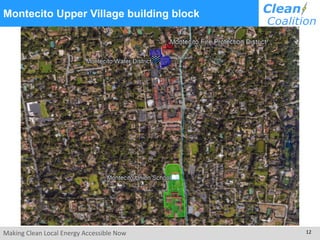
Montecito Upper Village building block
Making Clean Local Energy Accessible Now 13
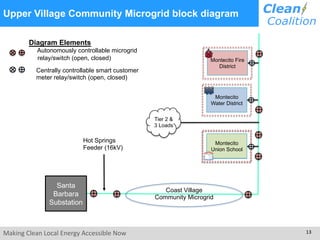
Upper Village Community Microgrid block diagram
Santa
Barbara
Substation
Tier 2 &
3 Loads
Diagram Elements
Autonomously controllable microgrid
relay/switch (open, closed) Montecito Fire
District
Southern
Portion
Montecito
Union School
Coast Village
Community Microgrid
Montecito
Water District
Hot Springs
Feeder (16kV)
Centrally controllable smart customer
meter relay/switch (open, closed)
Making Clean Local Energy Accessible Now 14
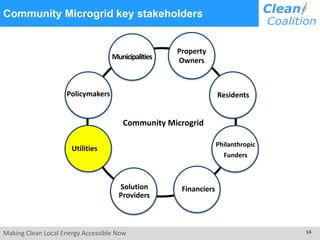
Community Microgrid key stakeholders
Community Microgrid
FinanciersSolution
Providers
Utilities
Property
OwnersMunicipalities
Residents
Philanthropic
Funders
Policymakers
Making Clean Local Energy Accessible Now 15
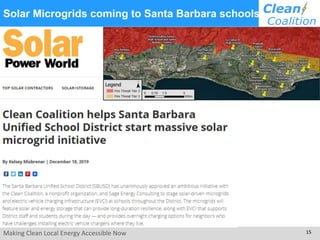
Solar Microgrids coming to Santa Barbara schools
Making Clean Local Energy Accessible Now 16
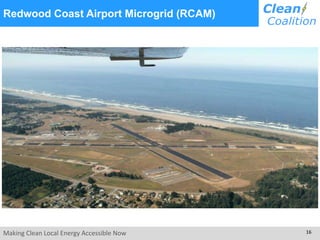
Redwood Coast Airport Microgrid (RCAM)
Making Clean Local Energy Accessible Now 17
RCAM key features
• Seamless grid isolation switch that islands the Community Microgrid
without any electricity service interruption to any of the 20 customers.
• 2 MW of solar and 8 MWh of storage that are DC-coupled front-of-
meter (FOM). The FOM solar+storage assets are owned by the
Redwood Coast Energy Authority (RCEA), a Community Choice agency.
• 250 kW of behind-the-meter (BTM) solar.
• Bank of 8 Level-2 EV charging ports in a BTM configuration that is load
controllable, including sheddable.
• Full PG&E control of the distribution grid at all times.
• All RCAM assets, both FOM & BTM, controlled by asset owners during
normal grid operations and by PG&E for master control during
Community Microgrid islanding operations.
• New tariff and business model innovations.
Making Clean Local Energy Accessible Now 18
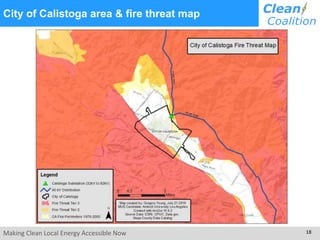
City of Calistoga area & fire threat map
Making Clean Local Energy Accessible Now 19
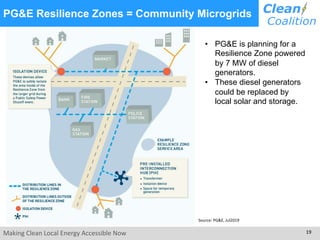
PG&E Resilience Zones = Community Microgrids
Source: PG&E, Jul2019
• PG&E is planning for a
Resilience Zone powered
by 7 MW of diesel
generators.
• These diesel generators
could be replaced by
local solar and storage.
Making Clean Local Energy Accessible Now 20
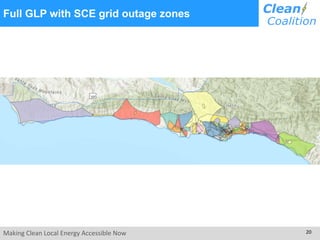
Full GLP with SCE grid outage zones
Making Clean Local Energy Accessible Now 21
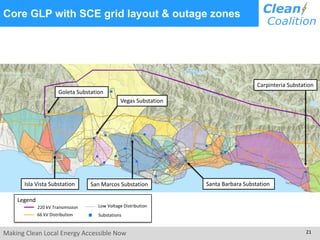
Core GLP with SCE grid layout & outage zones
Goleta Substation
Vegas Substation
Santa Barbara Substation
Carpinteria Substation
San Marcos SubstationIsla Vista Substation
Legend
220 kV Transmission
66 kV Distribution
Low Voltage Distribution
Substations
Making Clean Local Energy Accessible Now 22
Legend
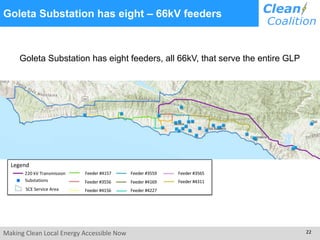
Goleta Substation has eight – 66kV feeders
Goleta Substation has eight feeders, all 66kV, that serve the entire GLP
Feeder #4157
Feeder #4156
Feeder #3556
Feeder #3559
Feeder #4169
Feeder #3565
Feeder #4227
Feeder #4311
220 kV Transmission
Substations
SCE Service Area
Making Clean Local Energy Accessible Now 23
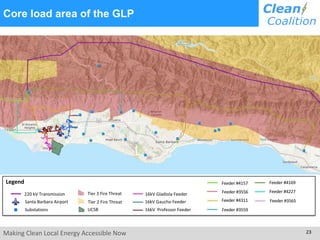
Core load area of the GLP
Legend
16kV Gladiola Feeder
Substations
16kV Gaucho Feeder
16kV Professor FeederUCSB
Santa Barbara Airport
Tier 3 Fire Threat
Tier 2 Fire Threat
220 kV Transmission
Feeder #4157
Feeder #3556
Feeder #3559
Feeder #4169
Feeder #3565
Feeder #4227
Feeder #4311
Making Clean Local Energy Accessible Now 24
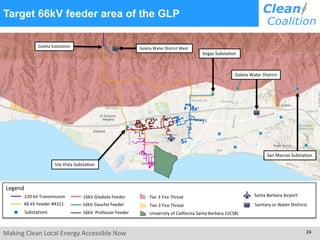
Target 66kV feeder area of the GLP
Legend
16kV Gladiola Feeder
Substations
16kV Gaucho Feeder
16kV Professor Feeder University of California Santa Barbara (UCSB)
Santa Barbara AirportTier 3 Fire Threat
Tier 2 Fire Threat
220 kV Transmission
66 kV Feeder #4311 Sanitary or Water Districts
Goleta Substation Goleta Water District West
Isla Vista Substation
Vegas Substation
San Marcos Substation
Goleta Water District
Making Clean Local Energy Accessible Now 25
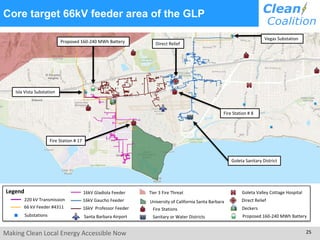
Core target 66kV feeder area of the GLP
Legend 16kV Gladiola Feeder
Substations
16kV Gaucho Feeder
16kV Professor Feeder
University of California Santa Barbara
Santa Barbara Airport
Tier 3 Fire Threat
220 kV Transmission
66 kV Feeder #4311 Fire Stations
Sanitary or Water Districts Proposed 160-240 MWh Battery
Goleta Valley Cottage Hospital
Direct Relief
Fire Station # 17
Direct Relief
Vegas Substation
Isla Vista Substation
Proposed 160-240 MWh Battery
Fire Station # 8
Goleta Sanitary District
Deckers
Making Clean Local Energy Accessible Now 26
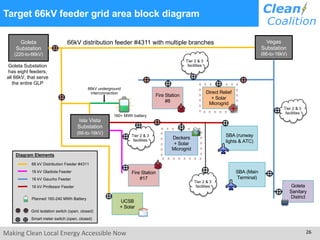
Target 66kV feeder grid area block diagram
Isla Vista
Substation
(66-to-16kV)
Fire Station
#17
66kV underground
interconnection
Vegas
Substation
(66-to-16kV)
UCSB
+ Solar
SBA (runway
lights & ATC)
Direct Relief
+ Solar
Microgrid
SBA (Main
Terminal)
Goleta
Sanitary
District
Goleta
Substation
(220-to-66kV)
Diagram Elements
66 kV Distribution Feeder #4311
16 kV Gladiola Feeder
16 kV Gaucho Feeder
16 kV Professor Feeder
Planned 160-240 MWh Battery
Grid isolation switch (open, closed)
Smart meter switch (open, closed)
Fire Station
#8
66kV distribution feeder #4311 with multiple branches
Deckers
+ Solar
Microgrid
Tier 2 & 3
facilities
Tier 2 & 3
facilities
Tier 2 & 3
facilities
160+ MWh battery
Goleta Substation
has eight feeders,
all 66kV, that serve
the entire GLP
Tier 2 & 3
facilities
Making Clean Local Energy Accessible Now 27
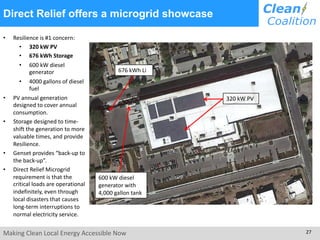
Direct Relief offers a microgrid showcase
320 kW PV
676 kWh Li
600 kW diesel
generator with
4,000 gallon tank
• Resilience is #1 concern:
• 320 kW PV
• 676 kWh Storage
• 600 kW diesel
generator
• 4000 gallons of diesel
fuel
• PV annual generation
designed to cover annual
consumption.
• Storage designed to time-
shift the generation to more
valuable times, and provide
Resilience.
• Genset provides “back-up to
the back-up”.
• Direct Relief Microgrid
requirement is that the
critical loads are operational
indefinitely, even through
local disasters that causes
long-term interruptions to
normal electricity service.
Making Clean Local Energy Accessible Now 28
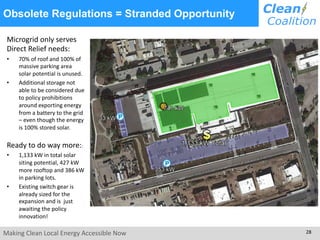
Obsolete Regulations = Stranded Opportunity
Microgrid only serves
Direct Relief needs:
• 70% of roof and 100% of
massive parking area
solar potential is unused.
• Additional storage not
able to be considered due
to policy prohibitions
around exporting energy
from a battery to the grid
– even though the energy
is 100% stored solar.
Ready to do way more::
• 1,133 kW in total solar
siting potential, 427 kW
more rooftop and 386 kW
in parking lots.
• Existing switch gear is
already sized for the
expansion and is just
awaiting the policy
innovation!
Making Clean Local Energy Accessible Now 29
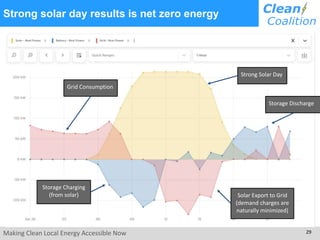
Strong solar day results is net zero energy
Strong Solar Day
Grid Consumption
Storage Charging
(from solar) Solar Export to Grid
(demand charges are
naturally minimized)
Storage Discharge
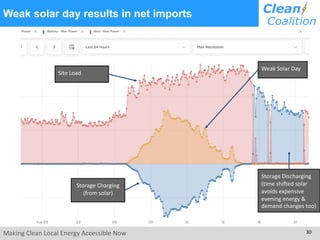
Making Clean Local Energy Accessible Now 30
Weak Solar Day
Site Load
Storage Charging
(from solar)
Storage Discharging
(time shifted solar
avoids expensive
evening energy &
demand changes too)
Weak solar day results in net imports
Making Clean Local Energy Accessible Now 31
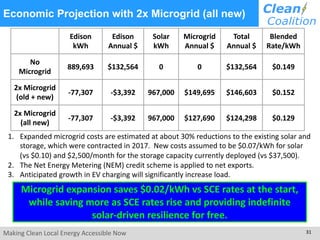
Economic Projection with 2x Microgrid (all new)
Edison
kWh
Edison
Annual $
Solar
kWh
Microgrid
Annual $
Total
Annual $
Blended
Rate/kWh
No
Microgrid
889,693 $132,564 0 0 $132,564 $0.149
2x Microgrid
(old + new)
-77,307 -$3,392 967,000 $149,695 $146,603 $0.152
2x Microgrid
(all new)
-77,307 -$3,392 967,000 $127,690 $124,298 $0.129
1. Expanded microgrid costs are estimated at about 30% reductions to the existing solar and
storage, which were contracted in 2017. New costs assumed to be $0.07/kWh for solar
(vs $0.10) and $2,500/month for the storage capacity currently deployed (vs $37,500).
2. The Net Energy Metering (NEM) credit scheme is applied to net exports.
3. Anticipated growth in EV charging will significantly increase load.
Microgrid expansion saves $0.02/kWh vs SCE rates at the start,
while saving more as SCE rates rise and providing indefinite
solar-driven resilience for free.
Making Clean Local Energy Accessible Now 32
0
10
20
30
40
50
60
70
80
90
100
0 10 20 30 40 50 60 70 80 90 100
Tier 1 = Critical load, ~10% of total load
Percentageoftotalload
Percentage of time
Tier 3 = Discretionary load, ~75% of total load
Tier 1 = Critical, life-sustaining load, ~10% of total load
Tier 2 = Priority load, ~15% of total load
Percentage of time online for Tier 1, 2, and 3 loads for
net zero solar + 2 hours storage microgrids at UCSB

Community microgrids for renewables driven resilience

  • 1.
    Making Clean LocalEnergy Accessible Now Community Microgrids Renewables-driven Resilience Craig Lewis Executive Director 650-796-2353 mobile craig@clean-coalition.org 12 March 2020
  • 2.
    Making Clean LocalEnergy Accessible Now 2 Clean Coalition (non-profit) Mission To accelerate the transition to renewable energy and a modern grid through technical, policy, and project development expertise. Renewable Energy End-Game 100% renewable energy; 25% local, interconnected within the distribution grid and ensuring resilience without dependence on the transmission grid; and 75% remote, fully dependent on the transmission grid for serving loads.
  • 3.
    Making Clean LocalEnergy Accessible Now 3 Community Microgrids are the grid of the future A Community Microgrid is a new approach for designing and operating the electric grid, stacked with local renewables and staged for resilience. Key features: • A targeted and coordinated distribution grid area served by one or more substations – ultimately including a transmission- distribution substation that sets the stage for Distribution System Operator (DSO) performance. • Ability to utilize existing distribution grid infrastructure to serve the Community Microgrid during broader grid outages • High penetrations of local renewables and other distributed energy resources (DER) such as energy storage and demand response. • Staged capability for indefinite renewables-driven backup power for critical community facilities across the grid area – achieved by 25% local renewables mix. • A solution that can be readily extended throughout a utility service territory – and replicated into any utility service territory around the world.
  • 4.
    Making Clean LocalEnergy Accessible Now 4 Natural gas infrastructure is not resilient • Assertion: Gas-driven generation is often claimed to be resilient. • Reality: Gas infrastructure is not resilient and takes much longer to restore than electricity infrastructure. • Threats: Gas infrastructure can be flat- out dangerous and highly vulnerable to earthquakes, fires, landslides, and terrorism. 0 0 0 0 2.5 5 10 30 65 100 5 25 60 95 97 98.5 100 100 100 100 1 DAY 2 DAYS 3 DAYS 1 W EEK 2 W EEKS 3 W EEKS 1 M ONTH 2 M ONTHS 3 M ONTHS 6 M ONTHS Potential Service Restoration Timeframes (M7.9 Earthquake) Gas Electricity 60% electric customers restored in 3 days. 60% gas restoration takes 30 times longer than electricity Source: The City and County of San Francisco Lifelines Study2010 San Bruno Pipeline Explosion
  • 5.
    Making Clean LocalEnergy Accessible Now 5 Value of Resilience (VOR) depends on tier of load • Everyone understands there is significant value to resilience provided by indefinite renewables- driven backup power • But, nobody has yet to quantify this value of unparalleled resilience. • Hence, there is an economic gap for innovative Community Microgrid projects while learning is still is the early stages. • The Clean Coalition aims to establish standardized Value of Resilience (VOR) for critical, priority, and discretionary loads that will help everyone understand that premiums are appropriate for indefinite renewables-driven backup power of critical loads and almost constant backup power to priority loads, which yields a configuration that delivers backup power to all loads a lot of the time • The Clean Coalition’s VOR approach will establish standardized values for resilience of three tiers of loads: • Tier 1 are mission-critical and life-sustaining loads, crucial to keep operational at all times, including during grid outages. Tier 1 loads usually represent about 10% of the total load. • Tier 2 are priority loads that should be maintained as long as long as doing so does not threaten the ability to maintain Tier 1 loads. Tier 2 loads are usually about 15% of the total load. • Tier 3 are discretionary loads make up the remaining loads, usually about 75% of the total load, and are maintained when doing so does not threaten the ability to maintain Tier 1 & 2 loads.
  • 6.
    Making Clean LocalEnergy Accessible Now 6 0 10 20 30 40 50 60 70 80 90 100 0 10 20 30 40 50 60 70 80 90 100 Tier 1 = Critical load, ~10% of total load Percentageoftotalload Percentage of time Tier 3 = Discretionary load, ~75% of total load Tier 1 = Critical, life-sustaining load, ~10% of total load Tier 2 = Priority load, ~15% of total load Percentage of time online for Tier 1, 2, and 3 loads for net zero solar + 2 hours storage microgrid at UCSB
  • 7.
    Making Clean LocalEnergy Accessible Now 7 Goleta Load Pocket (GLP) The GLP is the perfect opportunity for a comprehensive Community Microgrid • GLP spans 70 miles of California coastline, from Point Conception to Lake Casitas, encompassing the cities of Goleta, Santa Barbara (including Montecito), and Carpinteria. • GLP is highly transmission-vulnerable and disaster-prone (fire, landslide, earthquake). • 200 megawatts (MW) of solar and 400 megawatt-hours (MWh) of energy storage will provide 100% protection to GLP against a complete transmission outage (“N-2 event”). • 200 MW of solar is equivalent to about 5 times the amount of solar currently deployed in the GLP and represents about 25% of the energy mix. • Multi-GWs of solar siting opportunity exists on commercial-scale built-environments like parking lots, parking structures, and rooftops; and 200 MW represents about 7% of the technical siting potential. • Other resources like energy efficiency, demand response, and offshore wind can significantly reduce solar+storage requirements.
  • 8.
    Making Clean LocalEnergy Accessible Now 8 SCE-proposed & CPUC-approved energy storage 280 MWh (70 MW x 4-hour) of energy storage has been formally proposed by SCE to the CPUC for siting within the GLP, with online dates by March 2021 Source: SCE LCR RFP April 22, 2019 = within the GLP
  • 9.
    Making Clean LocalEnergy Accessible Now 9 Community Microgrids obviate gas peakers • Thanks in part to Clean Coalition analyses, California regulators blocked repowering of the Ellwood gas peaker in Goleta and constructing the massive Puente gas peaker in Oxnard. • “Let’s take this opportunity to move the Oxnard community into the clean energy future — which is here already.” Carmen Ramirez, Mayor of Oxnard • Significant opportunity to leverage this work to prevent future new gas plant proposals across the country
  • 10.
    Making Clean LocalEnergy Accessible Now 10 Community Microgrids cheaper than gas peakers • Leveraging our technical and economic expertise, the Clean Coalition conducted an analysis to determine the viability of solar+storage as a better alternative
  • 11.
    Making Clean LocalEnergy Accessible Now 11 UCSB Community Microgrid – Area Map
  • 12.
    Making Clean LocalEnergy Accessible Now 12 Montecito Upper Village building block
  • 13.
    Making Clean LocalEnergy Accessible Now 13 Upper Village Community Microgrid block diagram Santa Barbara Substation Tier 2 & 3 Loads Diagram Elements Autonomously controllable microgrid relay/switch (open, closed) Montecito Fire District Southern Portion Montecito Union School Coast Village Community Microgrid Montecito Water District Hot Springs Feeder (16kV) Centrally controllable smart customer meter relay/switch (open, closed)
  • 14.
    Making Clean LocalEnergy Accessible Now 14 Community Microgrid key stakeholders Community Microgrid FinanciersSolution Providers Utilities Property OwnersMunicipalities Residents Philanthropic Funders Policymakers
  • 15.
    Making Clean LocalEnergy Accessible Now 15 Solar Microgrids coming to Santa Barbara schools
  • 16.
    Making Clean LocalEnergy Accessible Now 16 Redwood Coast Airport Microgrid (RCAM)
  • 17.
    Making Clean LocalEnergy Accessible Now 17 RCAM key features • Seamless grid isolation switch that islands the Community Microgrid without any electricity service interruption to any of the 20 customers. • 2 MW of solar and 8 MWh of storage that are DC-coupled front-of- meter (FOM). The FOM solar+storage assets are owned by the Redwood Coast Energy Authority (RCEA), a Community Choice agency. • 250 kW of behind-the-meter (BTM) solar. • Bank of 8 Level-2 EV charging ports in a BTM configuration that is load controllable, including sheddable. • Full PG&E control of the distribution grid at all times. • All RCAM assets, both FOM & BTM, controlled by asset owners during normal grid operations and by PG&E for master control during Community Microgrid islanding operations. • New tariff and business model innovations.
  • 18.
    Making Clean LocalEnergy Accessible Now 18 City of Calistoga area & fire threat map
  • 19.
    Making Clean LocalEnergy Accessible Now 19 PG&E Resilience Zones = Community Microgrids Source: PG&E, Jul2019 • PG&E is planning for a Resilience Zone powered by 7 MW of diesel generators. • These diesel generators could be replaced by local solar and storage.
  • 20.
    Making Clean LocalEnergy Accessible Now 20 Full GLP with SCE grid outage zones
  • 21.
    Making Clean LocalEnergy Accessible Now 21 Core GLP with SCE grid layout & outage zones Goleta Substation Vegas Substation Santa Barbara Substation Carpinteria Substation San Marcos SubstationIsla Vista Substation Legend 220 kV Transmission 66 kV Distribution Low Voltage Distribution Substations
  • 22.
    Making Clean LocalEnergy Accessible Now 22 Legend Goleta Substation has eight – 66kV feeders Goleta Substation has eight feeders, all 66kV, that serve the entire GLP Feeder #4157 Feeder #4156 Feeder #3556 Feeder #3559 Feeder #4169 Feeder #3565 Feeder #4227 Feeder #4311 220 kV Transmission Substations SCE Service Area
  • 23.
    Making Clean LocalEnergy Accessible Now 23 Core load area of the GLP Legend 16kV Gladiola Feeder Substations 16kV Gaucho Feeder 16kV Professor FeederUCSB Santa Barbara Airport Tier 3 Fire Threat Tier 2 Fire Threat 220 kV Transmission Feeder #4157 Feeder #3556 Feeder #3559 Feeder #4169 Feeder #3565 Feeder #4227 Feeder #4311
  • 24.
    Making Clean LocalEnergy Accessible Now 24 Target 66kV feeder area of the GLP Legend 16kV Gladiola Feeder Substations 16kV Gaucho Feeder 16kV Professor Feeder University of California Santa Barbara (UCSB) Santa Barbara AirportTier 3 Fire Threat Tier 2 Fire Threat 220 kV Transmission 66 kV Feeder #4311 Sanitary or Water Districts Goleta Substation Goleta Water District West Isla Vista Substation Vegas Substation San Marcos Substation Goleta Water District
  • 25.
    Making Clean LocalEnergy Accessible Now 25 Core target 66kV feeder area of the GLP Legend 16kV Gladiola Feeder Substations 16kV Gaucho Feeder 16kV Professor Feeder University of California Santa Barbara Santa Barbara Airport Tier 3 Fire Threat 220 kV Transmission 66 kV Feeder #4311 Fire Stations Sanitary or Water Districts Proposed 160-240 MWh Battery Goleta Valley Cottage Hospital Direct Relief Fire Station # 17 Direct Relief Vegas Substation Isla Vista Substation Proposed 160-240 MWh Battery Fire Station # 8 Goleta Sanitary District Deckers
  • 26.
    Making Clean LocalEnergy Accessible Now 26 Target 66kV feeder grid area block diagram Isla Vista Substation (66-to-16kV) Fire Station #17 66kV underground interconnection Vegas Substation (66-to-16kV) UCSB + Solar SBA (runway lights & ATC) Direct Relief + Solar Microgrid SBA (Main Terminal) Goleta Sanitary District Goleta Substation (220-to-66kV) Diagram Elements 66 kV Distribution Feeder #4311 16 kV Gladiola Feeder 16 kV Gaucho Feeder 16 kV Professor Feeder Planned 160-240 MWh Battery Grid isolation switch (open, closed) Smart meter switch (open, closed) Fire Station #8 66kV distribution feeder #4311 with multiple branches Deckers + Solar Microgrid Tier 2 & 3 facilities Tier 2 & 3 facilities Tier 2 & 3 facilities 160+ MWh battery Goleta Substation has eight feeders, all 66kV, that serve the entire GLP Tier 2 & 3 facilities
  • 27.
    Making Clean LocalEnergy Accessible Now 27 Direct Relief offers a microgrid showcase 320 kW PV 676 kWh Li 600 kW diesel generator with 4,000 gallon tank • Resilience is #1 concern: • 320 kW PV • 676 kWh Storage • 600 kW diesel generator • 4000 gallons of diesel fuel • PV annual generation designed to cover annual consumption. • Storage designed to time- shift the generation to more valuable times, and provide Resilience. • Genset provides “back-up to the back-up”. • Direct Relief Microgrid requirement is that the critical loads are operational indefinitely, even through local disasters that causes long-term interruptions to normal electricity service.
  • 28.
    Making Clean LocalEnergy Accessible Now 28 Obsolete Regulations = Stranded Opportunity Microgrid only serves Direct Relief needs: • 70% of roof and 100% of massive parking area solar potential is unused. • Additional storage not able to be considered due to policy prohibitions around exporting energy from a battery to the grid – even though the energy is 100% stored solar. Ready to do way more:: • 1,133 kW in total solar siting potential, 427 kW more rooftop and 386 kW in parking lots. • Existing switch gear is already sized for the expansion and is just awaiting the policy innovation!
  • 29.
    Making Clean LocalEnergy Accessible Now 29 Strong solar day results is net zero energy Strong Solar Day Grid Consumption Storage Charging (from solar) Solar Export to Grid (demand charges are naturally minimized) Storage Discharge
  • 30.
    Making Clean LocalEnergy Accessible Now 30 Weak Solar Day Site Load Storage Charging (from solar) Storage Discharging (time shifted solar avoids expensive evening energy & demand changes too) Weak solar day results in net imports
  • 31.
    Making Clean LocalEnergy Accessible Now 31 Economic Projection with 2x Microgrid (all new) Edison kWh Edison Annual $ Solar kWh Microgrid Annual $ Total Annual $ Blended Rate/kWh No Microgrid 889,693 $132,564 0 0 $132,564 $0.149 2x Microgrid (old + new) -77,307 -$3,392 967,000 $149,695 $146,603 $0.152 2x Microgrid (all new) -77,307 -$3,392 967,000 $127,690 $124,298 $0.129 1. Expanded microgrid costs are estimated at about 30% reductions to the existing solar and storage, which were contracted in 2017. New costs assumed to be $0.07/kWh for solar (vs $0.10) and $2,500/month for the storage capacity currently deployed (vs $37,500). 2. The Net Energy Metering (NEM) credit scheme is applied to net exports. 3. Anticipated growth in EV charging will significantly increase load. Microgrid expansion saves $0.02/kWh vs SCE rates at the start, while saving more as SCE rates rise and providing indefinite solar-driven resilience for free.
  • 32.
    Making Clean LocalEnergy Accessible Now 32 0 10 20 30 40 50 60 70 80 90 100 0 10 20 30 40 50 60 70 80 90 100 Tier 1 = Critical load, ~10% of total load Percentageoftotalload Percentage of time Tier 3 = Discretionary load, ~75% of total load Tier 1 = Critical, life-sustaining load, ~10% of total load Tier 2 = Priority load, ~15% of total load Percentage of time online for Tier 1, 2, and 3 loads for net zero solar + 2 hours storage microgrids at UCSB