Making Clean Local Energy Accessible Now
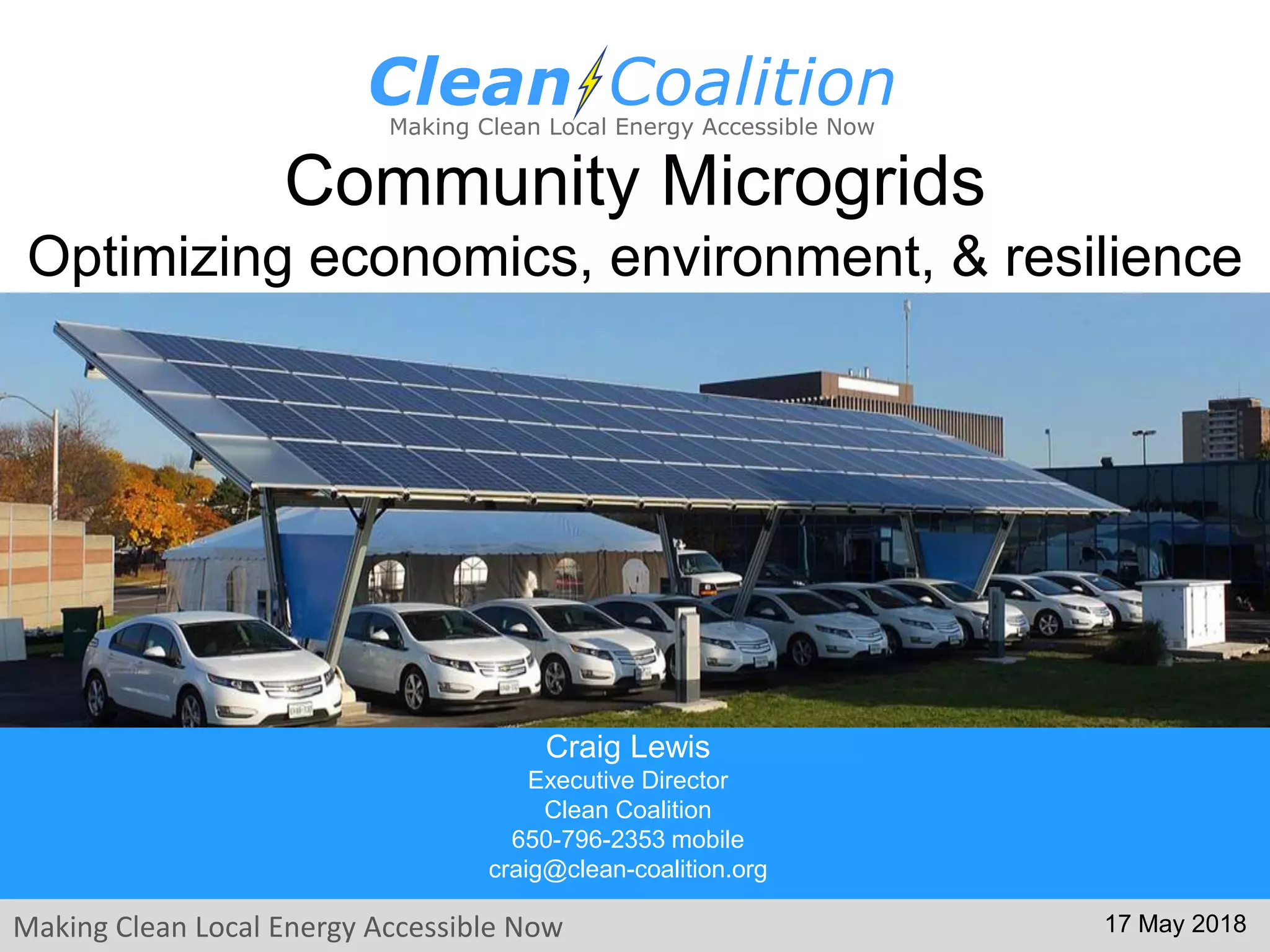
Community Microgrids
Optimizing economics, environment, & resilience
17 May 2018
Craig Lewis
Executive Director
Clean Coalition
650-796-2353 mobile
craig@clean-coalition.org
Making Clean Local Energy Accessible Now 2
Clean Coalition (non-profit) Mission
To accelerate the transition to renewable
energy and a modern grid through
technical, policy, and project
development expertise
Making Clean Local Energy Accessible Now 3
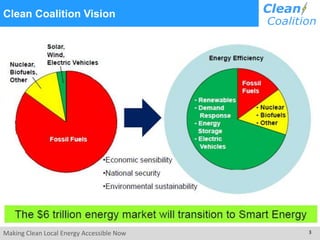
Clean Coalition Vision
Making Clean Local Energy Accessible Now 4
Top overarching objective: 25 by 25
Ensure that by 2025, at least 25% of all
electricity consumption in the United States is
from local renewable energy sources
Locally generated electricity does not travel over the
transmission grid to get from the location it is generated
to where it is consumed
Making Clean Local Energy Accessible Now 5
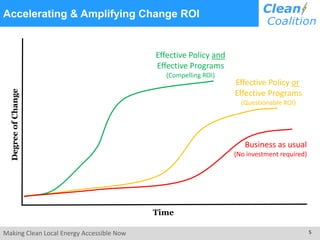
Accelerating & Amplifying Change ROIDegreeofChange
Time
Effective Policy and
Effective Programs
(Compelling ROI)
Effective Policy or
Effective Programs
(Questionable ROI)
Business as usual
(No investment required)
Making Clean Local Energy Accessible Now 6
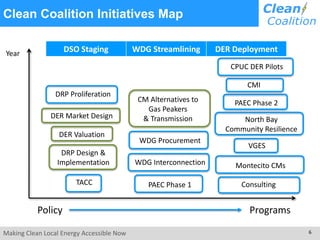
Clean Coalition Initiatives Map
Policy Programs
DSO Staging WDG Streamlining DER Deployment
PAEC Phase 1TACC
WDG Procurement
WDG Interconnection
DRP Proliferation
CMI
PAEC Phase 2
VGES
Consulting
CPUC DER Pilots
DRP Design &
Implementation
Year
CM Alternatives to
Gas Peakers
& TransmissionDER Market Design
Montecito CMs
North Bay
Community Resilience
DER Valuation
Making Clean Local Energy Accessible Now 7
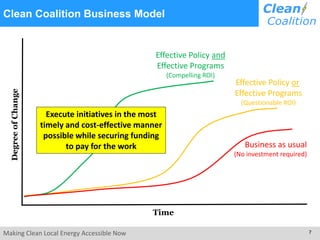
Clean Coalition Business ModelDegreeofChange
Time
Effective Policy and
Effective Programs
(Compelling ROI)
Effective Policy or
Effective Programs
(Questionable ROI)
Business as usual
(No investment required)
Execute initiatives in the most
timely and cost-effective manner
possible while securing funding
to pay for the work
Making Clean Local Energy Accessible Now 8
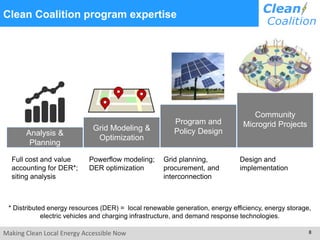
Clean Coalition program expertise
Powerflow modeling;
DER optimization
Grid planning,
procurement, and
interconnection
Design and
implementation
Analysis &
Planning
Program and
Policy Design
Community
Microgrid ProjectsGrid Modeling &
Optimization
Full cost and value
accounting for DER*;
siting analysis
* Distributed energy resources (DER) = local renewable generation, energy efficiency, energy storage,
electric vehicles and charging infrastructure, and demand response technologies.
Making Clean Local Energy Accessible Now 9
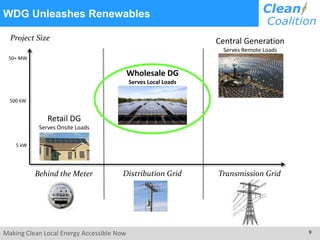
WDG Unleashes Renewables
Distribution Grid
Project Size
Behind the Meter
Central Generation
Serves Remote Loads
Wholesale DG
Serves Local Loads
Retail DG
Serves Onsite Loads
Transmission Grid
5 kW
50+ MW
500 kW
Making Clean Local Energy Accessible Now 10
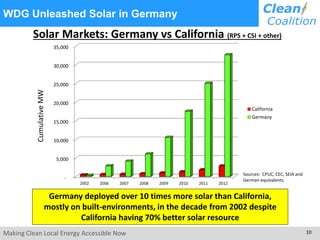
WDG Unleashed Solar in Germany
Solar Markets: Germany vs California (RPS + CSI + other)
Germany deployed over 10 times more solar than California,
mostly on built-environments, in the decade from 2002 despite
California having 70% better solar resource
Sources: CPUC, CEC, SEIA and
German equivalents.
CumulativeMW
-
5,000
10,000
15,000
20,000
25,000
30,000
35,000
2002 2006 2007 2008 2009 2010 2011 2012
California
Germany
Making Clean Local Energy Accessible Now 11
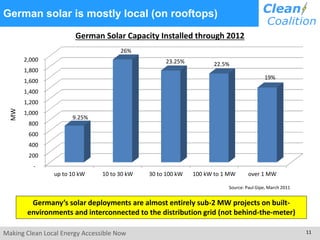
German solar is mostly local (on rooftops)
-
200
400
600
800
1,000
1,200
1,400
1,600
1,800
2,000
up to 10 kW 10 to 30 kW 30 to 100 kW 100 kW to 1 MW over 1 MW
MW
German Solar Capacity Installed through 2012
Source: Paul Gipe, March 2011
Germany’s solar deployments are almost entirely sub-2 MW projects on built-
environments and interconnected to the distribution grid (not behind-the-meter)
22.5%
26%
23.25%
9.25%
19%
Making Clean Local Energy Accessible Now 12
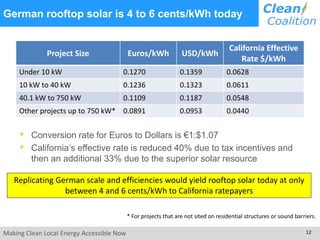
German rooftop solar is 4 to 6 cents/kWh today
Project Size Euros/kWh USD/kWh
California Effective
Rate $/kWh
Under 10 kW 0.1270 0.1359 0.0628
10 kW to 40 kW 0.1236 0.1323 0.0611
40.1 kW to 750 kW 0.1109 0.1187 0.0548
Other projects up to 750 kW* 0.0891 0.0953 0.0440
Conversion rate for Euros to Dollars is €1:$1.07
California’s effective rate is reduced 40% due to tax incentives and
then an additional 33% due to the superior solar resource
Replicating German scale and efficiencies would yield rooftop solar today at only
between 4 and 6 cents/kWh to California ratepayers
* For projects that are not sited on residential structures or sound barriers.
Making Clean Local Energy Accessible Now 13
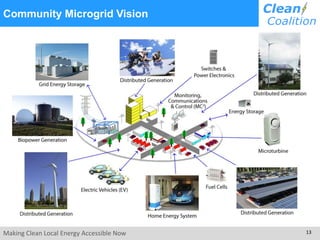
Community Microgrid Vision
Making Clean Local Energy Accessible Now 14
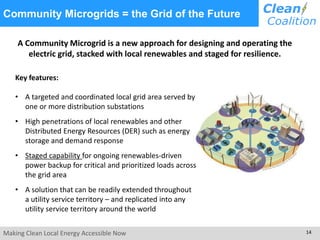
Community Microgrids = the Grid of the Future
Key features:
• A targeted and coordinated local grid area served by
one or more distribution substations
• High penetrations of local renewables and other
Distributed Energy Resources (DER) such as energy
storage and demand response
• Staged capability for ongoing renewables-driven
power backup for critical and prioritized loads across
the grid area
• A solution that can be readily extended throughout
a utility service territory – and replicated into any
utility service territory around the world
A Community Microgrid is a new approach for designing and operating the
electric grid, stacked with local renewables and staged for resilience.
Making Clean Local Energy Accessible Now 15
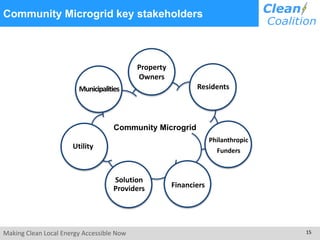
Community Microgrid key stakeholders
Community Microgrid
Financiers
Solution
Providers
Utility
Property
Owners
Municipalities Residents
Philanthropic
Funders
Making Clean Local Energy Accessible Now 16
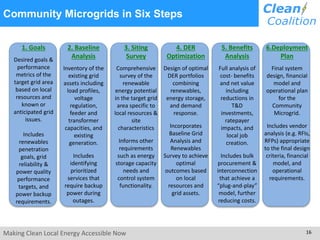
Community Microgrids in Six Steps
1. Goals
Desired goals &
performance
metrics of the
target grid area
based on local
resources and
known or
anticipated grid
issues.
Includes
renewables
penetration
goals, grid
reliability &
power quality
performance
targets, and
power backup
requirements.
2. Baseline
Analysis
Inventory of the
existing grid
assets including
load profiles,
voltage
regulation,
feeder and
transformer
capacities, and
existing
generation.
Includes
identifying
prioritized
services that
require backup
power during
outages.
3. Siting
Survey
Comprehensive
survey of the
renewable
energy potential
in the target grid
area specific to
local resources &
site
characteristics
Informs other
requirements
such as energy
storage capacity
needs and
control system
functionality.
4. DER
Optimization
Design of optimal
DER portfolios
combining
renewables,
energy storage,
and demand
response.
Incorporates
Baseline Grid
Analysis and
Renewables
Survey to achieve
optimal
outcomes based
on local
resources and
grid assets.
5. Benefits
Analysis
Full analysis of
cost- benefits
and net value
including
reductions in
T&D
investments,
ratepayer
impacts, and
local job
creation.
Includes bulk
procurement &
interconnection
that achieve a
“plug-and-play”
model, further
reducing costs.
6.Deployment
Plan
Final system
design, financial
model and
operational plan
for the
Community
Microgrid.
Includes vendor
analysis (e.g. RFIs,
RFPs) appropriate
to the final design
criteria, financial
model, and
operational
requirements.
Making Clean Local Energy Accessible Now 17
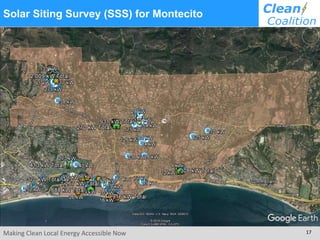
Solar Siting Survey (SSS) for Montecito
Making Clean Local Energy Accessible Now 18
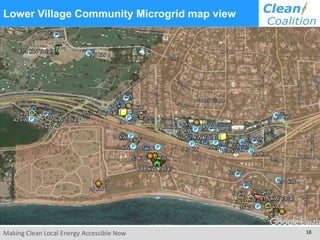
Lower Village Community Microgrid map view
Making Clean Local Energy Accessible Now 19
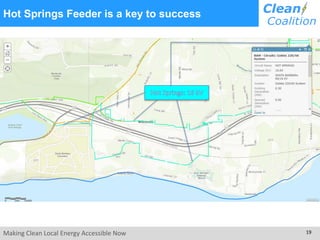
Hot Springs Feeder is a key to success
Making Clean Local Energy Accessible Now 20
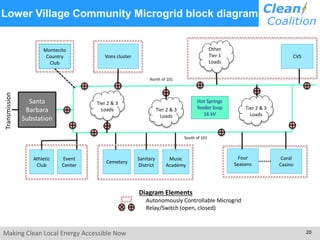
Lower Village Community Microgrid block diagram
Transmission
Santa
Barbara
Substation
Diagram Elements
Autonomously Controllable Microgrid
Relay/Switch (open, closed)
North of 101
South of 101
Other
Tier 1
Loads
Montecito
Country
Club
Vons cluster CVS
Four
Seasons
Coral
Casino
Athletic
Club
Event
Center
Cemetery
Sanitary
District
Music
Academy
Tier 2 & 3
Loads
Tier 2 & 3
Loads Tier 2 & 3
Loads
Making Clean Local Energy Accessible Now 21
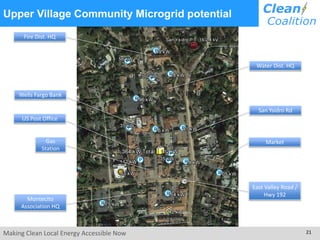
Upper Village Community Microgrid potential
Fire Dist. HQ
Water Dist. HQ
MarketGas
Station
US Post Office
Wells Fargo Bank
Montecito
Association HQ
East Valley Road /
Hwy 192
San Ysidro Rd
Making Clean Local Energy Accessible Now 22
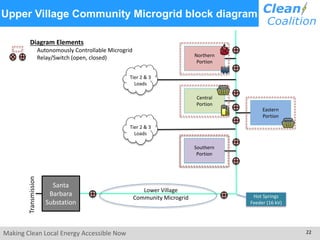
Upper Village Community Microgrid block diagram
Transmission
Santa
Barbara
Substation
Tier 2 & 3
Loads
Hot Springs
Feeder (16 kV)
Diagram Elements
Autonomously Controllable Microgrid
Relay/Switch (open, closed) Northern
Portion
Central
Portion
Eastern
Portion
Southern
Portion
Southern
Portion
Tier 2 & 3
Loads
Lower Village
Community Microgrid
Making Clean Local Energy Accessible Now 23
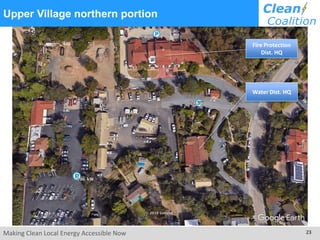
Upper Village northern portion
Fire Protection
Dist. HQ
Water Dist. HQ
Making Clean Local Energy Accessible Now 24
Montecito Community Microgrids use of funds
1. $300k - $600k to take each comprehensive Community
Microgrid from an idea to being ready for deployment
• 30% - Project Staging.
• 45% - Project Planning & Engineering.
• 25% - Deployment Preparation.
2. $7.5 million to deploy Upper Village Community Microgrid
• $2 million for 500 kWac of solar at $4k/kWac (mostly smallish solar
carports and rooftop arrays).
• $2 million for 500 kW / 500 kWh of energy storage at $1k/kWh.
• $2 million for grid upgrades like the addition of grid isolation
switches etc.
• $1.5 million for Monitoring, Communications, and Control (MC2).
3. $22.5 million to deploy Lower Village Community Microgrid
• Economies of scale from more than 5 times the levels of solar and
energy storage; and larger individual project sizes.
• Leverage grid upgrade and MC2 learning from Upper Village efforts.
Making Clean Local Energy Accessible Now 25
Montecito Community Microgrids source of funds
1. $300k - $600k to take a Community Microgrid from an idea
to being ready for deployment
• Philanthropic funding.
2. $7.5 million to deploy Upper Village Community Microgrid
• About half pays for itself (most of the solar and about half the
energy storage and MC2).
• Other half (about $3.75 million) needs to be paid by grants and
philanthropic funding; and possibly via SCE ratebasing.
3. $22.5 million to deploy Lower Village Community Microgrid
• Will require about 25% to be paid by grants and philanthropic
funding; and possibly via SCE ratebasing.
Making Clean Local Energy Accessible Now 26
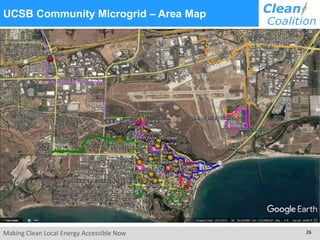
UCSB Community Microgrid – Area Map
Making Clean Local Energy Accessible Now 27
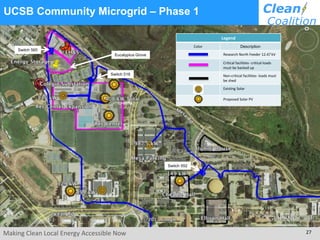
UCSB Community Microgrid – Phase 1
Switch 565
Switch 516
Switch 552
Eucalyptus Grove
Legend
Color Description
Research North Feeder 12.47 kV
Critical facilities- critical loads
must be backed up
Non-critical facilities- loads must
be shed
Existing Solar
Proposed Solar PV
Making Clean Local Energy Accessible Now 28
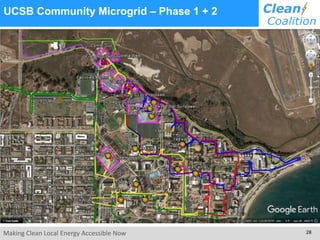
UCSB Community Microgrid – Phase 1 + 2
Making Clean Local Energy Accessible Now 29
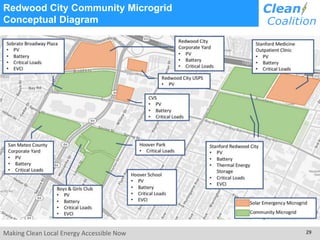
Redwood City Community Microgrid
Conceptual Diagram
Making Clean Local Energy Accessible Now 30
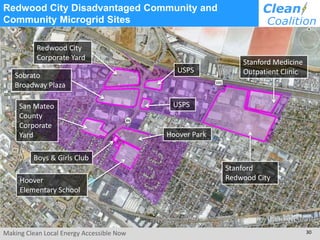
Redwood City
Corporate Yard
Sobrato
Broadway Plaza
San Mateo
County
Corporate
Yard
Boys & Girls Club
Hoover
Elementary School
Stanford
Redwood City
Hoover Park
Stanford Medicine
Outpatient Clinic
Redwood City Disadvantaged Community and
Community Microgrid Sites
USPS
USPS
Making Clean Local Energy Accessible Now 31
Redwood City
Corporate Yard
Sobrato
Broadway Plaza
San Mateo
County
Corporate
Yard
Boys & Girls Club
Hoover
Elementary School
Stanford
Redwood City
Hoover Park
Stanford Medicine
Outpatient Clinic
Redwood City Disadvantaged Community and
Community Microgrid Sites
USPS
USPS
Making Clean Local Energy Accessible Now 32
Site Name
Meters or
Buildings Critical Loads
NEM Solar
[kW AC]
FIT Solar
[kW AC]
Total
Solar [kW
AC] Battery [kW]
Battery
[kWh]
EVCI
(Level 2)
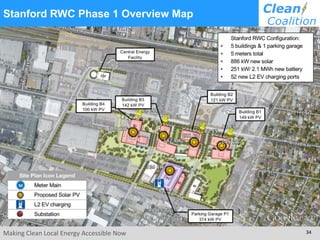
Stanford Redwood
City
Phase 1
P1, B1-B4
Campus emergency
response
886 0 886 251 2,100 52
Hoover Cluster
Hoover School Shelter & food service 73 203 276 29 150 20
Boys & Girls Club Shelter & food service 11 90 101 0 0 10
Hoover Park Equipment staging 0 0 0 0 0 0
Redwood City
Corporate Yard
Redwood City
Corporate Yard
Road and public
facility maintenance
and repair
136 352 488 58 360 *4
San Mateo County
Corporate Yard
(SMC Yard)
SMC Yard Meter 1
Road and public
facility maintenance
and repair
65 0 65 58 240 0
SMC Yard Meter 2 33 121 154 0 0 *4
SMC Yard Meter 3 0 79 79 0 0 0
Sobrato Broadway
Plaza
Sobrato Broadway
Plaza (multiple
meters)
Low income housing 0 1,197 1,197 TBD TBD TBD
Sobrato CVS Pharmacy & grocery 0 83 83 TBD TBD TBD
New Deployments TOTAL 1,204 2,125 3,329 396 2,850 82
Deployment Summary
With net metering, only 1.2 MW can be deployed.
With a new FIT program, an additional 2.1 MW of local, renewable generation could
be deployed in a disadvantaged community.
Making Clean Local Energy Accessible Now 33
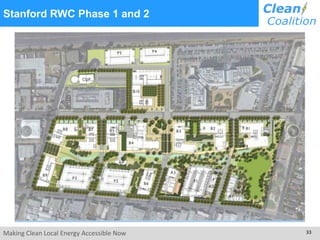
Stanford RWC Phase 1 and 2
Making Clean Local Energy Accessible Now 34
Stanford RWC Phase 1 Overview Map
Making Clean Local Energy Accessible Now 35
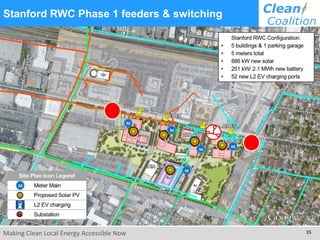
Stanford RWC Phase 1 feeders & switching
Making Clean Local Energy Accessible Now 36
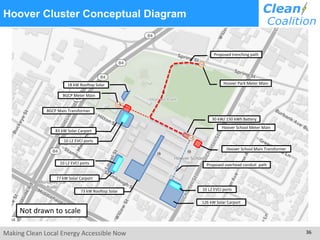
Hoover Cluster Conceptual Diagram
126 kW Solar Carport
77 kW Solar Carport
Hoover School Main Transformer
30 kW/ 150 kWh Battery
M
M
M
83 kW Solar Carport
Not drawn to scale
10 L2 EVCI ports
10 L2 EVCI ports
10 L2 EVCI ports
73 kW Rooftop Solar
BGCP Main Transformer
BGCP Meter Main
Hoover School Meter Main
Proposed trenching path
Hoover Park Meter Main
Proposed overhead conduit path
18 kW Rooftop Solar
Making Clean Local Energy Accessible Now 37
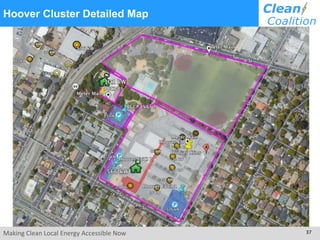
Hoover Cluster Detailed Map
Making Clean Local Energy Accessible Now 38
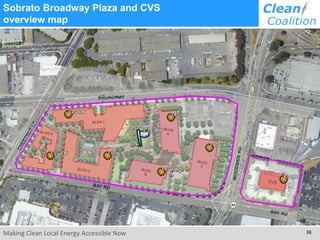
Sobrato Broadway Plaza and CVS
overview map
Making Clean Local Energy Accessible Now 39
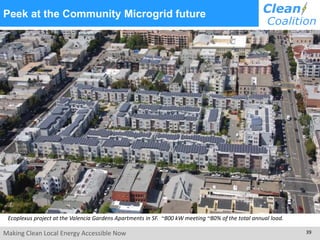
Ecoplexus project at the Valencia Gardens Apartments in SF. ~800 kW meeting ~80% of the total annual load.
Peek at the Community Microgrid future
Making Clean Local Energy Accessible Now 40
Backup
Making Clean Local Energy Accessible Now 41
Community Microgrids obviate gas peakers
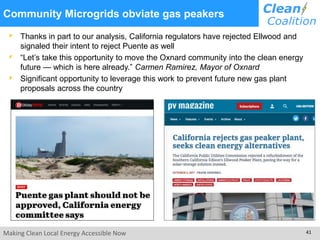
Thanks in part to our analysis, California regulators have rejected Ellwood and
signaled their intent to reject Puente as well
“Let’s take this opportunity to move the Oxnard community into the clean energy
future — which is here already.” Carmen Ramirez, Mayor of Oxnard
Significant opportunity to leverage this work to prevent future new gas plant
proposals across the country
Making Clean Local Energy Accessible Now 42
Community Microgrids cheaper than gas peakers
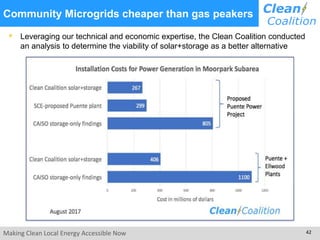
Leveraging our technical and economic expertise, the Clean Coalition conducted
an analysis to determine the viability of solar+storage as a better alternative

Community Microgrids: Optimizing economics, environment, & resilience (5/17/18)

  • 1.
    Making Clean LocalEnergy Accessible Now Community Microgrids Optimizing economics, environment, & resilience 17 May 2018 Craig Lewis Executive Director Clean Coalition 650-796-2353 mobile craig@clean-coalition.org
  • 2.
    Making Clean LocalEnergy Accessible Now 2 Clean Coalition (non-profit) Mission To accelerate the transition to renewable energy and a modern grid through technical, policy, and project development expertise
  • 3.
    Making Clean LocalEnergy Accessible Now 3 Clean Coalition Vision
  • 4.
    Making Clean LocalEnergy Accessible Now 4 Top overarching objective: 25 by 25 Ensure that by 2025, at least 25% of all electricity consumption in the United States is from local renewable energy sources Locally generated electricity does not travel over the transmission grid to get from the location it is generated to where it is consumed
  • 5.
    Making Clean LocalEnergy Accessible Now 5 Accelerating & Amplifying Change ROIDegreeofChange Time Effective Policy and Effective Programs (Compelling ROI) Effective Policy or Effective Programs (Questionable ROI) Business as usual (No investment required)
  • 6.
    Making Clean LocalEnergy Accessible Now 6 Clean Coalition Initiatives Map Policy Programs DSO Staging WDG Streamlining DER Deployment PAEC Phase 1TACC WDG Procurement WDG Interconnection DRP Proliferation CMI PAEC Phase 2 VGES Consulting CPUC DER Pilots DRP Design & Implementation Year CM Alternatives to Gas Peakers & TransmissionDER Market Design Montecito CMs North Bay Community Resilience DER Valuation
  • 7.
    Making Clean LocalEnergy Accessible Now 7 Clean Coalition Business ModelDegreeofChange Time Effective Policy and Effective Programs (Compelling ROI) Effective Policy or Effective Programs (Questionable ROI) Business as usual (No investment required) Execute initiatives in the most timely and cost-effective manner possible while securing funding to pay for the work
  • 8.
    Making Clean LocalEnergy Accessible Now 8 Clean Coalition program expertise Powerflow modeling; DER optimization Grid planning, procurement, and interconnection Design and implementation Analysis & Planning Program and Policy Design Community Microgrid ProjectsGrid Modeling & Optimization Full cost and value accounting for DER*; siting analysis * Distributed energy resources (DER) = local renewable generation, energy efficiency, energy storage, electric vehicles and charging infrastructure, and demand response technologies.
  • 9.
    Making Clean LocalEnergy Accessible Now 9 WDG Unleashes Renewables Distribution Grid Project Size Behind the Meter Central Generation Serves Remote Loads Wholesale DG Serves Local Loads Retail DG Serves Onsite Loads Transmission Grid 5 kW 50+ MW 500 kW
  • 10.
    Making Clean LocalEnergy Accessible Now 10 WDG Unleashed Solar in Germany Solar Markets: Germany vs California (RPS + CSI + other) Germany deployed over 10 times more solar than California, mostly on built-environments, in the decade from 2002 despite California having 70% better solar resource Sources: CPUC, CEC, SEIA and German equivalents. CumulativeMW - 5,000 10,000 15,000 20,000 25,000 30,000 35,000 2002 2006 2007 2008 2009 2010 2011 2012 California Germany
  • 11.
    Making Clean LocalEnergy Accessible Now 11 German solar is mostly local (on rooftops) - 200 400 600 800 1,000 1,200 1,400 1,600 1,800 2,000 up to 10 kW 10 to 30 kW 30 to 100 kW 100 kW to 1 MW over 1 MW MW German Solar Capacity Installed through 2012 Source: Paul Gipe, March 2011 Germany’s solar deployments are almost entirely sub-2 MW projects on built- environments and interconnected to the distribution grid (not behind-the-meter) 22.5% 26% 23.25% 9.25% 19%
  • 12.
    Making Clean LocalEnergy Accessible Now 12 German rooftop solar is 4 to 6 cents/kWh today Project Size Euros/kWh USD/kWh California Effective Rate $/kWh Under 10 kW 0.1270 0.1359 0.0628 10 kW to 40 kW 0.1236 0.1323 0.0611 40.1 kW to 750 kW 0.1109 0.1187 0.0548 Other projects up to 750 kW* 0.0891 0.0953 0.0440 Conversion rate for Euros to Dollars is €1:$1.07 California’s effective rate is reduced 40% due to tax incentives and then an additional 33% due to the superior solar resource Replicating German scale and efficiencies would yield rooftop solar today at only between 4 and 6 cents/kWh to California ratepayers * For projects that are not sited on residential structures or sound barriers.
  • 13.
    Making Clean LocalEnergy Accessible Now 13 Community Microgrid Vision
  • 14.
    Making Clean LocalEnergy Accessible Now 14 Community Microgrids = the Grid of the Future Key features: • A targeted and coordinated local grid area served by one or more distribution substations • High penetrations of local renewables and other Distributed Energy Resources (DER) such as energy storage and demand response • Staged capability for ongoing renewables-driven power backup for critical and prioritized loads across the grid area • A solution that can be readily extended throughout a utility service territory – and replicated into any utility service territory around the world A Community Microgrid is a new approach for designing and operating the electric grid, stacked with local renewables and staged for resilience.
  • 15.
    Making Clean LocalEnergy Accessible Now 15 Community Microgrid key stakeholders Community Microgrid Financiers Solution Providers Utility Property Owners Municipalities Residents Philanthropic Funders
  • 16.
    Making Clean LocalEnergy Accessible Now 16 Community Microgrids in Six Steps 1. Goals Desired goals & performance metrics of the target grid area based on local resources and known or anticipated grid issues. Includes renewables penetration goals, grid reliability & power quality performance targets, and power backup requirements. 2. Baseline Analysis Inventory of the existing grid assets including load profiles, voltage regulation, feeder and transformer capacities, and existing generation. Includes identifying prioritized services that require backup power during outages. 3. Siting Survey Comprehensive survey of the renewable energy potential in the target grid area specific to local resources & site characteristics Informs other requirements such as energy storage capacity needs and control system functionality. 4. DER Optimization Design of optimal DER portfolios combining renewables, energy storage, and demand response. Incorporates Baseline Grid Analysis and Renewables Survey to achieve optimal outcomes based on local resources and grid assets. 5. Benefits Analysis Full analysis of cost- benefits and net value including reductions in T&D investments, ratepayer impacts, and local job creation. Includes bulk procurement & interconnection that achieve a “plug-and-play” model, further reducing costs. 6.Deployment Plan Final system design, financial model and operational plan for the Community Microgrid. Includes vendor analysis (e.g. RFIs, RFPs) appropriate to the final design criteria, financial model, and operational requirements.
  • 17.
    Making Clean LocalEnergy Accessible Now 17 Solar Siting Survey (SSS) for Montecito
  • 18.
    Making Clean LocalEnergy Accessible Now 18 Lower Village Community Microgrid map view
  • 19.
    Making Clean LocalEnergy Accessible Now 19 Hot Springs Feeder is a key to success
  • 20.
    Making Clean LocalEnergy Accessible Now 20 Lower Village Community Microgrid block diagram Transmission Santa Barbara Substation Diagram Elements Autonomously Controllable Microgrid Relay/Switch (open, closed) North of 101 South of 101 Other Tier 1 Loads Montecito Country Club Vons cluster CVS Four Seasons Coral Casino Athletic Club Event Center Cemetery Sanitary District Music Academy Tier 2 & 3 Loads Tier 2 & 3 Loads Tier 2 & 3 Loads
  • 21.
    Making Clean LocalEnergy Accessible Now 21 Upper Village Community Microgrid potential Fire Dist. HQ Water Dist. HQ MarketGas Station US Post Office Wells Fargo Bank Montecito Association HQ East Valley Road / Hwy 192 San Ysidro Rd
  • 22.
    Making Clean LocalEnergy Accessible Now 22 Upper Village Community Microgrid block diagram Transmission Santa Barbara Substation Tier 2 & 3 Loads Hot Springs Feeder (16 kV) Diagram Elements Autonomously Controllable Microgrid Relay/Switch (open, closed) Northern Portion Central Portion Eastern Portion Southern Portion Southern Portion Tier 2 & 3 Loads Lower Village Community Microgrid
  • 23.
    Making Clean LocalEnergy Accessible Now 23 Upper Village northern portion Fire Protection Dist. HQ Water Dist. HQ
  • 24.
    Making Clean LocalEnergy Accessible Now 24 Montecito Community Microgrids use of funds 1. $300k - $600k to take each comprehensive Community Microgrid from an idea to being ready for deployment • 30% - Project Staging. • 45% - Project Planning & Engineering. • 25% - Deployment Preparation. 2. $7.5 million to deploy Upper Village Community Microgrid • $2 million for 500 kWac of solar at $4k/kWac (mostly smallish solar carports and rooftop arrays). • $2 million for 500 kW / 500 kWh of energy storage at $1k/kWh. • $2 million for grid upgrades like the addition of grid isolation switches etc. • $1.5 million for Monitoring, Communications, and Control (MC2). 3. $22.5 million to deploy Lower Village Community Microgrid • Economies of scale from more than 5 times the levels of solar and energy storage; and larger individual project sizes. • Leverage grid upgrade and MC2 learning from Upper Village efforts.
  • 25.
    Making Clean LocalEnergy Accessible Now 25 Montecito Community Microgrids source of funds 1. $300k - $600k to take a Community Microgrid from an idea to being ready for deployment • Philanthropic funding. 2. $7.5 million to deploy Upper Village Community Microgrid • About half pays for itself (most of the solar and about half the energy storage and MC2). • Other half (about $3.75 million) needs to be paid by grants and philanthropic funding; and possibly via SCE ratebasing. 3. $22.5 million to deploy Lower Village Community Microgrid • Will require about 25% to be paid by grants and philanthropic funding; and possibly via SCE ratebasing.
  • 26.
    Making Clean LocalEnergy Accessible Now 26 UCSB Community Microgrid – Area Map
  • 27.
    Making Clean LocalEnergy Accessible Now 27 UCSB Community Microgrid – Phase 1 Switch 565 Switch 516 Switch 552 Eucalyptus Grove Legend Color Description Research North Feeder 12.47 kV Critical facilities- critical loads must be backed up Non-critical facilities- loads must be shed Existing Solar Proposed Solar PV
  • 28.
    Making Clean LocalEnergy Accessible Now 28 UCSB Community Microgrid – Phase 1 + 2
  • 29.
    Making Clean LocalEnergy Accessible Now 29 Redwood City Community Microgrid Conceptual Diagram
  • 30.
    Making Clean LocalEnergy Accessible Now 30 Redwood City Corporate Yard Sobrato Broadway Plaza San Mateo County Corporate Yard Boys & Girls Club Hoover Elementary School Stanford Redwood City Hoover Park Stanford Medicine Outpatient Clinic Redwood City Disadvantaged Community and Community Microgrid Sites USPS USPS
  • 31.
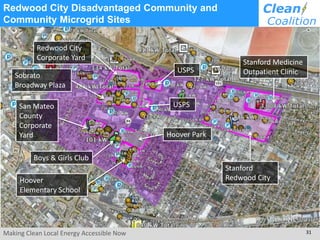
    Making Clean LocalEnergy Accessible Now 31 Redwood City Corporate Yard Sobrato Broadway Plaza San Mateo County Corporate Yard Boys & Girls Club Hoover Elementary School Stanford Redwood City Hoover Park Stanford Medicine Outpatient Clinic Redwood City Disadvantaged Community and Community Microgrid Sites USPS USPS
  • 32.
    Making Clean LocalEnergy Accessible Now 32 Site Name Meters or Buildings Critical Loads NEM Solar [kW AC] FIT Solar [kW AC] Total Solar [kW AC] Battery [kW] Battery [kWh] EVCI (Level 2) Stanford Redwood City Phase 1 P1, B1-B4 Campus emergency response 886 0 886 251 2,100 52 Hoover Cluster Hoover School Shelter & food service 73 203 276 29 150 20 Boys & Girls Club Shelter & food service 11 90 101 0 0 10 Hoover Park Equipment staging 0 0 0 0 0 0 Redwood City Corporate Yard Redwood City Corporate Yard Road and public facility maintenance and repair 136 352 488 58 360 *4 San Mateo County Corporate Yard (SMC Yard) SMC Yard Meter 1 Road and public facility maintenance and repair 65 0 65 58 240 0 SMC Yard Meter 2 33 121 154 0 0 *4 SMC Yard Meter 3 0 79 79 0 0 0 Sobrato Broadway Plaza Sobrato Broadway Plaza (multiple meters) Low income housing 0 1,197 1,197 TBD TBD TBD Sobrato CVS Pharmacy & grocery 0 83 83 TBD TBD TBD New Deployments TOTAL 1,204 2,125 3,329 396 2,850 82 Deployment Summary With net metering, only 1.2 MW can be deployed. With a new FIT program, an additional 2.1 MW of local, renewable generation could be deployed in a disadvantaged community.
  • 33.
    Making Clean LocalEnergy Accessible Now 33 Stanford RWC Phase 1 and 2
  • 34.
    Making Clean LocalEnergy Accessible Now 34 Stanford RWC Phase 1 Overview Map
  • 35.
    Making Clean LocalEnergy Accessible Now 35 Stanford RWC Phase 1 feeders & switching
  • 36.
    Making Clean LocalEnergy Accessible Now 36 Hoover Cluster Conceptual Diagram 126 kW Solar Carport 77 kW Solar Carport Hoover School Main Transformer 30 kW/ 150 kWh Battery M M M 83 kW Solar Carport Not drawn to scale 10 L2 EVCI ports 10 L2 EVCI ports 10 L2 EVCI ports 73 kW Rooftop Solar BGCP Main Transformer BGCP Meter Main Hoover School Meter Main Proposed trenching path Hoover Park Meter Main Proposed overhead conduit path 18 kW Rooftop Solar
  • 37.
    Making Clean LocalEnergy Accessible Now 37 Hoover Cluster Detailed Map
  • 38.
    Making Clean LocalEnergy Accessible Now 38 Sobrato Broadway Plaza and CVS overview map
  • 39.
    Making Clean LocalEnergy Accessible Now 39 Ecoplexus project at the Valencia Gardens Apartments in SF. ~800 kW meeting ~80% of the total annual load. Peek at the Community Microgrid future
  • 40.
    Making Clean LocalEnergy Accessible Now 40 Backup
  • 41.
    Making Clean LocalEnergy Accessible Now 41 Community Microgrids obviate gas peakers Thanks in part to our analysis, California regulators have rejected Ellwood and signaled their intent to reject Puente as well “Let’s take this opportunity to move the Oxnard community into the clean energy future — which is here already.” Carmen Ramirez, Mayor of Oxnard Significant opportunity to leverage this work to prevent future new gas plant proposals across the country
  • 42.
    Making Clean LocalEnergy Accessible Now 42 Community Microgrids cheaper than gas peakers Leveraging our technical and economic expertise, the Clean Coalition conducted an analysis to determine the viability of solar+storage as a better alternative