Washington State Ocean Energy Conference Tom Hicks DASN (Energy)
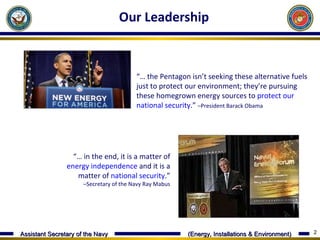
Our Leadership “…  the Pentagon isn’t seeking these alternative fuels just to protect our environment; they’re pursuing these homegrown energy sources to  protect our national security .”  –President Barack Obama “…  in the end, it is a matter of  energy independence  and it is a matter of  national security .”  –Secretary of the Navy Ray Mabus
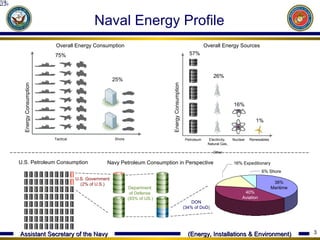
U.S. Petroleum Consumption 33% DON (34% of DoD) Tactical Energy Consumption Shore 57% 25% Overall Energy Consumption Overall Energy Sources 26% 16% 1% Petroleum Electricity,  Natural Gas,  Other Nuclear Renewables Energy Consumption Navy Petroleum Consumption in Perspective U.S. Government (2% of U.S.) 75% 40% Aviation 38% Maritime Department  of Defense  (93% of US.) Naval Energy Profile 6% Shore 16% Expeditionary
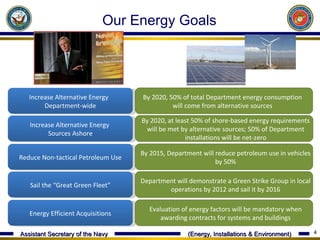
Increase Alternative Energy  Sources Ashore Sail the  “Great Green Fleet” Reduce Non-tactical Petroleum Use Energy Efficient Acquisitions Increase Alternative Energy  Department-wide By 2020, at least 50% of shore-based energy requirements will be met by alternative sources; 50% of Department installations will be net-zero Department will demonstrate a Green Strike Group in local operations by 2012 and sail it by 2016 By 2015, Department will reduce petroleum use in vehicles by 50% Evaluation of energy factors will be mandatory when awarding contracts for systems and buildings By 2020, 50% of total Department energy consumption will come from alternative sources Our Energy Goals
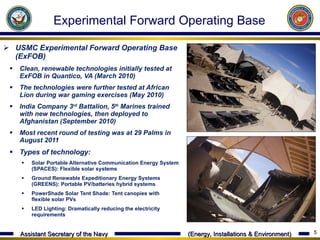
USMC Experimental Forward Operating Base (ExFOB)  Clean, renewable technologies initially tested at ExFOB in Quantico, VA (March 2010) The technologies were further tested at African Lion during war gaming exercises (May 2010) India Company 3 rd  Battalion, 5 th  Marines trained with new technologies, then deployed to Afghanistan (September 2010) Most recent round of testing was at 29 Palms in August 2011 Types of technology:  Solar Portable Alternative Communication Energy System (SPACES): Flexible solar systems Ground Renewable Expeditionary Energy Systems (GREENS): Portable PV/batteries hybrid systems  PowerShade Solar Tent Shade: Tent canopies with flexible solar PVs LED Lighting: Dramatically reducing the electricity requirements Experimental Forward Operating Base
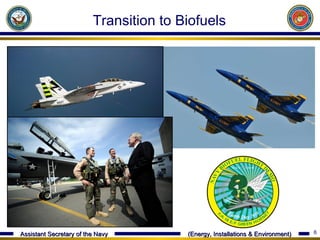
Transition to Biofuels
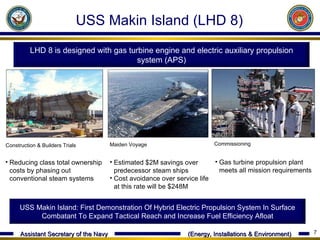
USS Makin Island: First Demonstration Of Hybrid Electric Propulsion System In Surface Combatant To Expand Tactical Reach and Increase Fuel Efficiency Afloat LHD 8 is designed with gas turbine engine and electric auxiliary propulsion system (APS) USS Makin Island (LHD 8) Gas turbine propulsion plant meets all mission requirements Commissioning Reducing class total ownership costs by phasing out conventional steam systems Construction & Builders Trials Estimated $2M savings over predecessor steam ships Cost avoidance over service life at this rate will be $248M Maiden Voyage
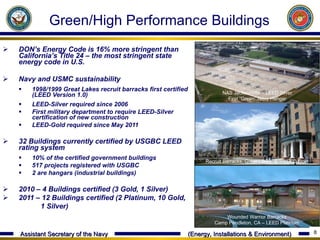
DON ’s Energy Code is 16% more stringent than California’s Title 24 – the most stringent state energy code in U.S.  Navy and USMC sustainability 1998/1999 Great Lakes recruit barracks first certified (LEED Version 1.0) LEED-Silver required since 2006 First military department to require LEED-Silver certification of new construction LEED-Gold required since May 2011 32 Buildings currently certified by USGBC LEED rating system 10% of the certified government buildings 517 projects registered with USGBC 2 are hangars (industrial buildings) 2010 – 4 Buildings certified (3 Gold, 1 Silver) 2011 – 12 Buildings certified (2 Platinum, 10 Gold,    1 Silver) Green/High Performance Buildings Wounded Warrior Barracks Camp Pendleton, CA – LEED Platinum NAS Jacksonville – LEED Silver First  “Green” Navy Hanger Recruit Barracks, Great Lakes, IL – LEED Gold
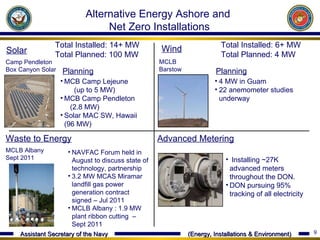
Advanced Metering Solar Wind Waste to Energy Camp Pendleton Box Canyon Solar MCLB Barstow  Total Installed: 14+ MW Total Planned: 100 MW  Total Installed: 6+ MW Total Planned: 4 MW NAVFAC Forum held in August to discuss state of technology, partnership  3.2 MW MCAS Miramar landfill gas power generation contract signed – Jul 2011 MCLB Albany : 1.9 MW plant ribbon cutting  – Sept 2011 MCLB Albany Sept 2011 Installing ~27K advanced meters throughout the DON. DON pursuing 95% tracking of all electricity  Alternative Energy Ashore and  Net Zero Installations MCB Camp Lejeune  (up to 5 MW) MCB Camp Pendleton  (2.8 MW) Solar MAC SW, Hawaii (96 MW) Planning 4 MW in Guam 22 anemometer studies underway Planning
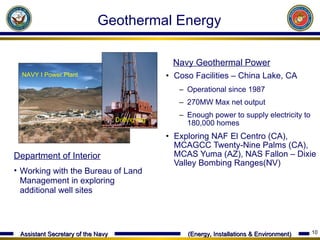
Coso Facilities – China Lake, CA  Operational since 1987 270MW Max net output Enough power to supply electricity to 180,000 homes  Exploring NAF El Centro (CA), MCAGCC Twenty-Nine Palms (CA), MCAS Yuma (AZ), NAS Fallon – Dixie Valley Bombing Ranges(NV) NAVY I Power Plant  Drilling Rig Navy Geothermal Power   Department of Interior Working with the Bureau of Land Management in exploring additional well sites  Geothermal Energy
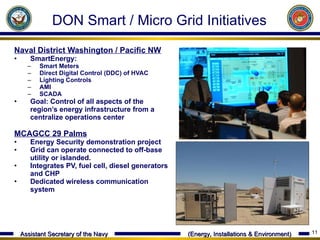
Naval District Washington / Pacific NW SmartEnergy: Smart Meters  Direct Digital Control (DDC) of HVAC  Lighting Controls AMI  SCADA  Goal: Control of all aspects of the region ’s energy infrastructure from a centralize operations center  MCAGCC 29 Palms Energy Security demonstration project Grid can operate connected to off-base utility or islanded.  Integrates PV, fuel cell, diesel generators and CHP  Dedicated wireless communication system  DON Smart / Micro Grid Initiatives
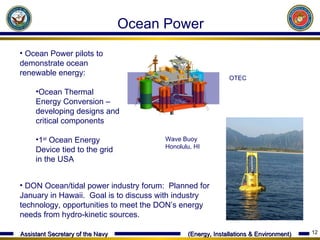
Wave Buoy Honolulu, HI OTEC Ocean Power pilots to demonstrate ocean renewable energy: Ocean Thermal Energy Conversion – developing designs and critical components 1 st  Ocean Energy Device tied to the grid in the USA Ocean Power DON Ocean/tidal power industry forum:  Planned for January in Hawaii.  Goal is to discuss with industry technology, opportunities to meet the DON ’s energy needs from hydro-kinetic sources.
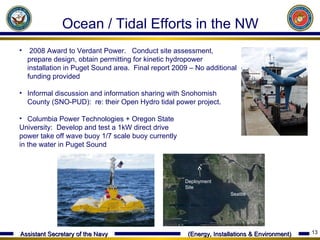
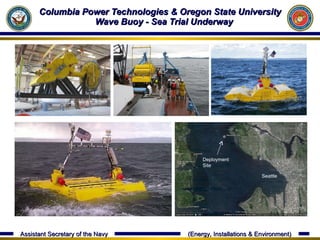
2008 Award to Verdant Power.  Conduct site assessment, prepare design, obtain permitting for kinetic hydropower installation in Puget Sound area.  Final report 2009 – No additional funding provided Informal discussion and information sharing with Snohomish County (SNO-PUD):  re: their Open Hydro tidal power project. Columbia Power Technologies + Oregon State  University:  Develop and test a 1kW direct drive  power take off wave buoy 1/7 scale buoy currently  in the water in Puget Sound Ocean / Tidal Efforts in the NW Seattle Deployment Site
QUESTIONS?
Backup
Columbia Power Technologies & Oregon State University Wave Buoy - Sea Trial Underway Seattle Deployment Site

Cwts ocean energy dasn hicks

  • 1.
    Washington State OceanEnergy Conference Tom Hicks DASN (Energy)
  • 2.
    Our Leadership “… the Pentagon isn’t seeking these alternative fuels just to protect our environment; they’re pursuing these homegrown energy sources to protect our national security .” –President Barack Obama “… in the end, it is a matter of energy independence and it is a matter of national security .” –Secretary of the Navy Ray Mabus
  • 3.
    U.S. Petroleum Consumption33% DON (34% of DoD) Tactical Energy Consumption Shore 57% 25% Overall Energy Consumption Overall Energy Sources 26% 16% 1% Petroleum Electricity, Natural Gas, Other Nuclear Renewables Energy Consumption Navy Petroleum Consumption in Perspective U.S. Government (2% of U.S.) 75% 40% Aviation 38% Maritime Department of Defense (93% of US.) Naval Energy Profile 6% Shore 16% Expeditionary
  • 4.
    Increase Alternative Energy Sources Ashore Sail the “Great Green Fleet” Reduce Non-tactical Petroleum Use Energy Efficient Acquisitions Increase Alternative Energy Department-wide By 2020, at least 50% of shore-based energy requirements will be met by alternative sources; 50% of Department installations will be net-zero Department will demonstrate a Green Strike Group in local operations by 2012 and sail it by 2016 By 2015, Department will reduce petroleum use in vehicles by 50% Evaluation of energy factors will be mandatory when awarding contracts for systems and buildings By 2020, 50% of total Department energy consumption will come from alternative sources Our Energy Goals
  • 5.
    USMC Experimental ForwardOperating Base (ExFOB) Clean, renewable technologies initially tested at ExFOB in Quantico, VA (March 2010) The technologies were further tested at African Lion during war gaming exercises (May 2010) India Company 3 rd Battalion, 5 th Marines trained with new technologies, then deployed to Afghanistan (September 2010) Most recent round of testing was at 29 Palms in August 2011 Types of technology: Solar Portable Alternative Communication Energy System (SPACES): Flexible solar systems Ground Renewable Expeditionary Energy Systems (GREENS): Portable PV/batteries hybrid systems PowerShade Solar Tent Shade: Tent canopies with flexible solar PVs LED Lighting: Dramatically reducing the electricity requirements Experimental Forward Operating Base
  • 6.
  • 7.
    USS Makin Island:First Demonstration Of Hybrid Electric Propulsion System In Surface Combatant To Expand Tactical Reach and Increase Fuel Efficiency Afloat LHD 8 is designed with gas turbine engine and electric auxiliary propulsion system (APS) USS Makin Island (LHD 8) Gas turbine propulsion plant meets all mission requirements Commissioning Reducing class total ownership costs by phasing out conventional steam systems Construction & Builders Trials Estimated $2M savings over predecessor steam ships Cost avoidance over service life at this rate will be $248M Maiden Voyage
  • 8.
    DON ’s EnergyCode is 16% more stringent than California’s Title 24 – the most stringent state energy code in U.S. Navy and USMC sustainability 1998/1999 Great Lakes recruit barracks first certified (LEED Version 1.0) LEED-Silver required since 2006 First military department to require LEED-Silver certification of new construction LEED-Gold required since May 2011 32 Buildings currently certified by USGBC LEED rating system 10% of the certified government buildings 517 projects registered with USGBC 2 are hangars (industrial buildings) 2010 – 4 Buildings certified (3 Gold, 1 Silver) 2011 – 12 Buildings certified (2 Platinum, 10 Gold, 1 Silver) Green/High Performance Buildings Wounded Warrior Barracks Camp Pendleton, CA – LEED Platinum NAS Jacksonville – LEED Silver First “Green” Navy Hanger Recruit Barracks, Great Lakes, IL – LEED Gold
  • 9.
    Advanced Metering SolarWind Waste to Energy Camp Pendleton Box Canyon Solar MCLB Barstow Total Installed: 14+ MW Total Planned: 100 MW Total Installed: 6+ MW Total Planned: 4 MW NAVFAC Forum held in August to discuss state of technology, partnership 3.2 MW MCAS Miramar landfill gas power generation contract signed – Jul 2011 MCLB Albany : 1.9 MW plant ribbon cutting – Sept 2011 MCLB Albany Sept 2011 Installing ~27K advanced meters throughout the DON. DON pursuing 95% tracking of all electricity Alternative Energy Ashore and Net Zero Installations MCB Camp Lejeune (up to 5 MW) MCB Camp Pendleton (2.8 MW) Solar MAC SW, Hawaii (96 MW) Planning 4 MW in Guam 22 anemometer studies underway Planning
  • 10.
    Coso Facilities –China Lake, CA Operational since 1987 270MW Max net output Enough power to supply electricity to 180,000 homes Exploring NAF El Centro (CA), MCAGCC Twenty-Nine Palms (CA), MCAS Yuma (AZ), NAS Fallon – Dixie Valley Bombing Ranges(NV) NAVY I Power Plant Drilling Rig Navy Geothermal Power Department of Interior Working with the Bureau of Land Management in exploring additional well sites Geothermal Energy
  • 11.
    Naval District Washington/ Pacific NW SmartEnergy: Smart Meters Direct Digital Control (DDC) of HVAC Lighting Controls AMI SCADA Goal: Control of all aspects of the region ’s energy infrastructure from a centralize operations center MCAGCC 29 Palms Energy Security demonstration project Grid can operate connected to off-base utility or islanded. Integrates PV, fuel cell, diesel generators and CHP Dedicated wireless communication system DON Smart / Micro Grid Initiatives
  • 12.
    Wave Buoy Honolulu,HI OTEC Ocean Power pilots to demonstrate ocean renewable energy: Ocean Thermal Energy Conversion – developing designs and critical components 1 st Ocean Energy Device tied to the grid in the USA Ocean Power DON Ocean/tidal power industry forum: Planned for January in Hawaii. Goal is to discuss with industry technology, opportunities to meet the DON ’s energy needs from hydro-kinetic sources.
  • 13.
    2008 Award toVerdant Power. Conduct site assessment, prepare design, obtain permitting for kinetic hydropower installation in Puget Sound area. Final report 2009 – No additional funding provided Informal discussion and information sharing with Snohomish County (SNO-PUD): re: their Open Hydro tidal power project. Columbia Power Technologies + Oregon State University: Develop and test a 1kW direct drive power take off wave buoy 1/7 scale buoy currently in the water in Puget Sound Ocean / Tidal Efforts in the NW Seattle Deployment Site
  • 14.
  • 15.
  • 16.
    Columbia Power Technologies& Oregon State University Wave Buoy - Sea Trial Underway Seattle Deployment Site

Editor's Notes

  • #4 This graphic underscores the challenge of the collective “we.” DoD is not a market maker, but it is the largest government and individual petroleum consumer and can serve as a technology leader. The Navy is the second largest fuel user in DOD, after the Air Force and before the Army. While the DON is a significant consumer of fuel, neither DON nor DOD can affect the price of oil. Therefore, both are at the mercy of the market – both the stability of supplies and fluctuations in price. We have to define and execute our own destiny. Navy energy use is dominated by tactical operations and petroleum fuel in particular. Currently, the Navy is highly dependent on petroleum to run its planes, ships, and vehicles. Aviation and maritime forces consume the bulk of petroleum, followed by tactical vehicles (i.e. mobility platforms and equipment for expeditionary forces, including Marine Corps), non-tactical vehicles (i.e. ground transportation at DON facilities), and facilities. The vast majority of alternative energy utilized by DON is derived from nuclear sources, rather than renewables or biofuels. DoD used 119 million barrels of petroleum in FY08. Blue Navy used 29.4 million barrels (not including Marine Corps).
  • #6 USMC EXFOB: - Phase one of the experiment simulated the energy and water demands of a Marine unit at forward operating bases similar to those in Afghanistan. The initial phase determined the baseline requirements of company-size and smaller FOBs. - Phase two, evaluating existing commercial technologies to meet the Marines' needs and increasing power generation efficiency to sustain a small base. - Phase three will be the end user evaluation. Equipment will be sent to Afghanistan to see how well it fares in a combat environment. - The fourth and final phase will facilitate future science and technology efforts by gathering data on experimental systems. Miramar Implementation Progress: Renewable Energy Utilization Land Fill Gas (LFG) Power Purchase Agreement (PPA) Three (3) MW (25,000 MWh/year) from contiguous landfill Appropriations ECIP: 700-800 kW PV ARRA (150 kW PV car port and PV street lights, solar hot water with all new boilers and solar hot water heating (2 hangars) Miramar Implementation Progress: Microgrid Microgrid baselining and assessment One line electrical diagram HOMER assessment DEW assessment • Distributed Energy Resources implementation “benchmark” Electrical load: 50,000 MWH/yr, 6 MW (average demand) Distributed Energy Resources Renewables (LFG-3 MW/25,000 MWH/yr, PV, SHW) Fossil (CHP-2.5MW/? MWH, D-G 5 MW (estimate)) • Controls (Microgrid level-pending, systems level (ESPC)) • Grid interconnection (discussion with SDG&E) • Demand response (discussion with SDG&E, private sector option) Miramar Progress: Fleet and Infrastructure Biodiesel/compressed natural gas on site and in use( E85 pending) Nearly 30% of vehicle fleet fuel used was alternative fuel Large number of AFVs/NEVs in inventory Vehicle inventory and fuel use data received and strategic assessment pending Opportunity: Alternative fuel use and petroleum reduction mandates focus on 0.5% of total Miramar fuel use. USMC Net Zero Energy Installations Pilot: MCAS Miramar, CA – DoD-DOE Initiative to build a Net Zero Communities/installations. Which include: Efficient Building Retrofits Efficient New Buildings Renewable Energy Utilization Electric grid Opportunities Vehicle Fleets
  • #10 FOR RENEWABLE GOALS: DON needs 2 million Mbtu/year new renewable to meet SECNAV goals DON needs 500,000 Mbtu/year installed to meet NDAA 2007/2010 goals Solar: Hawaii solar MAC – first task order in December 2010 assuming no problems pop up Camp Pendleton – two 1.4 MW projects, one under construction, should be completed December 2010, second is FY11 MILCON Advanced Metering Initiative: All remaining metering contracts will be awarded in FY11 and FY12 to meet EPAct 05 goals for electric metering Gas, steam, and water meters are also being installed with 2016 goal as outlined in EISA 2007 Small Modular Reactors (SMR): CNA continuing to study – Sept draft with Nov final feasibility study planned FOR OFFICIAL USE ONLY: MAY NOT BE RELEASABLE UNDER FOIA EXEMPTION 5
  • #11 This is a Public/private venture. Our contractor puts up the money to develop the resource, he also operates the plant and owns the electricity produced. Navy provides the land and geothermal resource and receives a percentage of the contractors revenue. DON can take either revenue for power or a combination of the two. This revenue finances our energy program world-wide. Navy Geothermal Program Office, NREL, Guam Power Authority, Guam Energy Office Local assessment wk of 19 APR supports test drilling Guam Energy Office (GEO) has ARRA grant fund - Working NEPA issue