









INTRODUCTION
MICRO HYDRO ELECTRIC PROJECT
REURAL ELECTRIFICATION
SLIDES BY ABHISHEK RAJ
MECHANICAL
RIT KOTTAAYM
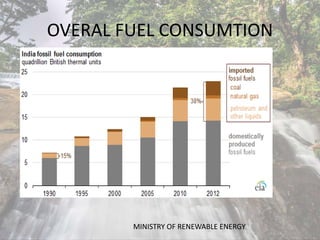
OVERAL FUEL CONSUMTION
MINISTRY OF RENEWABLE ENERGY
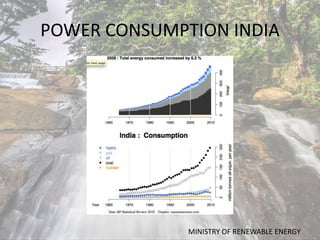
POWER CONSUMPTION INDIA
MINISTRY OF RENEWABLE ENERGY
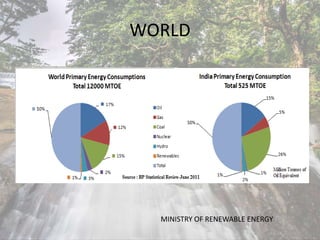
WORLD
MINISTRY OF RENEWABLE ENERGY
MAKE IN INDIA
• AS WE ARE A LARGE IMPORTER OF CRUDE
OIL,OUR REURAL AREAS ARE STILL UNDER
DARKNESS
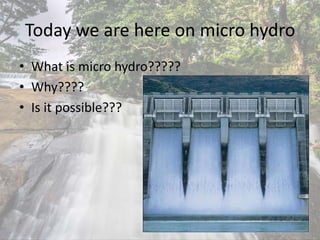
Today we are here on micro hydro
• What is micro hydro?????
• Why????
• Is it possible???
Of course it’s possible
• Minimum environmental impact
• Small in scale
• seasonal
• Consistent: Produces continuously, 24/7
Is it true???
• We don’t need a
DAM, but some
flowing water
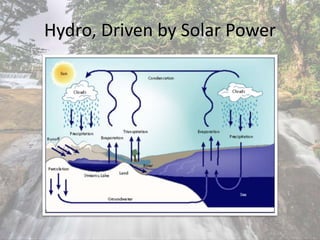
Hydro, Driven by Solar Power
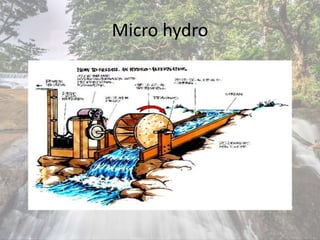
Micro hydro
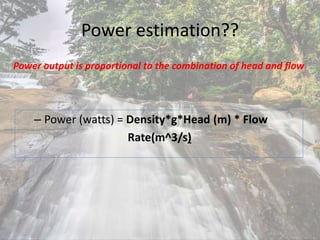
Power estimation??
– Power (watts) = Density*g*Head (m) * Flow
Rate(m^3/s)
Power output is proportional to the combination of head and flow
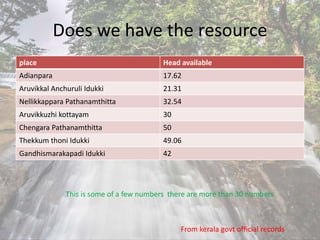
Does we have the resource
place Head available
Adianpara 17.62
Aruvikkal Anchuruli Idukki 21.31
Nellikkappara Pathanamthitta 32.54
Aruvikkuzhi kottayam 30
Chengara Pathanamthitta 50
Thekkum thoni Idukki 49.06
Gandhismarakapadi Idukki 42
This is some of a few numbers there are more than 30 numbers
From kerala govt official records
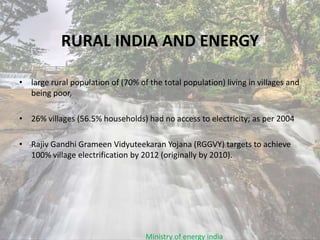
RURAL INDIA AND ENERGY
• large rural population of (70% of the total population) living in villages and
being poor,
• 26% villages (56.5% households) had no access to electricity; as per 2004
• Rajiv Gandhi Grameen Vidyuteekaran Yojana (RGGVY) targets to achieve
100% village electrification by 2012 (originally by 2010).
Ministry of energy india
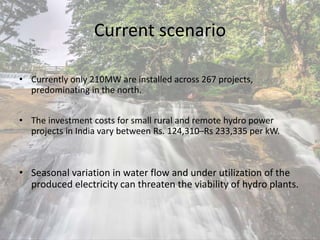
Current scenario
• Currently only 210MW are installed across 267 projects,
predominating in the north.
• The investment costs for small rural and remote hydro power
projects in India vary between Rs. 124,310–Rs 233,335 per kW.
• Seasonal variation in water flow and under utilization of the
produced electricity can threaten the viability of hydro plants.
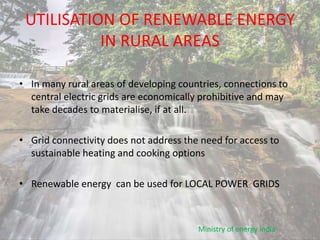
UTILISATION OF RENEWABLE ENERGY
IN RURAL AREAS
• In many rural areas of developing countries, connections to
central electric grids are economically prohibitive and may
take decades to materialise, if at all.
• Grid connectivity does not address the need for access to
sustainable heating and cooking options
• Renewable energy can be used for LOCAL POWER GRIDS
Ministry of energy india
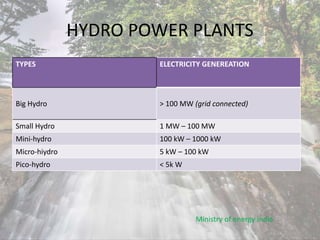
HYDRO POWER PLANTS
TYPES ELECTRICITY GENEREATION
Big Hydro > 100 MW (grid connected)
Small Hydro 1 MW – 100 MW
Mini-hydro 100 kW – 1000 kW
Micro-hiydro 5 kW – 100 kW
Pico-hydro < 5k W
Ministry of energy india
CASE STUDY-MALASYA
SIRIM
WHAT IS SIRIM??
• http://www.sirim.my/
• SIRIM Berhad, formerly known as the
Standards and Industrial Research Institute of
Malaysia, is a corporate organisation owned
wholly by the Malaysian Government, under
the Minister of Finance Incorporated.
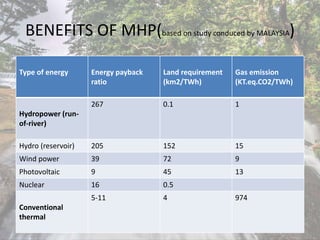
BENEFITS OF MHP(based on study conduced by MALAYSIA)
Type of energy Energy payback
ratio
Land requirement
(km2/TWh)
Gas emission
(KT.eq.CO2/TWh)
Hydropower (run-
of-river)
267 0.1 1
Hydro (reservoir) 205 152 15
Wind power 39 72 9
Photovoltaic 9 45 13
Nuclear 16 0.5
Conventional
thermal
5-11 4 974
PROJECT FEASIBILITY STUDY
FEASIBILITY-HYDROLOGY
• Catchment Area- to ensure continuous supply of water.
• Flood Discharge- to determine suitable location for civil
structure from flood prone area.
• Potential Power-To determine suitable design of civil structure
for optimum micro hydro power.
• Dependable Discharge- to determine the type of turbine and
civil structure.
DESIGN STUDY
MICRO HYDRO COMPONENTS
• Civil & Structure:
i.Intake weir and settling basin
ii.Water Channel
iii.Forebay tank
iv.Penstock
v.Power House
• Electro-mechanical:
i.Turbine
ii.Generator
• Electrical & Transmission
• i.Control Unit
• ii.Poles
• iii.Transmission Cables
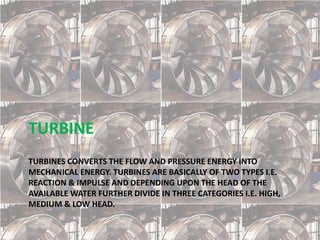
TURBINES CONVERTS THE FLOW AND PRESSURE ENERGY INTO
MECHANICAL ENERGY. TURBINES ARE BASICALLY OF TWO TYPES I.E.
REACTION & IMPULSE AND DEPENDING UPON THE HEAD OF THE
AVAILABLE WATER FURTHER DIVIDE IN THREE CATEGORIES I.E. HIGH,
MEDIUM & LOW HEAD.
TURBINE
TURBINES
IMPULSE
• Pelton,
• Turgo Wheel
• Cross Flow
REACTION
• Francis
• Axial Flow
 Propeller,
 Semi Kaplan,
 Kaplan
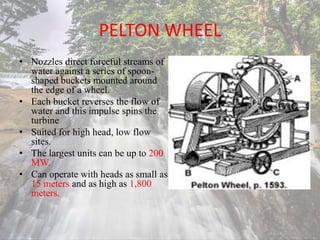
PELTON WHEEL
• Nozzles direct forceful streams of
water against a series of spoon-
shaped buckets mounted around
the edge of a wheel.
• Each bucket reverses the flow of
water and this impulse spins the
turbine
• Suited for high head, low flow
sites.
• The largest units can be up to 200
MW.
• Can operate with heads as small as
15 meters and as high as 1,800
meters.
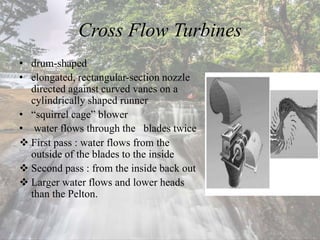
Cross Flow Turbines
• drum-shaped
• elongated, rectangular-section nozzle
directed against curved vanes on a
cylindrically shaped runner
• “squirrel cage” blower
• water flows through the blades twice
 First pass : water flows from the
outside of the blades to the inside
 Second pass : from the inside back out
 Larger water flows and lower heads
than the Pelton.
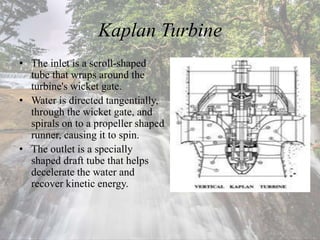
Kaplan Turbine
• The inlet is a scroll-shaped
tube that wraps around the
turbine's wicket gate.
• Water is directed tangentially,
through the wicket gate, and
spirals on to a propeller shaped
runner, causing it to spin.
• The outlet is a specially
shaped draft tube that helps
decelerate the water and
recover kinetic energy.
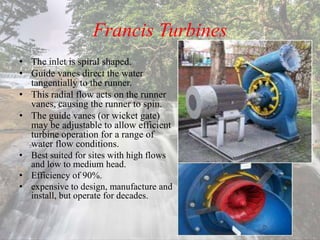
Francis Turbines
• The inlet is spiral shaped.
• Guide vanes direct the water
tangentially to the runner.
• This radial flow acts on the runner
vanes, causing the runner to spin.
• The guide vanes (or wicket gate)
may be adjustable to allow efficient
turbine operation for a range of
water flow conditions.
• Best suited for sites with high flows
and low to medium head.
• Efficiency of 90%.
• expensive to design, manufacture and
install, but operate for decades.
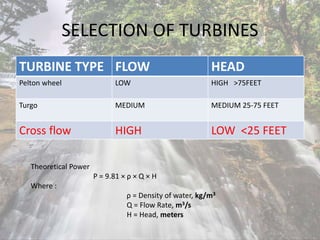
SELECTION OF TURBINES
TURBINE TYPE FLOW HEAD
Pelton wheel LOW HIGH >75FEET
Turgo MEDIUM MEDIUM 25-75 FEET
Cross flow HIGH LOW <25 FEET
Theoretical Power
P = 9.81 × ρ × Q × H
Where :
ρ = Density of water, kg/m3
Q = Flow Rate, m3/s
H = Head, meters
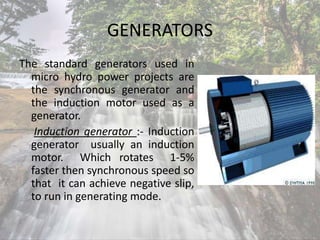
GENERATORS
The standard generators used in
micro hydro power projects are
the synchronous generator and
the induction motor used as a
generator.
Induction generator :- Induction
generator usually an induction
motor. Which rotates 1-5%
faster then synchronous speed so
that it can achieve negative slip,
to run in generating mode.
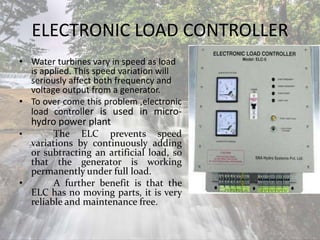
ELECTRONIC LOAD CONTROLLER
• Water turbines vary in speed as load
is applied. This speed variation will
seriously affect both frequency and
voltage output from a generator.
• To over come this problem ,electronic
load controller is used in micro-
hydro power plant
• The ELC prevents speed
variations by continuously adding
or subtracting an artificial load, so
that the generator is working
permanently under full load.
• A further benefit is that the
ELC has no moving parts, it is very
reliable and maintenance free.
MALAYSIA
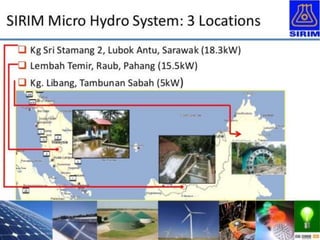
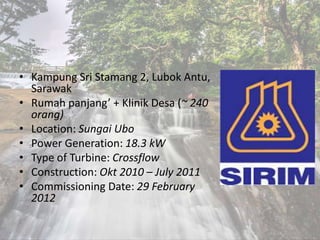
SIRIM PROJECT IMPLEMENTAION
• Kampung Sri Stamang 2, Lubok Antu,
Sarawak
• Rumah panjang’ + Klinik Desa (~ 240
orang)
• Location: Sungai Ubo
• Power Generation: 18.3 kW
• Type of Turbine: Crossflow
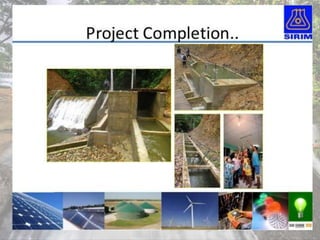
• Construction: Okt 2010 – July 2011
• Commissioning Date: 29 February
2012
COST ANALYSIS
micro-hydro; power plant; Hink river;
Engineering Department, University of Papua,
Jl.Gunung Salju Amban, Manokwari, 98314,
Indonesia
MEATHOD
• Economic analysis of a micro-hydro power plant is
important to evaluate the eligibility of the plant.
• It includes cost, benefit and benefit cost ratio, and
payback period to build the plant.
COST
 Cost in developing a micro-hydro power plant will be
investment and operational cost
• Daily benefit of micro-hydro power plant operation will be the
product of power production and fixed price ofthe power.
• By multiplying daily benefit within 30 days, it will give monthly
benefit value. Annual benefit is 12times higher than monthly
benefit
• Payback period is the time period for paying back all of the
cost. The payback period is calculated by counting the number
of years taken to recover the cash invested in a project. The
investment is feasible if the payback period is lower than
investment period
Potency of Hink River
• A survey had been done to investigate hydrolic potency of the Hink
River in earth coordinate of 1o 14’ 08.9” S and 133o 57’ 14.2” E.
• Measured by a GPS, the height of the head was about 10 m.
Therefore, the hidrolyc potency of theriver with flow rate 0.3m3/s
• POWER (TH)=(1000 )(9.8 )(0.3 )(10 ) =29.4KW
• overall efficiency will be 50-70%, and
• then the generated power is in between 14.70-20.58 kW. Therefore,
the turbine and generator should be chosen
• higher than 20.58 kW.
COST OF POWER PLANT SETTING
• Civil Equipment
• Waterworks of the planning micro-hydro power plant include weir,
intake, forebay and tailrace. Flood gate and
• trash screen are the complement equipments that are placed in
intake and forebay. Flood gate is used to maintain thepower plant,
and trashrack is used to separate trash from water before it comes
to the turbine.
• Dimension planning of power house was 3x3 m and it will be
semi pemanent building with set forth of gaveL stone in
bottom side and thick board in upper side. Slove and machine
foundation will be reinforced concrete with
• iron cast type K-225 and the house will be roofed by
corrugated iron.
Energy Production and Distribution
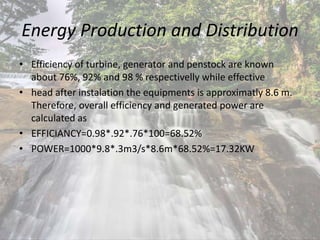
• Efficiency of turbine, generator and penstock are known
about 76%, 92% and 98 % respectivelly while effective
• head after instalation the equipments is approximatly 8.6 m.
Therefore, overall efficiency and generated power are
calculated as
• EFFICIANCY=0.98*.92*.76*100=68.52%
• POWER=1000*9.8*.3m3/s*8.6m*68.52%=17.32KW
Economic Analysis
• Investment of the micro-hydro power plant is
approximately Rp. 778224202.02, including
direct cost and indirect
• cost. Contingencies cost is predicted about 5%
of direct cost and engineering cost is about 7%
of direct cost for
• survey, supervision cost, detail design and
planning
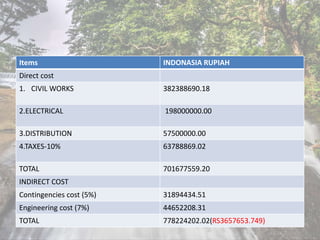
Items INDONASIA RUPIAH
Direct cost
1. CIVIL WORKS 382388690.18
2.ELECTRICAL 198000000.00
3.DISTRIBUTION 57500000.00
4.TAXES-10% 63788869.02
TOTAL 701677559.20
INDIRECT COST
Contingencies cost (5%) 31894434.51
Engineering cost (7%) 44652208.31
TOTAL 778224202.02(RS3657653.749)
• Annual generator output is about 149644.8 kWh; therefore annual benefit is about
Rp. 92543126.40 at powerprice Rp. 720.00/kWh and monthly load benefit is
chosen about Rp. 32000.00 per month kWh or in this case about
• Rp. 5468160.00 per month. Cost which includes deviation of civil building (30
years), deviation of electrical and mechanical (25 years), deviation of distribution
lines (30 years), operation and maintenance cost, and 3% of bank interest as in
table
• Profit of annual operation is the benefit minus cost and it will cost Rp.
44933537.85. Benefit factor build by the
• micro-hydro power plant in Hink district is about 1.94 and payback periode will be
17.32 years or about 17 years and 4 month. Electrical and mechanical equipment
can reach 25 years and the building can life until 30 years.
• According to the criterion of benefit cost ratio and payback period, the
development of micro-hydro power plant inHink district is feasible.
• 1Rp=Rs0.0047
Conclusion
• The result of water supply measurement in Hink River shows
that maximum flow rate is 0.4 m3/s. With head about 10m,
the hydraulic potency is equal to 29.5 kW
• We have many spots in kerala where this project can be
adopted
• It can solve the power solution in remote areas
• Many government policies support the development of the
micro hydro projects
TARGET AREAS
• MINIMISING HEAD REQUIREMENTS
• (ASTONISHING FACT THAT IT CAN BE DONE AS
SMALL AS 0.5 M)
• REVERSE PUMP MECHANISM FOR POWER
PRODUCTION
THANK YOU
BY
ABHISHEK RAJ
RIT KOTTAYAM

Micro Hydrro electricc projects

  • 1.
    INTRODUCTION MICRO HYDRO ELECTRICPROJECT REURAL ELECTRIFICATION SLIDES BY ABHISHEK RAJ MECHANICAL RIT KOTTAAYM
  • 2.
  • 3.
  • 4.
  • 5.
    MAKE IN INDIA •AS WE ARE A LARGE IMPORTER OF CRUDE OIL,OUR REURAL AREAS ARE STILL UNDER DARKNESS
  • 6.
    Today we arehere on micro hydro • What is micro hydro????? • Why???? • Is it possible???
  • 7.
    Of course it’spossible • Minimum environmental impact • Small in scale • seasonal • Consistent: Produces continuously, 24/7
  • 8.
    Is it true??? •We don’t need a DAM, but some flowing water
  • 9.
    Hydro, Driven bySolar Power
  • 10.
  • 11.
    Power estimation?? – Power(watts) = Density*g*Head (m) * Flow Rate(m^3/s) Power output is proportional to the combination of head and flow
  • 12.
    Does we havethe resource place Head available Adianpara 17.62 Aruvikkal Anchuruli Idukki 21.31 Nellikkappara Pathanamthitta 32.54 Aruvikkuzhi kottayam 30 Chengara Pathanamthitta 50 Thekkum thoni Idukki 49.06 Gandhismarakapadi Idukki 42 This is some of a few numbers there are more than 30 numbers From kerala govt official records
  • 13.
    RURAL INDIA ANDENERGY • large rural population of (70% of the total population) living in villages and being poor, • 26% villages (56.5% households) had no access to electricity; as per 2004 • Rajiv Gandhi Grameen Vidyuteekaran Yojana (RGGVY) targets to achieve 100% village electrification by 2012 (originally by 2010). Ministry of energy india
  • 14.
    Current scenario • Currentlyonly 210MW are installed across 267 projects, predominating in the north. • The investment costs for small rural and remote hydro power projects in India vary between Rs. 124,310–Rs 233,335 per kW. • Seasonal variation in water flow and under utilization of the produced electricity can threaten the viability of hydro plants.
  • 15.
    UTILISATION OF RENEWABLEENERGY IN RURAL AREAS • In many rural areas of developing countries, connections to central electric grids are economically prohibitive and may take decades to materialise, if at all. • Grid connectivity does not address the need for access to sustainable heating and cooking options • Renewable energy can be used for LOCAL POWER GRIDS Ministry of energy india
  • 16.
    HYDRO POWER PLANTS TYPESELECTRICITY GENEREATION Big Hydro > 100 MW (grid connected) Small Hydro 1 MW – 100 MW Mini-hydro 100 kW – 1000 kW Micro-hiydro 5 kW – 100 kW Pico-hydro < 5k W Ministry of energy india
  • 17.
  • 18.
    WHAT IS SIRIM?? •http://www.sirim.my/ • SIRIM Berhad, formerly known as the Standards and Industrial Research Institute of Malaysia, is a corporate organisation owned wholly by the Malaysian Government, under the Minister of Finance Incorporated.
  • 19.
    BENEFITS OF MHP(basedon study conduced by MALAYSIA) Type of energy Energy payback ratio Land requirement (km2/TWh) Gas emission (KT.eq.CO2/TWh) Hydropower (run- of-river) 267 0.1 1 Hydro (reservoir) 205 152 15 Wind power 39 72 9 Photovoltaic 9 45 13 Nuclear 16 0.5 Conventional thermal 5-11 4 974
  • 21.
  • 22.
    FEASIBILITY-HYDROLOGY • Catchment Area-to ensure continuous supply of water. • Flood Discharge- to determine suitable location for civil structure from flood prone area. • Potential Power-To determine suitable design of civil structure for optimum micro hydro power. • Dependable Discharge- to determine the type of turbine and civil structure.
  • 23.
  • 24.
    MICRO HYDRO COMPONENTS •Civil & Structure: i.Intake weir and settling basin ii.Water Channel iii.Forebay tank iv.Penstock v.Power House • Electro-mechanical: i.Turbine ii.Generator
  • 25.
    • Electrical &Transmission • i.Control Unit • ii.Poles • iii.Transmission Cables
  • 26.
    TURBINES CONVERTS THEFLOW AND PRESSURE ENERGY INTO MECHANICAL ENERGY. TURBINES ARE BASICALLY OF TWO TYPES I.E. REACTION & IMPULSE AND DEPENDING UPON THE HEAD OF THE AVAILABLE WATER FURTHER DIVIDE IN THREE CATEGORIES I.E. HIGH, MEDIUM & LOW HEAD. TURBINE
  • 27.
    TURBINES IMPULSE • Pelton, • TurgoWheel • Cross Flow REACTION • Francis • Axial Flow  Propeller,  Semi Kaplan,  Kaplan
  • 28.
    PELTON WHEEL • Nozzlesdirect forceful streams of water against a series of spoon- shaped buckets mounted around the edge of a wheel. • Each bucket reverses the flow of water and this impulse spins the turbine • Suited for high head, low flow sites. • The largest units can be up to 200 MW. • Can operate with heads as small as 15 meters and as high as 1,800 meters.
  • 29.
    Cross Flow Turbines •drum-shaped • elongated, rectangular-section nozzle directed against curved vanes on a cylindrically shaped runner • “squirrel cage” blower • water flows through the blades twice  First pass : water flows from the outside of the blades to the inside  Second pass : from the inside back out  Larger water flows and lower heads than the Pelton.
  • 30.
    Kaplan Turbine • Theinlet is a scroll-shaped tube that wraps around the turbine's wicket gate. • Water is directed tangentially, through the wicket gate, and spirals on to a propeller shaped runner, causing it to spin. • The outlet is a specially shaped draft tube that helps decelerate the water and recover kinetic energy.
  • 31.
    Francis Turbines • Theinlet is spiral shaped. • Guide vanes direct the water tangentially to the runner. • This radial flow acts on the runner vanes, causing the runner to spin. • The guide vanes (or wicket gate) may be adjustable to allow efficient turbine operation for a range of water flow conditions. • Best suited for sites with high flows and low to medium head. • Efficiency of 90%. • expensive to design, manufacture and install, but operate for decades.
  • 32.
    SELECTION OF TURBINES TURBINETYPE FLOW HEAD Pelton wheel LOW HIGH >75FEET Turgo MEDIUM MEDIUM 25-75 FEET Cross flow HIGH LOW <25 FEET Theoretical Power P = 9.81 × ρ × Q × H Where : ρ = Density of water, kg/m3 Q = Flow Rate, m3/s H = Head, meters
  • 33.
    GENERATORS The standard generatorsused in micro hydro power projects are the synchronous generator and the induction motor used as a generator. Induction generator :- Induction generator usually an induction motor. Which rotates 1-5% faster then synchronous speed so that it can achieve negative slip, to run in generating mode.
  • 34.
    ELECTRONIC LOAD CONTROLLER •Water turbines vary in speed as load is applied. This speed variation will seriously affect both frequency and voltage output from a generator. • To over come this problem ,electronic load controller is used in micro- hydro power plant • The ELC prevents speed variations by continuously adding or subtracting an artificial load, so that the generator is working permanently under full load. • A further benefit is that the ELC has no moving parts, it is very reliable and maintenance free.
  • 35.
  • 36.
    • Kampung SriStamang 2, Lubok Antu, Sarawak • Rumah panjang’ + Klinik Desa (~ 240 orang) • Location: Sungai Ubo • Power Generation: 18.3 kW • Type of Turbine: Crossflow • Construction: Okt 2010 – July 2011 • Commissioning Date: 29 February 2012
  • 38.
    COST ANALYSIS micro-hydro; powerplant; Hink river; Engineering Department, University of Papua, Jl.Gunung Salju Amban, Manokwari, 98314, Indonesia
  • 39.
    MEATHOD • Economic analysisof a micro-hydro power plant is important to evaluate the eligibility of the plant. • It includes cost, benefit and benefit cost ratio, and payback period to build the plant. COST  Cost in developing a micro-hydro power plant will be investment and operational cost
  • 40.
    • Daily benefitof micro-hydro power plant operation will be the product of power production and fixed price ofthe power. • By multiplying daily benefit within 30 days, it will give monthly benefit value. Annual benefit is 12times higher than monthly benefit • Payback period is the time period for paying back all of the cost. The payback period is calculated by counting the number of years taken to recover the cash invested in a project. The investment is feasible if the payback period is lower than investment period
  • 41.
    Potency of HinkRiver • A survey had been done to investigate hydrolic potency of the Hink River in earth coordinate of 1o 14’ 08.9” S and 133o 57’ 14.2” E. • Measured by a GPS, the height of the head was about 10 m. Therefore, the hidrolyc potency of theriver with flow rate 0.3m3/s • POWER (TH)=(1000 )(9.8 )(0.3 )(10 ) =29.4KW • overall efficiency will be 50-70%, and • then the generated power is in between 14.70-20.58 kW. Therefore, the turbine and generator should be chosen • higher than 20.58 kW.
  • 42.
    COST OF POWERPLANT SETTING • Civil Equipment • Waterworks of the planning micro-hydro power plant include weir, intake, forebay and tailrace. Flood gate and • trash screen are the complement equipments that are placed in intake and forebay. Flood gate is used to maintain thepower plant, and trashrack is used to separate trash from water before it comes to the turbine. • Dimension planning of power house was 3x3 m and it will be semi pemanent building with set forth of gaveL stone in bottom side and thick board in upper side. Slove and machine foundation will be reinforced concrete with • iron cast type K-225 and the house will be roofed by corrugated iron.
  • 43.
    Energy Production andDistribution • Efficiency of turbine, generator and penstock are known about 76%, 92% and 98 % respectivelly while effective • head after instalation the equipments is approximatly 8.6 m. Therefore, overall efficiency and generated power are calculated as • EFFICIANCY=0.98*.92*.76*100=68.52% • POWER=1000*9.8*.3m3/s*8.6m*68.52%=17.32KW
  • 44.
    Economic Analysis • Investmentof the micro-hydro power plant is approximately Rp. 778224202.02, including direct cost and indirect • cost. Contingencies cost is predicted about 5% of direct cost and engineering cost is about 7% of direct cost for • survey, supervision cost, detail design and planning
  • 45.
    Items INDONASIA RUPIAH Directcost 1. CIVIL WORKS 382388690.18 2.ELECTRICAL 198000000.00 3.DISTRIBUTION 57500000.00 4.TAXES-10% 63788869.02 TOTAL 701677559.20 INDIRECT COST Contingencies cost (5%) 31894434.51 Engineering cost (7%) 44652208.31 TOTAL 778224202.02(RS3657653.749)
  • 46.
    • Annual generatoroutput is about 149644.8 kWh; therefore annual benefit is about Rp. 92543126.40 at powerprice Rp. 720.00/kWh and monthly load benefit is chosen about Rp. 32000.00 per month kWh or in this case about • Rp. 5468160.00 per month. Cost which includes deviation of civil building (30 years), deviation of electrical and mechanical (25 years), deviation of distribution lines (30 years), operation and maintenance cost, and 3% of bank interest as in table • Profit of annual operation is the benefit minus cost and it will cost Rp. 44933537.85. Benefit factor build by the • micro-hydro power plant in Hink district is about 1.94 and payback periode will be 17.32 years or about 17 years and 4 month. Electrical and mechanical equipment can reach 25 years and the building can life until 30 years. • According to the criterion of benefit cost ratio and payback period, the development of micro-hydro power plant inHink district is feasible. • 1Rp=Rs0.0047
  • 47.
    Conclusion • The resultof water supply measurement in Hink River shows that maximum flow rate is 0.4 m3/s. With head about 10m, the hydraulic potency is equal to 29.5 kW • We have many spots in kerala where this project can be adopted • It can solve the power solution in remote areas • Many government policies support the development of the micro hydro projects
  • 48.
    TARGET AREAS • MINIMISINGHEAD REQUIREMENTS • (ASTONISHING FACT THAT IT CAN BE DONE AS SMALL AS 0.5 M) • REVERSE PUMP MECHANISM FOR POWER PRODUCTION
  • 49.