Community Assets on a Map
Using HealthyCity.org to Map Assets in Your Community
Wednesday, October 16th
10:00am-11:30am
Presenters
Janice C. Miller
Manager, Community Research Lab
jburns@advanceproj.org

Taisha Bonilla
Training and Communications Coordinator

www.Healthycity.org
Facebook.com/HealthyCityCA
@HealthyCityCA
info@healthycity.org

tbonilla@advanceproj.org

Reginald Johnson
Community Partnership Leader, First 5 LA
Best Start Watts-Willowbrook
rhjohnson@gmail.com

www.AdvancementProjectCA.org
Facebook.com/AdvancementProjectCA
info@advanceproj.org
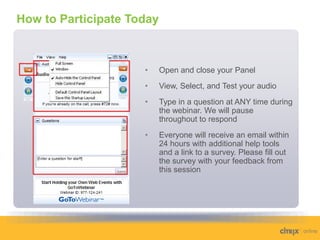
How to Participate Today

•

Open and close your Panel

•

View, Select, and Test your audio

•

Type in a question at ANY time during
the webinar. We will pause
throughout to respond

•

Everyone will receive an email within
24 hours with additional help tools
and a link to a survey. Please fill out
the survey with your feedback from
this session
Share and Engage!
Open/minimize Firefox:
We will be doing some handson live demos!
Share what you’ve learned and
created:
#Map4Change
#AssetMapping
#Wikimaps
#HealthyCity
Healthy City is a program of
Advancement Project is a public policy change organization rooted in the
civil rights movement. We engineer large-scale systems change to remedy
inequality, expand opportunity and open paths to upward mobility. Our goal
is that members of all communities have the safety, opportunity and health
they need to thrive.
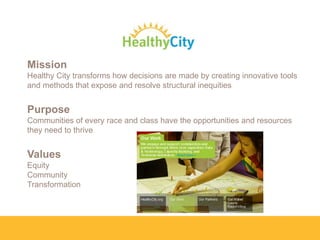
Mission
Healthy City transforms how decisions are made by creating innovative tools
and methods that expose and resolve structural inequities

Purpose
Communities of every race and class have the opportunities and resources
they need to thrive

Values
Equity
Community
Transformation
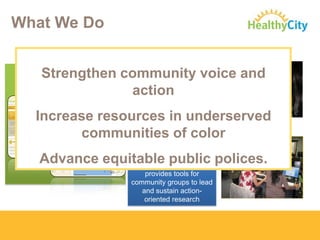
What We Do
ONLINE MAPPING
TECHNOLOGY
www.HealthyCity.org

DIRECT TECHNICAL
ASSISTANCE:

Strengthen community voice and
Work ON-THE-GROUND
action targeted
to develop
research/policy
strategies and web
tools.

Increase resources in underserved
communities of color
COMMUNITY
RESEARCH LAB

Advance equitable public polices.
Engages, trains, and
provides tools for
community groups to lead
and sustain actionoriented research
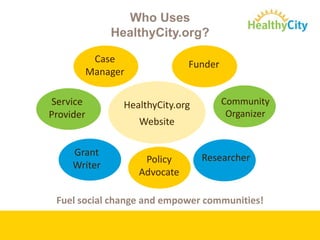
Who Uses
HealthyCity.org?
Case
Manager
Service
Provider

Grant
Writer

Funder

HealthyCity.org
Website

Policy
Advocate

Community
Organizer

Researcher

Fuel social change and empower communities!
Today you will
learn how to…
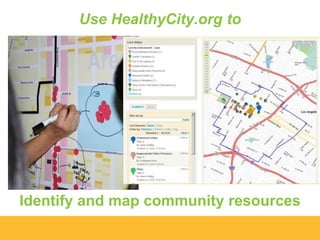
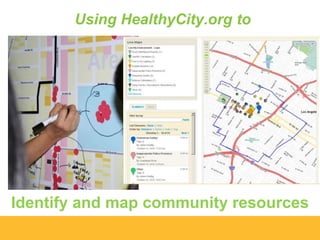
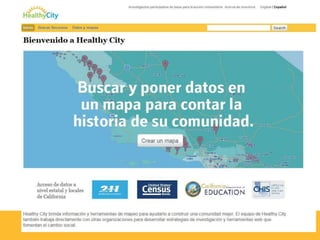
Use HealthyCity.org to

Identify and map community resources
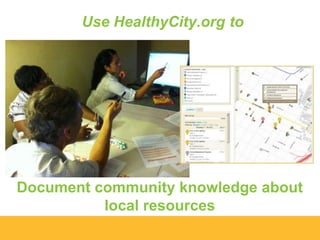
Use HealthyCity.org to

Document community knowledge about
local resources
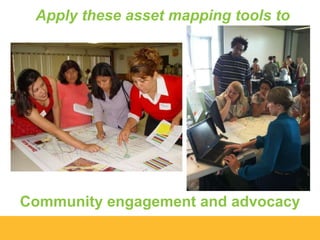
Apply these asset mapping tools to

Community engagement and advocacy
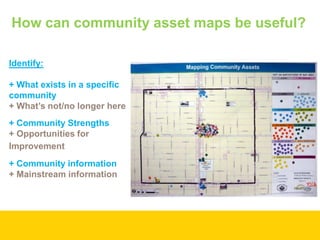
How can community asset maps be useful?
Identify:

+ What exists in a specific
community
+ What’s not/no longer here
+ Community Strengths
+ Opportunities for
Improvement
+ Community information
+ Mainstream information
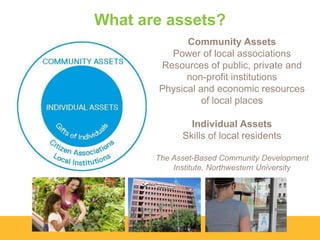
What are assets?
Community Assets
Power of local associations
Resources of public, private and
non-profit institutions
Physical and economic resources
of local places
Individual Assets
Skills of local residents
The Asset-Based Community Development
Institute, Northwestern University
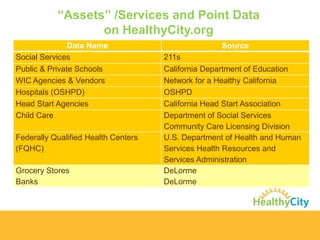
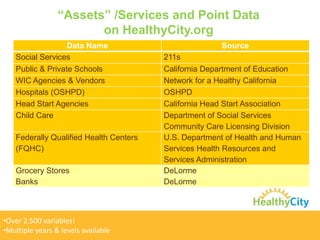
“Assets” /Services and Point Data
on HealthyCity.org
Data Name
Social Services
Public & Private Schools
WIC Agencies & Vendors
Hospitals (OSHPD)
Head Start Agencies
Child Care

Federally Qualified Health Centers
(FQHC)
Grocery Stores
Banks

Source
211s
California Department of Education
Network for a Healthy California
OSHPD
California Head Start Association
Department of Social Services
Community Care Licensing Division
U.S. Department of Health and Human
Services Health Resources and
Services Administration
DeLorme
DeLorme
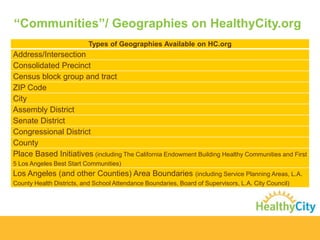
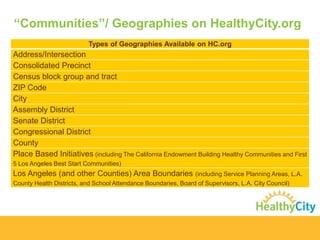
“Communities”/ Geographies on HealthyCity.org
Types of Geographies Available on HC.org

Address/Intersection
Consolidated Precinct
Census block group and tract
ZIP Code
City
Assembly District
Senate District
Congressional District
County
Place Based Initiatives (including The California Endowment Building Healthy Communities and First
5 Los Angeles Best Start Communities)

Los Angeles (and other Counties) Area Boundaries (including Service Planning Areas, L.A.
County Health Districts, and School Attendance Boundaries, Board of Supervisors, L.A. City Council)
Using HealthyCity.org to

Identify and map community resources
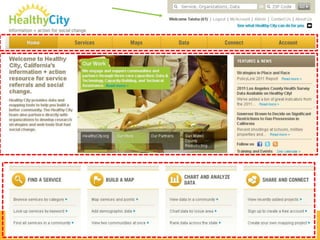
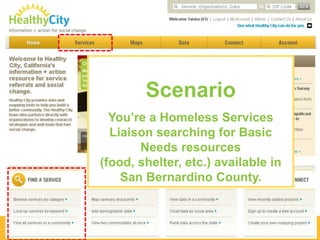
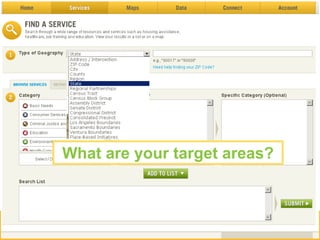
Scenario
You’re a Homeless Services
Liaison searching for Basic
Needs resources
(food, shelter, etc.) available in
San Bernardino County.
What are your target areas?
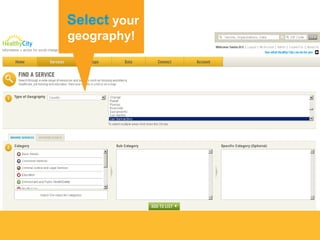
Select your
geography!
“Communities”/ Geographies on HealthyCity.org
Types of Geographies Available on HC.org

Address/Intersection
Consolidated Precinct
Census block group and tract
ZIP Code
City
Assembly District
Senate District
Congressional District
County
Place Based Initiatives (including The California Endowment Building Healthy Communities and First
5 Los Angeles Best Start Communities)

Los Angeles (and other Counties) Area Boundaries (including Service Planning Areas, L.A.
County Health Districts, and School Attendance Boundaries, Board of Supervisors, L.A. City Council)
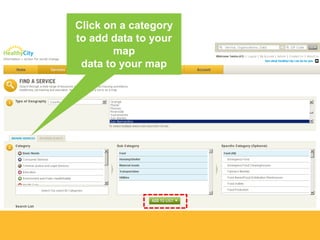
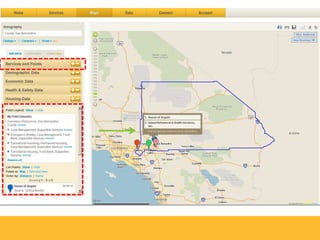
Click on a category
to add data to your
map
data to your map
“Assets” /Services and Point Data
on HealthyCity.org
Data Name
Social Services
Public & Private Schools
WIC Agencies & Vendors
Hospitals (OSHPD)
Head Start Agencies
Child Care

Federally Qualified Health Centers
(FQHC)
Grocery Stores
Banks

•Over 2,500 variables!
•Multiple years & levels available

Source
211s
California Department of Education
Network for a Healthy California
OSHPD
California Head Start Association
Department of Social Services
Community Care Licensing Division
U.S. Department of Health and Human
Services Health Resources and
Services Administration
DeLorme
DeLorme
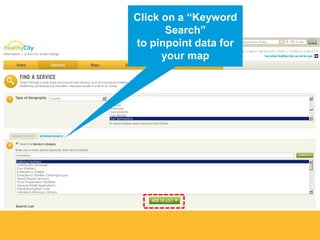
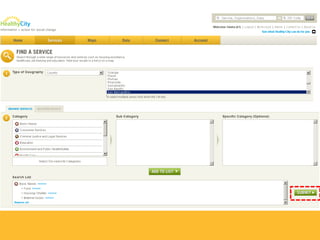
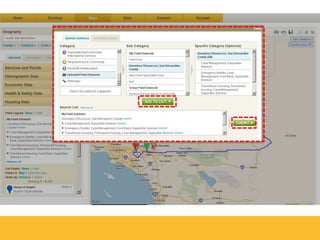
Click on a “Keyword
Search”
to pinpoint data for
your map
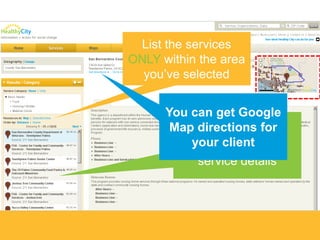
List the services
ONLY within the area
you’ve selected
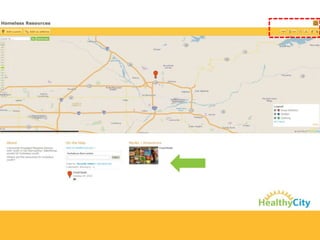
You can get Google
MapBrowse through
directions for
your client
listings to look at
service details
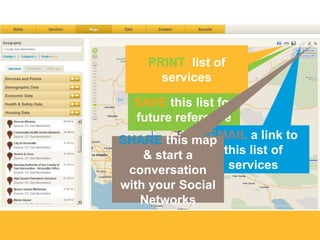
PRINT list of
services
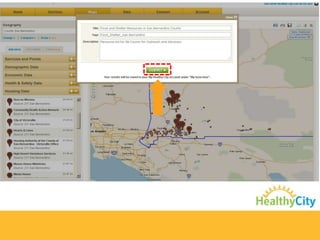
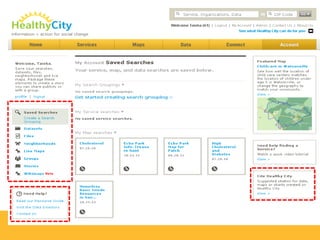
SAVE this list for
future reference
EMAIL a link to
SHARE this map
this list of
& start a
services
conversation
with your Social
Networks
Questions?
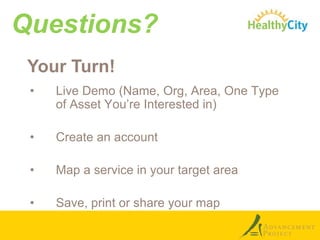
Your Turn!
•

Live Demo (Name, Org, Area, One Type
of Asset You’re Interested in)

•

Create an account

•

Map a service in your target area

•

Save, print or share your map
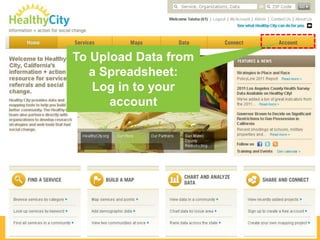
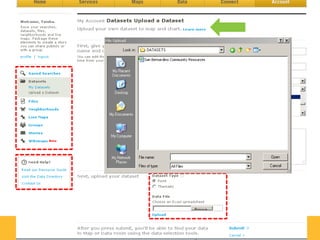
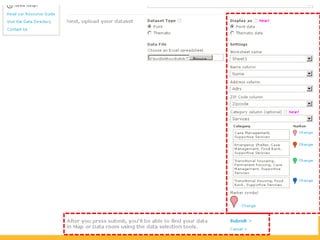
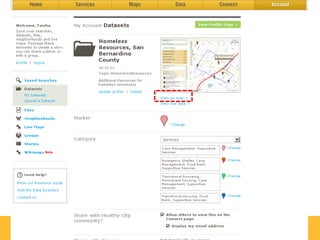
To Upload Data from
a Spreadsheet:
Log in to your
account
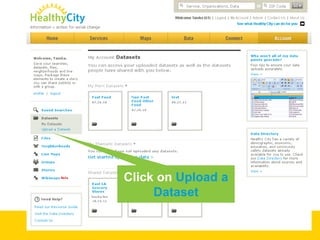
Click on Upload a
Dataset
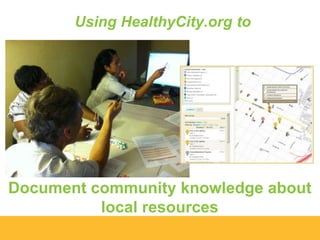
Using HealthyCity.org to

Document community knowledge about
local resources
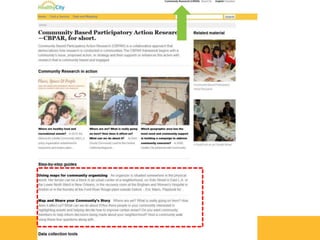
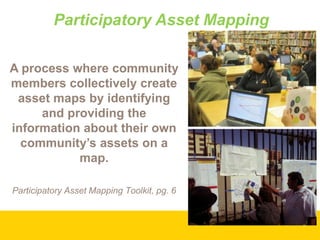
Participatory Asset Mapping
A process where community
members collectively create
asset maps by identifying
and providing the
information about their own
community’s assets on a
map.
Participatory Asset Mapping Toolkit, pg. 6
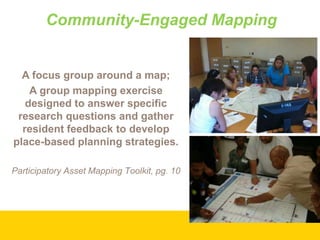
Community-Engaged Mapping

A focus group around a map;
A group mapping exercise
designed to answer specific
research questions and gather
resident feedback to develop
place-based planning strategies.
Participatory Asset Mapping Toolkit, pg. 10
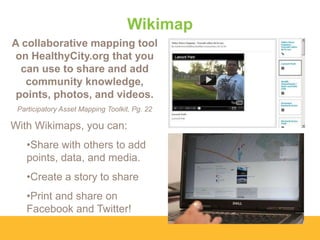
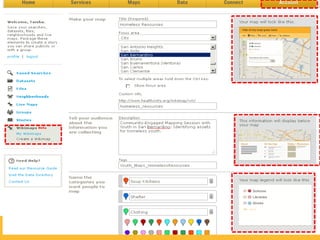
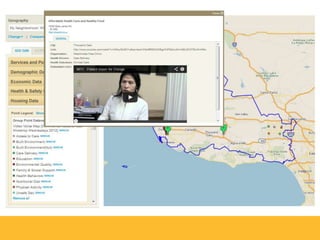
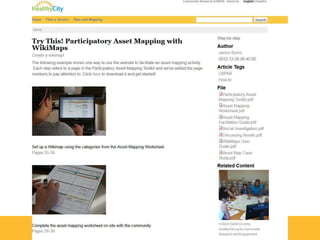
Wikimap
A collaborative mapping tool
on HealthyCity.org that you
can use to share and add
community knowledge,
points, photos, and videos.
Participatory Asset Mapping Toolkit, Pg. 22

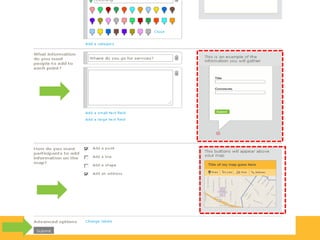
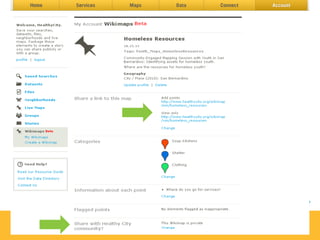
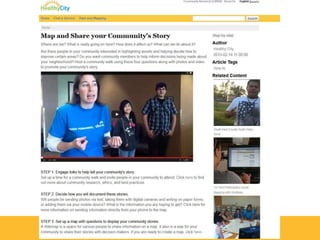
With Wikimaps, you can:

•Share with others to add
points, data, and media.
•Create a story to share

•Print and share on
Facebook and Twitter!
Questions?
Your Turn!
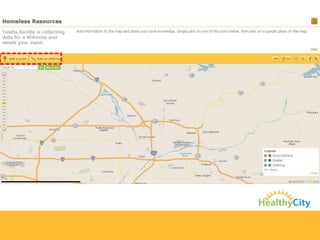
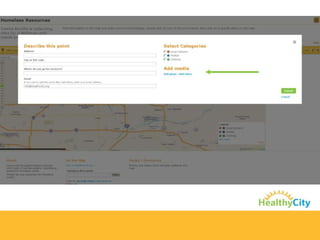
Do you know of a resource
in this community that we
could add to the map?
Type it in the chat box and
we will add it to the map!
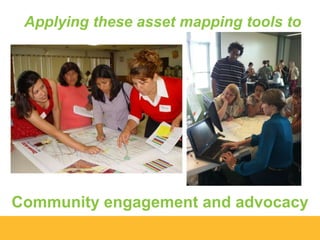
Applying these asset mapping tools to

Community engagement and advocacy
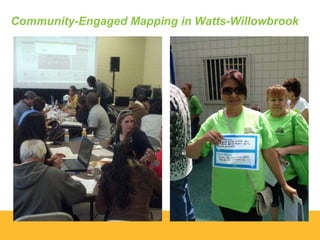
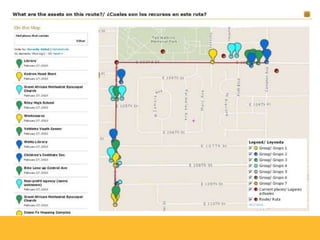
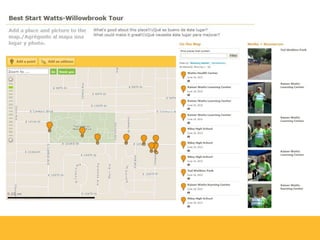
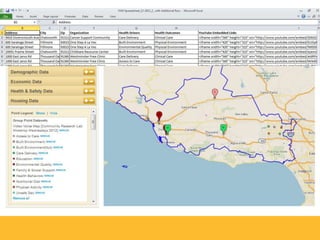
Community-Engaged Mapping in Watts-Willowbrook
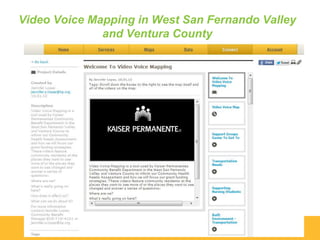
Video Voice Mapping in West San Fernando Valley
and Ventura County
Additional Tools
&

Resources!
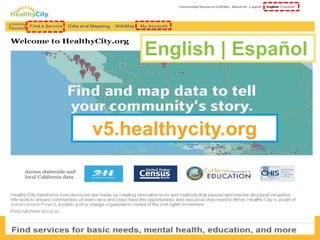
English | Español

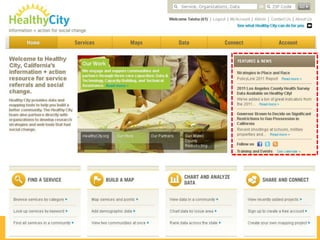
v5.healthycity.org
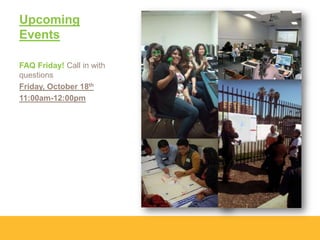
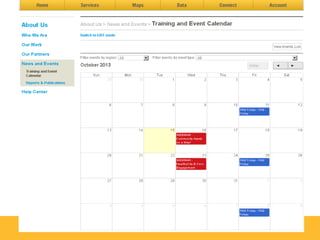
Upcoming
Events
FAQ Friday! Call in with
questions
Friday, October 18th
11:00am-12:00pm
THANK YOU!!!

Thank You!
Your feedback is very
important to us!
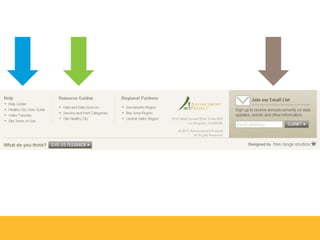
We will be following up
with you in 24 hours with
an email and a survey!

Community assetsonamapwebinar finaltb

  • 1.
    Community Assets ona Map Using HealthyCity.org to Map Assets in Your Community Wednesday, October 16th 10:00am-11:30am Presenters Janice C. Miller Manager, Community Research Lab jburns@advanceproj.org Taisha Bonilla Training and Communications Coordinator www.Healthycity.org Facebook.com/HealthyCityCA @HealthyCityCA info@healthycity.org tbonilla@advanceproj.org Reginald Johnson Community Partnership Leader, First 5 LA Best Start Watts-Willowbrook rhjohnson@gmail.com www.AdvancementProjectCA.org Facebook.com/AdvancementProjectCA info@advanceproj.org
  • 2.
    How to ParticipateToday • Open and close your Panel • View, Select, and Test your audio • Type in a question at ANY time during the webinar. We will pause throughout to respond • Everyone will receive an email within 24 hours with additional help tools and a link to a survey. Please fill out the survey with your feedback from this session
  • 3.
    Share and Engage! Open/minimizeFirefox: We will be doing some handson live demos! Share what you’ve learned and created: #Map4Change #AssetMapping #Wikimaps #HealthyCity
  • 4.
    Healthy City isa program of Advancement Project is a public policy change organization rooted in the civil rights movement. We engineer large-scale systems change to remedy inequality, expand opportunity and open paths to upward mobility. Our goal is that members of all communities have the safety, opportunity and health they need to thrive.
  • 5.
    Mission Healthy City transformshow decisions are made by creating innovative tools and methods that expose and resolve structural inequities Purpose Communities of every race and class have the opportunities and resources they need to thrive Values Equity Community Transformation
  • 6.
    What We Do ONLINEMAPPING TECHNOLOGY www.HealthyCity.org DIRECT TECHNICAL ASSISTANCE: Strengthen community voice and Work ON-THE-GROUND action targeted to develop research/policy strategies and web tools. Increase resources in underserved communities of color COMMUNITY RESEARCH LAB Advance equitable public polices. Engages, trains, and provides tools for community groups to lead and sustain actionoriented research
  • 7.
  • 8.
  • 9.
    Use HealthyCity.org to Identifyand map community resources
  • 10.
    Use HealthyCity.org to Documentcommunity knowledge about local resources
  • 11.
    Apply these assetmapping tools to Community engagement and advocacy
  • 12.
    How can communityasset maps be useful? Identify: + What exists in a specific community + What’s not/no longer here + Community Strengths + Opportunities for Improvement + Community information + Mainstream information
  • 13.
    What are assets? CommunityAssets Power of local associations Resources of public, private and non-profit institutions Physical and economic resources of local places Individual Assets Skills of local residents The Asset-Based Community Development Institute, Northwestern University
  • 14.
    “Assets” /Services andPoint Data on HealthyCity.org Data Name Social Services Public & Private Schools WIC Agencies & Vendors Hospitals (OSHPD) Head Start Agencies Child Care Federally Qualified Health Centers (FQHC) Grocery Stores Banks Source 211s California Department of Education Network for a Healthy California OSHPD California Head Start Association Department of Social Services Community Care Licensing Division U.S. Department of Health and Human Services Health Resources and Services Administration DeLorme DeLorme
  • 15.
    “Communities”/ Geographies onHealthyCity.org Types of Geographies Available on HC.org Address/Intersection Consolidated Precinct Census block group and tract ZIP Code City Assembly District Senate District Congressional District County Place Based Initiatives (including The California Endowment Building Healthy Communities and First 5 Los Angeles Best Start Communities) Los Angeles (and other Counties) Area Boundaries (including Service Planning Areas, L.A. County Health Districts, and School Attendance Boundaries, Board of Supervisors, L.A. City Council)
  • 17.
    Using HealthyCity.org to Identifyand map community resources
  • 18.
    Scenario You’re a HomelessServices Liaison searching for Basic Needs resources (food, shelter, etc.) available in San Bernardino County.
  • 19.
    What are yourtarget areas?
  • 20.
  • 21.
    “Communities”/ Geographies onHealthyCity.org Types of Geographies Available on HC.org Address/Intersection Consolidated Precinct Census block group and tract ZIP Code City Assembly District Senate District Congressional District County Place Based Initiatives (including The California Endowment Building Healthy Communities and First 5 Los Angeles Best Start Communities) Los Angeles (and other Counties) Area Boundaries (including Service Planning Areas, L.A. County Health Districts, and School Attendance Boundaries, Board of Supervisors, L.A. City Council)
  • 22.
    Click on acategory to add data to your map data to your map
  • 23.
    “Assets” /Services andPoint Data on HealthyCity.org Data Name Social Services Public & Private Schools WIC Agencies & Vendors Hospitals (OSHPD) Head Start Agencies Child Care Federally Qualified Health Centers (FQHC) Grocery Stores Banks •Over 2,500 variables! •Multiple years & levels available Source 211s California Department of Education Network for a Healthy California OSHPD California Head Start Association Department of Social Services Community Care Licensing Division U.S. Department of Health and Human Services Health Resources and Services Administration DeLorme DeLorme
  • 24.
    Click on a“Keyword Search” to pinpoint data for your map
  • 26.
    List the services ONLYwithin the area you’ve selected You can get Google MapBrowse through directions for your client listings to look at service details
  • 27.
    PRINT list of services SAVEthis list for future reference EMAIL a link to SHARE this map this list of & start a services conversation with your Social Networks
  • 30.
    Questions? Your Turn! • Live Demo(Name, Org, Area, One Type of Asset You’re Interested in) • Create an account • Map a service in your target area • Save, print or share your map
  • 31.
    To Upload Datafrom a Spreadsheet: Log in to your account
  • 32.
    Click on Uploada Dataset
  • 38.
    Using HealthyCity.org to Documentcommunity knowledge about local resources
  • 39.
    Participatory Asset Mapping Aprocess where community members collectively create asset maps by identifying and providing the information about their own community’s assets on a map. Participatory Asset Mapping Toolkit, pg. 6
  • 40.
    Community-Engaged Mapping A focusgroup around a map; A group mapping exercise designed to answer specific research questions and gather resident feedback to develop place-based planning strategies. Participatory Asset Mapping Toolkit, pg. 10
  • 41.
    Wikimap A collaborative mappingtool on HealthyCity.org that you can use to share and add community knowledge, points, photos, and videos. Participatory Asset Mapping Toolkit, Pg. 22 With Wikimaps, you can: •Share with others to add points, data, and media. •Create a story to share •Print and share on Facebook and Twitter!
  • 48.
    Questions? Your Turn! Do youknow of a resource in this community that we could add to the map? Type it in the chat box and we will add it to the map!
  • 49.
    Applying these assetmapping tools to Community engagement and advocacy
  • 50.
  • 53.
    Video Voice Mappingin West San Fernando Valley and Ventura County
  • 57.
  • 58.
  • 63.
    Upcoming Events FAQ Friday! Callin with questions Friday, October 18th 11:00am-12:00pm
  • 67.
    THANK YOU!!! Thank You! Yourfeedback is very important to us! We will be following up with you in 24 hours with an email and a survey!

Editor's Notes

  • #4 JONATHAN
  • #7 Can also speak to allows engagement – allows folks to get on the same page/understanding. Speak a common language.
  • #8 HC.org provides these people with data and technology to support their work within and on behalf of our communities. HC.org helps encourage data-driven planning and inform policy within sectors such as Education, Public Safety, Health, Public Health, Government, etc. Some of our funders include F5, CA Endowment…
  • #11 Community-engaged mapping is a place-based and community-based approach to research that allows community members to identify specific places of issue, concern, or strength. In the pictures above, youth first identified places where they felt unsafe, then identified the environmental design issues that they felt contribute to and permeate crime.
  • #12 Collect safety and school discipline data (including student input from CRED and hot-spot mapping) and share data with parents and a community. Build trust with parents; increase parent understanding of discipline policies; increase the positive behavioral interventions for disciplinary issues; decrease the number of suspensions/expulsions/student out-of-school time.
  • #13 Collect safety and school discipline data (including student input from CRED and hot-spot mapping) and share data with parents and a community. Build trust with parents; increase parent understanding of discipline policies; increase the positive behavioral interventions for disciplinary issues; decrease the number of suspensions/expulsions/student out-of-school time.
  • #18 1. Data such as demographic, health, education, and housing
  • #19 Community-engaged mapping is a place-based and community-based approach to research that allows community members to identify specific places of issue, concern, or strength. In the pictures above, youth first identified places where they felt unsafe, then identified the environmental design issues that they felt contribute to and permeate crime.
  • #21 1. Data such as demographic, health, education, and housing
  • #22 1. Data such as demographic, health, education, and housing
  • #24 1. Data such as demographic, health, education, and housing
  • #26 1. Data such as demographic, health, education, and housing
  • #27 1. Data such as demographic, health, education, and housing
  • #28 1. Data such as demographic, health, education, and housing
  • #29 1. Data such as demographic, health, education, and housing
  • #30 1. Data such as demographic, health, education, and housing
  • #31 1. Data such as demographic, health, education, and housing
  • #32 JONATHAN
  • #40 Collect safety and school discipline data (including student input from CRED and hot-spot mapping) and share data with parents and a community. Build trust with parents; increase parent understanding of discipline policies; increase the positive behavioral interventions for disciplinary issues; decrease the number of suspensions/expulsions/student out-of-school time.
  • #46 1. Data such as demographic, health, education, and housing
  • #47 1. Data such as demographic, health, education, and housing
  • #48 1. Data such as demographic, health, education, and housing
  • #49 1. Data such as demographic, health, education, and housing
  • #51 TAISHA
  • #52 Collect safety and school discipline data (including student input from CRED and hot-spot mapping) and share data with parents and a community. Build trust with parents; increase parent understanding of discipline policies; increase the positive behavioral interventions for disciplinary issues; decrease the number of suspensions/expulsions/student out-of-school time.
  • #53 1. Data such as demographic, health, education, and housing
  • #54 AgendaOverview, Purpose of the Exercise, What is an asset?Small group breakoutIdentify assets and add them to the map in small groups – What are the resources for families with children 0-5 in this area?Prioritize three assets identified on the map – Which places were identified most?
  • #55 Collect safety and school discipline data (including student input from CRED and hot-spot mapping) and share data with parents and a community. Build trust with parents; increase parent understanding of discipline policies; increase the positive behavioral interventions for disciplinary issues; decrease the number of suspensions/expulsions/student out-of-school time.
  • #60 1. Data such as demographic, health, education, and housing
  • #61 TAISHA
  • #62 TAISHA1. Data such as demographic, health, education, and housing