
Investigating the Immigrant Health 
Paradox in California 
Wednesday, September 10th 
www.Healthycity.org 
Facebook.com/HealthyCityCA 
@HealthyCityCA 
info@healthycity.org 
www.AdvancementProjectCA.org 
Facebook.com/AdvancementProjectCA 
info@advanceproj.org 
11:00am – 12:00pm 
Taisha Bonilla 
Training & Communications Coordinator 
tbonilla@advanceproj.org 
Jose Cuchilla 
Healthy City Data Analyst 
jcuchilla@advanceproj.org
Healthy City is a program of 
Championing the struggle for greater equity and opportunity for all, 
Advancement Project California fosters upward mobility in communities 
most impacted by economic and racial injustice. 
We build alliances and trust, use data-driven policy solutions, create 
innovative tools and work alongside communities. 
We ignite social transformation! 
Integrity * Innovation * Capacity-Building * Collaboration * Audacity * Equity *
What We Do 
DIRECT TECHNICAL 
ASSISTANCE: 
Work ON-THE-GROUND 
to develop targeted 
research/policy 
strategies and web 
tools. 
COMMUNITY 
RESEARCH LAB 
Engages, trains, and 
provides tools for 
community groups to lead 
and sustain action-oriented 
research 
ONLINE MAPPING 
TECHNOLOGY 
www.HealthyCity.org
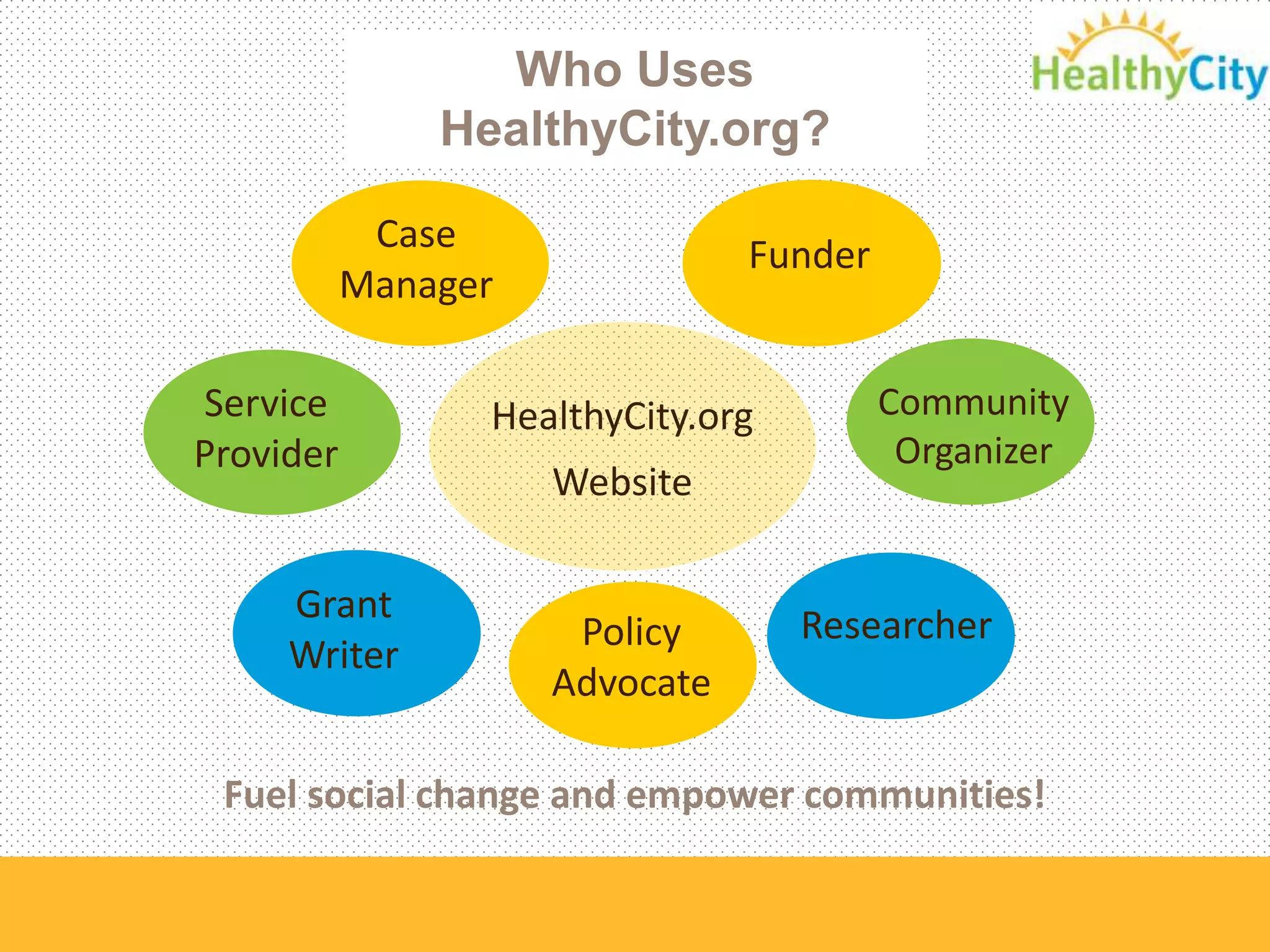
HealthyCity.org? 
Case 
Manager 
Who Uses 
Funder 
HealthyCity.org 
Website 
Service 
Provider 
Policy 
Advocate 
Community 
Organizer 
Researcher 
Grant 
Writer 
Fuel social change and empower communities!
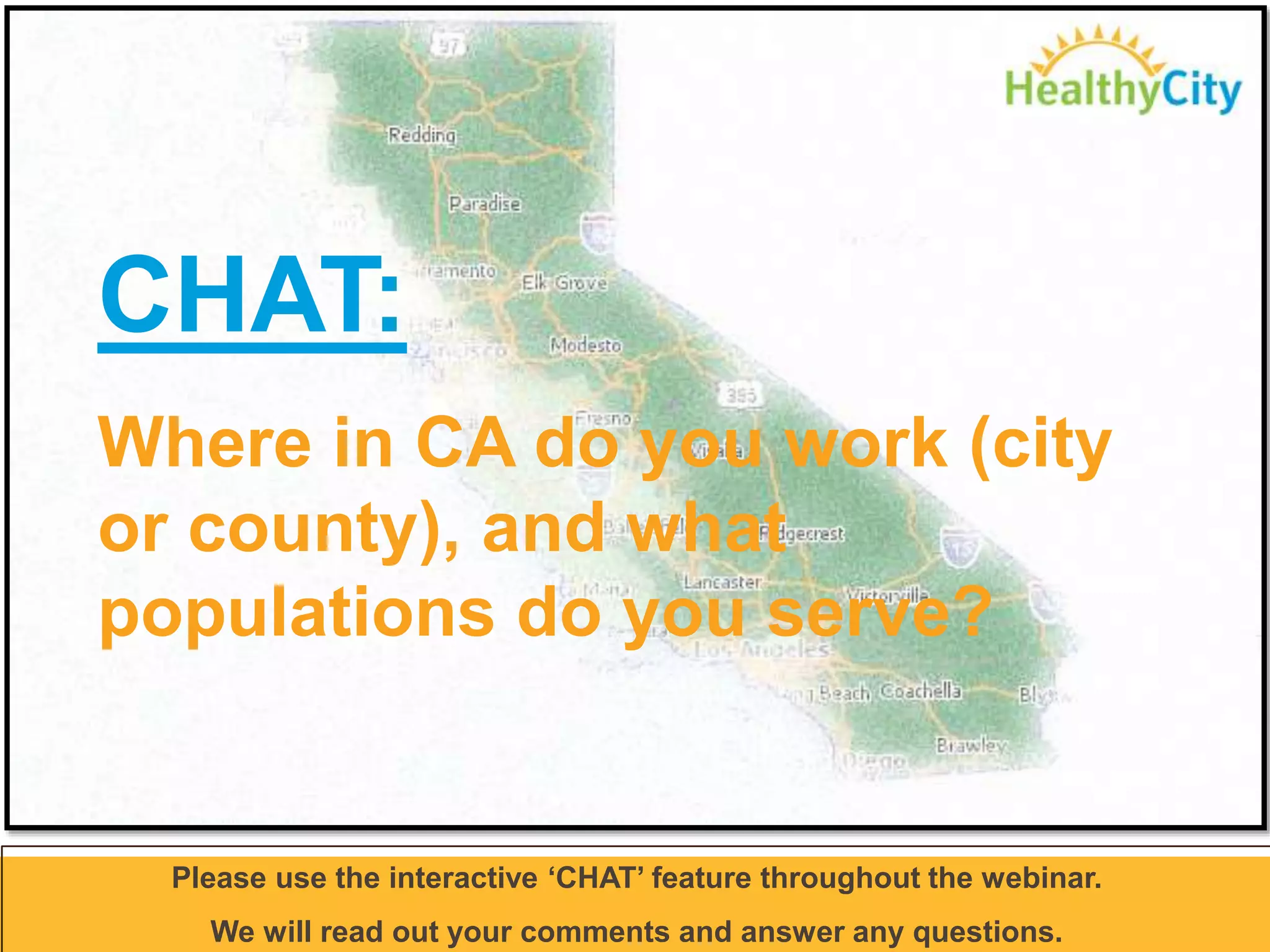
CHAT: 
Where in CA do you work (city 
or county), and what 
populations do you serve? 
Please use the interactive ‘CHAT’ feature throughout the webinar. 
We will read out your comments and answer any questions.
Webinar Agenda: 
• Learn about the Immigrant Health Paradox 
• Examine diabetes hospitalization rates among US and 
Foreign-Born Hispanics/Latin@s 
• Using the Social Determinants of Health framework, we 
will explore potential contributing factors 
• Live demonstration of how to access and map related 
data on other communities of interest on 
HealthyCity.org
Exploring the Association between 
Acculturation and Diabetes among 
US/foreign-born Hispanics 
-Jose Cuchilla, Healthy City Data Analyst- 
 Jose Cuchilla1 
 Micere Keels, PhD2 
 1 California State Polytechnic University 
of Pomona 
 2 The University of Chicago, Department 
of Comparative Human Development
Social Determinants of Health 
“The economic and social conditions that influence individuals and group differences in health status.” 
– The World Health Organization 
http://www.baltimorehia.org/social-determinants-of-health.html
The Immigrant Health Paradox 
Despite lower levels of education and income, 
immigrants are generally healthier than the US-born 
population 
Lower mortality (Jasso et al., 2002; Muennig and Fahs, 2002) 
Lower rates of obesity (Gordon-Larsen, 2003) 
Better mental health (Dey and Lucas, 2006) 
Lower rates of heart and circulatory disease (Singh and Siahpush, 2001) 
However, as their length of residence increases, so does the prevalence 
of poor health behaviors and chronic conditions (Kaplan, 2004)
The Acculturation Hypothesis 
Acculturation 
The acquisition and integration of dominant cultural norms by 
members of a non-dominant group (Gordon-Larsen, 2003). 
Over time, immigrants integrate American behavioral norms and 
lifestyles (Gordon-Larsen, 2003). 
Immigrant dietary patterns 
More fruits and vegetables (Satia-Abouta, 2002) 
Less processed foods (Akresh, 2007) 
Americanization 
Eat less fruits & vegetable (Neuhouser, 2004) 
Eat more red meat & processed foods (Ayala, 2008) 
Less exercise (Lanza, 2005) 
Increase smoking & drinking (Detjen et al., 2007)
Research on acculturation and Type-2 diabetes 
Limited research exists on the association of length of 
residence and type 2 diabetes outcomes 
Research that does exist has two limitations… 
1) Regional sample 
2) Self-reported data to measure diabetes
A quantitative analysis of diabetes prevalence in 
Hispanics 
2001- 2010 NHANES (CDC) 
Nationally representative sample 
US/foreign-born Mexican Americans ages 20-65 
Tested for diabetes (n= 2417) 
Fasting blood glucose test 
Nativity (US-born/foreign-born) 
Acculturation (Length of time [years] in the US) 
STATA 
T-test 
Logistic Regression 
Model 1: Basic Differences 
Model 2: Control
Research Question and Hypothesis 
RQ: Does nativity and acculturation affect diabetes health outcomes 
among Hispanics? 
H1: Hispanics born in the US will be more likely to suffer from diabetes than 
foreign born Hispanics. 
H2: The longer foreign born Hispanics are in the US, the more likely they 
are to have diabetes.
Native-born Mexican Americans had a higher rate 
of diabetes 
Table 1: Descriptive Characteristics 
Variable 
Full Sample 
(n= 5416) 
Native 
(n= 2035) 
Foreign 
(n=3381) 
Diabetes (%) 10.63 12.57 9.49 
Undiagnosed Diabetes (%) 33.20 30.09 35.66 
Female (%) 52.25 56.16 49.83 
Length in US (%) 
<5 years 18.66 
5 - <15 years 32.54 
15 - <30 years 33.15 
30+ years 15.66 
Citizenship (%) 22.61 
Education (%) 
<9th grade 33.90 9.30 48.70 
9th grade - H.S. 41.26 47.72 37.41 
Some College 18.26 31.55 10.27 
College Degree 6.57 11.42 3.61 
Married (%) 60.75 53.79 64.82 
No Insurance (%) 47.62 27.25 59.85 
Significant values (t-test: p<0.05) indicated in red.
Foreign-born Mexican Americans were less likely 
to have diabetes 
Table 2: Logistic regression results for nativity 
Diabetes Model 1* Model 2** 
Variable 
Odds Ratio 
(Std. Err.) 
P-value 
Odds Ratio 
(Std. Err.) 
P-value 
All Mexican Americans 
Native born reference category 
Foreign born 0.73 0.018 0.50 <0.001 
(0.10) (0.09) 
*Model 1: Includes only nativity or length in US. 
**Model 2: Adds controls for education, poverty, marital status, smoker, insurance, age, and gender.
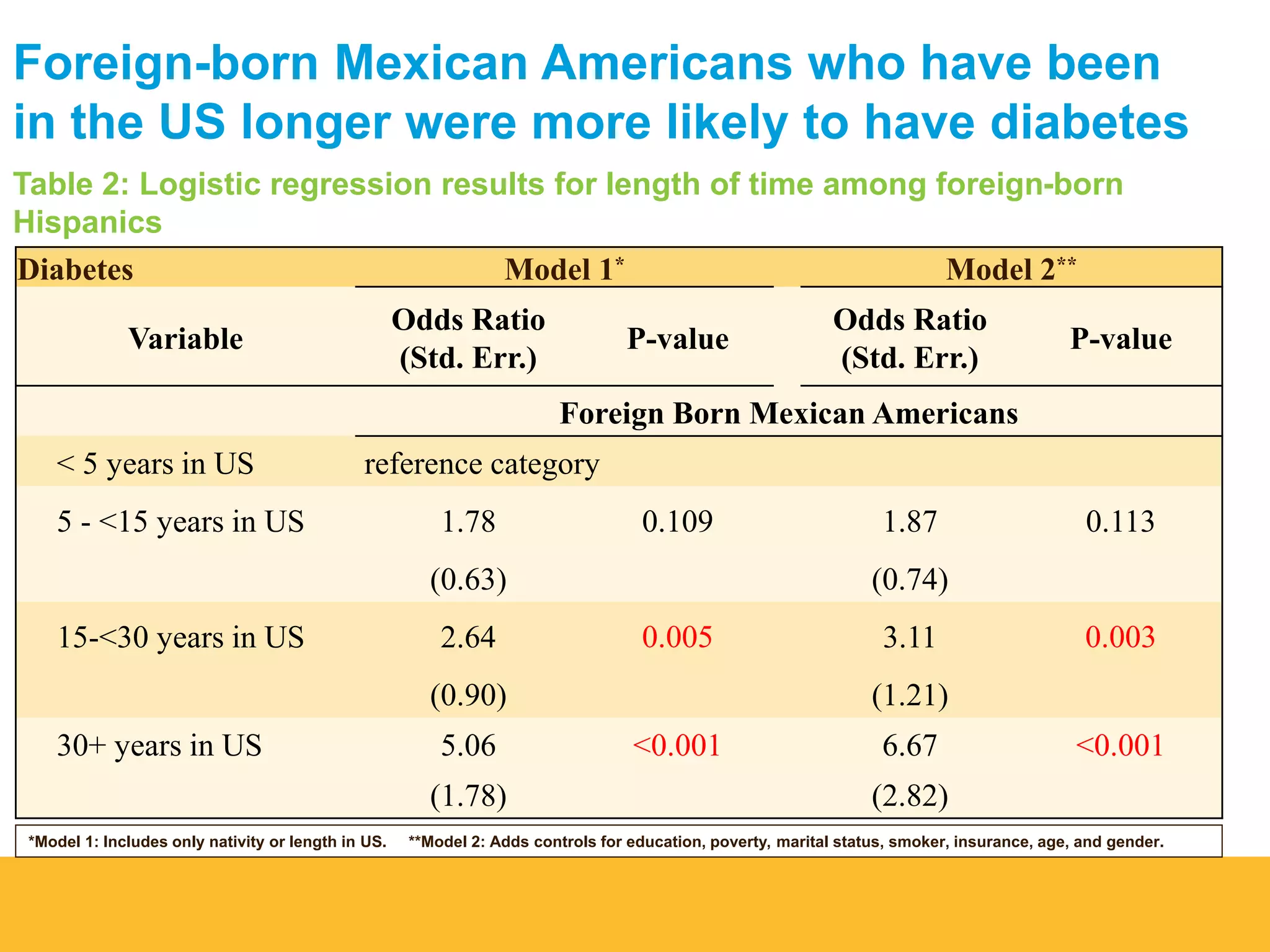
Foreign-born Mexican Americans who have been 
in the US longer were more likely to have diabetes 
Table 2: Logistic regression results for length of time among foreign-born 
Hispanics 
Diabetes Model 1* Model 2** 
Variable 
Odds Ratio 
(Std. Err.) 
P-value 
Odds Ratio 
(Std. Err.) 
P-value 
Foreign Born Mexican Americans 
< 5 years in US reference category 
5 - <15 years in US 1.78 0.109 1.87 0.113 
(0.63) (0.74) 
15-<30 years in US 2.64 0.005 3.11 0.003 
(0.90) (1.21) 
30+ years in US 5.06 <0.001 6.67 <0.001 
(1.78) (2.82) 
*Model 1: Includes only nativity or length in US. **Model 2: Adds controls for education, poverty, marital status, smoker, insurance, age, and gender.
Nativity and acculturation highlight important risk 
factors for diabetes 
Nativity & length of time in the US 
• Study supports the immigrant health paradox 
• Supports the acculturation hypothesis 
• Identifying length of residence as a risk factor is useful 
for targeting populations for diabetes prevention 
“Obesogenic” environments (Powell, 2010) 
• Low income communities (Walker, 2010) 
• Less supermarkets (Weinberg, 1995) 
• Longer distance (Rose and Richards, 2004)
Questions?
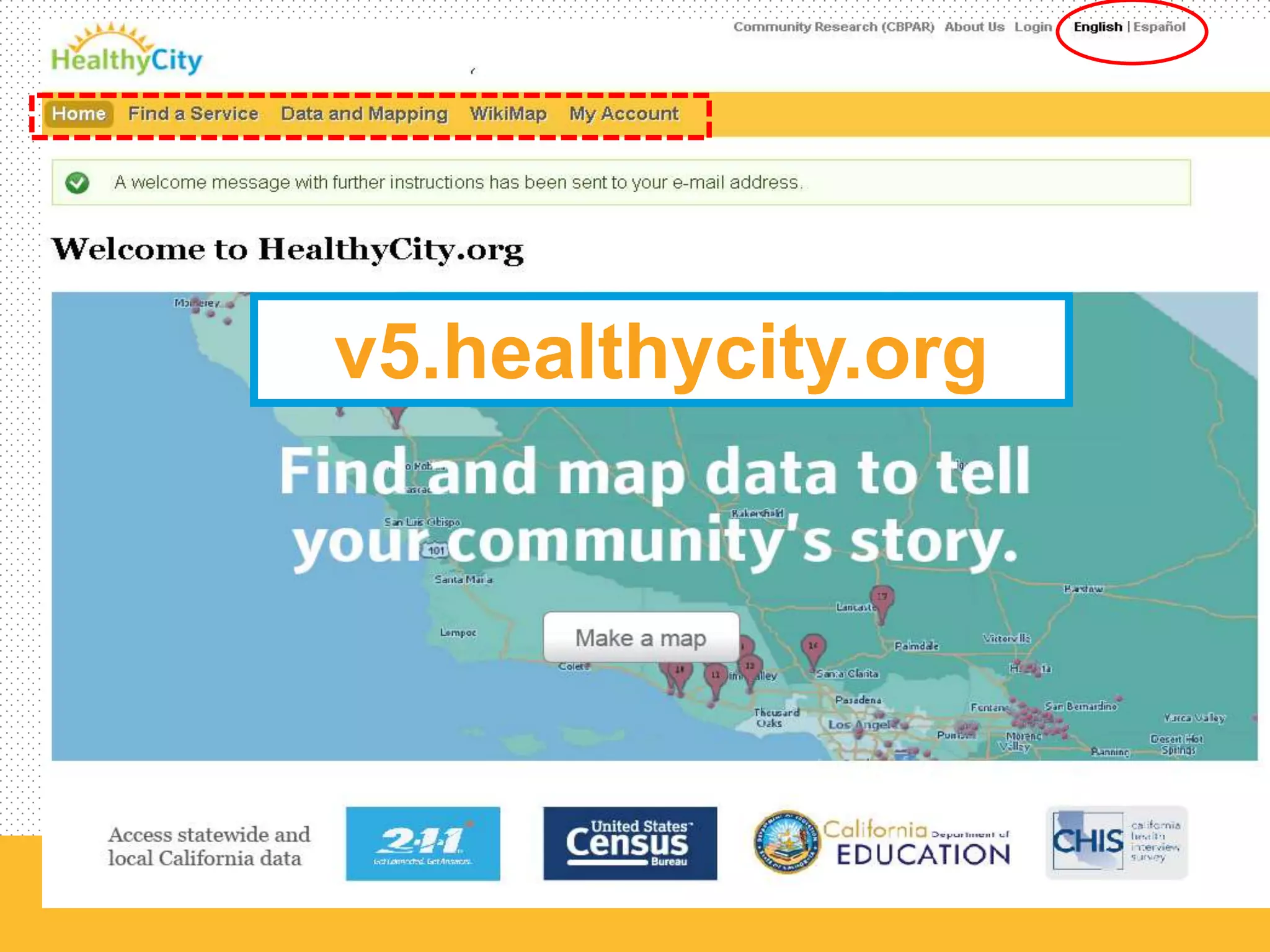
v5.healthycity.org
What is available on HealthyCity.org… 
Services Listings Interactive Mapping Data Ranking 
View Community 
Data/Stories 
Map Your Data/Media
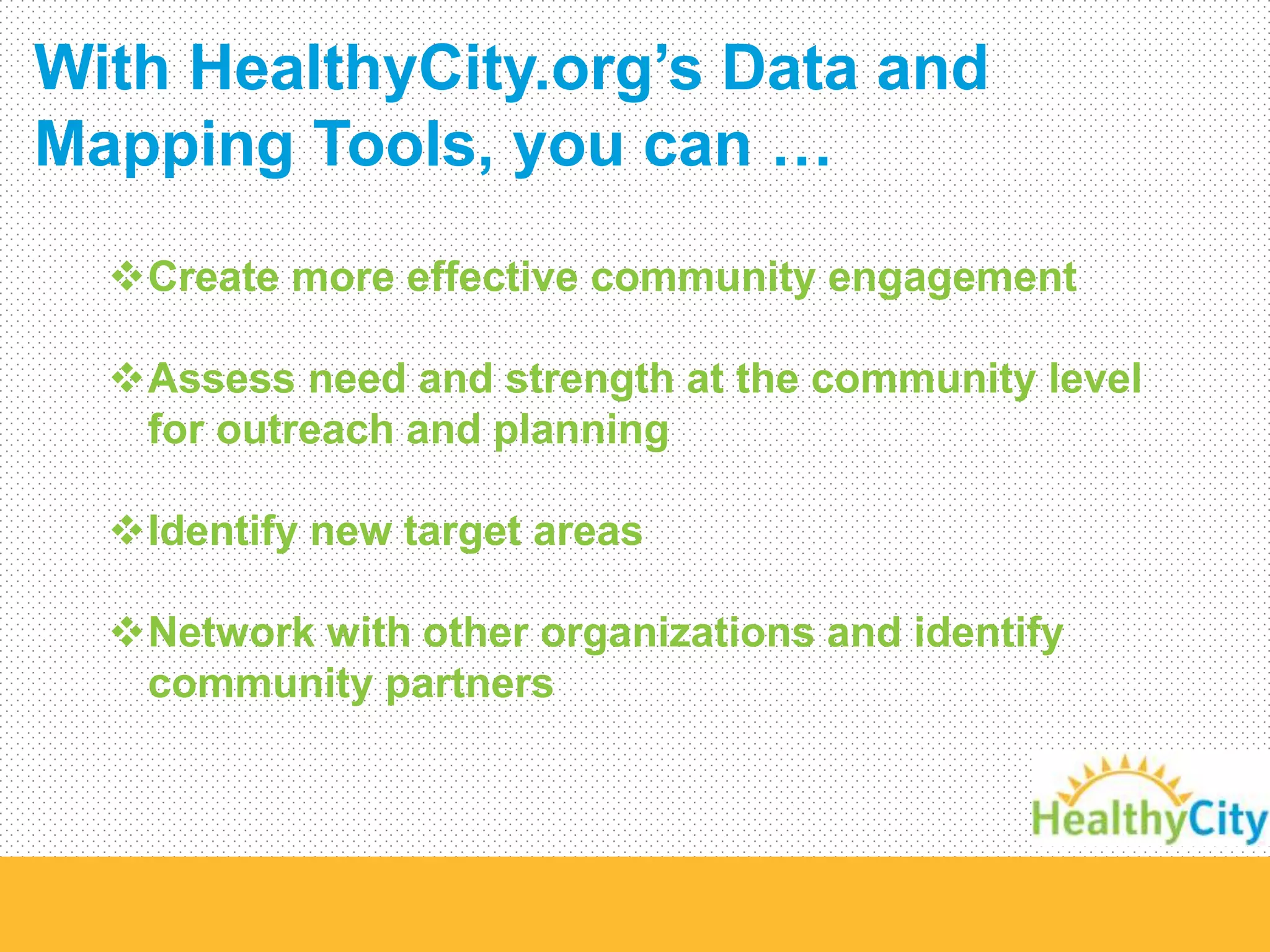
With HealthyCity.org’s Data and 
Mapping Tools, you can … 
Create more effective community engagement 
Assess need and strength at the community level 
for outreach and planning 
Identify new target areas 
Network with other organizations and identify 
community partners
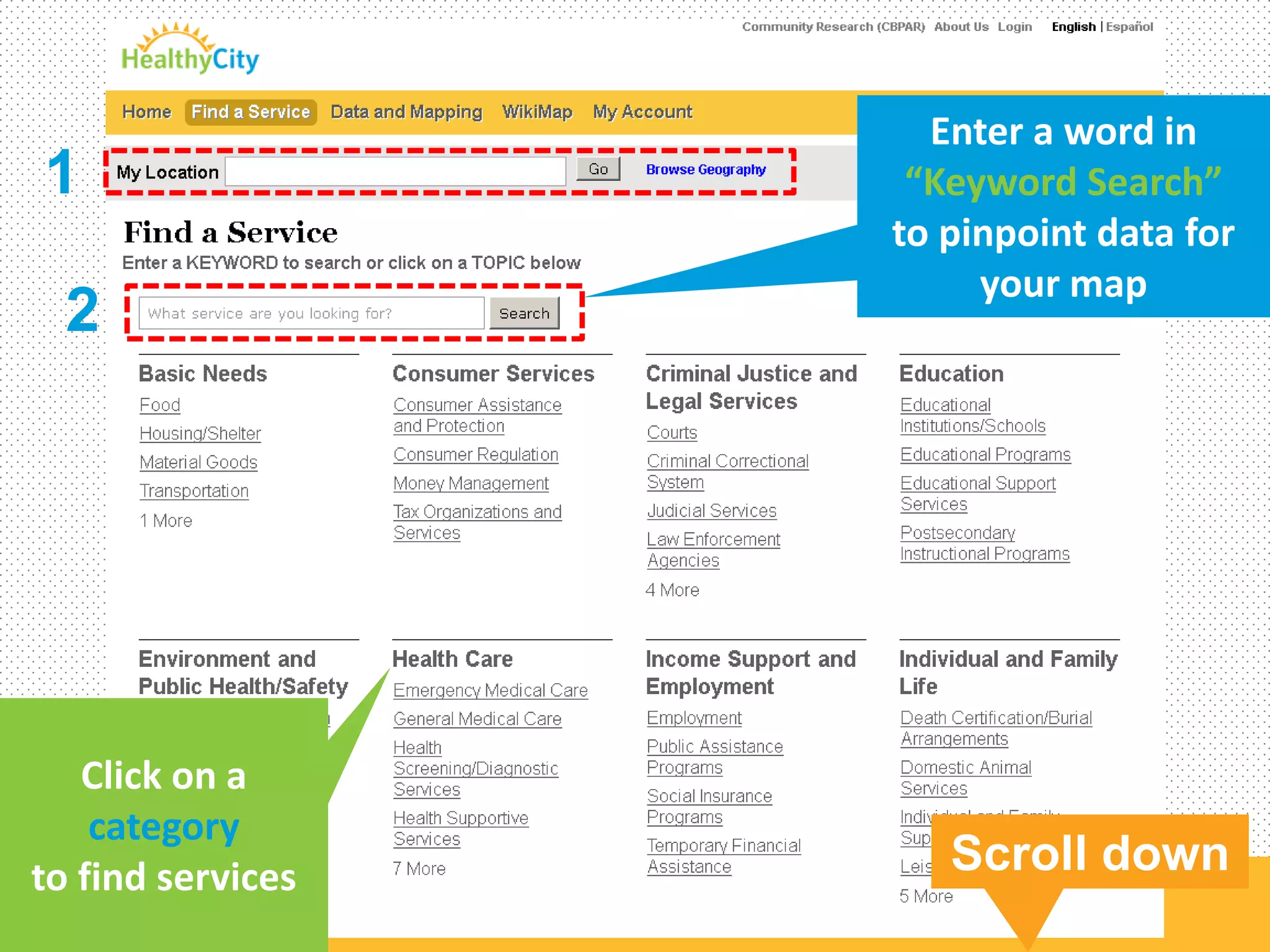
1 
2 
Enter a word in 
“Keyword Search” 
to pinpoint data for 
your map 
Click on a 
category 
to find services Scroll down
1 2 3 
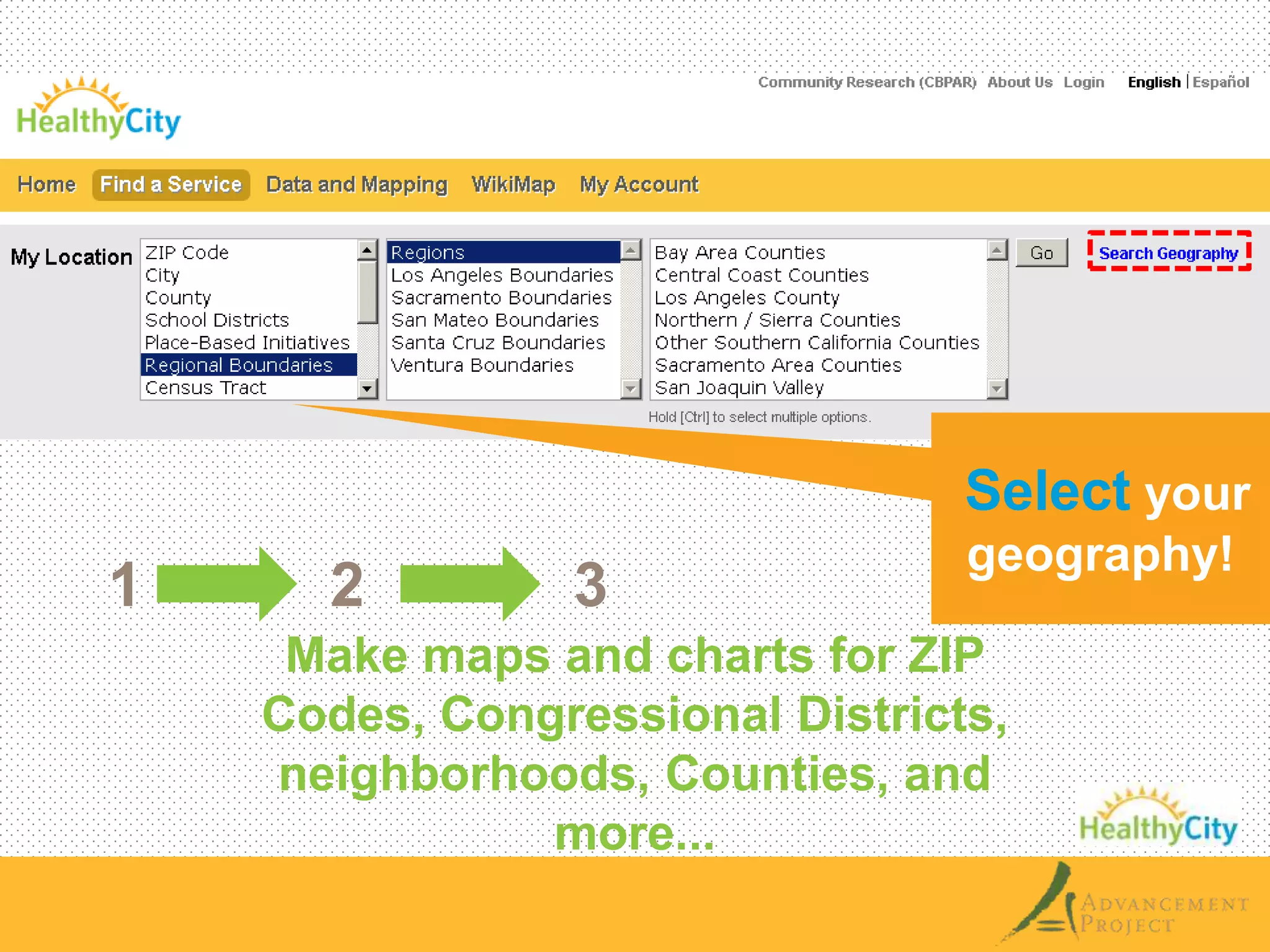
Make maps and charts for ZIP 
Codes, Congressional Districts, 
neighborhoods, Counties, and 
more... 
Select your 
geography!
Search results and 
categories 
Filter 
and 
sort 
your 
results
Name 
your 
list! 
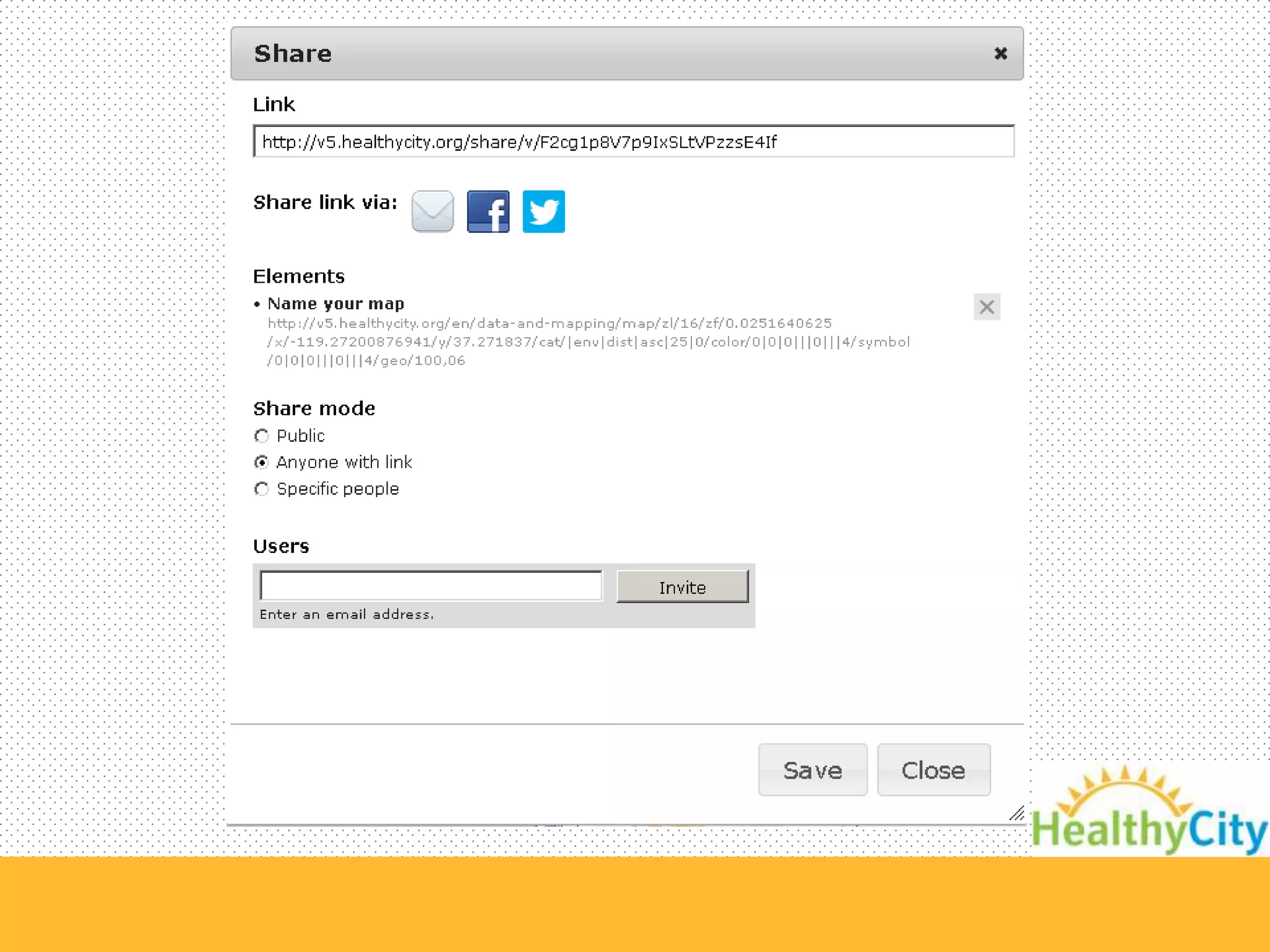
Print, 
save & 
share 
your 
list
View contact 
details with a 
direct link for 
directions!
Browse through 
listings to look at 
service details
1 
Select your 
2 geography!
1 2 3 
Make maps and charts for ZIP 
Codes, Congressional Districts, 
neighborhoods, Counties, and 
more... 
Select your 
geography!
Upload your own 
data using an Excel 
file! 
To upload data from 
a spreadsheet: 
Make sure you are 
logged into your 
account!
On to the 
website!
Questions?
Thank You! 
www.Healthycity.org 
Facebook.com/HealthyCityCA 
@HealthyCityCA 
info@healthycity.org 
www.AdvancementProjectCA.org 
Facebook.com/AdvancementProjectCA 
info@advanceproj.org 
Your feedback is very 
important to us! 
We will be following up with 
you in 24 hours with an 
email and a survey!

Immigrant Health Paradox

  • 1.
    Investigating the ImmigrantHealth Paradox in California Wednesday, September 10th www.Healthycity.org Facebook.com/HealthyCityCA @HealthyCityCA info@healthycity.org www.AdvancementProjectCA.org Facebook.com/AdvancementProjectCA info@advanceproj.org 11:00am – 12:00pm Taisha Bonilla Training & Communications Coordinator tbonilla@advanceproj.org Jose Cuchilla Healthy City Data Analyst jcuchilla@advanceproj.org
  • 2.
    Healthy City isa program of Championing the struggle for greater equity and opportunity for all, Advancement Project California fosters upward mobility in communities most impacted by economic and racial injustice. We build alliances and trust, use data-driven policy solutions, create innovative tools and work alongside communities. We ignite social transformation! Integrity * Innovation * Capacity-Building * Collaboration * Audacity * Equity *
  • 3.
    What We Do DIRECT TECHNICAL ASSISTANCE: Work ON-THE-GROUND to develop targeted research/policy strategies and web tools. COMMUNITY RESEARCH LAB Engages, trains, and provides tools for community groups to lead and sustain action-oriented research ONLINE MAPPING TECHNOLOGY www.HealthyCity.org
  • 4.
    HealthyCity.org? Case Manager Who Uses Funder HealthyCity.org Website Service Provider Policy Advocate Community Organizer Researcher Grant Writer Fuel social change and empower communities!
  • 5.
    CHAT: Where inCA do you work (city or county), and what populations do you serve? Please use the interactive ‘CHAT’ feature throughout the webinar. We will read out your comments and answer any questions.
  • 6.
    Webinar Agenda: •Learn about the Immigrant Health Paradox • Examine diabetes hospitalization rates among US and Foreign-Born Hispanics/Latin@s • Using the Social Determinants of Health framework, we will explore potential contributing factors • Live demonstration of how to access and map related data on other communities of interest on HealthyCity.org
  • 7.
    Exploring the Associationbetween Acculturation and Diabetes among US/foreign-born Hispanics -Jose Cuchilla, Healthy City Data Analyst-  Jose Cuchilla1  Micere Keels, PhD2  1 California State Polytechnic University of Pomona  2 The University of Chicago, Department of Comparative Human Development
  • 8.
    Social Determinants ofHealth “The economic and social conditions that influence individuals and group differences in health status.” – The World Health Organization http://www.baltimorehia.org/social-determinants-of-health.html
  • 9.
    The Immigrant HealthParadox Despite lower levels of education and income, immigrants are generally healthier than the US-born population Lower mortality (Jasso et al., 2002; Muennig and Fahs, 2002) Lower rates of obesity (Gordon-Larsen, 2003) Better mental health (Dey and Lucas, 2006) Lower rates of heart and circulatory disease (Singh and Siahpush, 2001) However, as their length of residence increases, so does the prevalence of poor health behaviors and chronic conditions (Kaplan, 2004)
  • 10.
    The Acculturation Hypothesis Acculturation The acquisition and integration of dominant cultural norms by members of a non-dominant group (Gordon-Larsen, 2003). Over time, immigrants integrate American behavioral norms and lifestyles (Gordon-Larsen, 2003). Immigrant dietary patterns More fruits and vegetables (Satia-Abouta, 2002) Less processed foods (Akresh, 2007) Americanization Eat less fruits & vegetable (Neuhouser, 2004) Eat more red meat & processed foods (Ayala, 2008) Less exercise (Lanza, 2005) Increase smoking & drinking (Detjen et al., 2007)
  • 11.
    Research on acculturationand Type-2 diabetes Limited research exists on the association of length of residence and type 2 diabetes outcomes Research that does exist has two limitations… 1) Regional sample 2) Self-reported data to measure diabetes
  • 12.
    A quantitative analysisof diabetes prevalence in Hispanics 2001- 2010 NHANES (CDC) Nationally representative sample US/foreign-born Mexican Americans ages 20-65 Tested for diabetes (n= 2417) Fasting blood glucose test Nativity (US-born/foreign-born) Acculturation (Length of time [years] in the US) STATA T-test Logistic Regression Model 1: Basic Differences Model 2: Control
  • 13.
    Research Question andHypothesis RQ: Does nativity and acculturation affect diabetes health outcomes among Hispanics? H1: Hispanics born in the US will be more likely to suffer from diabetes than foreign born Hispanics. H2: The longer foreign born Hispanics are in the US, the more likely they are to have diabetes.
  • 14.
    Native-born Mexican Americanshad a higher rate of diabetes Table 1: Descriptive Characteristics Variable Full Sample (n= 5416) Native (n= 2035) Foreign (n=3381) Diabetes (%) 10.63 12.57 9.49 Undiagnosed Diabetes (%) 33.20 30.09 35.66 Female (%) 52.25 56.16 49.83 Length in US (%) <5 years 18.66 5 - <15 years 32.54 15 - <30 years 33.15 30+ years 15.66 Citizenship (%) 22.61 Education (%) <9th grade 33.90 9.30 48.70 9th grade - H.S. 41.26 47.72 37.41 Some College 18.26 31.55 10.27 College Degree 6.57 11.42 3.61 Married (%) 60.75 53.79 64.82 No Insurance (%) 47.62 27.25 59.85 Significant values (t-test: p<0.05) indicated in red.
  • 15.
    Foreign-born Mexican Americanswere less likely to have diabetes Table 2: Logistic regression results for nativity Diabetes Model 1* Model 2** Variable Odds Ratio (Std. Err.) P-value Odds Ratio (Std. Err.) P-value All Mexican Americans Native born reference category Foreign born 0.73 0.018 0.50 <0.001 (0.10) (0.09) *Model 1: Includes only nativity or length in US. **Model 2: Adds controls for education, poverty, marital status, smoker, insurance, age, and gender.
  • 16.
    Foreign-born Mexican Americanswho have been in the US longer were more likely to have diabetes Table 2: Logistic regression results for length of time among foreign-born Hispanics Diabetes Model 1* Model 2** Variable Odds Ratio (Std. Err.) P-value Odds Ratio (Std. Err.) P-value Foreign Born Mexican Americans < 5 years in US reference category 5 - <15 years in US 1.78 0.109 1.87 0.113 (0.63) (0.74) 15-<30 years in US 2.64 0.005 3.11 0.003 (0.90) (1.21) 30+ years in US 5.06 <0.001 6.67 <0.001 (1.78) (2.82) *Model 1: Includes only nativity or length in US. **Model 2: Adds controls for education, poverty, marital status, smoker, insurance, age, and gender.
  • 17.
    Nativity and acculturationhighlight important risk factors for diabetes Nativity & length of time in the US • Study supports the immigrant health paradox • Supports the acculturation hypothesis • Identifying length of residence as a risk factor is useful for targeting populations for diabetes prevention “Obesogenic” environments (Powell, 2010) • Low income communities (Walker, 2010) • Less supermarkets (Weinberg, 1995) • Longer distance (Rose and Richards, 2004)
  • 18.
  • 20.
  • 22.
    What is availableon HealthyCity.org… Services Listings Interactive Mapping Data Ranking View Community Data/Stories Map Your Data/Media
  • 23.
    With HealthyCity.org’s Dataand Mapping Tools, you can … Create more effective community engagement Assess need and strength at the community level for outreach and planning Identify new target areas Network with other organizations and identify community partners
  • 24.
    1 2 Entera word in “Keyword Search” to pinpoint data for your map Click on a category to find services Scroll down
  • 25.
    1 2 3 Make maps and charts for ZIP Codes, Congressional Districts, neighborhoods, Counties, and more... Select your geography!
  • 26.
    Search results and categories Filter and sort your results
  • 27.
    Name your list! Print, save & share your list
  • 28.
    View contact detailswith a direct link for directions!
  • 29.
    Browse through listingsto look at service details
  • 30.
    1 Select your 2 geography!
  • 31.
    1 2 3 Make maps and charts for ZIP Codes, Congressional Districts, neighborhoods, Counties, and more... Select your geography!
  • 33.
    Upload your own data using an Excel file! To upload data from a spreadsheet: Make sure you are logged into your account!
  • 36.
    On to the website!
  • 37.
  • 39.
    Thank You! www.Healthycity.org Facebook.com/HealthyCityCA @HealthyCityCA info@healthycity.org www.AdvancementProjectCA.org Facebook.com/AdvancementProjectCA info@advanceproj.org Your feedback is very important to us! We will be following up with you in 24 hours with an email and a survey!