
Links & Keyword Analysis

For Websites, Social Media Communities & SEO
       Jake Aull, GSU Social Media Marketing Course

                   September 2011
Topics of this Presentation


 •  The Digital & Keyword Research Process

 •  What to Analyze, & What Tools to Use

 •  Applying the Digital Marketing Funnel
    & the Web Visitor Clickstream Journy
The Research Process
Keyword Optimization – Process Inputs


 •  Content/Inputs:
   –  Brand measurement assessment
      •  what’s easy to measure?

   –  SEO goals discovery

   –  Content/keyword analysis of site

   –  Keyword research, analysis and comparison
Keyword Optimization – Initial Research Reports


 •  Reports/Outputs:
   –  Competitor ranking report
      •  Backlinks

   –  Keyword effectiveness index/ranking reports

   –  Head and long-tail keyword weighting for optimal
      keywords/phrases

   –  KPIs and measurement plan
What to Analyze, & Tools to Use
Link Building


 •  Link Building & Inbound Links can include:
    –    Press release/white paper placement
    –    Social bookmarking (Del.icio.us)
    –    Submission to share sites (e.g., Digg, Technorati)
    –    Search engine local directories/site submissions (e.g.,
         Yahoo! Local, InsiderPages, Yelp, etc.)

 •  Tools:
    –  Pro SEO tools utilized: Google AdWords keyword tool,
       SEO Book Tools, iSpionage.com
    –  .xls report downloads, aggregated spreadsheets
Website Analytics

 •  Search Results:
    –  Search engines (Google, Bing, Yahoo!)
    –  Additional search engine tools (e.g., Google Webmaster tools,
       Google Analytics)

 •  Analytics:
    –    KPI plan integration
    –    Keyword monitoring set-up (e.g., Google Alerts, SocialMention)
    –    Google analytics set-up
    –    Website auto reports set-up

 •  Monitoring:
    –    SocialMention.com
    –    Google Alerts
    –    HootSuite
    –    RSS/email subscribe to updates/comments
Back Links Analysis


 •  Let's say you wish to assess backlinks/inbound
    links to a website:

   –  Go to Yahoo.com

   –  Type “linkdomain:yoursite.com –site:yoursite.com” in
      the search field

   –  This will report the number of backlinks, while
      subtracting your own brand site’s irrelevant internal
      links.

   –  For more, see:
     http://searchenginewatch.com/article/2067876/SEO-Link-Building-Fundamentals
Back Links Analysis


 •  Inbound web links (a.k.a. backlinks and referrals)
    are vital. Here's why:
    –  They boost search engine rankings (both for the target
       website and themselves).
    –  They increase paths to the target - more ways and places
       for visitors to find the site.
    –  They create alternative entry paths for crawlers to specific
       web pages (even when the target site is not optimized for
       search engines).
    –  Inbound links represent a solid, alternative (to in-site) web
       metric. They gauge the content value and referral traffic of
       a site in the online marketplace (especially valuable if there
       are issues with existing in-site SEO or analytics).
    –  They get shared among web users and multiplicity of
       network effects occurs.
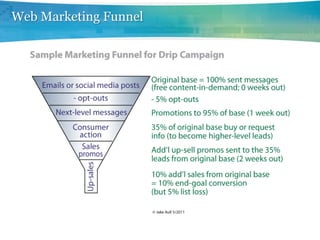
Applying the Digital Marketing Funnel

    & The Customer Journey Clickstream
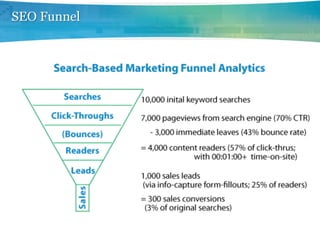
SEO Funnel
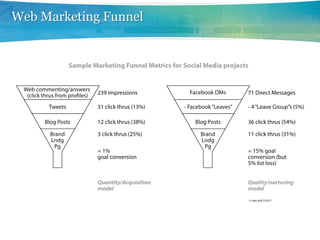
Web Marketing Funnel
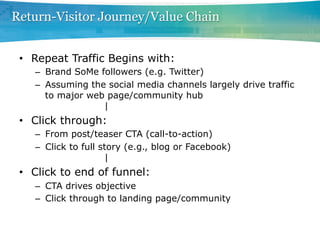
Return-Visitor Journey/Value Chain


 •  Repeat Traffic Begins with:
    –  Brand SoMe followers (e.g. Twitter)
    –  Assuming the social media channels largely drive traffic
       to major web page/community hub
                   |
 •  Click through:
    –  From post/teaser CTA (call-to-action)
    –  Click to full story (e.g., blog or Facebook)
                      |
 •  Click to end of funnel:
    –  CTA drives objective
    –  Click through to landing page/community

GSU links&keywords analysis; websites, social communities & SEO

  • 1.
    Links & KeywordAnalysis For Websites, Social Media Communities & SEO Jake Aull, GSU Social Media Marketing Course September 2011
  • 2.
    Topics of thisPresentation •  The Digital & Keyword Research Process •  What to Analyze, & What Tools to Use •  Applying the Digital Marketing Funnel & the Web Visitor Clickstream Journy
  • 3.
  • 4.
    Keyword Optimization –Process Inputs •  Content/Inputs: –  Brand measurement assessment •  what’s easy to measure? –  SEO goals discovery –  Content/keyword analysis of site –  Keyword research, analysis and comparison
  • 5.
    Keyword Optimization –Initial Research Reports •  Reports/Outputs: –  Competitor ranking report •  Backlinks –  Keyword effectiveness index/ranking reports –  Head and long-tail keyword weighting for optimal keywords/phrases –  KPIs and measurement plan
  • 6.
    What to Analyze,& Tools to Use
  • 7.
    Link Building • Link Building & Inbound Links can include: –  Press release/white paper placement –  Social bookmarking (Del.icio.us) –  Submission to share sites (e.g., Digg, Technorati) –  Search engine local directories/site submissions (e.g., Yahoo! Local, InsiderPages, Yelp, etc.) •  Tools: –  Pro SEO tools utilized: Google AdWords keyword tool, SEO Book Tools, iSpionage.com –  .xls report downloads, aggregated spreadsheets
  • 8.
    Website Analytics • Search Results: –  Search engines (Google, Bing, Yahoo!) –  Additional search engine tools (e.g., Google Webmaster tools, Google Analytics) •  Analytics: –  KPI plan integration –  Keyword monitoring set-up (e.g., Google Alerts, SocialMention) –  Google analytics set-up –  Website auto reports set-up •  Monitoring: –  SocialMention.com –  Google Alerts –  HootSuite –  RSS/email subscribe to updates/comments
  • 9.
    Back Links Analysis •  Let's say you wish to assess backlinks/inbound links to a website: –  Go to Yahoo.com –  Type “linkdomain:yoursite.com –site:yoursite.com” in the search field –  This will report the number of backlinks, while subtracting your own brand site’s irrelevant internal links. –  For more, see: http://searchenginewatch.com/article/2067876/SEO-Link-Building-Fundamentals
  • 10.
    Back Links Analysis •  Inbound web links (a.k.a. backlinks and referrals) are vital. Here's why: –  They boost search engine rankings (both for the target website and themselves). –  They increase paths to the target - more ways and places for visitors to find the site. –  They create alternative entry paths for crawlers to specific web pages (even when the target site is not optimized for search engines). –  Inbound links represent a solid, alternative (to in-site) web metric. They gauge the content value and referral traffic of a site in the online marketplace (especially valuable if there are issues with existing in-site SEO or analytics). –  They get shared among web users and multiplicity of network effects occurs.
  • 11.
    Applying the DigitalMarketing Funnel & The Customer Journey Clickstream
  • 12.
  • 13.
  • 14.
  • 15.
    Return-Visitor Journey/Value Chain •  Repeat Traffic Begins with: –  Brand SoMe followers (e.g. Twitter) –  Assuming the social media channels largely drive traffic to major web page/community hub | •  Click through: –  From post/teaser CTA (call-to-action) –  Click to full story (e.g., blog or Facebook) | •  Click to end of funnel: –  CTA drives objective –  Click through to landing page/community