SEO Tutorial Search Engine Optimization
Agenda What is SEO Industry Research SEO Process Technical aspects of SEO Social Media - MySpace Optimization Measuring SEO success SEO Tools
What is SEO ( Search Engine Optimization )? The process of improving web pages so they rank higher in search engines for your targeted keywords.  Crawlability / Optimized Code Internal Link Structure Link Popularity / Relevance Key Factors Content Relevance
Where are the Organic Results? Organic Pay Per Click Pay Per Click
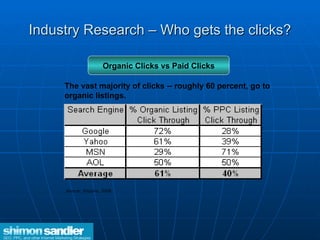
Industry Research – Who gets the clicks? The vast majority of clicks -- roughly 60 percent, go to organic listings.   Source: Enquiro, 2006 Organic Clicks vs Paid Clicks
Industry Research: Organic SEO is the most popular form of SEM Organic SEO is the most popular  form of SEM, with almost three-quarters of advertisers using this method, with paid placement a very close second at 71%
Industry Research & The case for SEO The majority of clicks are going to Organic listings. SEO is the most popular form of SEM. SEO provides a high ROI. Many people don’t go past the 1 st   page in the Search results.  Users trust the Natural results to be more relevant to their Search query. Reasons to conduct SEO *Sources: Iprospect Research, eMarketer
SEO Process Step 1 : Discuss Business objectives. Step 2 : Conduct initial keyword analysis. Step 3 : Identify the keyword/landing page combinations. Step 4 : Interim Client Approval for Keyword/Landing Pages. Step 5 : Baseline Ranking & Traffic reports.  Step 6 : On-site & Off-site optimization.  Step 7 : Detailed Recommendation documents.  Step 8 : Implementation. Step 9 : Monitoring and Optimizing: We provide monthly reporting and optimization recommendations. The reporting is compared to the baseline (or previous month’s results) to identify trends and help guide additional adjustments.
Technical SEO Comprehensive Website Analysis  Keyword Research and Analysis.  Baseline Ranking report.  Competitive analysis in Search Engines.  Content Analysis & SEO Copywriting.  Analysis of URL structure & information architecture.  Analysis of internal linking.  Analysis of source code and page layout.  Code validation.  Search Engine Saturation. Link Popularity Analysis.  Link Relevancy & Co-Citation Analysis (Topical Relevancy).
Page Title Alt-Tags Link Title Tags Site-Side Optimization Technical SEO - Example of Page Elements Anchor Text Navigation
Technical SEO - Source Code Title Tag Javascript Meta data
Social Media - MySpace Optimization
MySpace Marketing and Optimization Getting more targeted friends (sort by demographic criteria). Leaving “friends” comments. Profile Customization. Sending Bulletins. Sending mass private messages (with banner ad). Writing keyword-rich content with outbound links containing keyword-rich anchor text. Getting inbound links from websites not on the  MySpace domain.
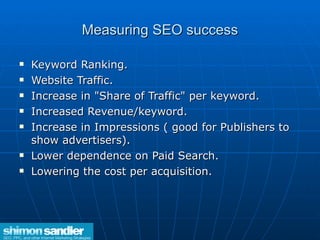
Measuring SEO success Keyword Ranking. Website Traffic. Increase in "Share of Traffic" per keyword.  Increased Revenue/keyword.  Increase in Impressions ( good for Publishers to show advertisers).  Lower dependence on Paid Search. Lowering the cost per acquisition.
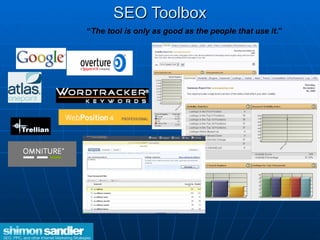
SEO Toolbox “ The tool is only as good as the people that use it .”
Thank You Created By Shimon Sand www.ShimonSandler.com

Seo

  • 1.
    SEO Tutorial SearchEngine Optimization
  • 2.
    Agenda What isSEO Industry Research SEO Process Technical aspects of SEO Social Media - MySpace Optimization Measuring SEO success SEO Tools
  • 3.
    What is SEO( Search Engine Optimization )? The process of improving web pages so they rank higher in search engines for your targeted keywords. Crawlability / Optimized Code Internal Link Structure Link Popularity / Relevance Key Factors Content Relevance
  • 4.
    Where are theOrganic Results? Organic Pay Per Click Pay Per Click
  • 5.
    Industry Research –Who gets the clicks? The vast majority of clicks -- roughly 60 percent, go to organic listings. Source: Enquiro, 2006 Organic Clicks vs Paid Clicks
  • 6.
    Industry Research: OrganicSEO is the most popular form of SEM Organic SEO is the most popular form of SEM, with almost three-quarters of advertisers using this method, with paid placement a very close second at 71%
  • 7.
    Industry Research &The case for SEO The majority of clicks are going to Organic listings. SEO is the most popular form of SEM. SEO provides a high ROI. Many people don’t go past the 1 st page in the Search results. Users trust the Natural results to be more relevant to their Search query. Reasons to conduct SEO *Sources: Iprospect Research, eMarketer
  • 8.
    SEO Process Step1 : Discuss Business objectives. Step 2 : Conduct initial keyword analysis. Step 3 : Identify the keyword/landing page combinations. Step 4 : Interim Client Approval for Keyword/Landing Pages. Step 5 : Baseline Ranking & Traffic reports. Step 6 : On-site & Off-site optimization. Step 7 : Detailed Recommendation documents. Step 8 : Implementation. Step 9 : Monitoring and Optimizing: We provide monthly reporting and optimization recommendations. The reporting is compared to the baseline (or previous month’s results) to identify trends and help guide additional adjustments.
  • 9.
    Technical SEO ComprehensiveWebsite Analysis Keyword Research and Analysis. Baseline Ranking report. Competitive analysis in Search Engines. Content Analysis & SEO Copywriting. Analysis of URL structure & information architecture. Analysis of internal linking. Analysis of source code and page layout. Code validation. Search Engine Saturation. Link Popularity Analysis. Link Relevancy & Co-Citation Analysis (Topical Relevancy).
  • 10.
    Page Title Alt-TagsLink Title Tags Site-Side Optimization Technical SEO - Example of Page Elements Anchor Text Navigation
  • 11.
    Technical SEO -Source Code Title Tag Javascript Meta data
  • 12.
    Social Media -MySpace Optimization
  • 13.
    MySpace Marketing andOptimization Getting more targeted friends (sort by demographic criteria). Leaving “friends” comments. Profile Customization. Sending Bulletins. Sending mass private messages (with banner ad). Writing keyword-rich content with outbound links containing keyword-rich anchor text. Getting inbound links from websites not on the MySpace domain.
  • 14.
    Measuring SEO successKeyword Ranking. Website Traffic. Increase in "Share of Traffic" per keyword. Increased Revenue/keyword. Increase in Impressions ( good for Publishers to show advertisers). Lower dependence on Paid Search. Lowering the cost per acquisition.
  • 15.
    SEO Toolbox “The tool is only as good as the people that use it .”
  • 16.
    Thank You CreatedBy Shimon Sand www.ShimonSandler.com