Google Snippet &
AMP
Tools : https://wpschema.com/schema-types/
Google Tool :https://developers.google.com/search/docs/guides/
Structure data testing tool :https://search.google.com/structured-data/testing-tool
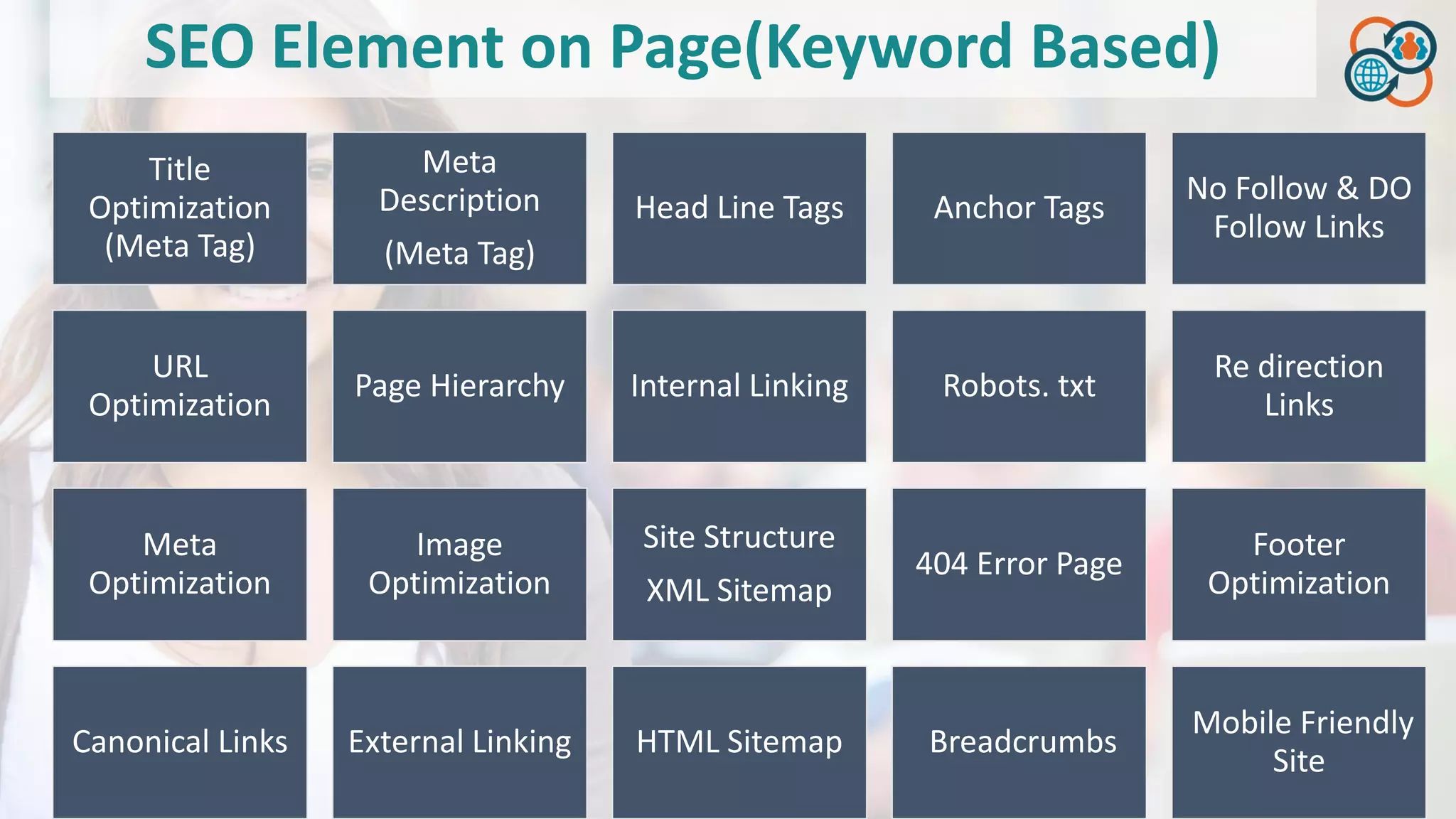
SEO Element on Page(Keyword Based)
Title
Optimization
(Meta Tag)
Meta
Description
(Meta Tag)
Head Line Tags Anchor Tags
No Follow & DO
Follow Links
URL
Optimization
Page Hierarchy Internal Linking Robots. txt
Re direction
Links
Meta
Optimization
Image
Optimization
Site Structure
XML Sitemap
404 Error Page
Footer
Optimization
Canonical Links External Linking HTML Sitemap Breadcrumbs
Mobile Friendly
Site
Rich Snippet
Schema.org
Rich Snippet
•Rich Snippets is the term used to describe structured data
markup that site operators can add to their existing HTML,
which in turn allow search engines to better understand
what information is contained on each web page.
•Structured data exists to solve this context problem and
explicitly tells search engines exactly what’s what on your
site.
• Schema Markup Makes Your Content More Visible In
Search Engines
Content Supported by Rich Snippet
• Jason LD (Recommended) - JavaScript notation embedded in a <script>
tag in the page head or body. The markup is not interleaved with the user-visible text,
which makes nested data items easier to express, such as the Country of a Postal
Address of a Music Venue of an Event. Also, Google can read JSON-LD data when it is
dynamically injected into the page's contents, such as by JavaScript code or embedded
widgets in your content management system.
• Microdata- An open-community HTML specification used to nest structured
data within HTML content. Like RDFa, it uses HTML tag attributes to name the
properties you want to expose as structured data. It is typically used in the page body,
but can be used in the head.
•RDFa - HTML5 extension that supports linked data by introducing HTML tag
attributes that correspond to the user-visible content that you want to describe for
search engines. RDFa is commonly used in both the head and body sections of the
HTML page.
Content Supported by Rich Snippet
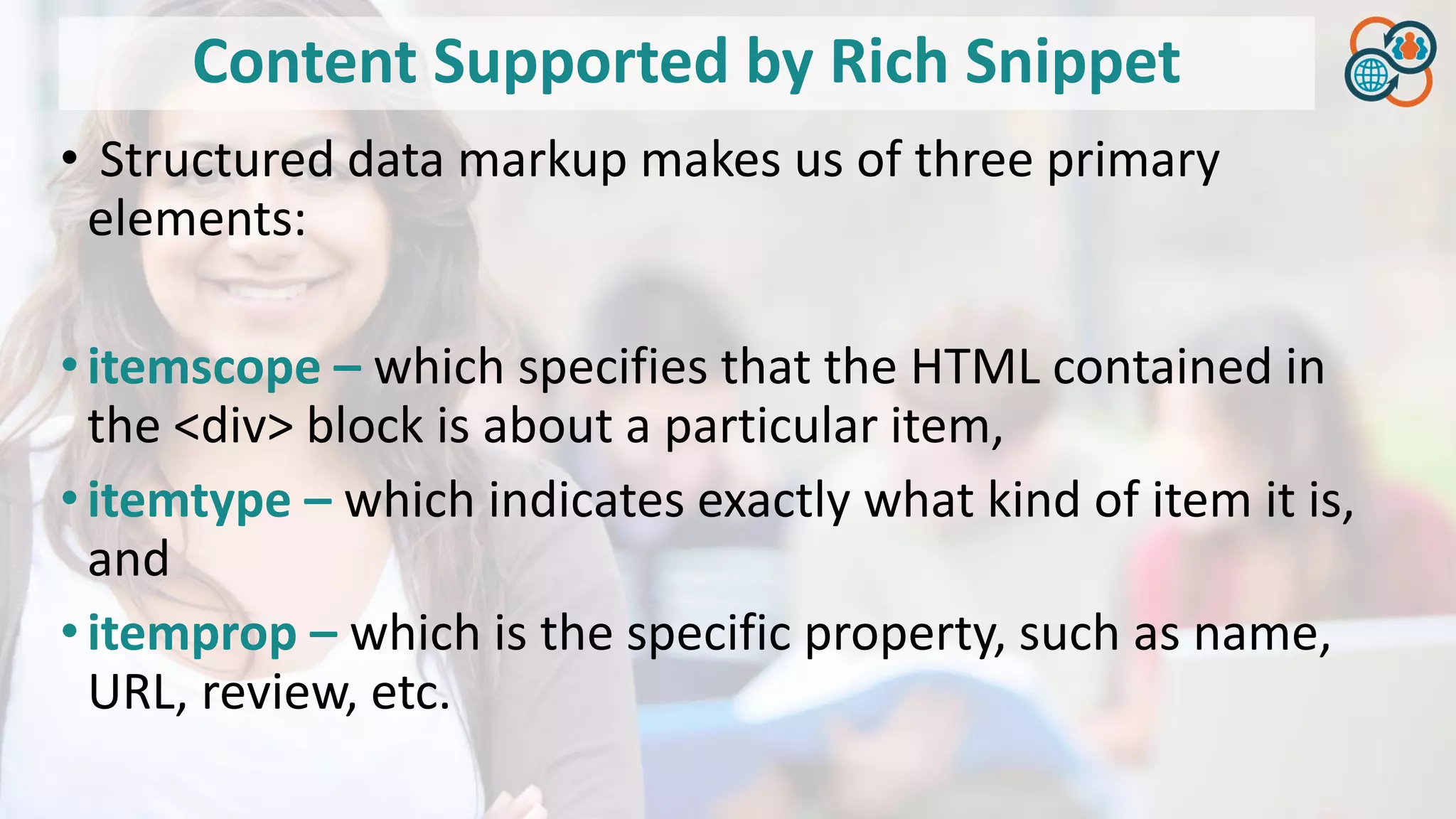
• Structured data markup makes us of three primary
elements:
•itemscope – which specifies that the HTML contained in
the <div> block is about a particular item,
•itemtype – which indicates exactly what kind of item it is,
and
•itemprop – which is the specific property, such as name,
URL, review, etc.
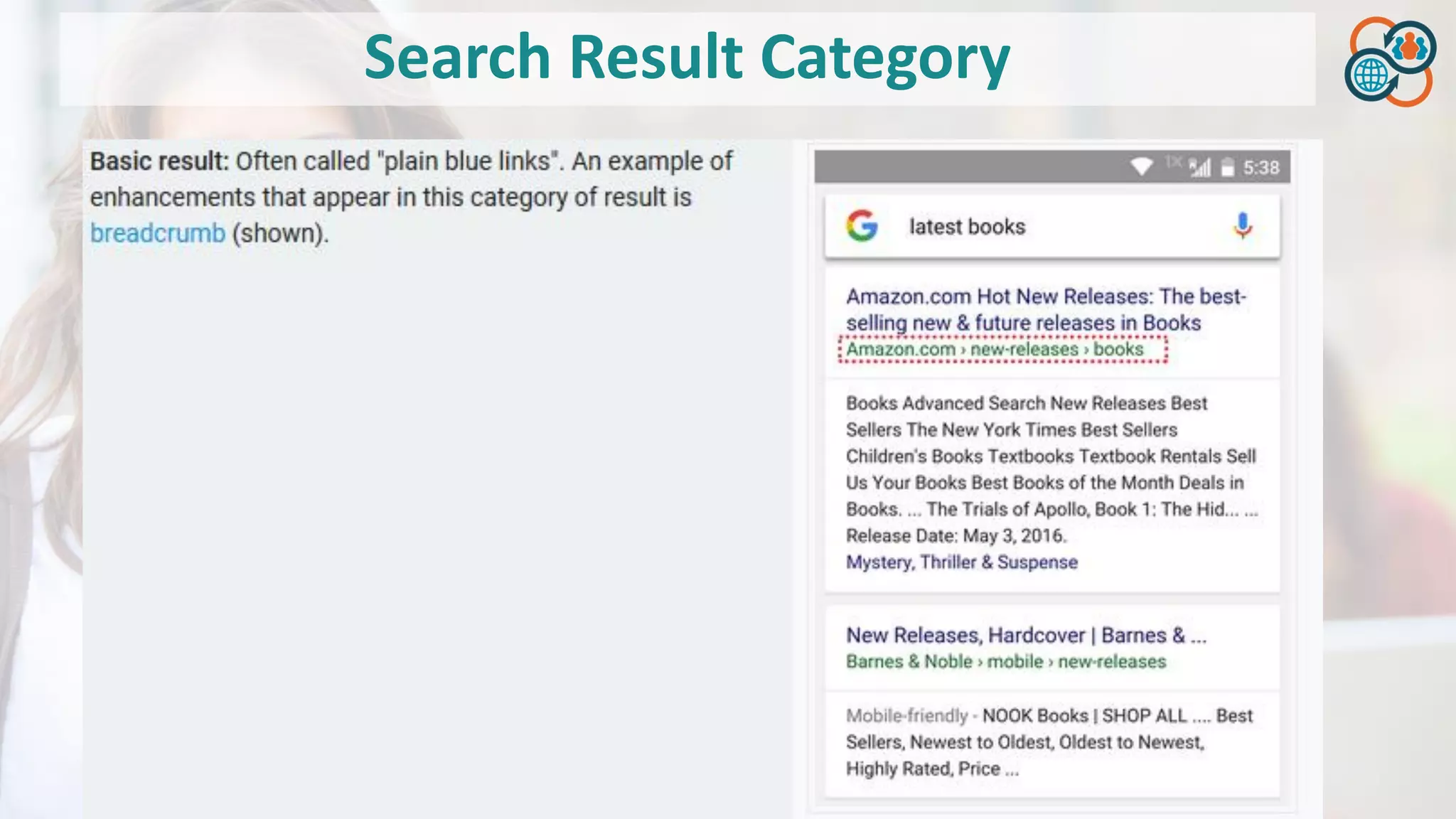
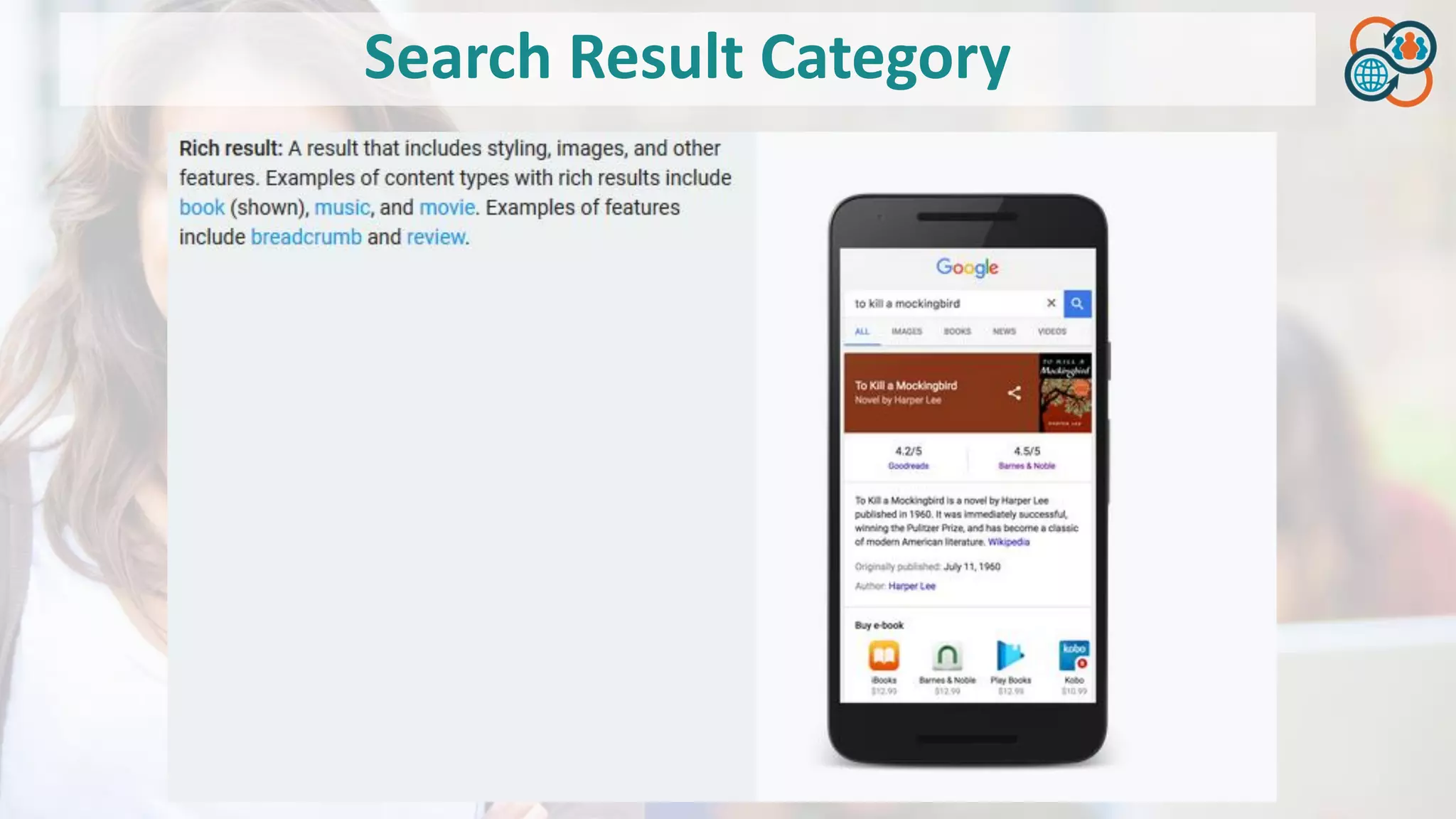
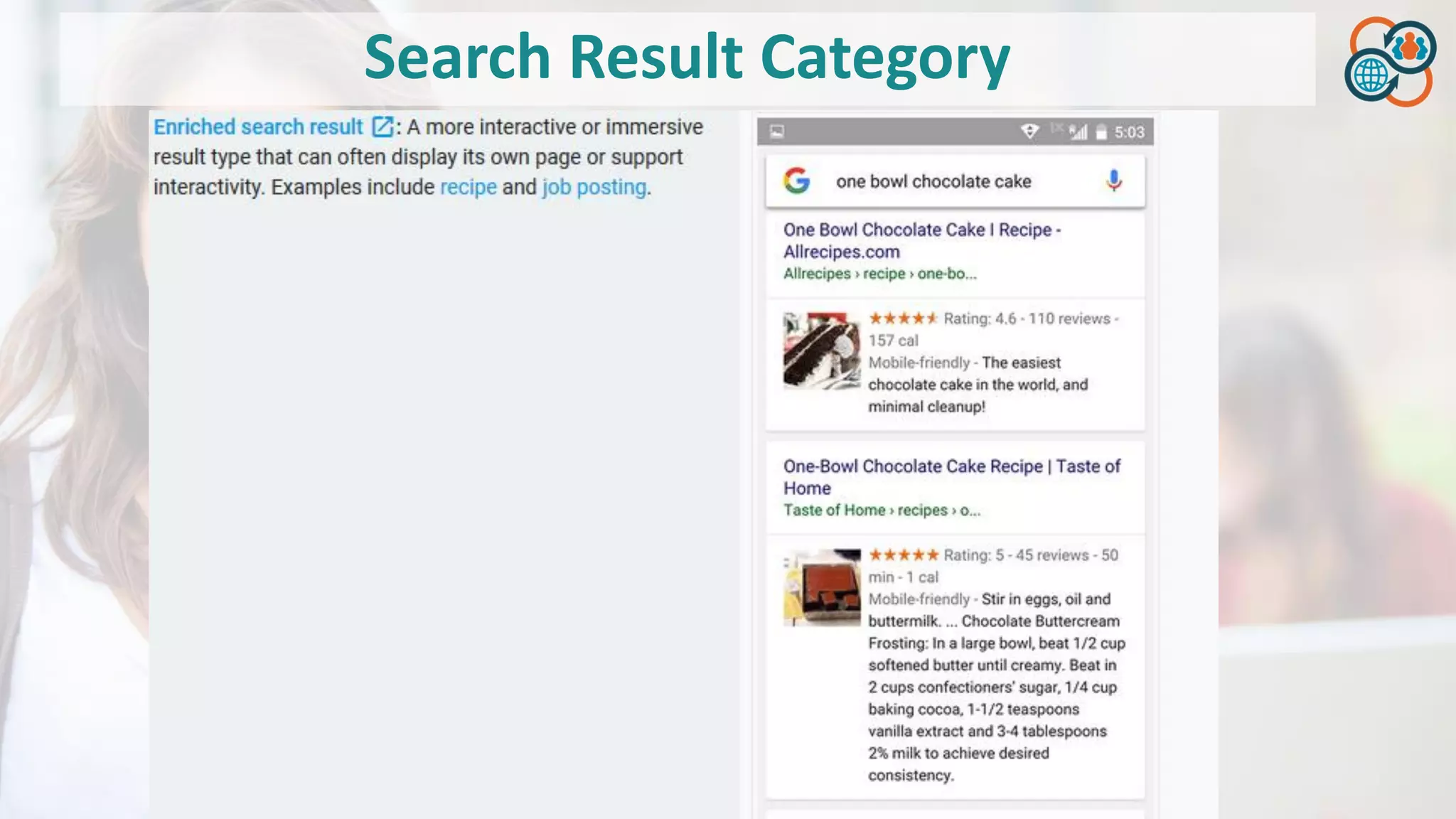
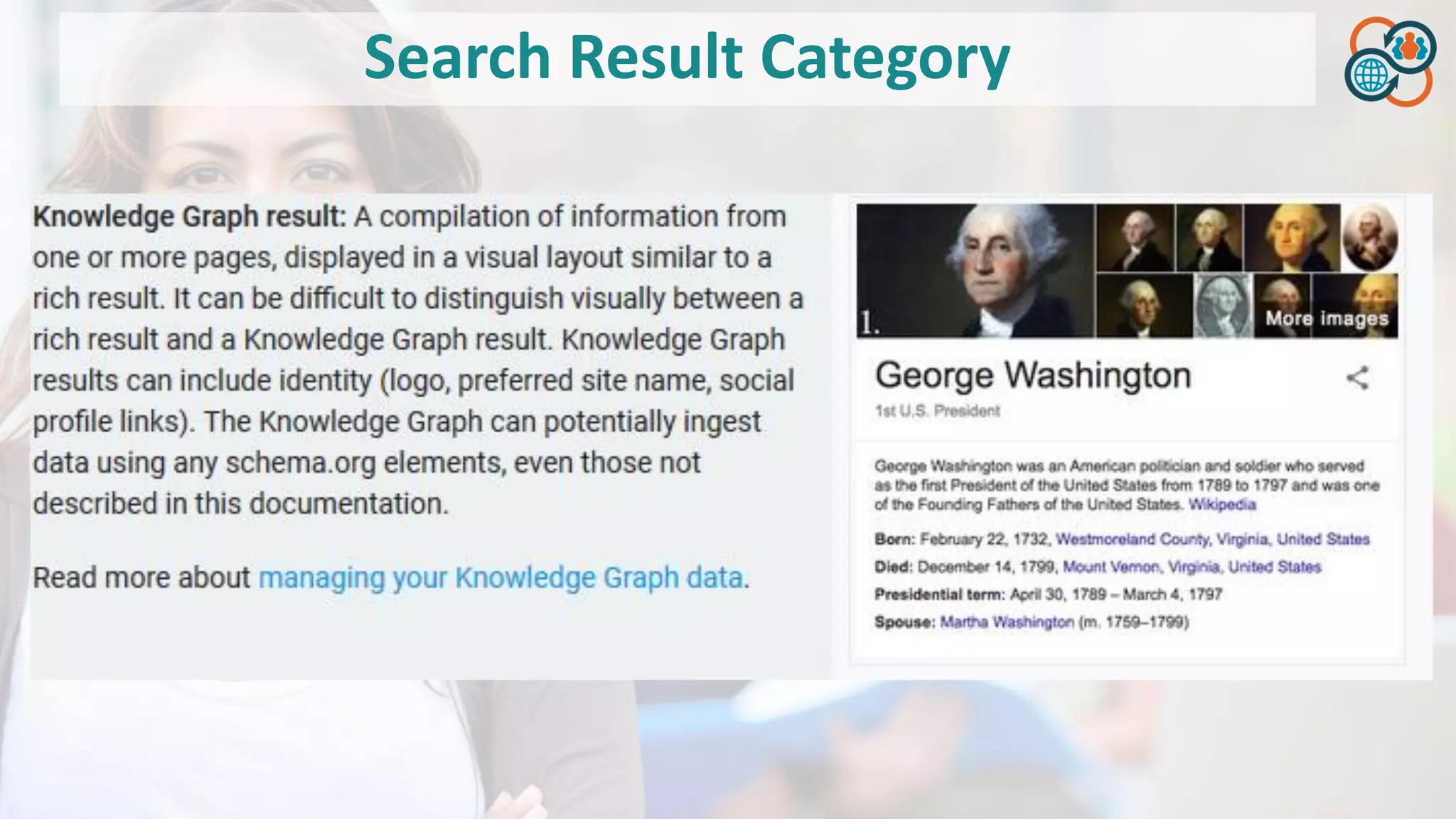
Search Result Category
Types of Rich Snippet
•Content type: Many search features are tied to the topic
of your page. For example, if the page has a recipe or a
news article, or contains information about an event or a
book. Google Search results can then apply content-
specific features such as making your page eligible to
appear in a top news stories carousel, a recipe carousel, or
an events list.
•Enhancements: These are features that, can be applied to
more than one kind of content type. For example,
providing review stars for a recipe or movie, or exposing a
carousel of rich results (previously known as rich cards).
“No guarantee that your page
will appear in Search results
with the specified feature”.
This is because search features depend on many factors,
including the search device type, location, and whether
Google thinks the feature would provide the best search
experience for the user.
Enhancement
Rich Snippet
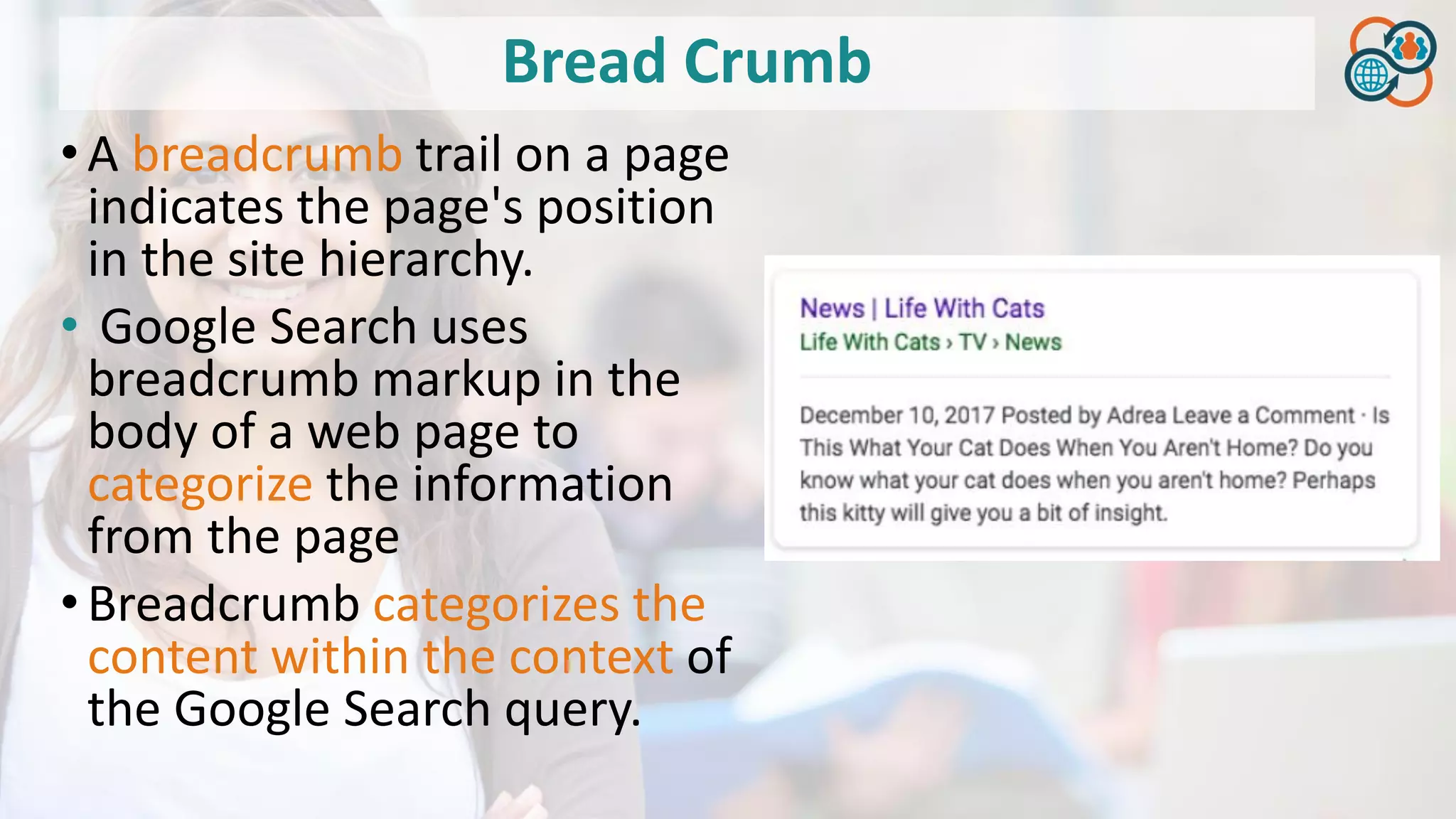
Bread Crumb
•A breadcrumb trail on a page
indicates the page's position
in the site hierarchy.
• Google Search uses
breadcrumb markup in the
body of a web page to
categorize the information
from the page
•Breadcrumb categorizes the
content within the context of
the Google Search query.
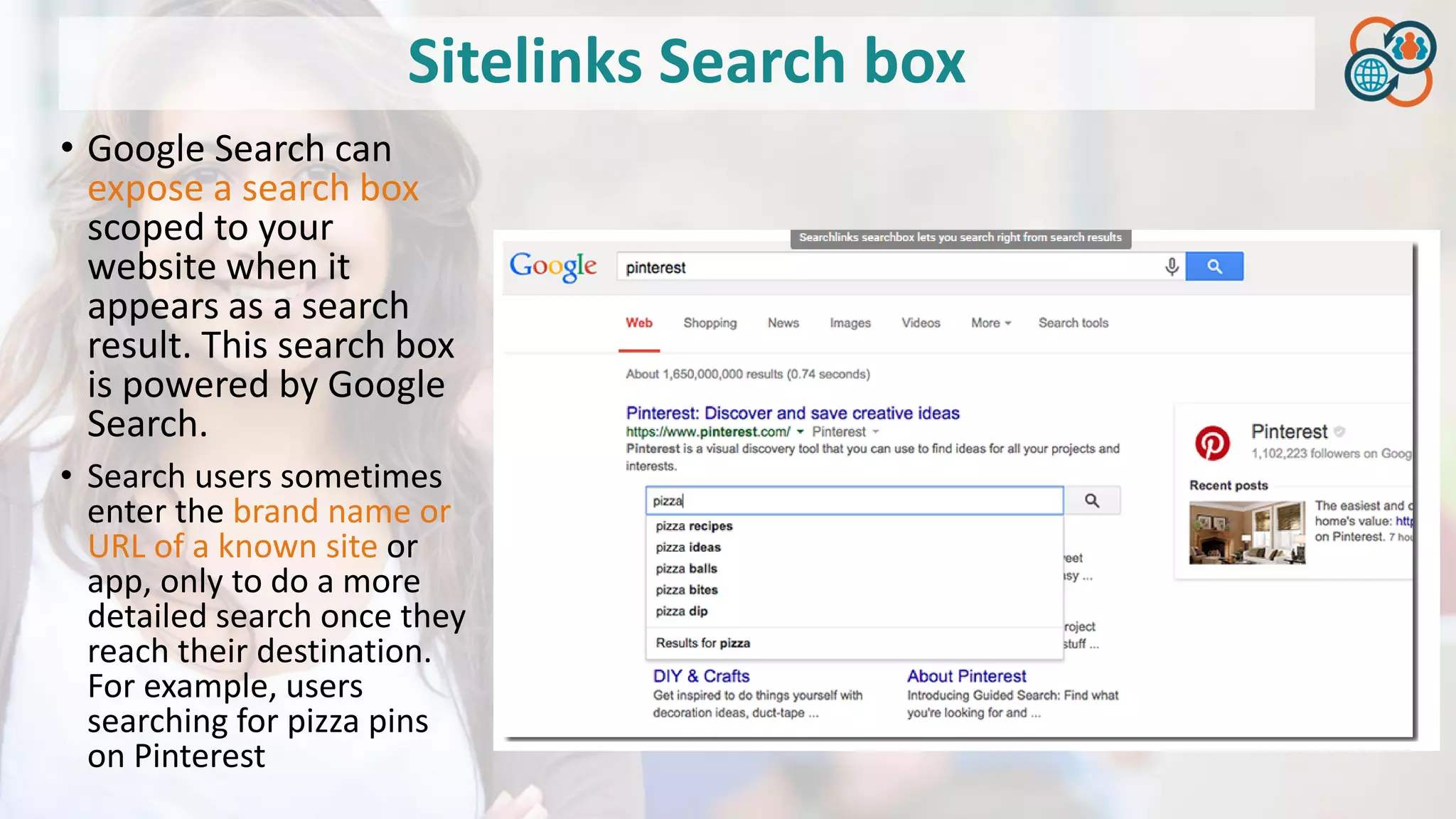
Sitelinks Search box
• Google Search can
expose a search box
scoped to your
website when it
appears as a search
result. This search box
is powered by Google
Search.
• Search users sometimes
enter the brand name or
URL of a known site or
app, only to do a more
detailed search once they
reach their destination.
For example, users
searching for pizza pins
on Pinterest
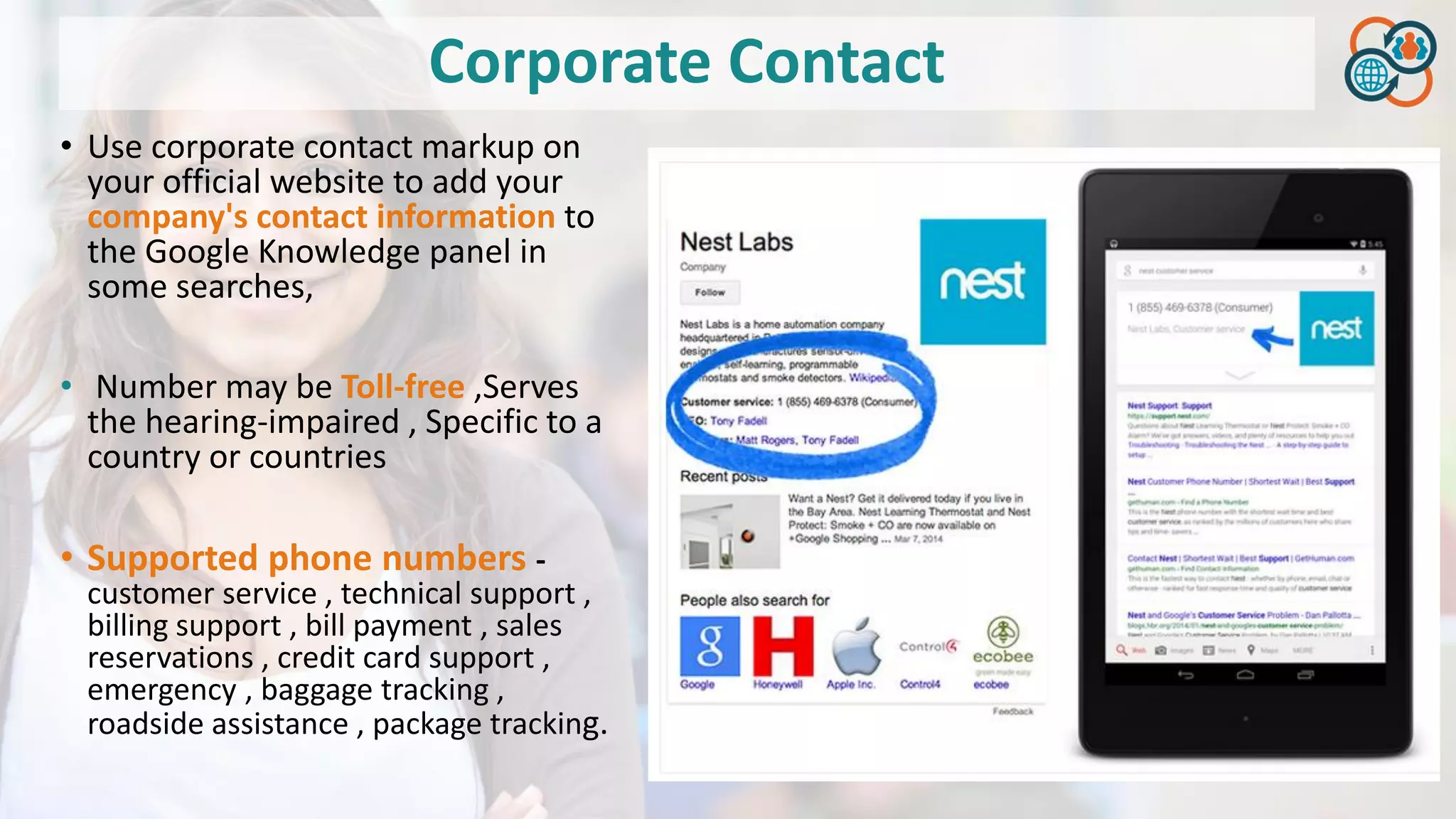
Corporate Contact
• Use corporate contact markup on
your official website to add your
company's contact information to
the Google Knowledge panel in
some searches,
• Number may be Toll-free ,Serves
the hearing-impaired , Specific to a
country or countries
• Supported phone numbers -
customer service , technical support ,
billing support , bill payment , sales
reservations , credit card support ,
emergency , baggage tracking ,
roadside assistance , package tracking.
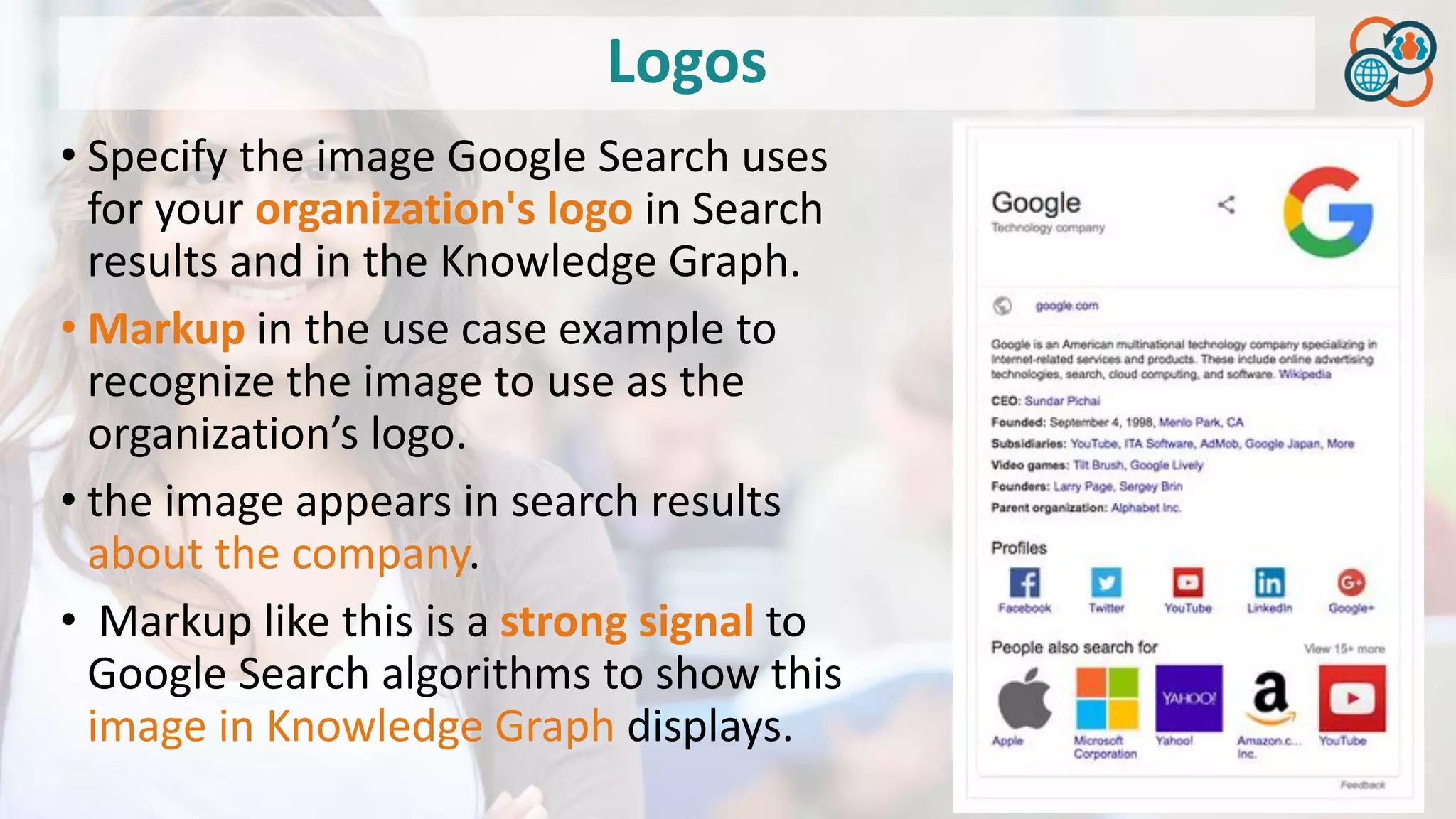
Logos
• Specify the image Google Search uses
for your organization's logo in Search
results and in the Knowledge Graph.
• Markup in the use case example to
recognize the image to use as the
organization’s logo.
• the image appears in search results
about the company.
• Markup like this is a strong signal to
Google Search algorithms to show this
image in Knowledge Graph displays.
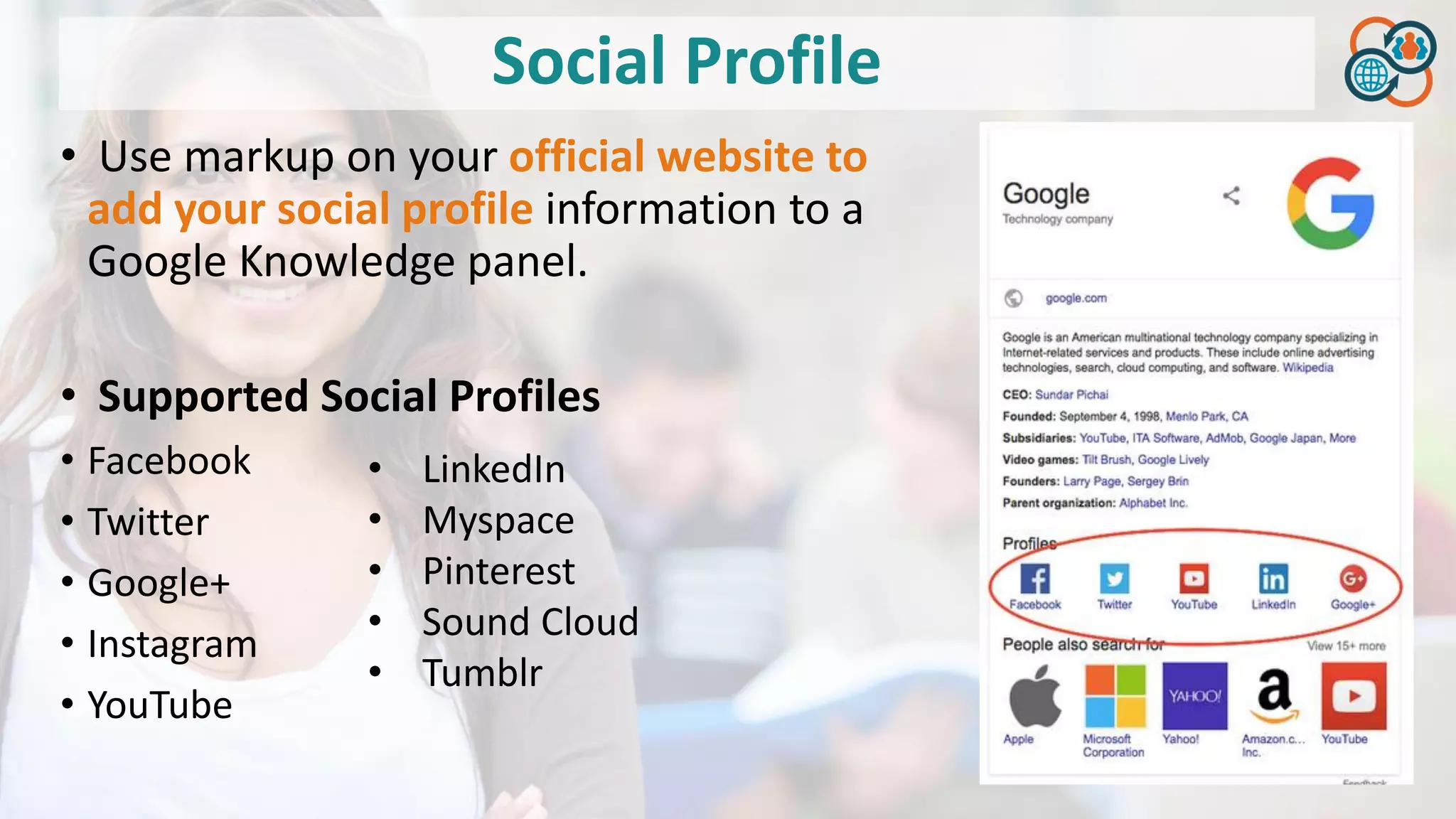
Social Profile
• Use markup on your official website to
add your social profile information to a
Google Knowledge panel.
• Supported Social Profiles
• Facebook
• Twitter
• Google+
• Instagram
• YouTube
• LinkedIn
• Myspace
• Pinterest
• Sound Cloud
• Tumblr
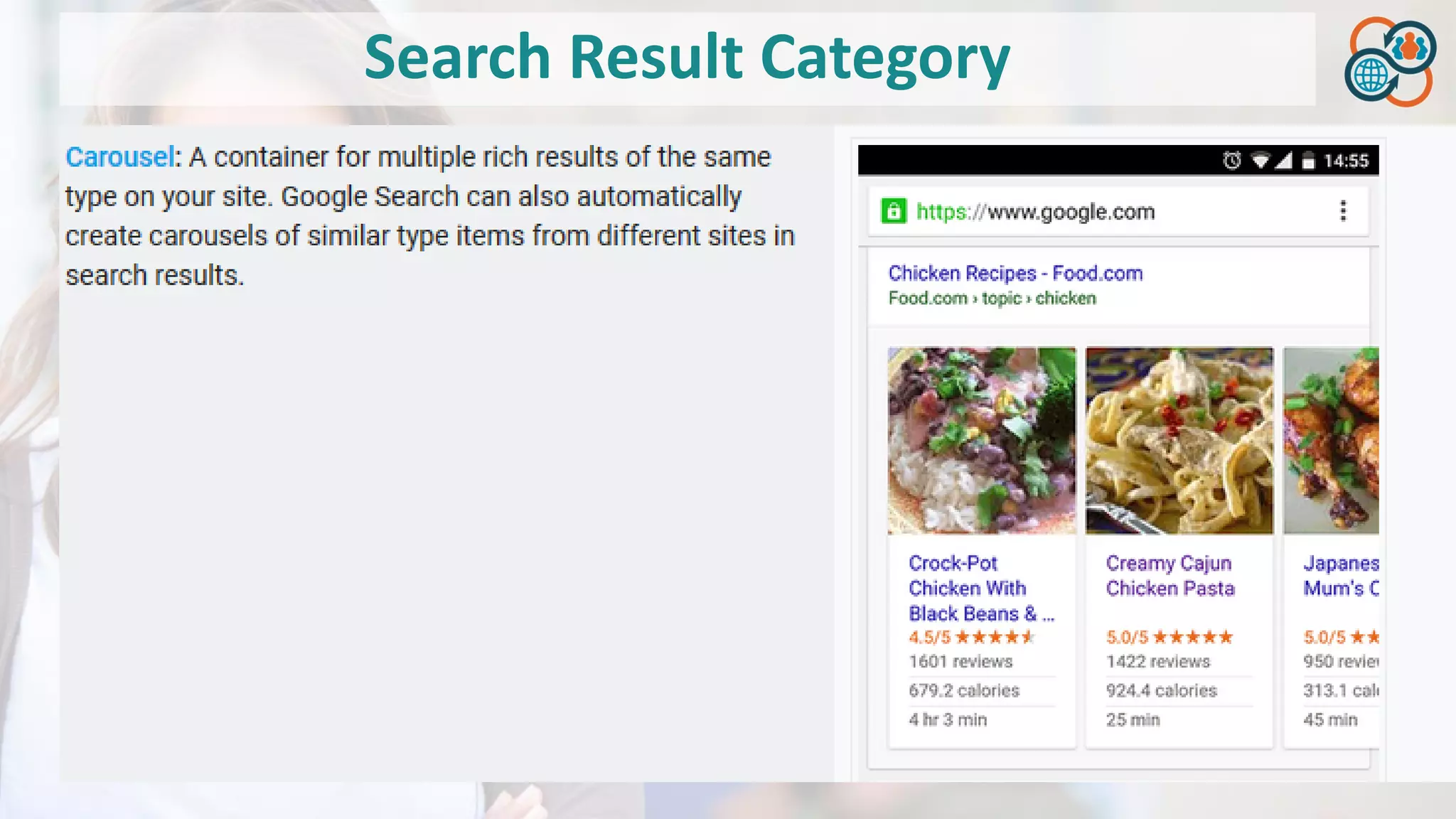
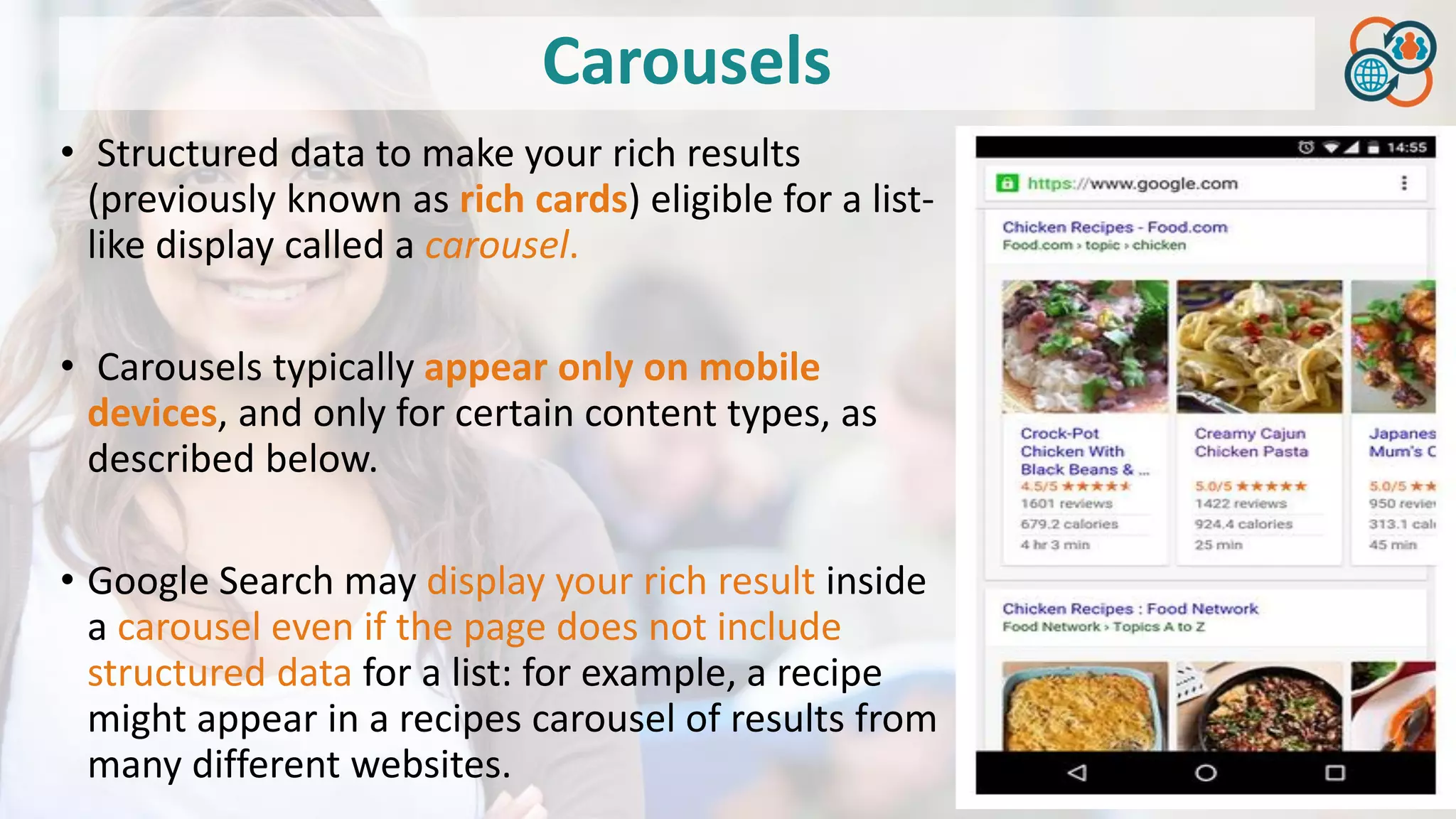
Carousels
• Structured data to make your rich results
(previously known as rich cards) eligible for a list-
like display called a carousel.
• Carousels typically appear only on mobile
devices, and only for certain content types, as
described below.
• Google Search may display your rich result inside
a carousel even if the page does not include
structured data for a list: for example, a recipe
might appear in a recipes carousel of results from
many different websites.
Content Based
Rich Snippet
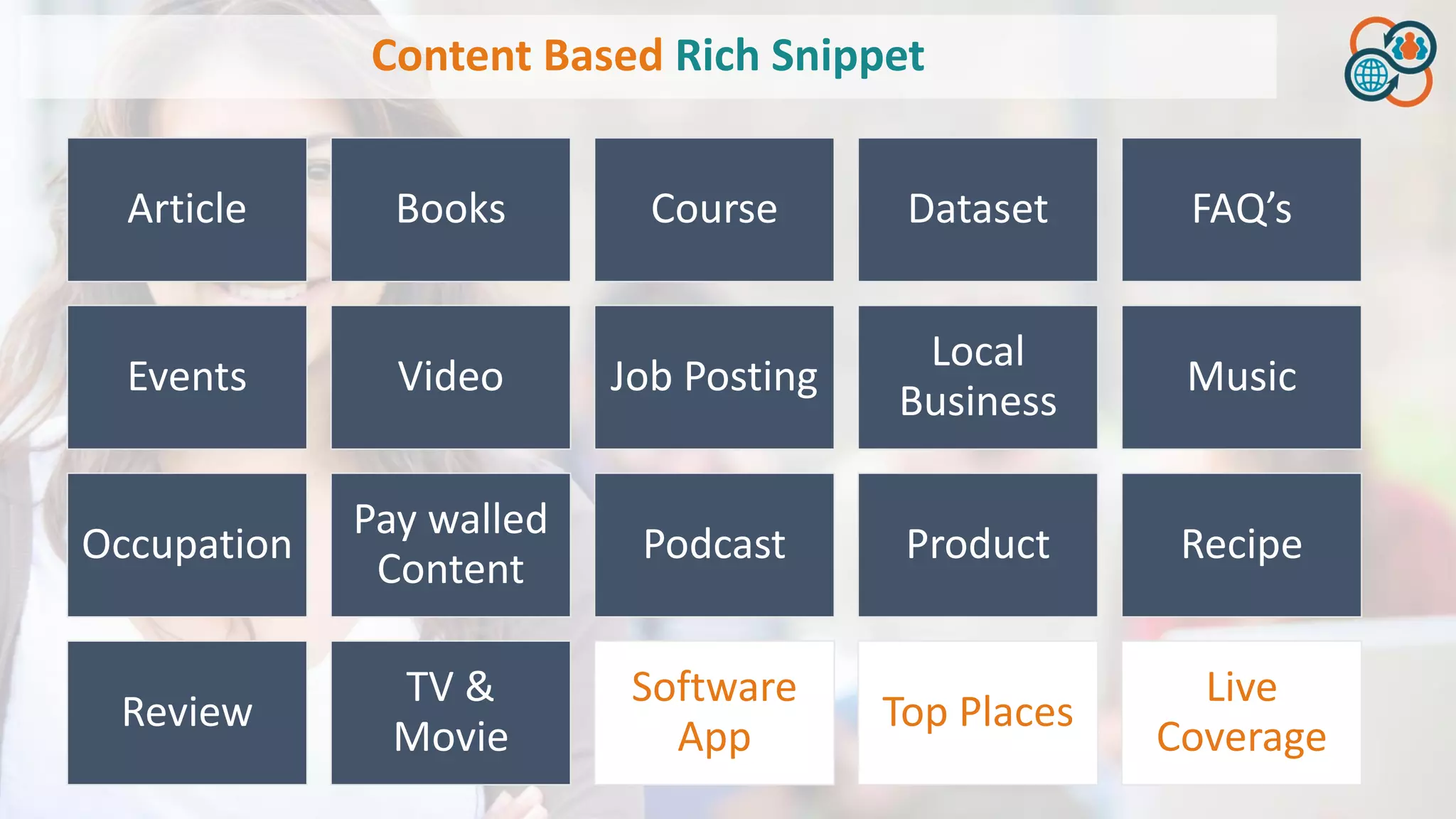
Content Based Rich Snippet
Article Books Course Dataset FAQ’s
Events Video Job Posting
Local
Business
Music
Occupation
Pay walled
Content
Podcast Product Recipe
Review
TV &
Movie
Software
App
Top Places
Live
Coverage
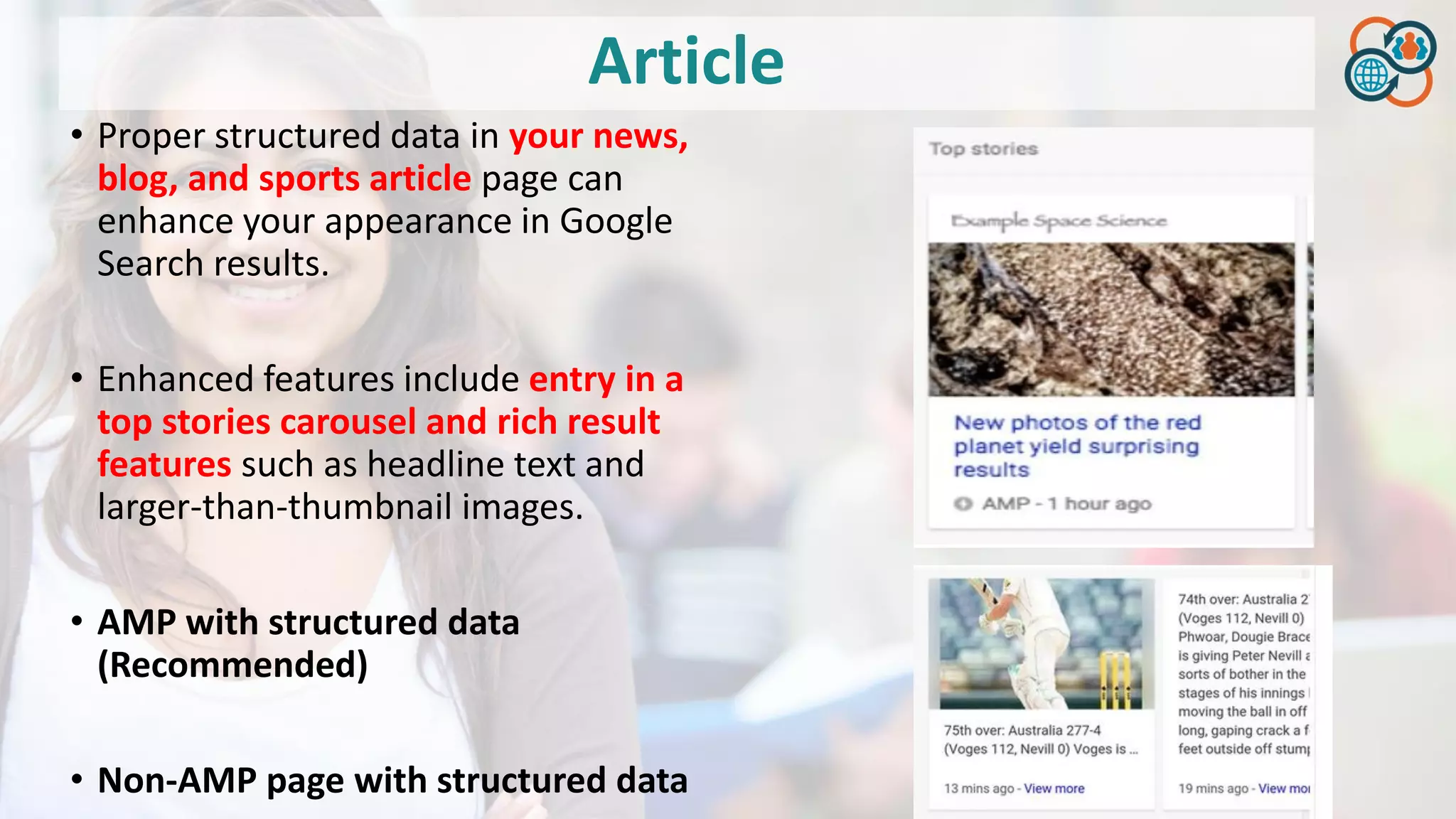
Article
• Proper structured data in your news,
blog, and sports article page can
enhance your appearance in Google
Search results.
• Enhanced features include entry in a
top stories carousel and rich result
features such as headline text and
larger-than-thumbnail images.
• AMP with structured data
(Recommended)
• Non-AMP page with structured data
Books
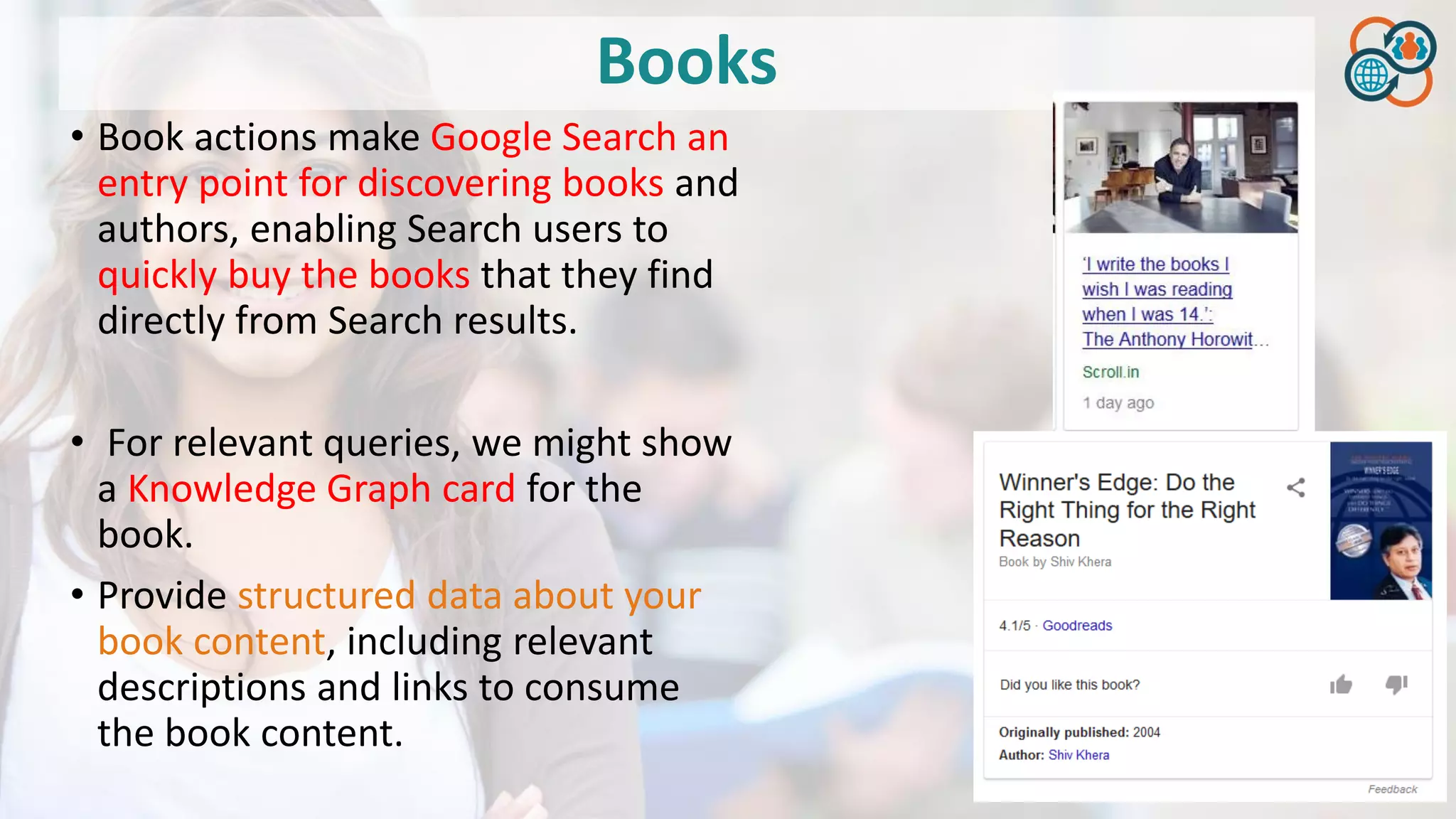
• Book actions make Google Search an
entry point for discovering books and
authors, enabling Search users to
quickly buy the books that they find
directly from Search results.
• For relevant queries, we might show
a Knowledge Graph card for the
book.
• Provide structured data about your
book content, including relevant
descriptions and links to consume
the book content.
Course
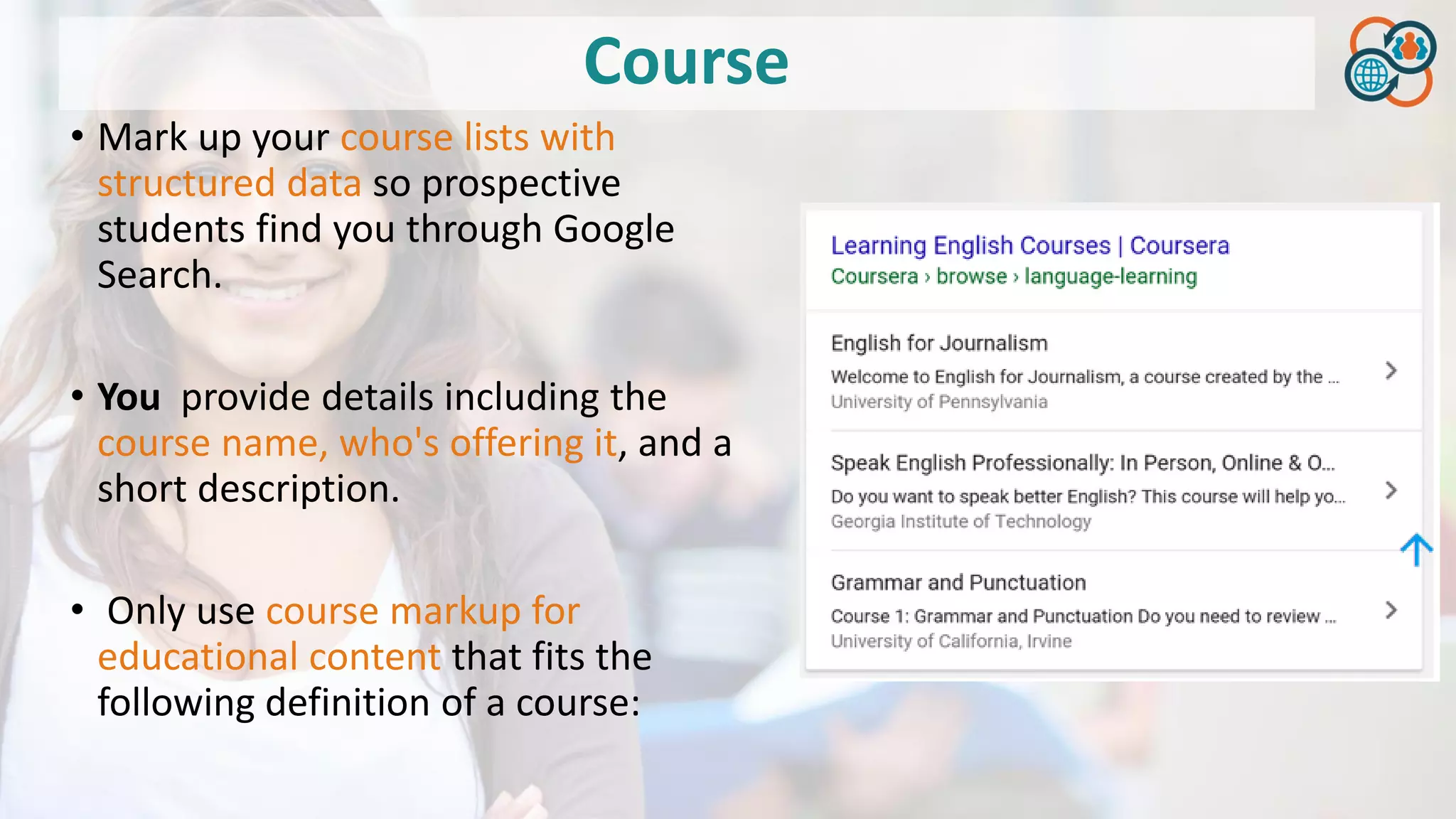
• Mark up your course lists with
structured data so prospective
students find you through Google
Search.
• You provide details including the
course name, who's offering it, and a
short description.
• Only use course markup for
educational content that fits the
following definition of a course:
Events
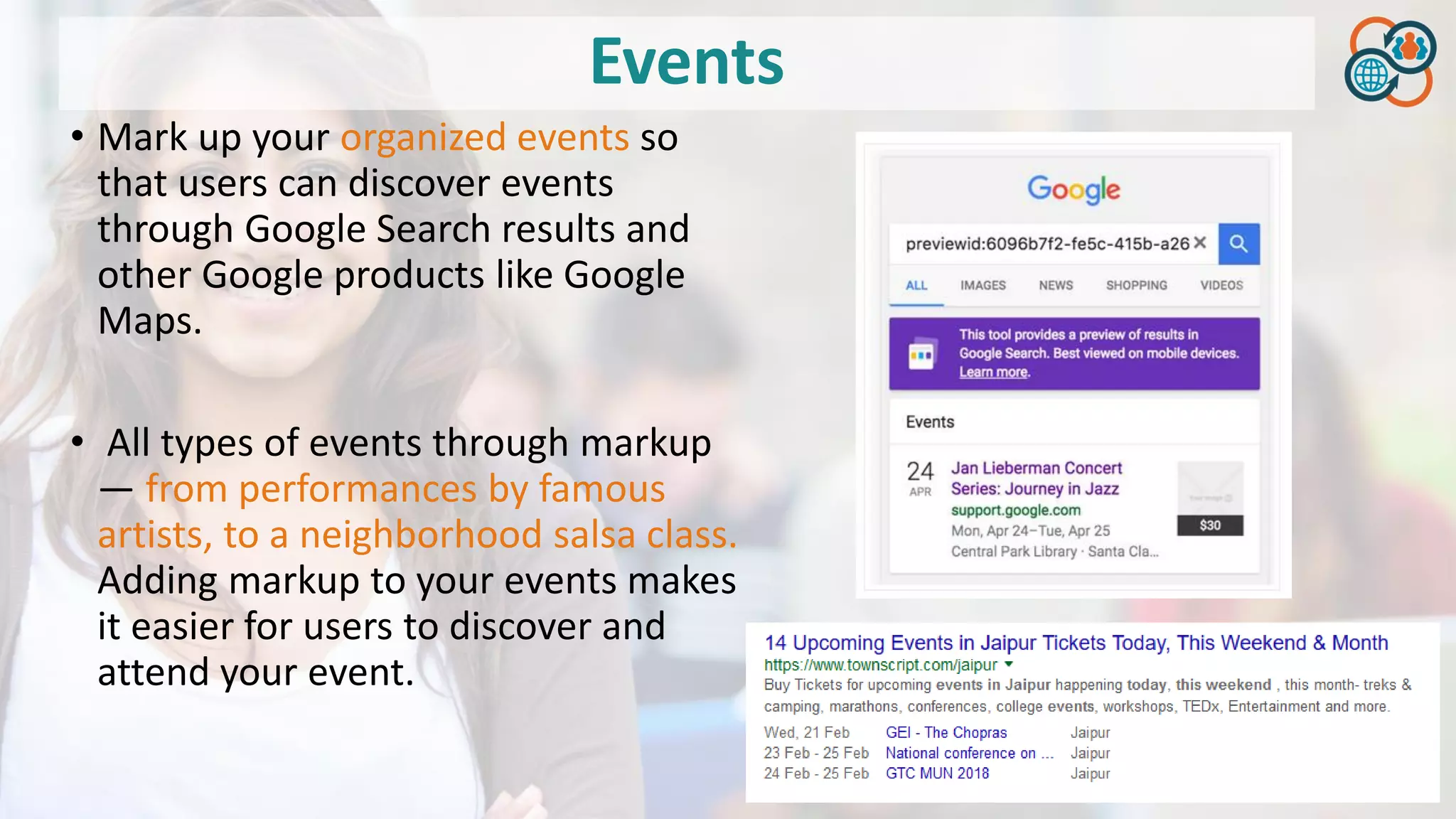
• Mark up your organized events so
that users can discover events
through Google Search results and
other Google products like Google
Maps.
• All types of events through markup
— from performances by famous
artists, to a neighborhood salsa class.
Adding markup to your events makes
it easier for users to discover and
attend your event.
Job Posting
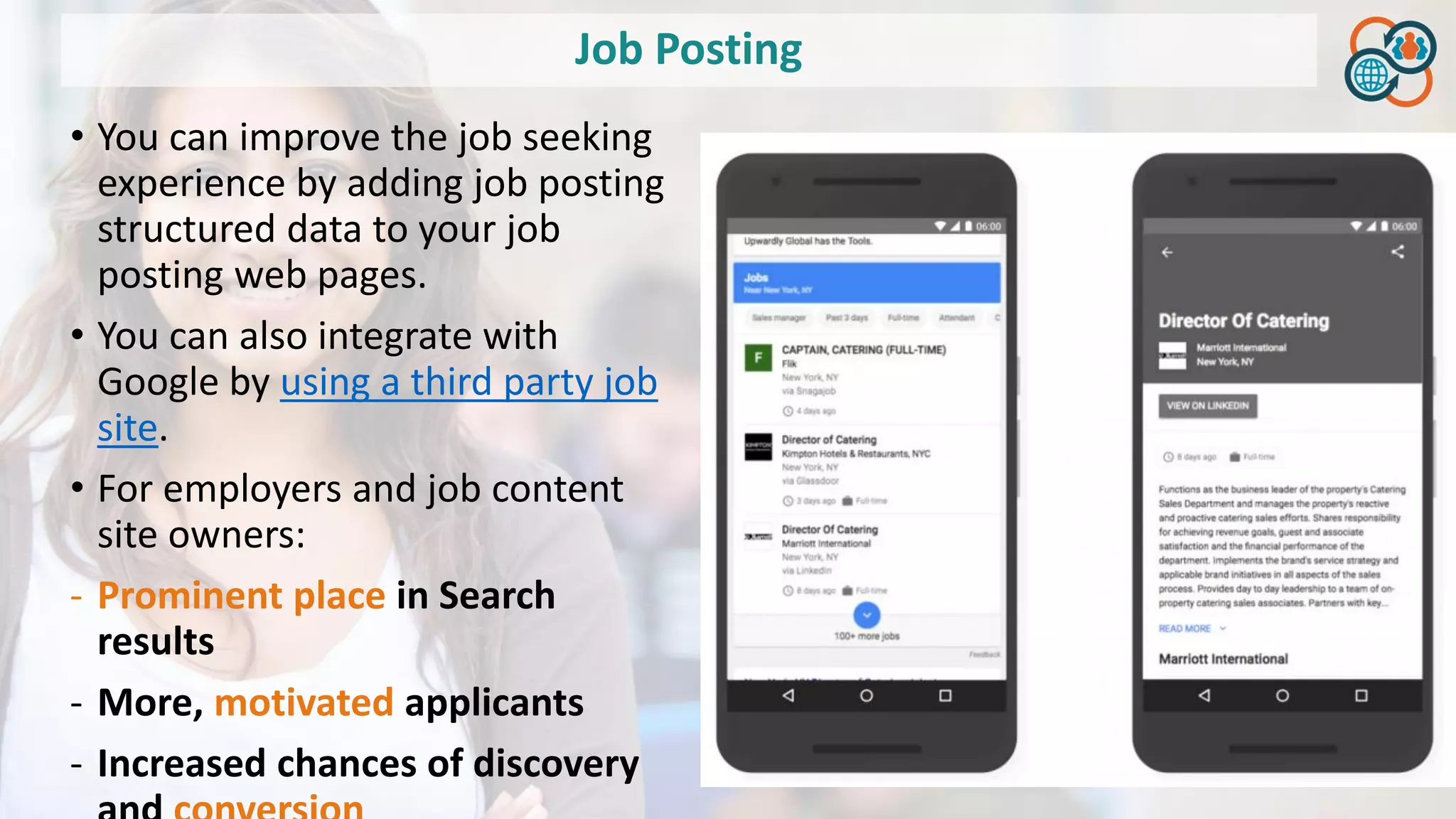
• You can improve the job seeking
experience by adding job posting
structured data to your job
posting web pages.
• You can also integrate with
Google by using a third party job
site.
• For employers and job content
site owners:
- Prominent place in Search
results
- More, motivated applicants
- Increased chances of discovery
Local Business
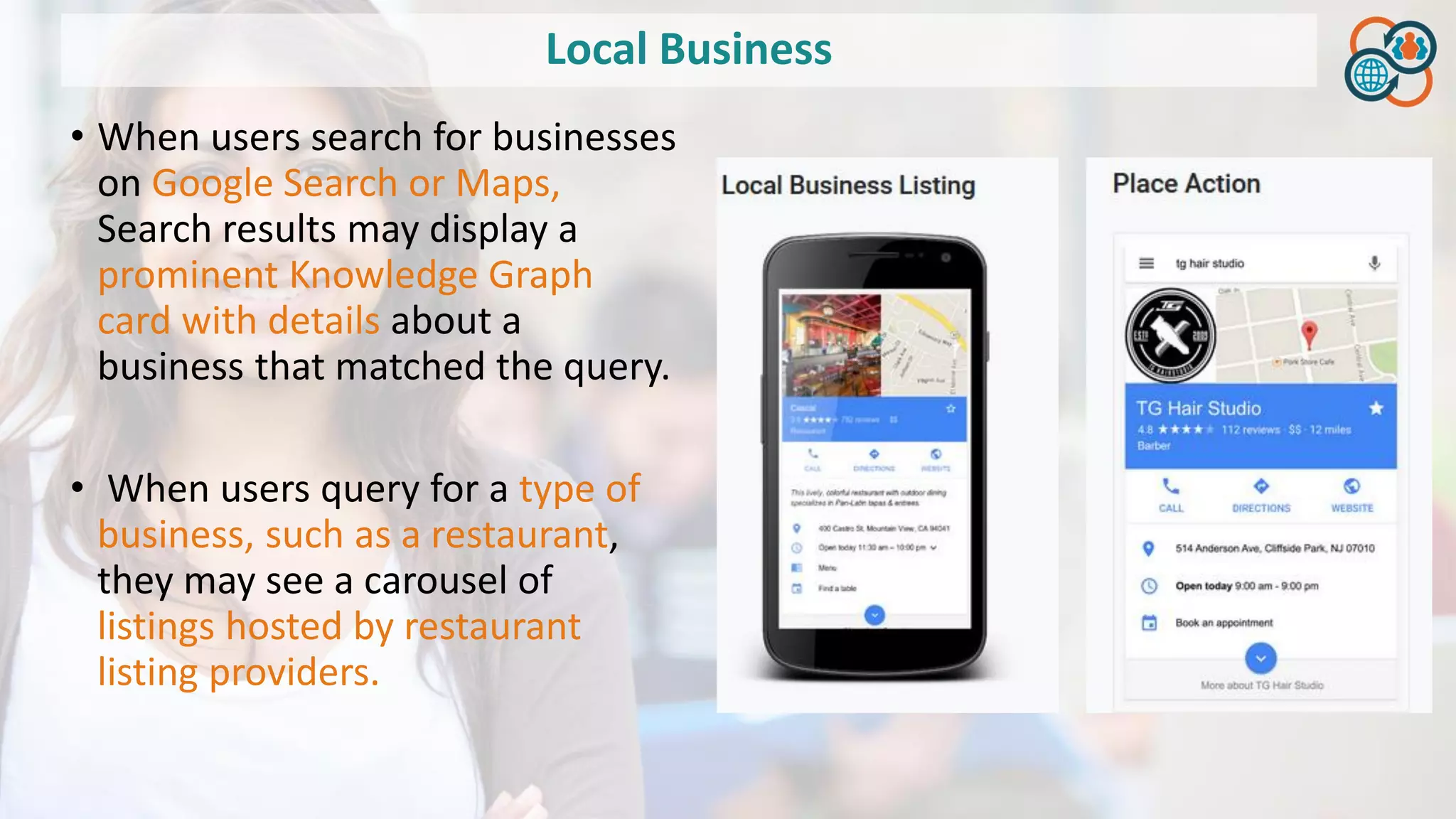
• When users search for businesses
on Google Search or Maps,
Search results may display a
prominent Knowledge Graph
card with details about a
business that matched the query.
• When users query for a type of
business, such as a restaurant,
they may see a carousel of
listings hosted by restaurant
listing providers.
Music
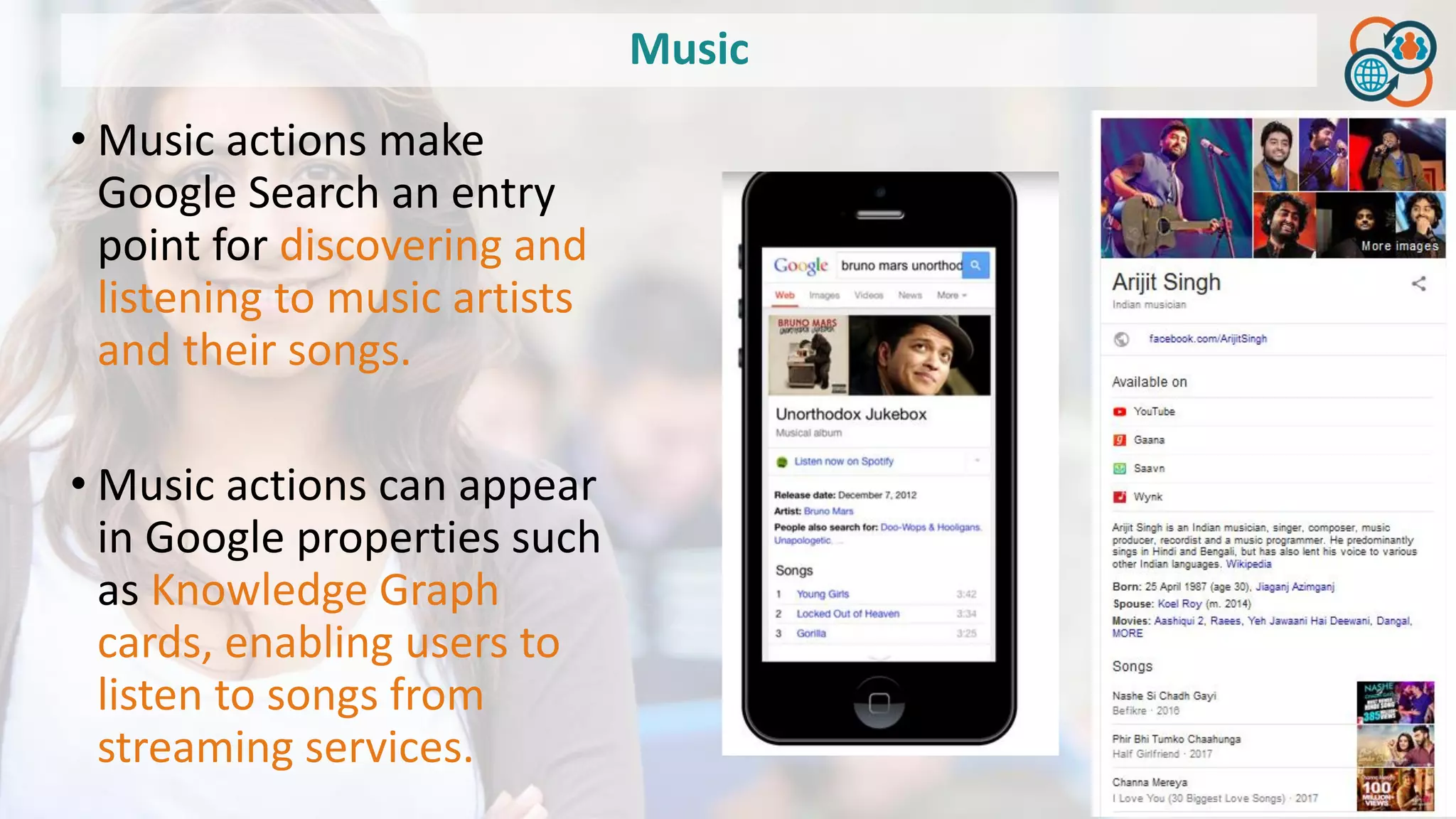
• Music actions make
Google Search an entry
point for discovering and
listening to music artists
and their songs.
• Music actions can appear
in Google properties such
as Knowledge Graph
cards, enabling users to
listen to songs from
streaming services.
Podcast
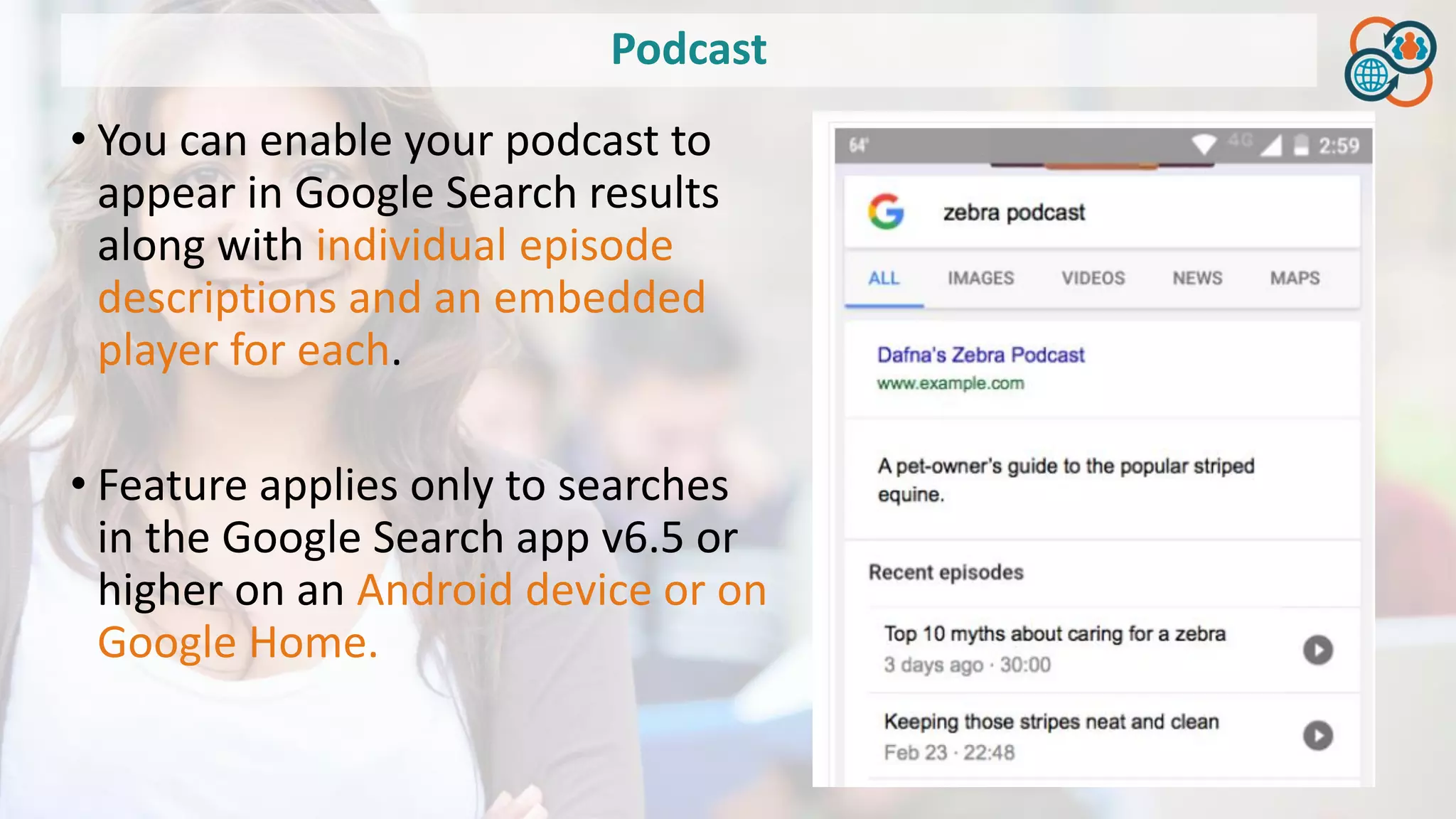
• You can enable your podcast to
appear in Google Search results
along with individual episode
descriptions and an embedded
player for each.
• Feature applies only to searches
in the Google Search app v6.5 or
higher on an Android device or on
Google Home.
Product
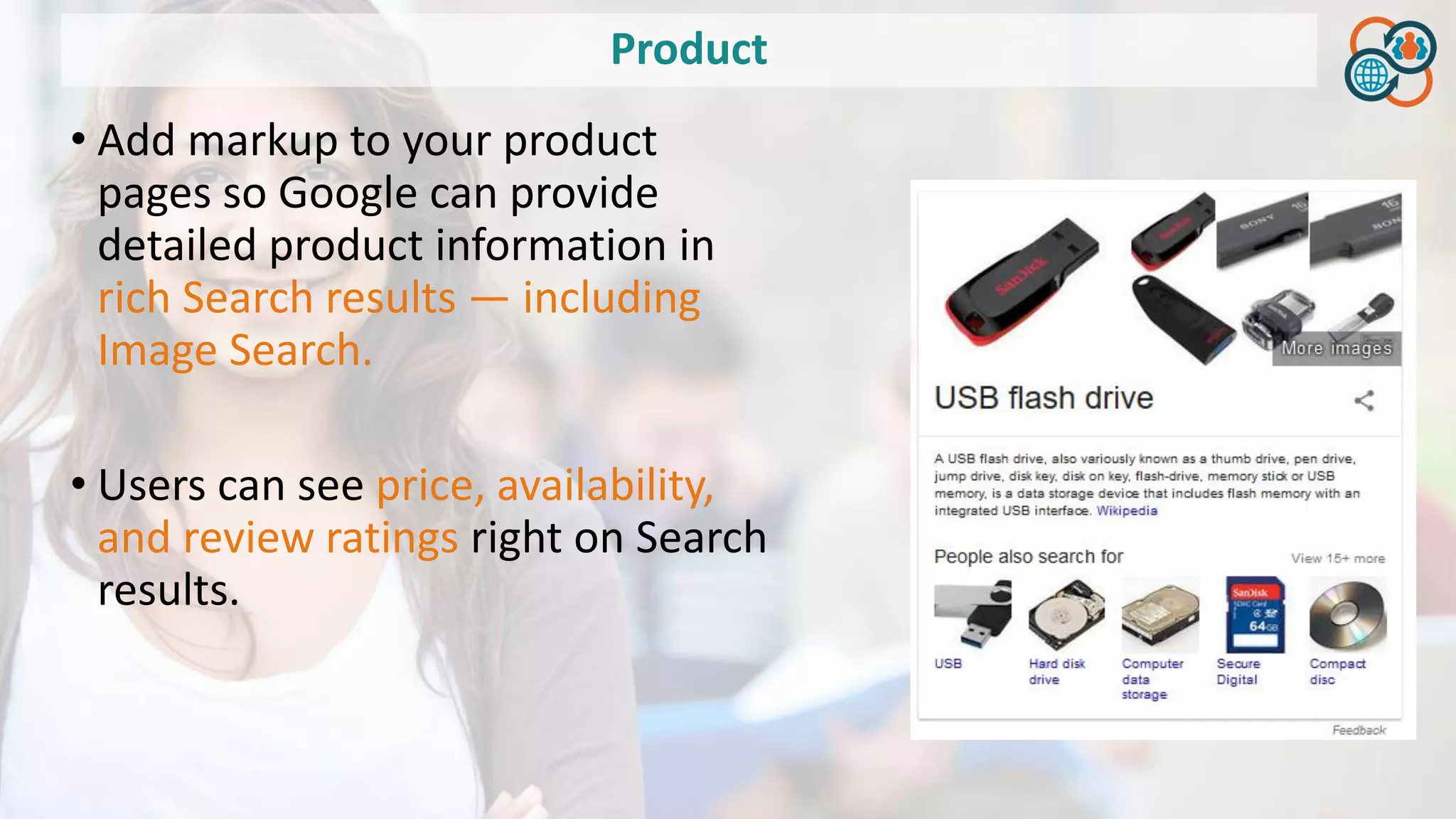
• Add markup to your product
pages so Google can provide
detailed product information in
rich Search results — including
Image Search.
• Users can see price, availability,
and review ratings right on Search
results.
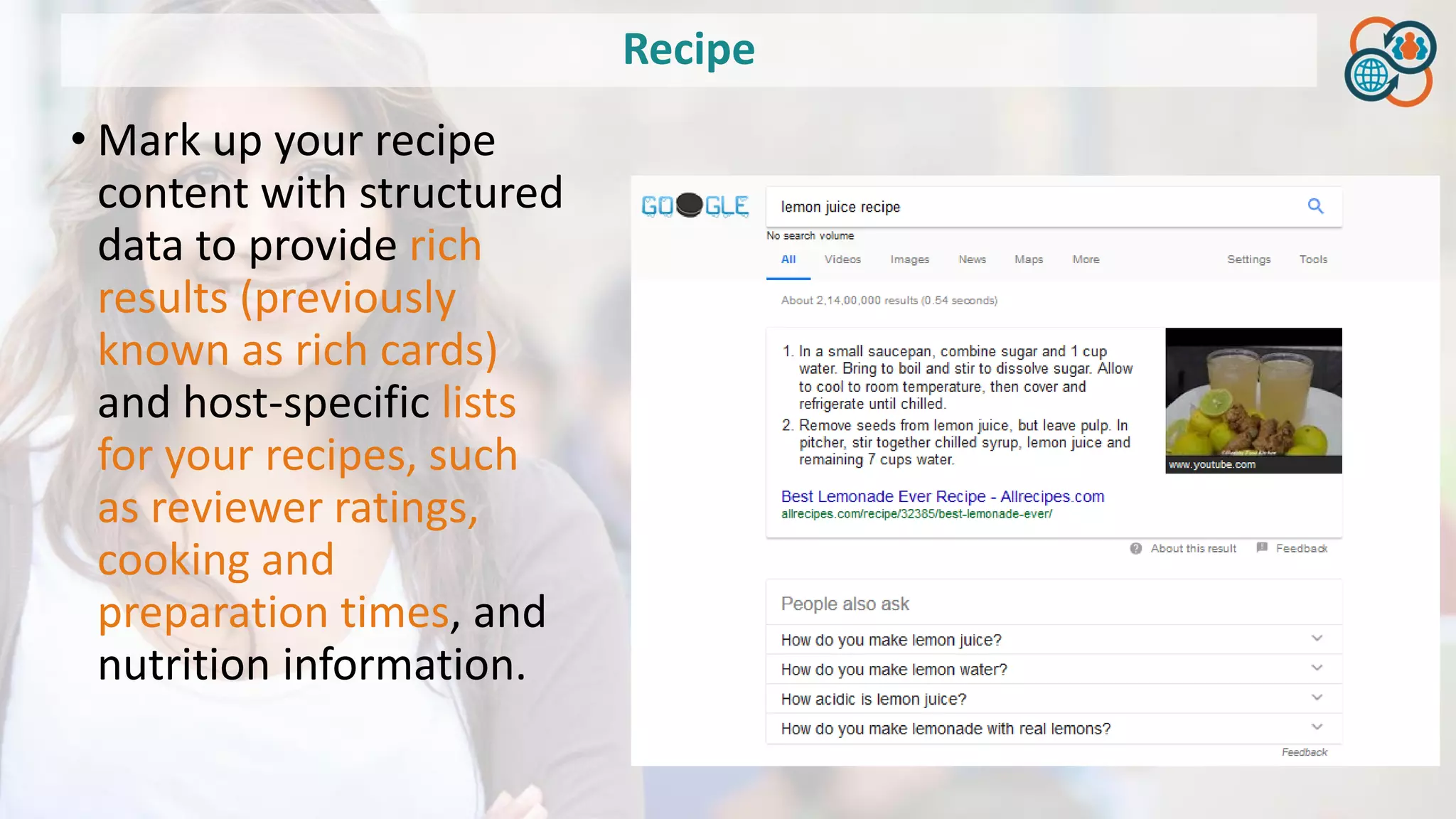
Recipe
• Mark up your recipe
content with structured
data to provide rich
results (previously
known as rich cards)
and host-specific lists
for your recipes, such
as reviewer ratings,
cooking and
preparation times, and
nutrition information.
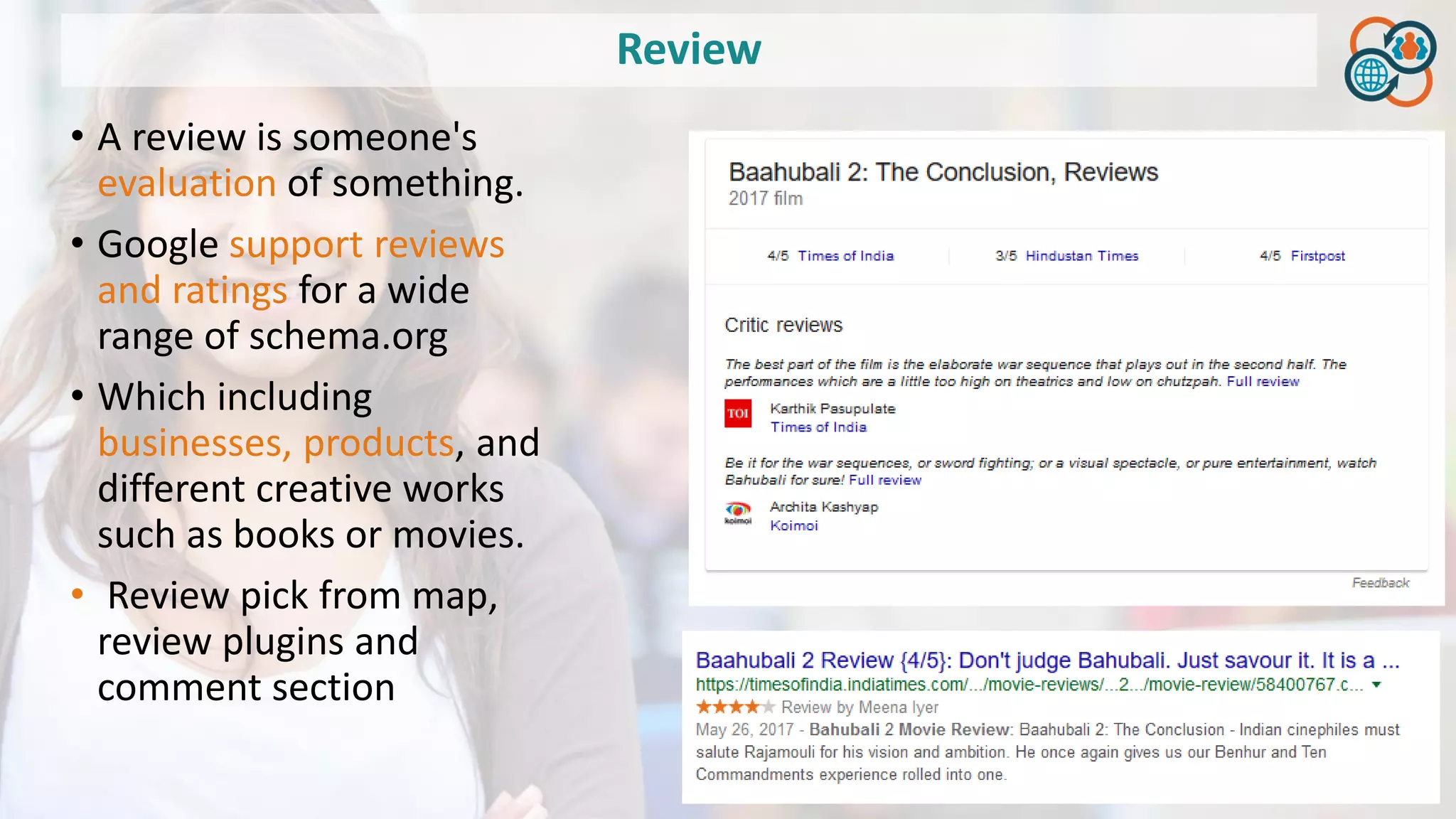
Review
• A review is someone's
evaluation of something.
• Google support reviews
and ratings for a wide
range of schema.org
• Which including
businesses, products, and
different creative works
such as books or movies.
• Review pick from map,
review plugins and
comment section
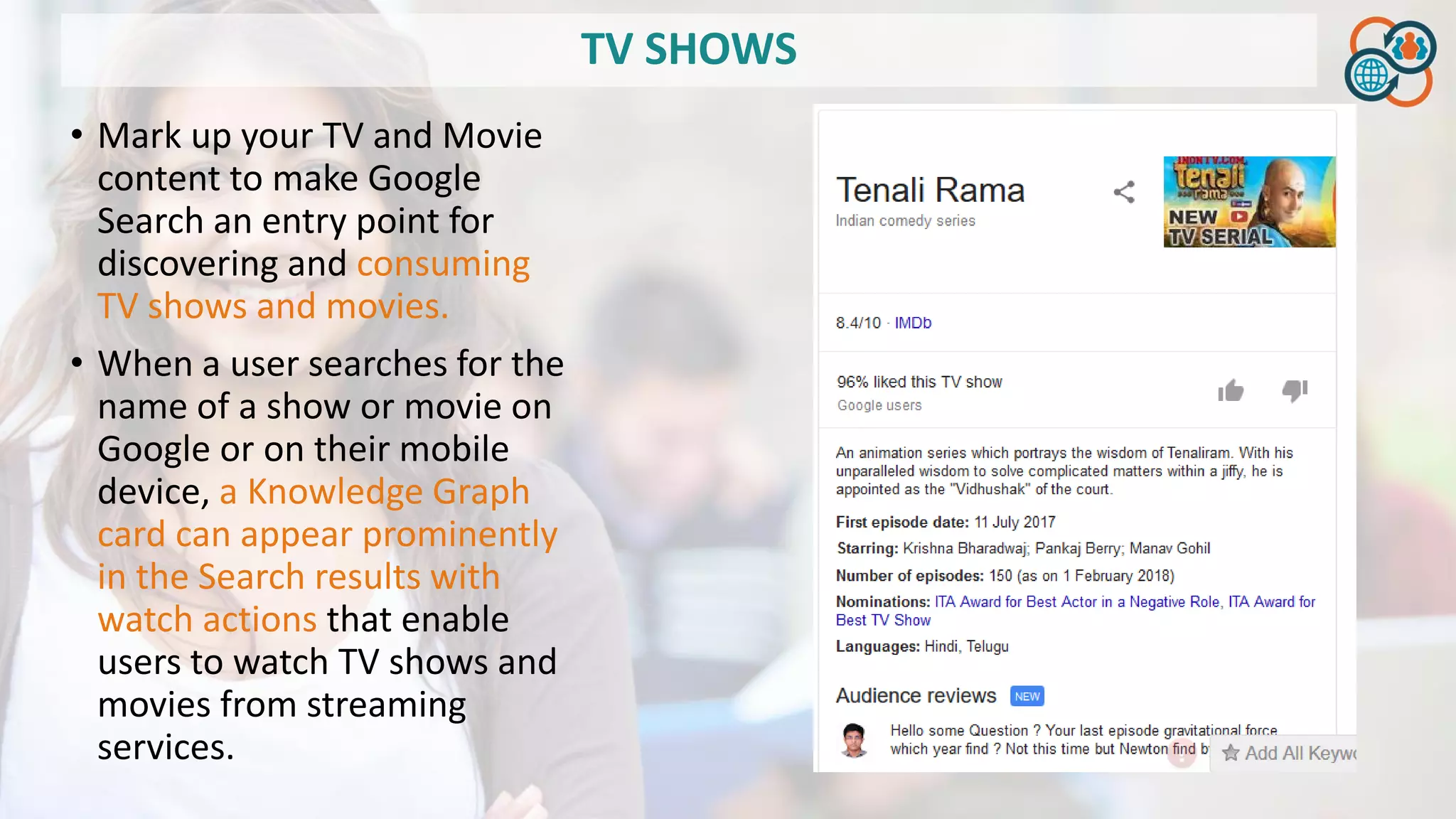
TV SHOWS
• Mark up your TV and Movie
content to make Google
Search an entry point for
discovering and consuming
TV shows and movies.
• When a user searches for the
name of a show or movie on
Google or on their mobile
device, a Knowledge Graph
card can appear prominently
in the Search results with
watch actions that enable
users to watch TV shows and
movies from streaming
services.
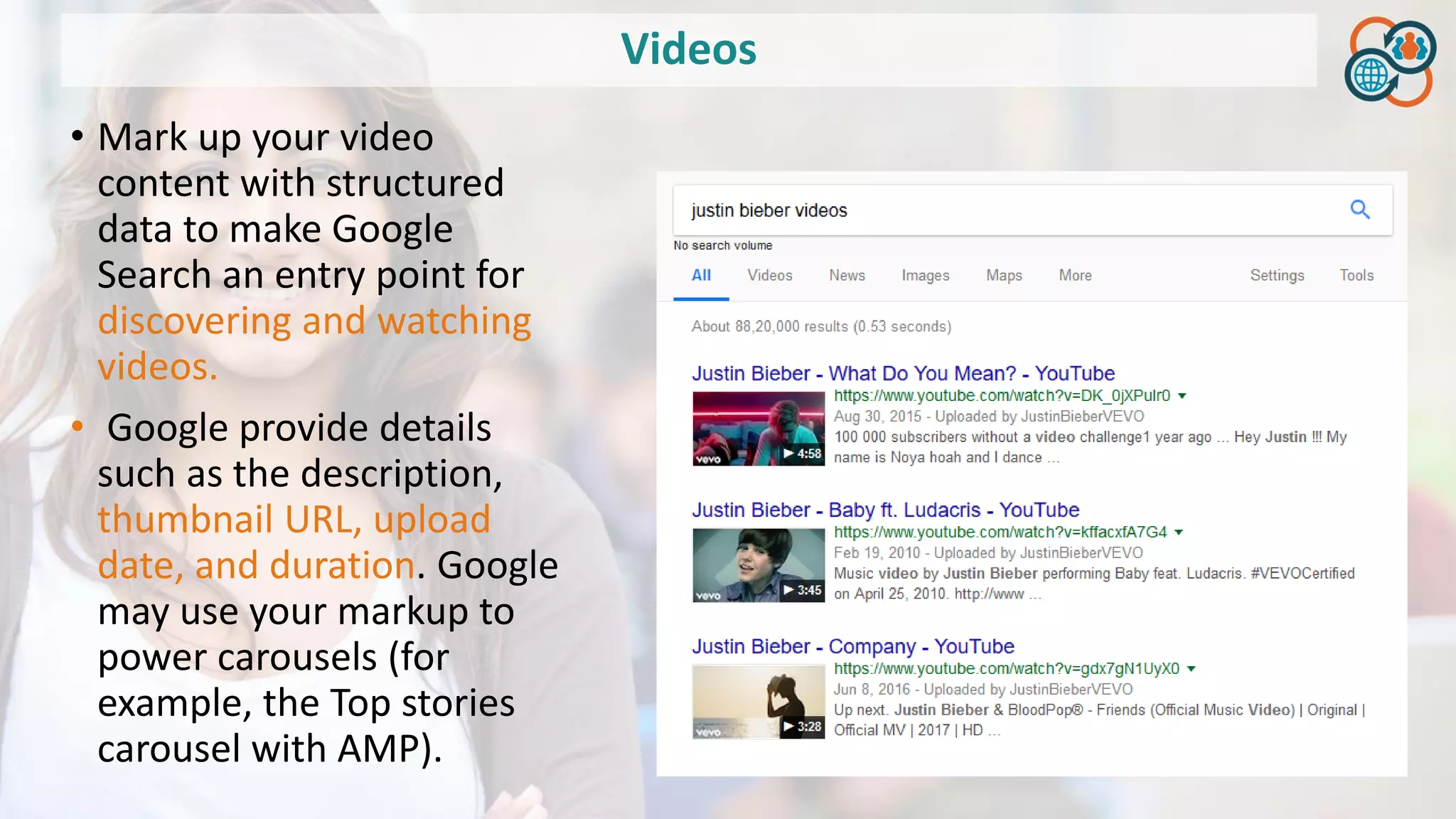
Videos
• Mark up your video
content with structured
data to make Google
Search an entry point for
discovering and watching
videos.
• Google provide details
such as the description,
thumbnail URL, upload
date, and duration. Google
may use your markup to
power carousels (for
example, the Top stories
carousel with AMP).
Beta Feature Snippet
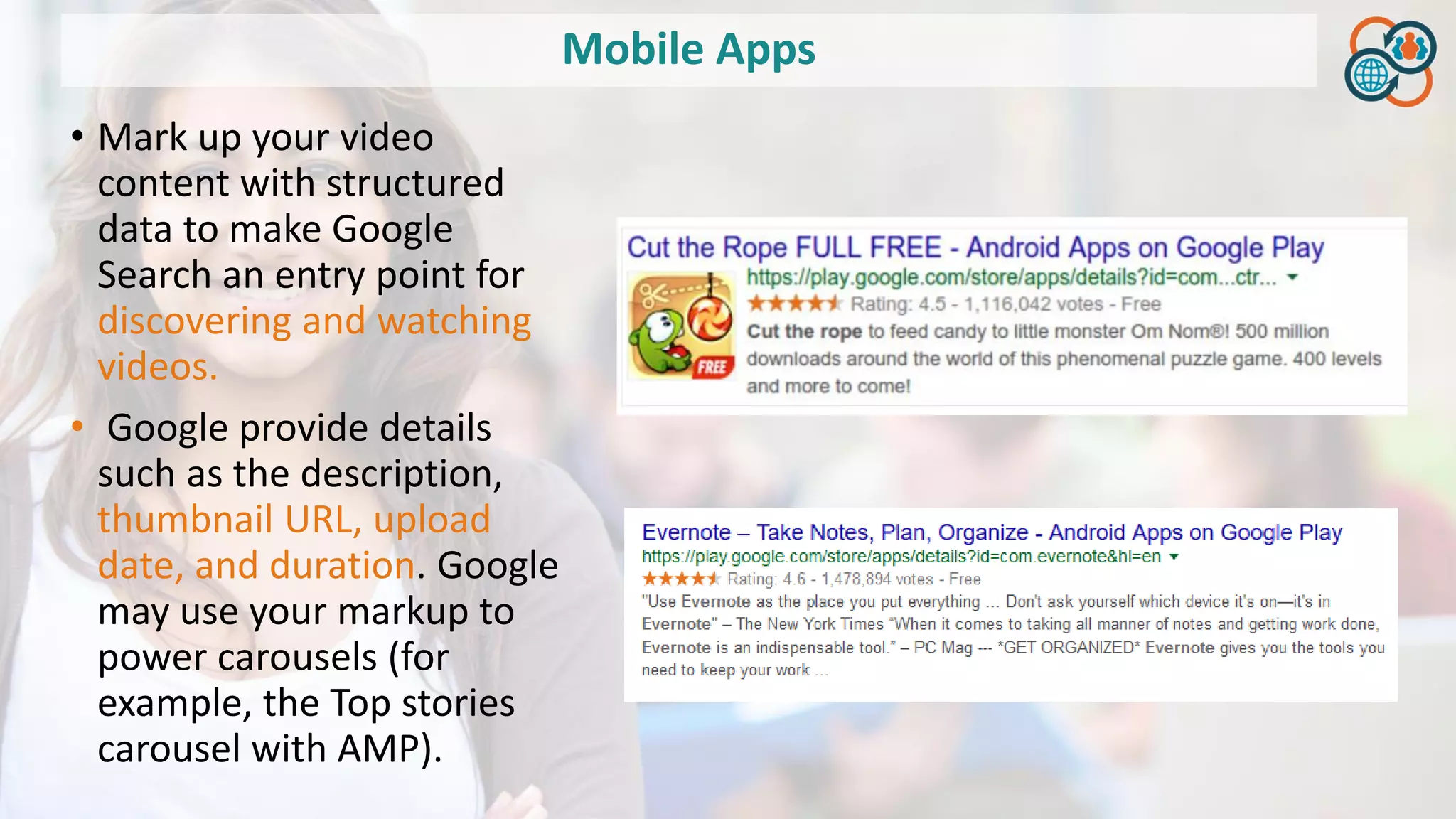
Mobile Apps
• Mark up your video
content with structured
data to make Google
Search an entry point for
discovering and watching
videos.
• Google provide details
such as the description,
thumbnail URL, upload
date, and duration. Google
may use your markup to
power carousels (for
example, the Top stories
carousel with AMP).
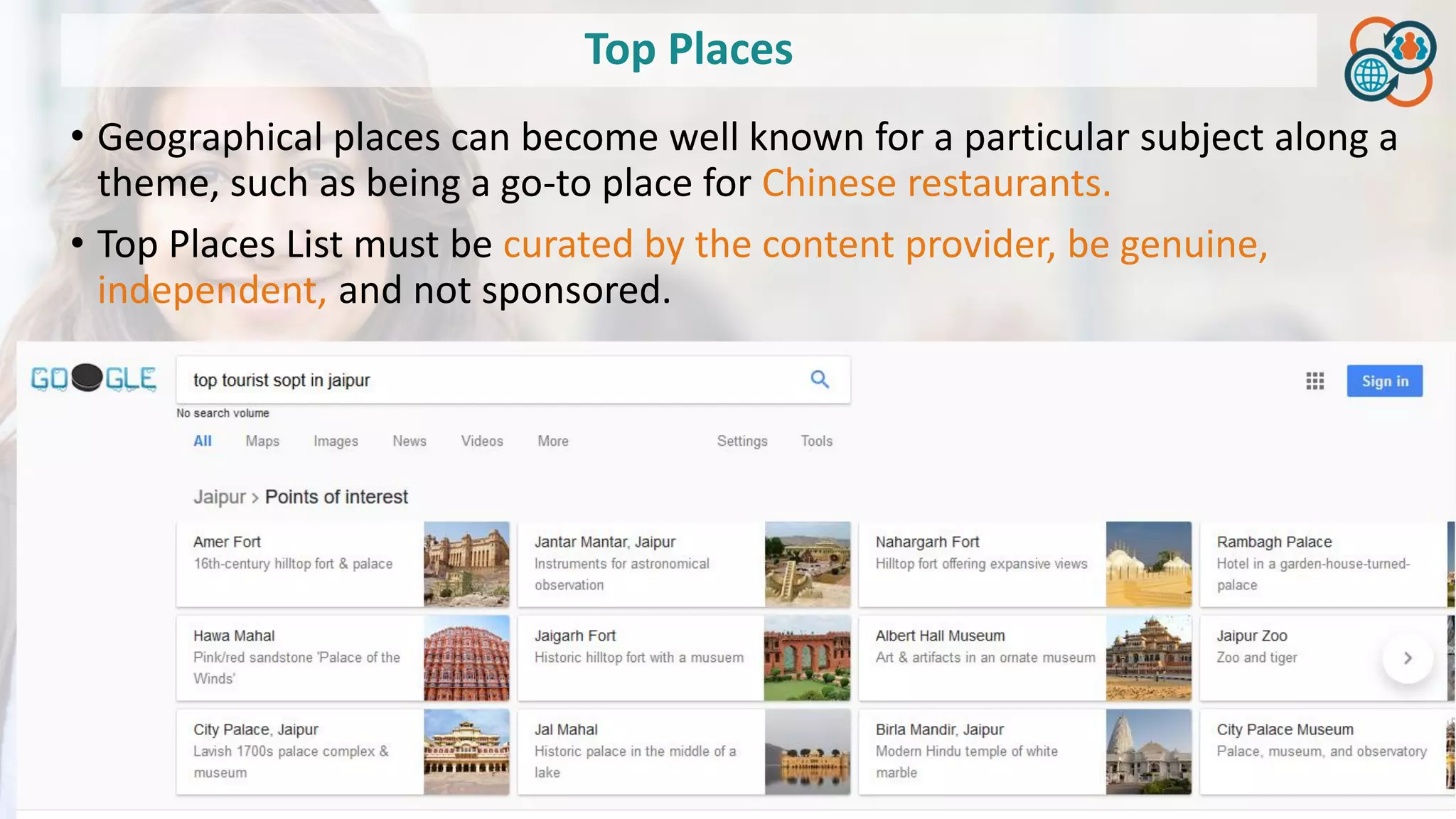
Top Places
• Geographical places can become well known for a particular subject along a
theme, such as being a go-to place for Chinese restaurants.
• Top Places List must be curated by the content provider, be genuine,
independent, and not sponsored.
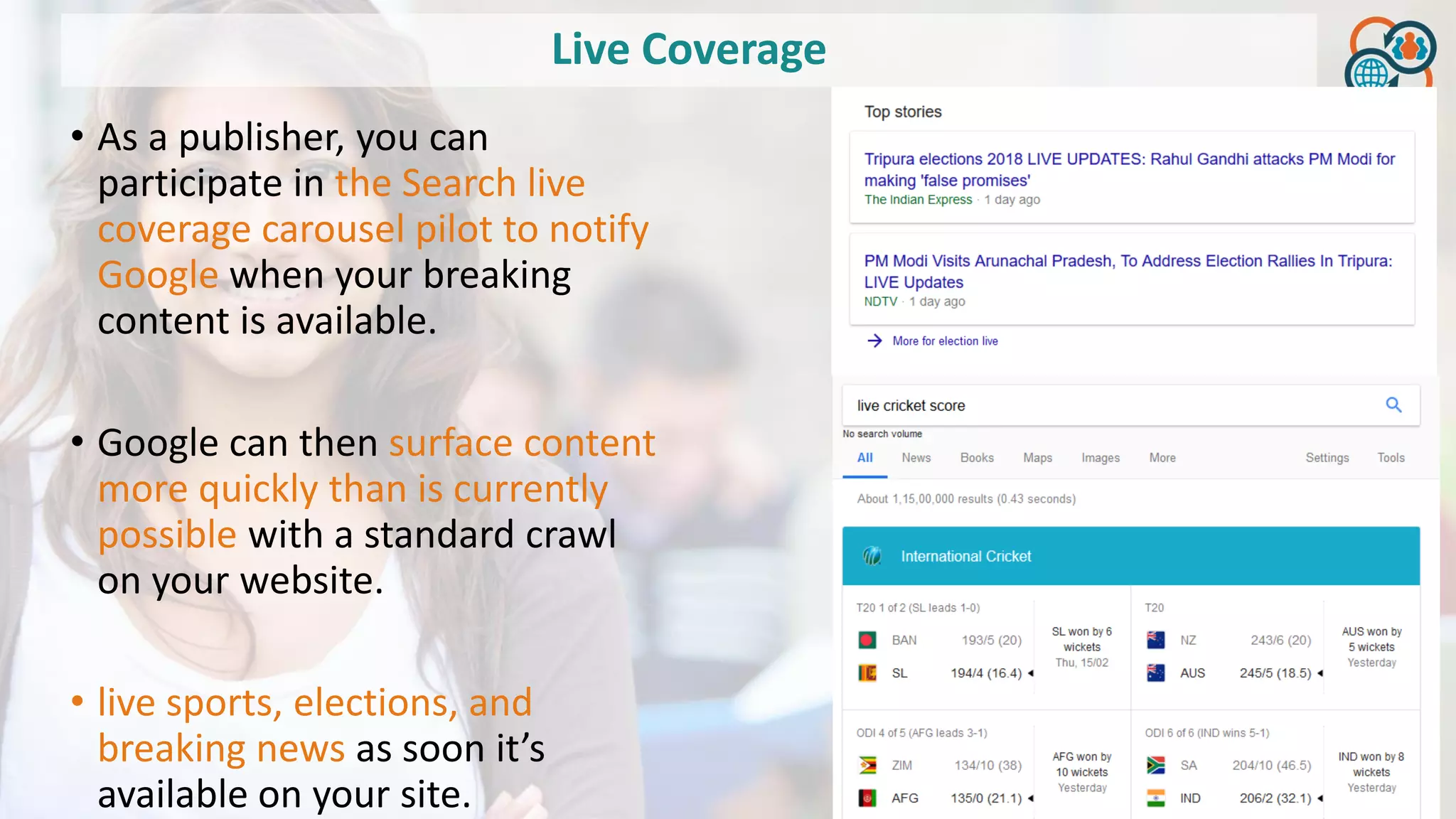
Live Coverage
• As a publisher, you can
participate in the Search live
coverage carousel pilot to notify
Google when your breaking
content is available.
• Google can then surface content
more quickly than is currently
possible with a standard crawl
on your website.
• live sports, elections, and
breaking news as soon it’s
available on your site.
Reasons Why Your Rich
Snippets Aren’t Showing
How to Test if Markup
Implementation Is Accurate
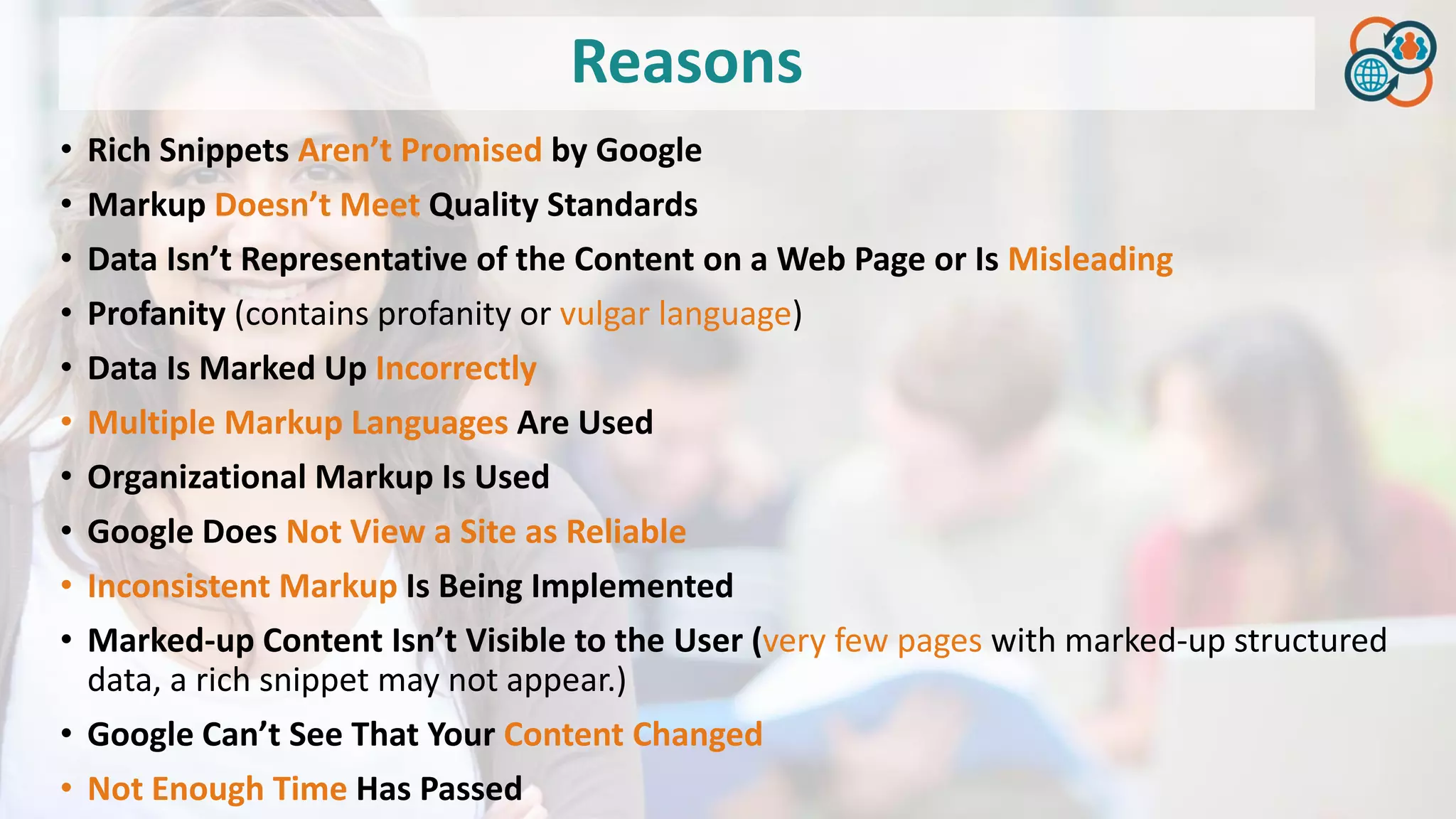
Reasons
• Rich Snippets Aren’t Promised by Google
• Markup Doesn’t Meet Quality Standards
• Data Isn’t Representative of the Content on a Web Page or Is Misleading
• Profanity (contains profanity or vulgar language)
• Data Is Marked Up Incorrectly
• Multiple Markup Languages Are Used
• Organizational Markup Is Used
• Google Does Not View a Site as Reliable
• Inconsistent Markup Is Being Implemented
• Marked-up Content Isn’t Visible to the User (very few pages with marked-up structured
data, a rich snippet may not appear.)
• Google Can’t See That Your Content Changed
• Not Enough Time Has Passed
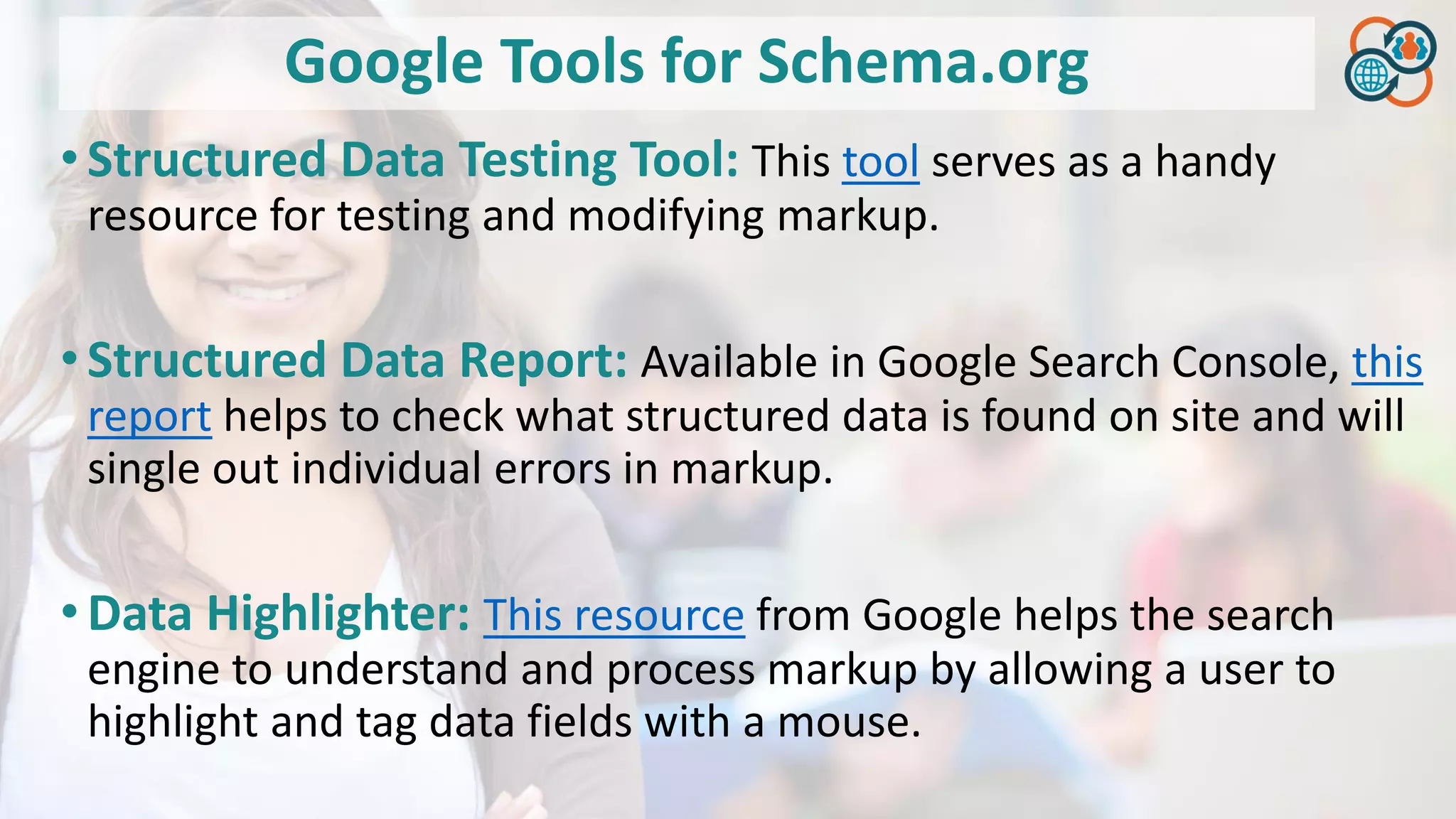
Google Tools for Schema.org
•Structured Data Testing Tool: This tool serves as a handy
resource for testing and modifying markup.
•Structured Data Report: Available in Google Search Console, this
report helps to check what structured data is found on site and will
single out individual errors in markup.
•Data Highlighter: This resource from Google helps the search
engine to understand and process markup by allowing a user to
highlight and tag data fields with a mouse.
Tools for working with Schema .org
• Generators
• Google Data Highlighter
• Google Structured Data Markup Helper
• JSON-LD Schema Generator by Hall Analysis
• Validators and test tools
• Yandex Structured data markup
• Yandex Structured data validator API
• Structured Data Testing Tool
• Google Search Console Rich Cards
• WordPress Plugins
• Yoast SEO Local (Our Local SEO plugin adds Schema.org for your business details, like
address, geo-location, opening hours, etc.)
• Yoast SEO (Yoast SEO uses JSON-LD to add Schema.org information about your site
search, your site name, your logo and your social profiles to your web pages.)
Benefit of Structured SERP
• Improve Your SERPs – Improving your SERPS or search engine search pages
means that the more your web site’s content is indexed by the search
engines, the higher your pages will rank on search engine searches.
• Increased Conversions – The more visitors you have to your web site, the
more likely they are to make purchases, which will greatly improve your
conversion rate. Increase your CTR – Improving your SERPs will lead directly
to an improved CTR or click through ratio. The higher your web site ranks on
the search results, the more likely it is that people will click through.
• Better ROI – By increasing your search engine rankings, click through ratio
and conversion rate, the inevitable result is an increased return on your
investment.
Google AMP
https://www.youtube.com/watch?v=RV7x6buCrHA
https://www.youtube.com/watch?time_continue=348&v=0f5E
A0y285w
Google AMP
• Google AMP stands for Accelerated Mobile Pages. It is an open source
initiative supported by technology companies like Google and Twitter.
• The goal of the project is to make web content load faster for mobile
users.
• For many mobile users, reading on the web is often slow. Most content
rich pages take several seconds to load despite all efforts taken by site
owners to speed up their website.
• Accelerated Mobile Pages or AMP uses bare minimal HTML and limited
Javascript. This allows the content to be hosted on Google AMP Cache.
• Accelerated Mobile Pages are platform-agnostic and can be used by any
app, browser, or web viewer. Currently it is used by Google, Twitter,
LinkedIn, Reddit, and others.

seo - on page - part iii - snippet &amp; amp

  • 1.
    Google Snippet & AMP Tools: https://wpschema.com/schema-types/ Google Tool :https://developers.google.com/search/docs/guides/ Structure data testing tool :https://search.google.com/structured-data/testing-tool
  • 2.
    SEO Element onPage(Keyword Based) Title Optimization (Meta Tag) Meta Description (Meta Tag) Head Line Tags Anchor Tags No Follow & DO Follow Links URL Optimization Page Hierarchy Internal Linking Robots. txt Re direction Links Meta Optimization Image Optimization Site Structure XML Sitemap 404 Error Page Footer Optimization Canonical Links External Linking HTML Sitemap Breadcrumbs Mobile Friendly Site
  • 3.
  • 4.
    Rich Snippet •Rich Snippetsis the term used to describe structured data markup that site operators can add to their existing HTML, which in turn allow search engines to better understand what information is contained on each web page. •Structured data exists to solve this context problem and explicitly tells search engines exactly what’s what on your site. • Schema Markup Makes Your Content More Visible In Search Engines
  • 5.
    Content Supported byRich Snippet • Jason LD (Recommended) - JavaScript notation embedded in a <script> tag in the page head or body. The markup is not interleaved with the user-visible text, which makes nested data items easier to express, such as the Country of a Postal Address of a Music Venue of an Event. Also, Google can read JSON-LD data when it is dynamically injected into the page's contents, such as by JavaScript code or embedded widgets in your content management system. • Microdata- An open-community HTML specification used to nest structured data within HTML content. Like RDFa, it uses HTML tag attributes to name the properties you want to expose as structured data. It is typically used in the page body, but can be used in the head. •RDFa - HTML5 extension that supports linked data by introducing HTML tag attributes that correspond to the user-visible content that you want to describe for search engines. RDFa is commonly used in both the head and body sections of the HTML page.
  • 6.
    Content Supported byRich Snippet • Structured data markup makes us of three primary elements: •itemscope – which specifies that the HTML contained in the <div> block is about a particular item, •itemtype – which indicates exactly what kind of item it is, and •itemprop – which is the specific property, such as name, URL, review, etc.
  • 7.
  • 8.
  • 9.
  • 10.
  • 11.
  • 12.
    Types of RichSnippet •Content type: Many search features are tied to the topic of your page. For example, if the page has a recipe or a news article, or contains information about an event or a book. Google Search results can then apply content- specific features such as making your page eligible to appear in a top news stories carousel, a recipe carousel, or an events list. •Enhancements: These are features that, can be applied to more than one kind of content type. For example, providing review stars for a recipe or movie, or exposing a carousel of rich results (previously known as rich cards).
  • 13.
    “No guarantee thatyour page will appear in Search results with the specified feature”. This is because search features depend on many factors, including the search device type, location, and whether Google thinks the feature would provide the best search experience for the user.
  • 14.
  • 15.
    Bread Crumb •A breadcrumbtrail on a page indicates the page's position in the site hierarchy. • Google Search uses breadcrumb markup in the body of a web page to categorize the information from the page •Breadcrumb categorizes the content within the context of the Google Search query.
  • 16.
    Sitelinks Search box •Google Search can expose a search box scoped to your website when it appears as a search result. This search box is powered by Google Search. • Search users sometimes enter the brand name or URL of a known site or app, only to do a more detailed search once they reach their destination. For example, users searching for pizza pins on Pinterest
  • 17.
    Corporate Contact • Usecorporate contact markup on your official website to add your company's contact information to the Google Knowledge panel in some searches, • Number may be Toll-free ,Serves the hearing-impaired , Specific to a country or countries • Supported phone numbers - customer service , technical support , billing support , bill payment , sales reservations , credit card support , emergency , baggage tracking , roadside assistance , package tracking.
  • 18.
    Logos • Specify theimage Google Search uses for your organization's logo in Search results and in the Knowledge Graph. • Markup in the use case example to recognize the image to use as the organization’s logo. • the image appears in search results about the company. • Markup like this is a strong signal to Google Search algorithms to show this image in Knowledge Graph displays.
  • 19.
    Social Profile • Usemarkup on your official website to add your social profile information to a Google Knowledge panel. • Supported Social Profiles • Facebook • Twitter • Google+ • Instagram • YouTube • LinkedIn • Myspace • Pinterest • Sound Cloud • Tumblr
  • 20.
    Carousels • Structured datato make your rich results (previously known as rich cards) eligible for a list- like display called a carousel. • Carousels typically appear only on mobile devices, and only for certain content types, as described below. • Google Search may display your rich result inside a carousel even if the page does not include structured data for a list: for example, a recipe might appear in a recipes carousel of results from many different websites.
  • 21.
  • 22.
    Content Based RichSnippet Article Books Course Dataset FAQ’s Events Video Job Posting Local Business Music Occupation Pay walled Content Podcast Product Recipe Review TV & Movie Software App Top Places Live Coverage
  • 23.
    Article • Proper structureddata in your news, blog, and sports article page can enhance your appearance in Google Search results. • Enhanced features include entry in a top stories carousel and rich result features such as headline text and larger-than-thumbnail images. • AMP with structured data (Recommended) • Non-AMP page with structured data
  • 24.
    Books • Book actionsmake Google Search an entry point for discovering books and authors, enabling Search users to quickly buy the books that they find directly from Search results. • For relevant queries, we might show a Knowledge Graph card for the book. • Provide structured data about your book content, including relevant descriptions and links to consume the book content.
  • 25.
    Course • Mark upyour course lists with structured data so prospective students find you through Google Search. • You provide details including the course name, who's offering it, and a short description. • Only use course markup for educational content that fits the following definition of a course:
  • 26.
    Events • Mark upyour organized events so that users can discover events through Google Search results and other Google products like Google Maps. • All types of events through markup — from performances by famous artists, to a neighborhood salsa class. Adding markup to your events makes it easier for users to discover and attend your event.
  • 27.
    Job Posting • Youcan improve the job seeking experience by adding job posting structured data to your job posting web pages. • You can also integrate with Google by using a third party job site. • For employers and job content site owners: - Prominent place in Search results - More, motivated applicants - Increased chances of discovery
  • 28.
    Local Business • Whenusers search for businesses on Google Search or Maps, Search results may display a prominent Knowledge Graph card with details about a business that matched the query. • When users query for a type of business, such as a restaurant, they may see a carousel of listings hosted by restaurant listing providers.
  • 29.
    Music • Music actionsmake Google Search an entry point for discovering and listening to music artists and their songs. • Music actions can appear in Google properties such as Knowledge Graph cards, enabling users to listen to songs from streaming services.
  • 30.
    Podcast • You canenable your podcast to appear in Google Search results along with individual episode descriptions and an embedded player for each. • Feature applies only to searches in the Google Search app v6.5 or higher on an Android device or on Google Home.
  • 31.
    Product • Add markupto your product pages so Google can provide detailed product information in rich Search results — including Image Search. • Users can see price, availability, and review ratings right on Search results.
  • 32.
    Recipe • Mark upyour recipe content with structured data to provide rich results (previously known as rich cards) and host-specific lists for your recipes, such as reviewer ratings, cooking and preparation times, and nutrition information.
  • 33.
    Review • A reviewis someone's evaluation of something. • Google support reviews and ratings for a wide range of schema.org • Which including businesses, products, and different creative works such as books or movies. • Review pick from map, review plugins and comment section
  • 34.
    TV SHOWS • Markup your TV and Movie content to make Google Search an entry point for discovering and consuming TV shows and movies. • When a user searches for the name of a show or movie on Google or on their mobile device, a Knowledge Graph card can appear prominently in the Search results with watch actions that enable users to watch TV shows and movies from streaming services.
  • 35.
    Videos • Mark upyour video content with structured data to make Google Search an entry point for discovering and watching videos. • Google provide details such as the description, thumbnail URL, upload date, and duration. Google may use your markup to power carousels (for example, the Top stories carousel with AMP).
  • 36.
  • 37.
    Mobile Apps • Markup your video content with structured data to make Google Search an entry point for discovering and watching videos. • Google provide details such as the description, thumbnail URL, upload date, and duration. Google may use your markup to power carousels (for example, the Top stories carousel with AMP).
  • 38.
    Top Places • Geographicalplaces can become well known for a particular subject along a theme, such as being a go-to place for Chinese restaurants. • Top Places List must be curated by the content provider, be genuine, independent, and not sponsored.
  • 39.
    Live Coverage • Asa publisher, you can participate in the Search live coverage carousel pilot to notify Google when your breaking content is available. • Google can then surface content more quickly than is currently possible with a standard crawl on your website. • live sports, elections, and breaking news as soon it’s available on your site.
  • 40.
    Reasons Why YourRich Snippets Aren’t Showing
  • 41.
    How to Testif Markup Implementation Is Accurate
  • 42.
    Reasons • Rich SnippetsAren’t Promised by Google • Markup Doesn’t Meet Quality Standards • Data Isn’t Representative of the Content on a Web Page or Is Misleading • Profanity (contains profanity or vulgar language) • Data Is Marked Up Incorrectly • Multiple Markup Languages Are Used • Organizational Markup Is Used • Google Does Not View a Site as Reliable • Inconsistent Markup Is Being Implemented • Marked-up Content Isn’t Visible to the User (very few pages with marked-up structured data, a rich snippet may not appear.) • Google Can’t See That Your Content Changed • Not Enough Time Has Passed
  • 43.
    Google Tools forSchema.org •Structured Data Testing Tool: This tool serves as a handy resource for testing and modifying markup. •Structured Data Report: Available in Google Search Console, this report helps to check what structured data is found on site and will single out individual errors in markup. •Data Highlighter: This resource from Google helps the search engine to understand and process markup by allowing a user to highlight and tag data fields with a mouse.
  • 44.
    Tools for workingwith Schema .org • Generators • Google Data Highlighter • Google Structured Data Markup Helper • JSON-LD Schema Generator by Hall Analysis • Validators and test tools • Yandex Structured data markup • Yandex Structured data validator API • Structured Data Testing Tool • Google Search Console Rich Cards • WordPress Plugins • Yoast SEO Local (Our Local SEO plugin adds Schema.org for your business details, like address, geo-location, opening hours, etc.) • Yoast SEO (Yoast SEO uses JSON-LD to add Schema.org information about your site search, your site name, your logo and your social profiles to your web pages.)
  • 45.
    Benefit of StructuredSERP • Improve Your SERPs – Improving your SERPS or search engine search pages means that the more your web site’s content is indexed by the search engines, the higher your pages will rank on search engine searches. • Increased Conversions – The more visitors you have to your web site, the more likely they are to make purchases, which will greatly improve your conversion rate. Increase your CTR – Improving your SERPs will lead directly to an improved CTR or click through ratio. The higher your web site ranks on the search results, the more likely it is that people will click through. • Better ROI – By increasing your search engine rankings, click through ratio and conversion rate, the inevitable result is an increased return on your investment.
  • 46.
  • 47.
    Google AMP • GoogleAMP stands for Accelerated Mobile Pages. It is an open source initiative supported by technology companies like Google and Twitter. • The goal of the project is to make web content load faster for mobile users. • For many mobile users, reading on the web is often slow. Most content rich pages take several seconds to load despite all efforts taken by site owners to speed up their website. • Accelerated Mobile Pages or AMP uses bare minimal HTML and limited Javascript. This allows the content to be hosted on Google AMP Cache. • Accelerated Mobile Pages are platform-agnostic and can be used by any app, browser, or web viewer. Currently it is used by Google, Twitter, LinkedIn, Reddit, and others.