
• Definition: An internet-based tool that searches an index of documents for a
particular term, phrase or text specified by the user. Commonly used to refer to large web-
based search engines that search through billions of pages on the internet.
• Different than a Directory
• Common Characteristics:
• Spider, Indexer, Database, Algorithm
• Find matching documents and display them according to relevance
• Frequent updates to documents searched and ranking algorithm
• Strive to produce “better”, more relevant results than competitors
 Spider “crawls” the web to find new documents (web pages, other
documents) typically by following hyperlinks from websites already in
their database
 Search engines indexes the content (text, code) in these documents by
adding it to their databases and then periodically updates this content
 Search engines search their own databases when a user enters in a
search to find related documents (not searching web pages in real-
time)
 Search engines rank the resulting documents using an algorithm
(mathematical formula) by assigning various weights and ranking
factors
 SEO = Search Engine Optimization
◦ Refers to the process of “optimizing” both the on-page
and off-page ranking factors in order to achieve high
search engine rankings for targeted search terms.
◦ Refers to the “industry” that has been created regarding
using keyword searching a means of increasing relevant
traffic to a website
 Reverse engineering, research and experiments gives
SEOs (search engine optimization professionals) a
“pretty good” idea of the major factors and approximate
weight assignments
 The SEO algorithm is constantly changed, tweaked &
updated
 Websites and documents being searched are also
constantly changing
 Varies by Search Engine – some give more weight to on-
page factors, some to link popularity
 Research desirable keywords and search phrases
(WordTracker, Overture, Google AdWords)
 Identify search phrases to target (should be relevant to
business/market, obtainable and profitable)
 “Clean” and optimize a website’s HTML code for
appropriate keyword density, title tag optimization, internal
linking structure, headings and subheadings, etc.
 Help in writing copy to appeal to both search engines and
actual website visitors
 Study competitors (competing websites) and
search engines
 Implement a quality link building campaign
 Add Quality content
 Constant monitoring of rankings for targeted
search terms
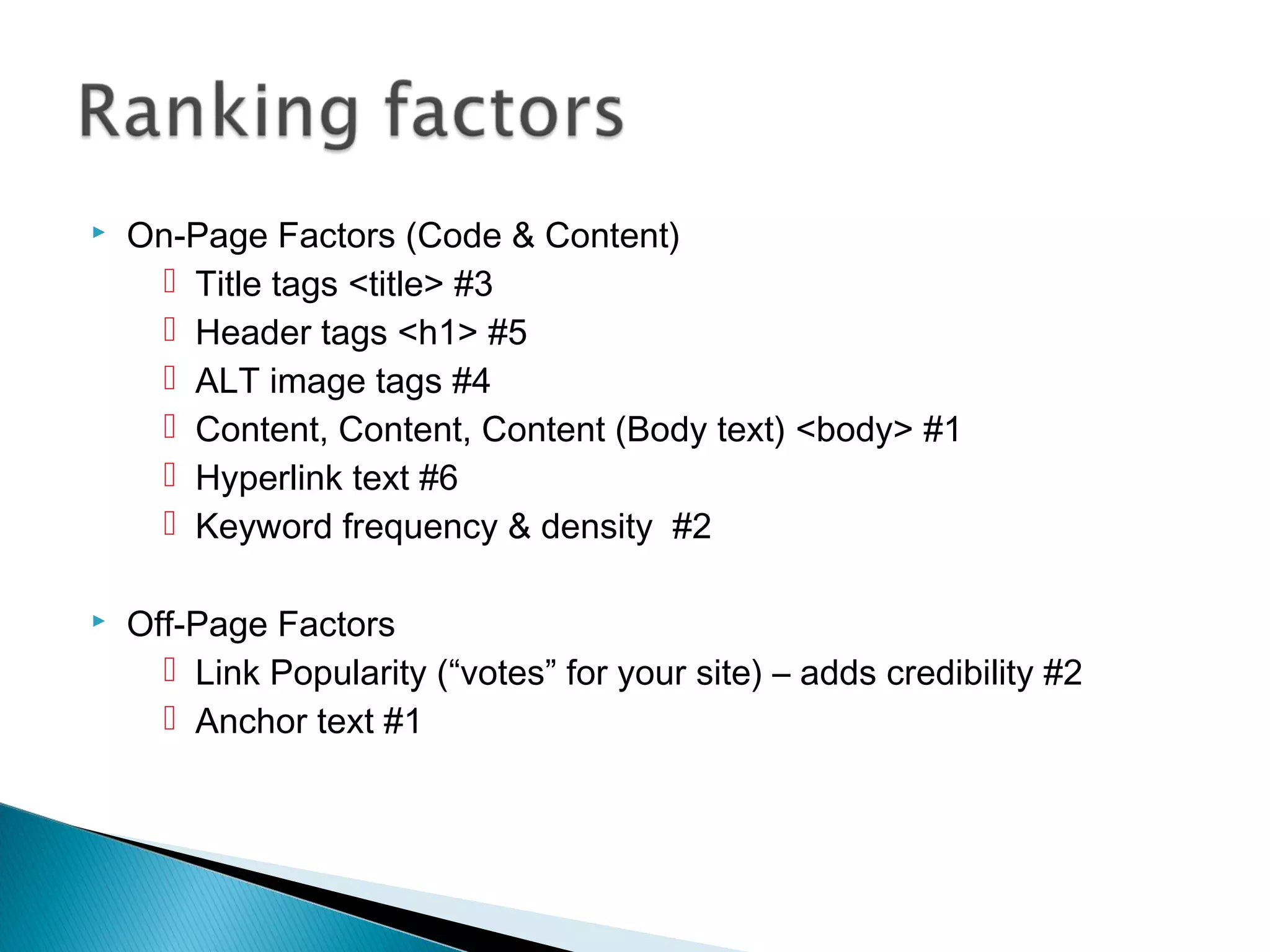
 On-Page Factors (Code & Content)
 Title tags <title> #3
 Header tags <h1> #5
 ALT image tags #4
 Content, Content, Content (Body text) <body> #1
 Hyperlink text #6
 Keyword frequency & density #2
 Off-Page Factors
 Link Popularity (“votes” for your site) – adds credibility #2
 Anchor text #1
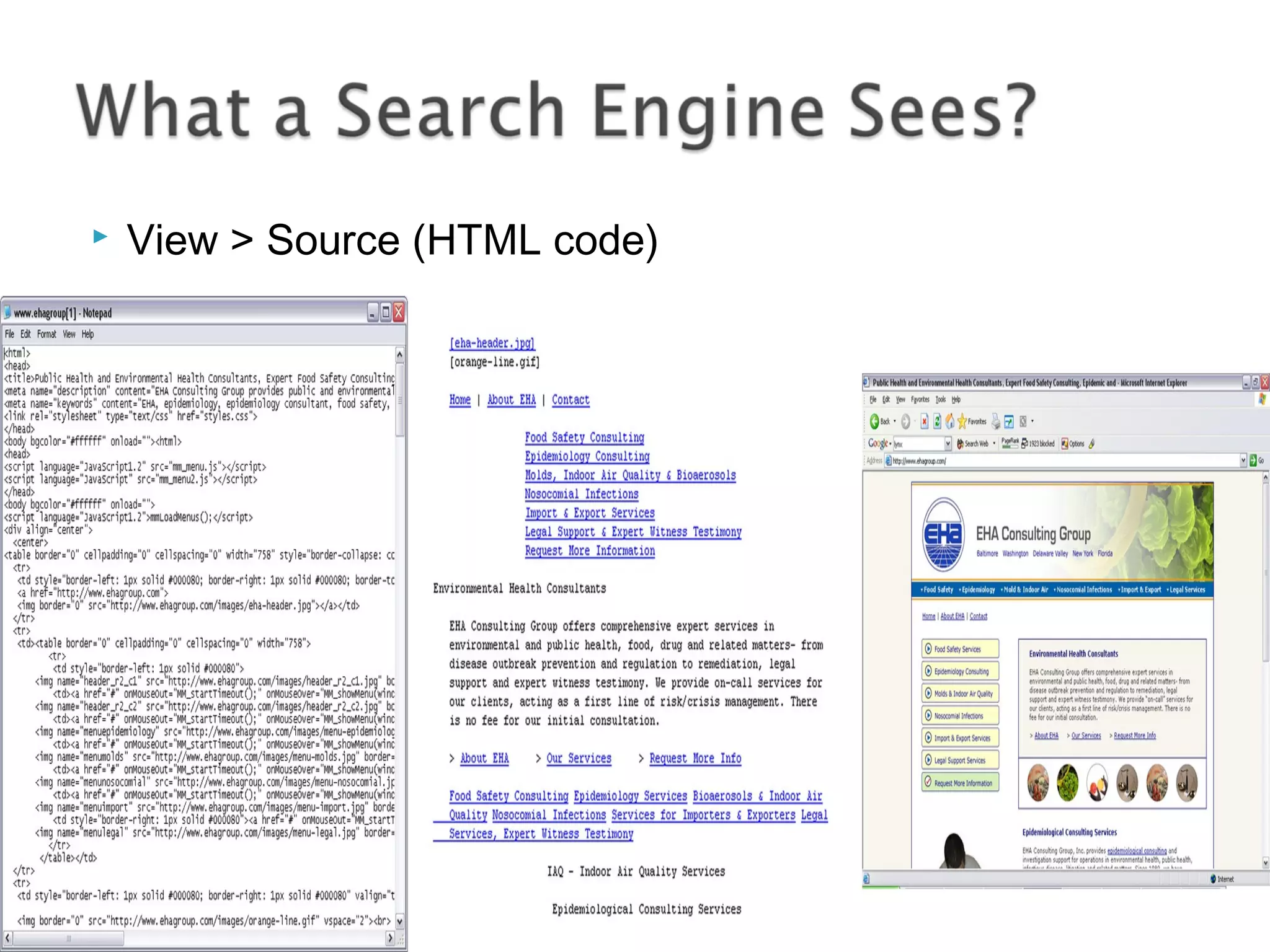
 View > Source (HTML code)
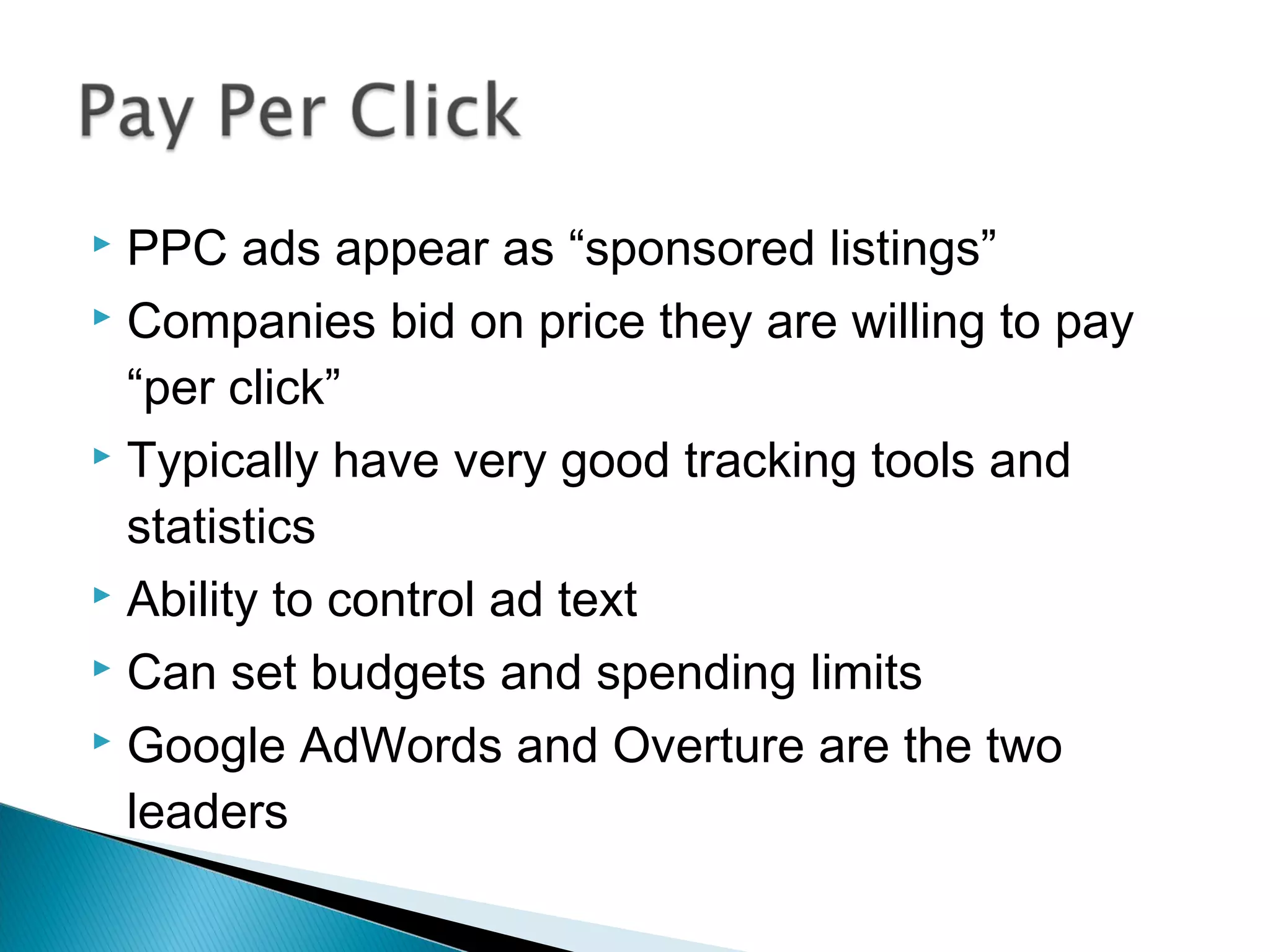
 PPC ads appear as “sponsored listings”
 Companies bid on price they are willing to pay
“per click”
 Typically have very good tracking tools and
statistics
 Ability to control ad text
 Can set budgets and spending limits
 Google AdWords and Overture are the two
leaders
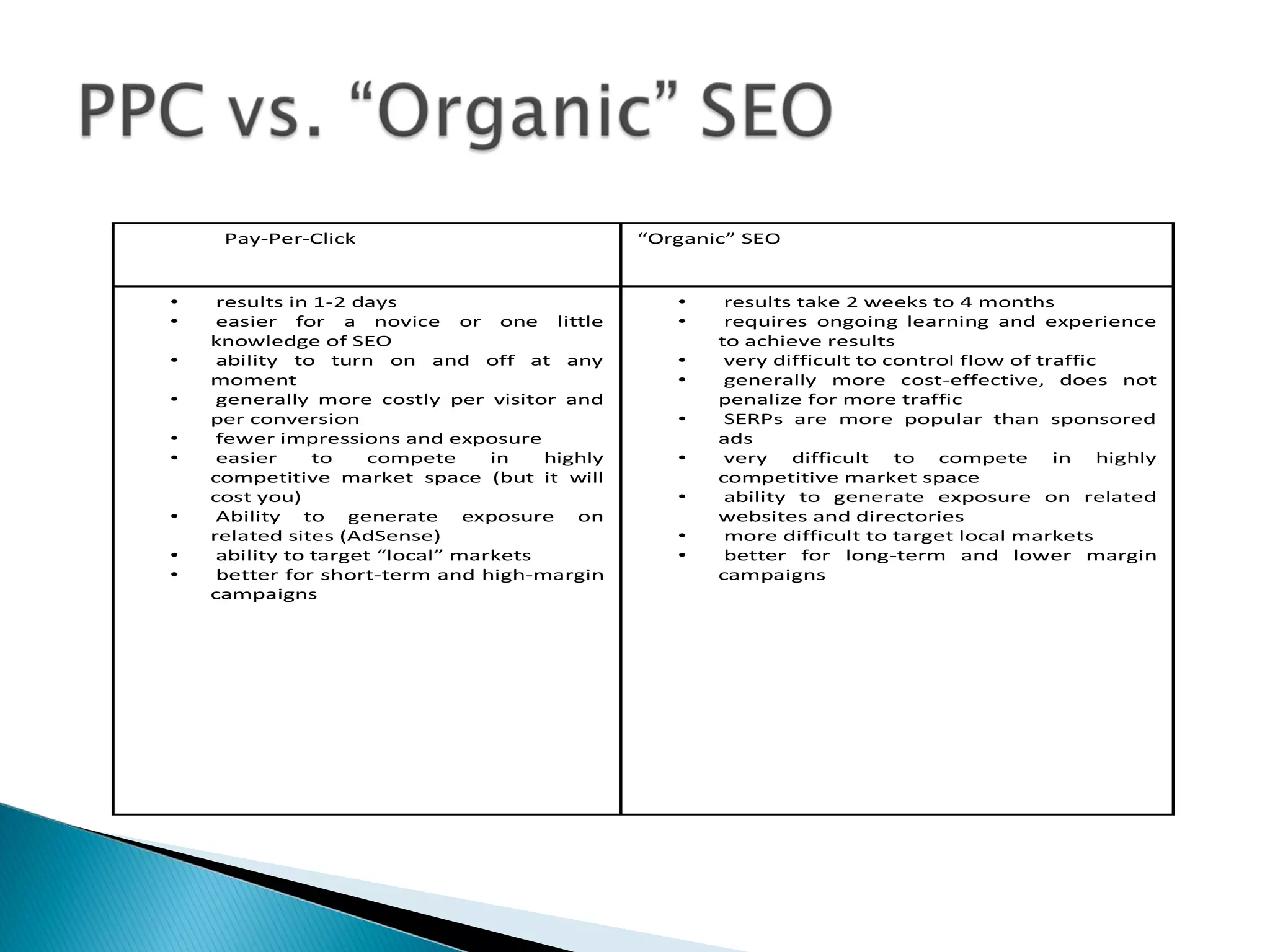
Pay-Per-Click “Organic” SEO
• results in 1-2 days
• easier for a novice or one little
knowledge of SEO
• ability to turn on and off at any
moment
• generally more costly per visitor and
per conversion
• fewer impressions and exposure
• easier to compete in highly
competitive market space (but it will
cost you)
• Ability to generate exposure on
related sites (AdSense)
• ability to target “local” markets
• better for short-term and high-margin
campaigns
• results take 2 weeks to 4 months
• requires ongoing learning and experience
to achieve results
• very difficult to control flow of traffic
• generally more cost-effective, does not
penalize for more traffic
• SERPs are more popular than sponsored
ads
• very difficult to compete in highly
competitive market space
• ability to generate exposure on related
websites and directories
• more difficult to target local markets
• better for long-term and lower margin
campaigns
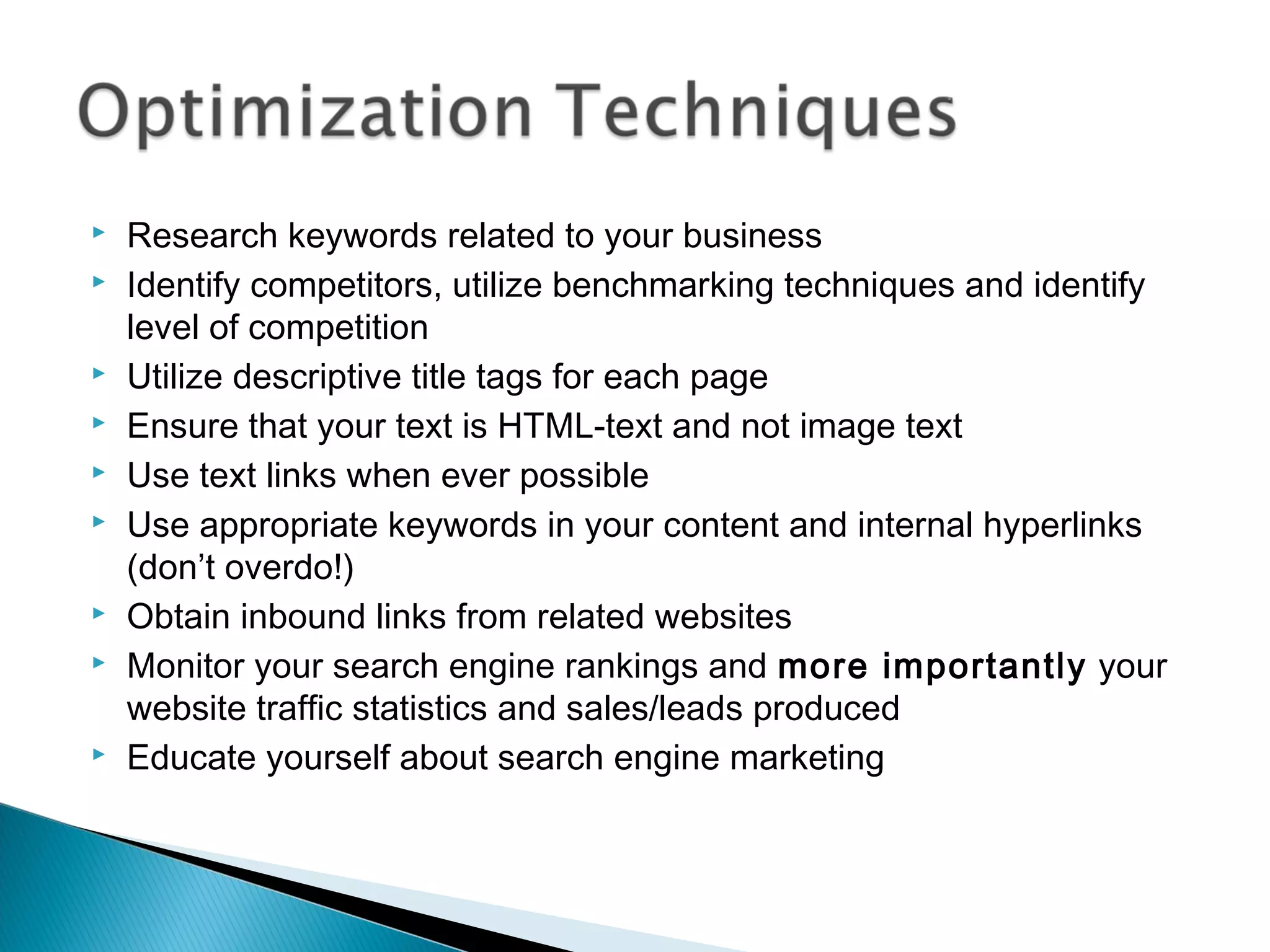
 Research keywords related to your business
 Identify competitors, utilize benchmarking techniques and identify
level of competition
 Utilize descriptive title tags for each page
 Ensure that your text is HTML-text and not image text
 Use text links when ever possible
 Use appropriate keywords in your content and internal hyperlinks
(don’t overdo!)
 Obtain inbound links from related websites
 Monitor your search engine rankings and more importantly your
website traffic statistics and sales/leads produced
 Educate yourself about search engine marketing
Search engine Optimization

Search engine Optimization

  • 2.
    • Definition: Aninternet-based tool that searches an index of documents for a particular term, phrase or text specified by the user. Commonly used to refer to large web- based search engines that search through billions of pages on the internet. • Different than a Directory • Common Characteristics: • Spider, Indexer, Database, Algorithm • Find matching documents and display them according to relevance • Frequent updates to documents searched and ranking algorithm • Strive to produce “better”, more relevant results than competitors
  • 4.
     Spider “crawls”the web to find new documents (web pages, other documents) typically by following hyperlinks from websites already in their database  Search engines indexes the content (text, code) in these documents by adding it to their databases and then periodically updates this content  Search engines search their own databases when a user enters in a search to find related documents (not searching web pages in real- time)  Search engines rank the resulting documents using an algorithm (mathematical formula) by assigning various weights and ranking factors
  • 5.
     SEO =Search Engine Optimization ◦ Refers to the process of “optimizing” both the on-page and off-page ranking factors in order to achieve high search engine rankings for targeted search terms. ◦ Refers to the “industry” that has been created regarding using keyword searching a means of increasing relevant traffic to a website
  • 6.
     Reverse engineering,research and experiments gives SEOs (search engine optimization professionals) a “pretty good” idea of the major factors and approximate weight assignments  The SEO algorithm is constantly changed, tweaked & updated  Websites and documents being searched are also constantly changing  Varies by Search Engine – some give more weight to on- page factors, some to link popularity
  • 7.
     Research desirablekeywords and search phrases (WordTracker, Overture, Google AdWords)  Identify search phrases to target (should be relevant to business/market, obtainable and profitable)  “Clean” and optimize a website’s HTML code for appropriate keyword density, title tag optimization, internal linking structure, headings and subheadings, etc.  Help in writing copy to appeal to both search engines and actual website visitors
  • 8.
     Study competitors(competing websites) and search engines  Implement a quality link building campaign  Add Quality content  Constant monitoring of rankings for targeted search terms
  • 9.
     On-Page Factors(Code & Content)  Title tags <title> #3  Header tags <h1> #5  ALT image tags #4  Content, Content, Content (Body text) <body> #1  Hyperlink text #6  Keyword frequency & density #2  Off-Page Factors  Link Popularity (“votes” for your site) – adds credibility #2  Anchor text #1
  • 10.
     View >Source (HTML code)
  • 12.
     PPC adsappear as “sponsored listings”  Companies bid on price they are willing to pay “per click”  Typically have very good tracking tools and statistics  Ability to control ad text  Can set budgets and spending limits  Google AdWords and Overture are the two leaders
  • 13.
    Pay-Per-Click “Organic” SEO •results in 1-2 days • easier for a novice or one little knowledge of SEO • ability to turn on and off at any moment • generally more costly per visitor and per conversion • fewer impressions and exposure • easier to compete in highly competitive market space (but it will cost you) • Ability to generate exposure on related sites (AdSense) • ability to target “local” markets • better for short-term and high-margin campaigns • results take 2 weeks to 4 months • requires ongoing learning and experience to achieve results • very difficult to control flow of traffic • generally more cost-effective, does not penalize for more traffic • SERPs are more popular than sponsored ads • very difficult to compete in highly competitive market space • ability to generate exposure on related websites and directories • more difficult to target local markets • better for long-term and lower margin campaigns
  • 14.
     Research keywordsrelated to your business  Identify competitors, utilize benchmarking techniques and identify level of competition  Utilize descriptive title tags for each page  Ensure that your text is HTML-text and not image text  Use text links when ever possible  Use appropriate keywords in your content and internal hyperlinks (don’t overdo!)  Obtain inbound links from related websites  Monitor your search engine rankings and more importantly your website traffic statistics and sales/leads produced  Educate yourself about search engine marketing