Part 1. Ecosystems
Objectives Part I: Ecosystems
• Describe the difference between an
ecosystem and a community.
• Explain how an ecosystem responds to
change.
• Identify the three major groups of terrestrial
biomes.
• Describe the four types of aquatic ecosystems.
• Identify two factors of climate that determine
a biome.
Vocabulary
• Community
• Ecosystem
• Habitat
• Biodiversity
• Succession
• Climate
• Biome
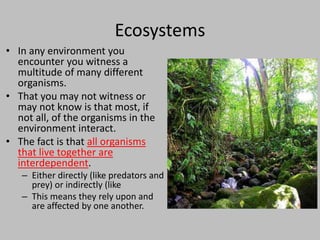
• In any environment you
encounter you witness a
multitude of many different
organisms.
• That you may not witness or
may not know is that most, if
not all, of the organisms in the
environment interact.
• The fact is that all organisms
that live together are
interdependent.
– Either directly (like predators and
prey) or indirectly (like
– This means they rely upon and
are affected by one another.
Ecosystems
Ecosystems
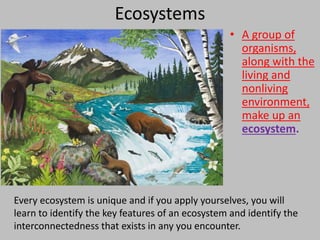
• A group of
organisms,
along with the
living and
nonliving
environment,
make up an
ecosystem.
Every ecosystem is unique and if you apply yourselves, you will
learn to identify the key features of an ecosystem and identify the
interconnectedness that exists in any you encounter.
Ecosystems
• Are broken down into two parts.
• Biotic = The living part of an ecosystem
involve the communities of organisms that live
there.
– This includes the animals and plants of the
ecosystem.
• Abiotic = The physical, non-living part.
– Includes an organism’s habitat = the physical
makeup of where it lives.
– Examples: the air (oxygen), water, rocks, sand,
sunlight, temperature, and climate.
Ecosystems & Abiotic
Factors
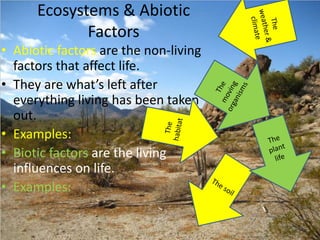
• Abiotic factors are the non-living
factors that affect life.
• They are what’s left after
everything living has been taken
out.
• Examples:
• Biotic factors are the living
influences on life.
• Examples:
Ecosystems & Biotic Factors
• A community includes everything (all plants,
animals, bugs etc.) that is alive in a location,
• But not every ecosystem is the same when you look
across the world.
• The differences are evidence in the diversity of life
all across the Earth’s many ecosystems.
• Meaning…that there is a great number of different
types of organisms in any one area.
• The measure of the variety of organisms in a given
area determines the ecosystem’s biodiversity.
Ecosystem Diversity = Biodiversity
• Biodiversity is an important aspect when studying
ecosystems.
– Tells how healthy and responsive an ecosystem is.
• The biodiversity of the ecosystem will determine
how well it responds to changing abiotic factors
(such as temperature and rainfall), as well as,
natural and man-made disasters (such as…?).
• Ecosystems with high biodiversity are better at
responding to change, therefore more resilient.
• This response is measured by how quickly life can
return to normal levels after a disaster.
The Effects of Biodiversity.
• Systems with low biodiversity can be severely
damaged easily.
• This is because of the low number of organisms
to have offspring (plants, food sources, prey, and
predators alike).
• When biodiversity changes in any ecosystem, that
ecosystem’s health changes too.
• Regardless, an ecosystem will respond (when it
can) in such a way as to restore the ecosystem
back to equilibrium & balance.
• The higher the biodiversity the easier it is to stay
in equilibrium.
Concept Check
• Get into groups.
• Examine the following ecosystems. Rate
the ecosystems 1-4 (1 being the lowest)
based upon the biodiversity. Give 2
pieces of evidence as support.
• Identify how this ecosystem would
respond to great change and how easy it
would be to return to equilibrium.
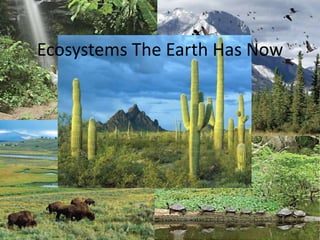
1. The Savana
3. Southeastern
Alaska
2. The Sonoran
Desert
4. Gulf of Mexico
Rate the ecosystems according to its biodiversity on a
scale of 1-4. Give 2 pieces of support.
Evolution of an Ecosystem:
Succession
• Some ecosystems respond rapidly to change, some
are very gradual…almost unnoticeable.
– Environmental organizations claim that every ecosystem
goes through great changes over long periods of time.
• The estimate is that roughly every 10,000 years every
climate can change drastically, causing a shift in the
biodiversity of an ecosystem.
• The process where one community replaces another
community over long periods of time is succession.
• This could be considered the evolution of an
ecosystem.
Pioneer Species
• When an ecosystem is created
life is initiated by a pioneer
species.
• Primary Succession starts with
a pioneer species.
– the first organisms to appear in a
newly made habitat.
• Often they change the habitat
in such a way that other
species can live in the
ecosystem.
– By decomposing and providing
nutrients for new species.
– EX. Lichen or moss
Then Primary Succession Occurs
• Once the lichen &
moss have
deposited their
remains in the soil
it will become
fertile enough for
the larger weeds.
• Then they’ll die &
decompose, further
fertilizing the soil.
• Then larger and
larger plants can
grow and be
sustained. Primary succession
Primary Succession
Secondary Succession
• Succession can also occur in an established ecosystem.
• When a catastrophic event takes place, such as a forest
fire or volcano, the barren soil left behind will recover.
• Secondary succession happen when a previously
established ecosystem recovers from a natural disaster.
• The biodiversity of surrounding ecosystems will play a
role in how fast this occurs.
Ecological Succession at Glacier Bay
• After millions of years of evolution, erosion,
natural disasters, shifting climates, plate
tectonics, and everything else that has shaped
our Earth, we are given the extreme diversity
in habitats we see today.
• The physical landscapes helped shape the
biodiversity present.
• Biology would be incomplete if we didn’t take
time to study the environments that influence
life.
Ecosystems The Earth Has Now
Biomes: Major Biological Communities
• A biome is a region, much larger than an ecosystem,
characterized by a specific kind of climate and certain
kinds of plant and animal communities.
• It’s the environment that really defines what can live where.
• The kinds of species that live in a particular place are
determined partly, if not completely, by climate.
– the average weather conditions (sunlight, rain &
temperature) in an area over a long period of time.
• You can notice this just by driving from here to Flagstaff.
• How many different species of life (not just animal – plants
included) can you find from here to there?
• As a result of the diversity in habitat, species (trees, animals,
insects) that live in a climate do so because they are specifically
built for it, as a part of a biome.
Elements of Climate
Major Biological Communities
• Biomes are very diverse but can be categorized into major groups.
• There boundaries are determined first by latitude, then by climate.
1st Basic Ecosystem Condition: Latitude
High Latitude Biomes
Temperate Biomes
Tropical Biomes
High Latitude Biomes
Temperate Biomes
The first condition to define a biome is by how close to the equator it is.
Give us three major categories:
- Tropical
- Temperate
- High-latitude
Terrestrial Biomes,
Tropical Biomes
• Because they are located at low latitudes
near the equator, all tropical biomes are
warm.
• Tropical rain forests receive large amounts
of rain and are warm all year. They have the
greatest biodiversity of any land biome.
• Savannas are tropical grasslands that have
long dry seasons and shorter wet seasons.
• Tropical deserts get very little rain. Because
deserts are drier, they have fewer plants
and animals than other biomes.
Terrestrial Biomes,
continued
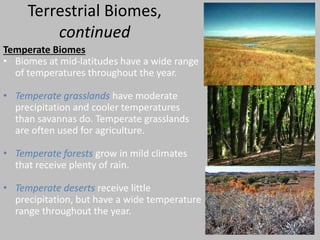
Temperate Biomes
• Biomes at mid-latitudes have a wide range
of temperatures throughout the year.
• Temperate grasslands have moderate
precipitation and cooler temperatures
than savannas do. Temperate grasslands
are often used for agriculture.
• Temperate forests grow in mild climates
that receive plenty of rain.
• Temperate deserts receive little
precipitation, but have a wide temperature
range throughout the year.
Terrestrial Biomes, continued
High-Latitude Biomes
• Biomes at high latitudes have
cold temperatures.
• Coniferous forests in cold, wet
climates are called taiga. Winters
are long and cold. Most of the
precipitation falls in the summer.
• The tundra gets very little rain, so
plants are short. Much of the
water in the soil is not available
because the water is frozen for
most of the year.
Aquatic Ecosystems
• Aquatic ecosystems are organized into
freshwater ecosystems, wetlands,
estuaries, and marine ecosystems.
• Freshwater ecosystems are located in
bodies of fresh water, such as lakes,
ponds, and rivers. These ecosystems
have a variety of plants, fish, arthropods,
mollusks, and other invertebrates.
• Wetlands provide a link between the
land and fully aquatic habitats. Water-
loving plants dominate wetlands.
Wetlands moderate flooding and clean
the water that flows through them.
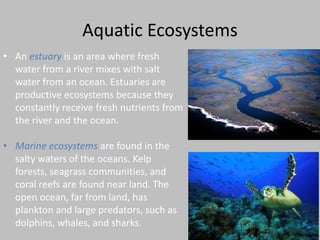
Aquatic Ecosystems
• An estuary is an area where fresh
water from a river mixes with salt
water from an ocean. Estuaries are
productive ecosystems because they
constantly receive fresh nutrients from
the river and the ocean.
• Marine ecosystems are found in the
salty waters of the oceans. Kelp
forests, seagrass communities, and
coral reefs are found near land. The
open ocean, far from land, has
plankton and large predators, such as
dolphins, whales, and sharks.
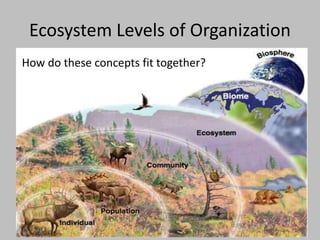
Ecosystem Levels of Organization
How do these concepts fit together?
Section 1: Summary
• ANY QUESTIONS???
Concept Check
• Which is bigger and more inclusive, communities or
populations?
• Which has only 1 type of organism?
• If a new island formed in the Pacific Ocean, what kind of
organism would be the first to establish a population there?
• After a volcanic eruption has covered an area with lava,
what type of ecological succession occurs?
• What is biodiversity?
• Why is biodiversity important to take notice of?
• What type of biome would include the grasslands of the
Serengeti?
• What type of biome do we live in here in Arizona?
• What type of biome has the most biodiversity on Earth?
• What type of biome has the least biodiversity on Earth?
Group Assignment
POGIL: Biomes of North America
• In groups, work through questions 1-8. You
will have 10 minutes then we will discuss as a
class.
• Now, work through questions 9-12. You will
have 10 minutes to work through the
questions, then we will discuss as a class.
• For homework, complete questions 13-16.
POGIL Answers.
1. Tundra/Desert
2. Tropical rainforest
3. Deserts
4. Temperate forests
5. .
a. Coniferous, deciduous (temperate), tropical
b. Taiga
6. .
a. Temperate
b. Little water but freezing temps
7. .
a. Precipitation
b. Not enough water
8. The combination of precipitation and
temperature are indicators of these type of
forests that exist in the N. American biomes.
9. .
a. The trend in biodiversity = how many
organisms live in the region.
b. How far from the equator the biome is.
c. The distance from the equator relates to
the average temperatures. The farther from
the equator the lower the temps get.
d. Q: (Addition) Do you think this graph is set
up correctly? Consider the variables
involved, do you think that distance
responds to biodiversity (as the graph
would indicate) or the other way around?
A: the dependent variable (in this case
10. .
a. Tundra
b. Taiga
c. Desert
d. Grassland
e. Deciduous forest
f. Tropical rain forests
11. See Map
12. .
a. Artic
b. Tundra
c. Tropical
d. Rain forest
13. .
a. Tropical rain forest
b. Moderate temps & lots of rain
c. Tundra
d. Low temps, little precipitation
14. Biodiversity, dependent upon temps and precipitation,
increase moving towards the equator.
15. .
a. Temperatures + Precipitation
b. Desert
c. Decreased food supply of the basic grain variety.
16. Tropical rain forests support many different organisms.
W/out the forests many species would suffer.
Wrap Up
• What did you learn today.
• Write something specific on your warm ups.
• Make sure to complete your book assignments
& homework by Friday.

1. Ecosystems.pptx

  • 1.
  • 2.
    Objectives Part I:Ecosystems • Describe the difference between an ecosystem and a community. • Explain how an ecosystem responds to change. • Identify the three major groups of terrestrial biomes. • Describe the four types of aquatic ecosystems. • Identify two factors of climate that determine a biome.
  • 3.
    Vocabulary • Community • Ecosystem •Habitat • Biodiversity • Succession • Climate • Biome
  • 4.
    • In anyenvironment you encounter you witness a multitude of many different organisms. • That you may not witness or may not know is that most, if not all, of the organisms in the environment interact. • The fact is that all organisms that live together are interdependent. – Either directly (like predators and prey) or indirectly (like – This means they rely upon and are affected by one another. Ecosystems
  • 5.
    Ecosystems • A groupof organisms, along with the living and nonliving environment, make up an ecosystem. Every ecosystem is unique and if you apply yourselves, you will learn to identify the key features of an ecosystem and identify the interconnectedness that exists in any you encounter.
  • 6.
    Ecosystems • Are brokendown into two parts. • Biotic = The living part of an ecosystem involve the communities of organisms that live there. – This includes the animals and plants of the ecosystem. • Abiotic = The physical, non-living part. – Includes an organism’s habitat = the physical makeup of where it lives. – Examples: the air (oxygen), water, rocks, sand, sunlight, temperature, and climate.
  • 7.
    Ecosystems & Abiotic Factors •Abiotic factors are the non-living factors that affect life. • They are what’s left after everything living has been taken out. • Examples: • Biotic factors are the living influences on life. • Examples:
  • 8.
    Ecosystems & BioticFactors • A community includes everything (all plants, animals, bugs etc.) that is alive in a location, • But not every ecosystem is the same when you look across the world. • The differences are evidence in the diversity of life all across the Earth’s many ecosystems. • Meaning…that there is a great number of different types of organisms in any one area. • The measure of the variety of organisms in a given area determines the ecosystem’s biodiversity.
  • 9.
    Ecosystem Diversity =Biodiversity • Biodiversity is an important aspect when studying ecosystems. – Tells how healthy and responsive an ecosystem is. • The biodiversity of the ecosystem will determine how well it responds to changing abiotic factors (such as temperature and rainfall), as well as, natural and man-made disasters (such as…?). • Ecosystems with high biodiversity are better at responding to change, therefore more resilient. • This response is measured by how quickly life can return to normal levels after a disaster.
  • 10.
    The Effects ofBiodiversity. • Systems with low biodiversity can be severely damaged easily. • This is because of the low number of organisms to have offspring (plants, food sources, prey, and predators alike). • When biodiversity changes in any ecosystem, that ecosystem’s health changes too. • Regardless, an ecosystem will respond (when it can) in such a way as to restore the ecosystem back to equilibrium & balance. • The higher the biodiversity the easier it is to stay in equilibrium.
  • 11.
    Concept Check • Getinto groups. • Examine the following ecosystems. Rate the ecosystems 1-4 (1 being the lowest) based upon the biodiversity. Give 2 pieces of evidence as support. • Identify how this ecosystem would respond to great change and how easy it would be to return to equilibrium.
  • 12.
    1. The Savana 3.Southeastern Alaska 2. The Sonoran Desert 4. Gulf of Mexico Rate the ecosystems according to its biodiversity on a scale of 1-4. Give 2 pieces of support.
  • 13.
    Evolution of anEcosystem: Succession • Some ecosystems respond rapidly to change, some are very gradual…almost unnoticeable. – Environmental organizations claim that every ecosystem goes through great changes over long periods of time. • The estimate is that roughly every 10,000 years every climate can change drastically, causing a shift in the biodiversity of an ecosystem. • The process where one community replaces another community over long periods of time is succession. • This could be considered the evolution of an ecosystem.
  • 14.
    Pioneer Species • Whenan ecosystem is created life is initiated by a pioneer species. • Primary Succession starts with a pioneer species. – the first organisms to appear in a newly made habitat. • Often they change the habitat in such a way that other species can live in the ecosystem. – By decomposing and providing nutrients for new species. – EX. Lichen or moss
  • 15.
    Then Primary SuccessionOccurs • Once the lichen & moss have deposited their remains in the soil it will become fertile enough for the larger weeds. • Then they’ll die & decompose, further fertilizing the soil. • Then larger and larger plants can grow and be sustained. Primary succession Primary Succession
  • 16.
    Secondary Succession • Successioncan also occur in an established ecosystem. • When a catastrophic event takes place, such as a forest fire or volcano, the barren soil left behind will recover. • Secondary succession happen when a previously established ecosystem recovers from a natural disaster. • The biodiversity of surrounding ecosystems will play a role in how fast this occurs.
  • 17.
  • 18.
    • After millionsof years of evolution, erosion, natural disasters, shifting climates, plate tectonics, and everything else that has shaped our Earth, we are given the extreme diversity in habitats we see today. • The physical landscapes helped shape the biodiversity present. • Biology would be incomplete if we didn’t take time to study the environments that influence life. Ecosystems The Earth Has Now
  • 19.
    Biomes: Major BiologicalCommunities • A biome is a region, much larger than an ecosystem, characterized by a specific kind of climate and certain kinds of plant and animal communities. • It’s the environment that really defines what can live where. • The kinds of species that live in a particular place are determined partly, if not completely, by climate. – the average weather conditions (sunlight, rain & temperature) in an area over a long period of time. • You can notice this just by driving from here to Flagstaff. • How many different species of life (not just animal – plants included) can you find from here to there? • As a result of the diversity in habitat, species (trees, animals, insects) that live in a climate do so because they are specifically built for it, as a part of a biome.
  • 20.
  • 21.
    Major Biological Communities •Biomes are very diverse but can be categorized into major groups. • There boundaries are determined first by latitude, then by climate.
  • 22.
    1st Basic EcosystemCondition: Latitude High Latitude Biomes Temperate Biomes Tropical Biomes High Latitude Biomes Temperate Biomes The first condition to define a biome is by how close to the equator it is. Give us three major categories: - Tropical - Temperate - High-latitude
  • 23.
    Terrestrial Biomes, Tropical Biomes •Because they are located at low latitudes near the equator, all tropical biomes are warm. • Tropical rain forests receive large amounts of rain and are warm all year. They have the greatest biodiversity of any land biome. • Savannas are tropical grasslands that have long dry seasons and shorter wet seasons. • Tropical deserts get very little rain. Because deserts are drier, they have fewer plants and animals than other biomes.
  • 24.
    Terrestrial Biomes, continued Temperate Biomes •Biomes at mid-latitudes have a wide range of temperatures throughout the year. • Temperate grasslands have moderate precipitation and cooler temperatures than savannas do. Temperate grasslands are often used for agriculture. • Temperate forests grow in mild climates that receive plenty of rain. • Temperate deserts receive little precipitation, but have a wide temperature range throughout the year.
  • 25.
    Terrestrial Biomes, continued High-LatitudeBiomes • Biomes at high latitudes have cold temperatures. • Coniferous forests in cold, wet climates are called taiga. Winters are long and cold. Most of the precipitation falls in the summer. • The tundra gets very little rain, so plants are short. Much of the water in the soil is not available because the water is frozen for most of the year.
  • 26.
    Aquatic Ecosystems • Aquaticecosystems are organized into freshwater ecosystems, wetlands, estuaries, and marine ecosystems. • Freshwater ecosystems are located in bodies of fresh water, such as lakes, ponds, and rivers. These ecosystems have a variety of plants, fish, arthropods, mollusks, and other invertebrates. • Wetlands provide a link between the land and fully aquatic habitats. Water- loving plants dominate wetlands. Wetlands moderate flooding and clean the water that flows through them.
  • 27.
    Aquatic Ecosystems • Anestuary is an area where fresh water from a river mixes with salt water from an ocean. Estuaries are productive ecosystems because they constantly receive fresh nutrients from the river and the ocean. • Marine ecosystems are found in the salty waters of the oceans. Kelp forests, seagrass communities, and coral reefs are found near land. The open ocean, far from land, has plankton and large predators, such as dolphins, whales, and sharks.
  • 28.
    Ecosystem Levels ofOrganization How do these concepts fit together?
  • 29.
    Section 1: Summary •ANY QUESTIONS???
  • 30.
    Concept Check • Whichis bigger and more inclusive, communities or populations? • Which has only 1 type of organism? • If a new island formed in the Pacific Ocean, what kind of organism would be the first to establish a population there? • After a volcanic eruption has covered an area with lava, what type of ecological succession occurs? • What is biodiversity? • Why is biodiversity important to take notice of? • What type of biome would include the grasslands of the Serengeti? • What type of biome do we live in here in Arizona? • What type of biome has the most biodiversity on Earth? • What type of biome has the least biodiversity on Earth?
  • 31.
    Group Assignment POGIL: Biomesof North America • In groups, work through questions 1-8. You will have 10 minutes then we will discuss as a class. • Now, work through questions 9-12. You will have 10 minutes to work through the questions, then we will discuss as a class. • For homework, complete questions 13-16.
  • 32.
    POGIL Answers. 1. Tundra/Desert 2.Tropical rainforest 3. Deserts 4. Temperate forests 5. . a. Coniferous, deciduous (temperate), tropical b. Taiga 6. . a. Temperate b. Little water but freezing temps 7. . a. Precipitation b. Not enough water 8. The combination of precipitation and temperature are indicators of these type of forests that exist in the N. American biomes. 9. . a. The trend in biodiversity = how many organisms live in the region. b. How far from the equator the biome is. c. The distance from the equator relates to the average temperatures. The farther from the equator the lower the temps get. d. Q: (Addition) Do you think this graph is set up correctly? Consider the variables involved, do you think that distance responds to biodiversity (as the graph would indicate) or the other way around? A: the dependent variable (in this case 10. . a. Tundra b. Taiga c. Desert d. Grassland e. Deciduous forest f. Tropical rain forests 11. See Map 12. . a. Artic b. Tundra c. Tropical d. Rain forest 13. . a. Tropical rain forest b. Moderate temps & lots of rain c. Tundra d. Low temps, little precipitation 14. Biodiversity, dependent upon temps and precipitation, increase moving towards the equator. 15. . a. Temperatures + Precipitation b. Desert c. Decreased food supply of the basic grain variety. 16. Tropical rain forests support many different organisms. W/out the forests many species would suffer.
  • 33.
    Wrap Up • Whatdid you learn today. • Write something specific on your warm ups. • Make sure to complete your book assignments & homework by Friday.