Communication part 2
By: PRIYA RANA
S.D COLLEGE, AMBALA CANTT
Intrapersonal communication: it is communication with ourselves
that takes place in our heads. For example, a person may use self-
talk to calm himself down in a stressful situation, or a shy person
may remind herself to smile during a social event
Interpersonal communication: It is an exchange of information
between two or more people
Group communication: It is the exchange of information and ideas
between individuals using interpersonal skills.There are several
ways in which groups can communicate for example phone calls,
emails, face-to face conversations, and memos.
Mass communication: Mass communication is a process in which a
person, group of people, or an organization sends a message
through a channel of communication to a large group of anonymous
and heterogeneous people and organizations. Channels of
communication include broadcast television, radio, social media,
and print
 Meta Communication:
Here the speaker’s choice of words unintentionally
communicates something more than what the actual words
state. For example, a flattering remark like “I’ve never seen you
so smartly dressed” could also mean that the regular attire of
the listener needed improvement
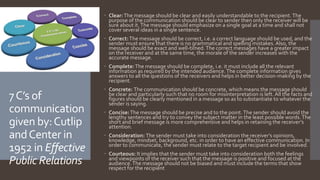
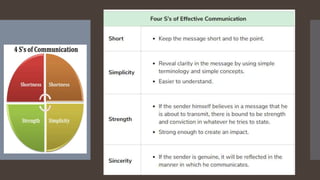
7C’s of
communication
given by:Cutlip
andCenter in
1952 in Effective
Public Relations
 Clear:The message should be clear and easily understandable to the recipient.The
purpose of the communication should be clear to sender then only the receiver will be
sure about it.The message should emphasize on a single goal at a time and shall not
cover several ideas in a single sentence.
 Correct:The message should be correct, i.e. a correct language should be used, and the
sender must ensure that there is no grammatical and spelling mistakes.Also, the
message should be exact and well-timed.The correct messages have a greater impact
on the receiver and at the same time, the morale of the sender increases with the
accurate message.
 Complete:The message should be complete, i.e. it must include all the relevant
information as required by the intended audience.The complete information gives
answers to all the questions of the receivers and helps in better decision-making by the
recipient.
 Concrete: The communication should be concrete, which means the message should
be clear and particularly such that no room for misinterpretation is left. All the facts and
figures should be clearly mentioned in a message so as to substantiate to whatever the
sender is saying.
 Concise:The message should be precise and to the point.The sender should avoid the
lengthy sentences and try to convey the subject matter in the least possible words.The
short and brief message is more comprehensive and helps in retaining the receiver’s
attention.
 Consideration: The sender must take into consideration the receiver’s opinions,
knowledge, mindset, background, etc. in order to have an effective communication. In
order to communicate, the sender must relate to the target recipient and be involved.
 Courteous: It implies that the sender must take into consideration both the feelings
and viewpoints of the receiver such that the message is positive and focused at the
audience.The message should not be biased and must include the terms that show
respect for the recipient
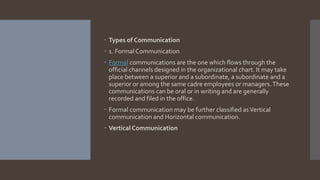
 Types of Communication
 1. Formal Communication
 Formal communications are the one which flows through the
official channels designed in the organizational chart. It may take
place between a superior and a subordinate, a subordinate and a
superior or among the same cadre employees or managers.These
communications can be oral or in writing and are generally
recorded and filed in the office.
 Formal communication may be further classified asVertical
communication and Horizontal communication.
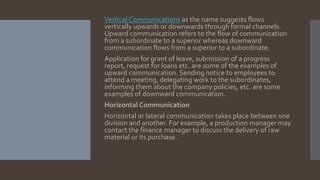
 Vertical Communication
Vertical Communications as the name suggests flows
vertically upwards or downwards through formal channels.
Upward communication refers to the flow of communication
from a subordinate to a superior whereas downward
communication flows from a superior to a subordinate.
Application for grant of leave, submission of a progress
report, request for loans etc. are some of the examples of
upward communication. Sending notice to employees to
attend a meeting, delegating work to the subordinates,
informing them about the company policies, etc. are some
examples of downward communication.
Horizontal Communication
Horizontal or lateral communication takes place between one
division and another. For example, a production manager may
contact the finance manager to discuss the delivery of raw
material or its purchase.
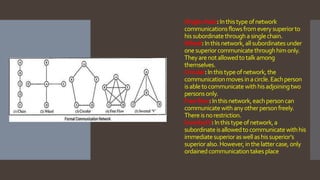
Singlechain:Inthistypeofnetwork
communicationsflowsfromeverysuperiorto
hissubordinatethroughasinglechain.
Wheel:Inthisnetwork,allsubordinatesunder
onesuperiorcommunicatethroughhimonly.
Theyarenotallowedtotalkamong
themselves.
Circular:Inthistypeofnetwork,the
communicationmovesinacircle.Eachperson
isabletocommunicatewithhisadjoiningtwo
personsonly.
Freeflow:Inthisnetwork,eachpersoncan
communicatewithanyotherpersonfreely.
Thereisnorestriction.
InvertedV:Inthistypeofnetwork,a
subordinateisallowedtocommunicatewithhis
immediatesuperioraswellashissuperior’s
superioralso.However,inthelattercase,only
ordainedcommunicationtakesplace
Informal Communication
 Any communication that takes place without following the formal channels of
communication is said to be informal communication.The Informal
communication is often referred to as the ‘grapevine’ as it spreads throughout
the organization and in all directions without any regard to the levels of
authority.
 The informal communication spreads rapidly, often gets distorted and it is very
difficult to detect the source of such communication. It also leads to rumours
which are not true. People’s behaviour is often affected by the rumours and
informal discussions which sometimes may hamper the work environment
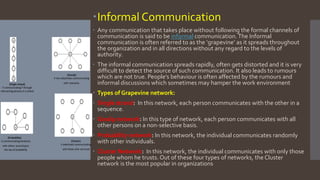
 Types of Grapevine network:
 Single strand: In this network, each person communicates with the other in a
sequence.
 Gossip network: In this type of network, each person communicates with all
other persons on a non-selective basis.
 Probability network: In this network, the individual communicates randomly
with other individuals.
 Cluster Network: In this network, the individual communicates with only those
people whom he trusts. Out of these four types of networks, the Cluster
network is the most popular in organizations
Non-verbal
Communication
 Communication without the use of language or words is called non-
verbal communication. It is made chiefly through expressions, body
movements, sounds, signs, symbols, colors, charts, graphs and maps.
 Non-verbal codes are a set of behavioral norms which indicate the
ethics and mind set of an individual.They are as follows:
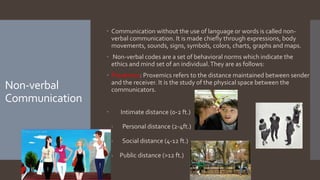
 Proxemics: Proxemics refers to the distance maintained between sender
and the receiver. It is the study of the physical space between the
communicators.
 Intimate distance (0-2 ft.)
· Personal distance (2-4ft.)
· Social distance (4-12 ft.)
· Public distance (>12 ft.)
Non-verbal
Communication
 Chronemics: It is the ethics of proper use of time to be observed
for non-verbal communication.The way an individual values time,
structures the time and reacts to time is a powerful tool of
communication.Time perceptions include punctuality, willingness
to wait and interactions.Chronemics refers to the effective use of
time in communication.The misuse of time or not completing the
work within time is a sigh of indiscipline.
 Artefacts: Artefacts indicates the infrastructure and interior of a
place of communication.The objects used in offices or houses
convey the signals about the occupant’s status. A congenial
environment helps in communication. It includes the elements like
color, ventilation, lighting and temperature. Layout of the
surroundings and space arrangements convey status and creates
an impact on the communication situation.
Non-verbal
Communication
 Kinesics is the study of the physical movements of the body. It also
deals with the posture of standing or sitting as well as with eye and
facial expressions.
The different aspects of body language are as follows:
 Facial expressions: Face is considered as an index of the mind. Several
emotions are conveyed through facial expressions.The emotions like
fear, happiness, surprise, sadness, truth, lies are well expressed
through facial expressions.
 Eye contact: Eyes are the windows to the soul. Maintaining an eye
contact with the listener is the most important part of oral
communication. Looking into a person’s eyes is the best way to
understand his attitude to all that you speak. If you avoid eye contact,
it indicates fear, doubt, confusion, nervousness etc.
 Vocalics/Paralanguage: Paralanguage deals with the expressions of
emotions and feelings with the help of different tones of voice.
Vocalics plays an important part in oral communication. It is the
effective use of tone and pitch of voice while speaking.Variations in
the voice can be used to express the feelings of delight, excitement,
grief, boredom etc.
Non-verbal
Communication
 Gesture: Gestures are used in verbal communication.They illustrate the
spoken messages. Suitable gestures make a speech or presentation more
effective. Following examples indicate the meaning of various gestures: •
Waving of hand indicates hello or good bye. • Making a fist indicates anger.
•Thumbs up sign shows appreciation or agreement. • Nodding of head
means agreement or negative remark. • Using hands to support head
indicates boredom
 Posture: Posture refers to the way we stand, sit or walk. It tells how bold,
confident, submissive or timid a person is.A person who stands, sits and
walks upright commands respect and attention. Poor posture indicates lack
of confidence and indiscipline. Following are the tips to maintain correct
posture: • Do not drag your feet while walking. • Do not drop your
shoulders. • Do not lean on the table. • Avoid crossing your legs before your
audience.
 Dress and appearance: Appearance is a blend of clothes, hair and
presentation style. Proper dress code should be used for the
communication situations. It helps to win the 14 appreciation of the
audience.Wrong dress code cannot bear the right results.The choice of
clothes, hair style, jewelry and accessories talk about the attitude, beliefs,
values and status of a person.
 Haptics: Haptics is communication by touch. It conveys emotions like
affection, concern, friendliness, anger, hate, violence, happiness and
encouragement. Handshakes are the sign of friendliness and agreement.
Patting on shoulders indicates praise. Holding hands of someone expresses
concern and care.
Barriers of
communication
 Organizational Barriers
The factors related to organizational structure, rules and regulations authority
relationships, etc. may sometimes act as barriers to effective communication. In
an organization with a highly centralized pattern, people may not be encouraged
to have free communication.Also, rigid rules and regulations and cumbersome
procedures may also become a hurdle to communication.
 Personal Barriers
The personal factors of both sender and receiver may act as a barrier to effective
communication. If a superior thinks that a particular communication may
adversely affect his authority, he may suppress such communication
 Attitude Barriers
Certain people like to be left alone.They are the introverts or just people who are
not very social.Others like to be social or sometimes extra clingy! Both these
cases could become a barrier to communication. Some people have attitude
issues, like huge ego and inconsiderate behaviours
 Perception Barriers
Different people perceive the same things differently.This is a fact which we
must consider during the communication process. Knowledge of the perception
levels of the audience is crucial to effective communication.All the messages or
communique must be easy and clear.There shouldn’t be any room for a
diversified interpretational set
Barriers to
Communication
 Psychological Barriers
There are various mental and psychological issues that may be
barriers to effective communication. Some people have stage fear,
speech disorders, phobia, depression etc. All of these conditions are
very difficult to manage sometimes and will most certainly limit the
ease of communication
 Semantic Barriers
These are concerned with the problems and obstructions in the
process of encoding and decoding of a message into words or
impressions. Normally, such barriers result due to use of wrong
words, faulty translations, different interpretations, etc.
For example, a manager has to communicate with workers who
have no knowledge of the English language and on the other side,
he is not well conversant with the Hindi language. Here, language is
a barrier to communication as the manager may not be able to
communicate properly with the workers.
Communication part2

Communication part2

  • 1.
    Communication part 2 By:PRIYA RANA S.D COLLEGE, AMBALA CANTT
  • 2.
    Intrapersonal communication: itis communication with ourselves that takes place in our heads. For example, a person may use self- talk to calm himself down in a stressful situation, or a shy person may remind herself to smile during a social event Interpersonal communication: It is an exchange of information between two or more people Group communication: It is the exchange of information and ideas between individuals using interpersonal skills.There are several ways in which groups can communicate for example phone calls, emails, face-to face conversations, and memos. Mass communication: Mass communication is a process in which a person, group of people, or an organization sends a message through a channel of communication to a large group of anonymous and heterogeneous people and organizations. Channels of communication include broadcast television, radio, social media, and print
  • 3.
     Meta Communication: Herethe speaker’s choice of words unintentionally communicates something more than what the actual words state. For example, a flattering remark like “I’ve never seen you so smartly dressed” could also mean that the regular attire of the listener needed improvement
  • 4.
    7C’s of communication given by:Cutlip andCenterin 1952 in Effective Public Relations  Clear:The message should be clear and easily understandable to the recipient.The purpose of the communication should be clear to sender then only the receiver will be sure about it.The message should emphasize on a single goal at a time and shall not cover several ideas in a single sentence.  Correct:The message should be correct, i.e. a correct language should be used, and the sender must ensure that there is no grammatical and spelling mistakes.Also, the message should be exact and well-timed.The correct messages have a greater impact on the receiver and at the same time, the morale of the sender increases with the accurate message.  Complete:The message should be complete, i.e. it must include all the relevant information as required by the intended audience.The complete information gives answers to all the questions of the receivers and helps in better decision-making by the recipient.  Concrete: The communication should be concrete, which means the message should be clear and particularly such that no room for misinterpretation is left. All the facts and figures should be clearly mentioned in a message so as to substantiate to whatever the sender is saying.  Concise:The message should be precise and to the point.The sender should avoid the lengthy sentences and try to convey the subject matter in the least possible words.The short and brief message is more comprehensive and helps in retaining the receiver’s attention.  Consideration: The sender must take into consideration the receiver’s opinions, knowledge, mindset, background, etc. in order to have an effective communication. In order to communicate, the sender must relate to the target recipient and be involved.  Courteous: It implies that the sender must take into consideration both the feelings and viewpoints of the receiver such that the message is positive and focused at the audience.The message should not be biased and must include the terms that show respect for the recipient
  • 6.
     Types ofCommunication  1. Formal Communication  Formal communications are the one which flows through the official channels designed in the organizational chart. It may take place between a superior and a subordinate, a subordinate and a superior or among the same cadre employees or managers.These communications can be oral or in writing and are generally recorded and filed in the office.  Formal communication may be further classified asVertical communication and Horizontal communication.  Vertical Communication
  • 7.
    Vertical Communications asthe name suggests flows vertically upwards or downwards through formal channels. Upward communication refers to the flow of communication from a subordinate to a superior whereas downward communication flows from a superior to a subordinate. Application for grant of leave, submission of a progress report, request for loans etc. are some of the examples of upward communication. Sending notice to employees to attend a meeting, delegating work to the subordinates, informing them about the company policies, etc. are some examples of downward communication. Horizontal Communication Horizontal or lateral communication takes place between one division and another. For example, a production manager may contact the finance manager to discuss the delivery of raw material or its purchase.
  • 8.
  • 9.
    Informal Communication  Anycommunication that takes place without following the formal channels of communication is said to be informal communication.The Informal communication is often referred to as the ‘grapevine’ as it spreads throughout the organization and in all directions without any regard to the levels of authority.  The informal communication spreads rapidly, often gets distorted and it is very difficult to detect the source of such communication. It also leads to rumours which are not true. People’s behaviour is often affected by the rumours and informal discussions which sometimes may hamper the work environment  Types of Grapevine network:  Single strand: In this network, each person communicates with the other in a sequence.  Gossip network: In this type of network, each person communicates with all other persons on a non-selective basis.  Probability network: In this network, the individual communicates randomly with other individuals.  Cluster Network: In this network, the individual communicates with only those people whom he trusts. Out of these four types of networks, the Cluster network is the most popular in organizations
  • 10.
    Non-verbal Communication  Communication withoutthe use of language or words is called non- verbal communication. It is made chiefly through expressions, body movements, sounds, signs, symbols, colors, charts, graphs and maps.  Non-verbal codes are a set of behavioral norms which indicate the ethics and mind set of an individual.They are as follows:  Proxemics: Proxemics refers to the distance maintained between sender and the receiver. It is the study of the physical space between the communicators.  Intimate distance (0-2 ft.) · Personal distance (2-4ft.) · Social distance (4-12 ft.) · Public distance (>12 ft.)
  • 11.
    Non-verbal Communication  Chronemics: Itis the ethics of proper use of time to be observed for non-verbal communication.The way an individual values time, structures the time and reacts to time is a powerful tool of communication.Time perceptions include punctuality, willingness to wait and interactions.Chronemics refers to the effective use of time in communication.The misuse of time or not completing the work within time is a sigh of indiscipline.  Artefacts: Artefacts indicates the infrastructure and interior of a place of communication.The objects used in offices or houses convey the signals about the occupant’s status. A congenial environment helps in communication. It includes the elements like color, ventilation, lighting and temperature. Layout of the surroundings and space arrangements convey status and creates an impact on the communication situation.
  • 12.
    Non-verbal Communication  Kinesics isthe study of the physical movements of the body. It also deals with the posture of standing or sitting as well as with eye and facial expressions. The different aspects of body language are as follows:  Facial expressions: Face is considered as an index of the mind. Several emotions are conveyed through facial expressions.The emotions like fear, happiness, surprise, sadness, truth, lies are well expressed through facial expressions.  Eye contact: Eyes are the windows to the soul. Maintaining an eye contact with the listener is the most important part of oral communication. Looking into a person’s eyes is the best way to understand his attitude to all that you speak. If you avoid eye contact, it indicates fear, doubt, confusion, nervousness etc.  Vocalics/Paralanguage: Paralanguage deals with the expressions of emotions and feelings with the help of different tones of voice. Vocalics plays an important part in oral communication. It is the effective use of tone and pitch of voice while speaking.Variations in the voice can be used to express the feelings of delight, excitement, grief, boredom etc.
  • 13.
    Non-verbal Communication  Gesture: Gesturesare used in verbal communication.They illustrate the spoken messages. Suitable gestures make a speech or presentation more effective. Following examples indicate the meaning of various gestures: • Waving of hand indicates hello or good bye. • Making a fist indicates anger. •Thumbs up sign shows appreciation or agreement. • Nodding of head means agreement or negative remark. • Using hands to support head indicates boredom  Posture: Posture refers to the way we stand, sit or walk. It tells how bold, confident, submissive or timid a person is.A person who stands, sits and walks upright commands respect and attention. Poor posture indicates lack of confidence and indiscipline. Following are the tips to maintain correct posture: • Do not drag your feet while walking. • Do not drop your shoulders. • Do not lean on the table. • Avoid crossing your legs before your audience.  Dress and appearance: Appearance is a blend of clothes, hair and presentation style. Proper dress code should be used for the communication situations. It helps to win the 14 appreciation of the audience.Wrong dress code cannot bear the right results.The choice of clothes, hair style, jewelry and accessories talk about the attitude, beliefs, values and status of a person.  Haptics: Haptics is communication by touch. It conveys emotions like affection, concern, friendliness, anger, hate, violence, happiness and encouragement. Handshakes are the sign of friendliness and agreement. Patting on shoulders indicates praise. Holding hands of someone expresses concern and care.
  • 14.
    Barriers of communication  OrganizationalBarriers The factors related to organizational structure, rules and regulations authority relationships, etc. may sometimes act as barriers to effective communication. In an organization with a highly centralized pattern, people may not be encouraged to have free communication.Also, rigid rules and regulations and cumbersome procedures may also become a hurdle to communication.  Personal Barriers The personal factors of both sender and receiver may act as a barrier to effective communication. If a superior thinks that a particular communication may adversely affect his authority, he may suppress such communication  Attitude Barriers Certain people like to be left alone.They are the introverts or just people who are not very social.Others like to be social or sometimes extra clingy! Both these cases could become a barrier to communication. Some people have attitude issues, like huge ego and inconsiderate behaviours  Perception Barriers Different people perceive the same things differently.This is a fact which we must consider during the communication process. Knowledge of the perception levels of the audience is crucial to effective communication.All the messages or communique must be easy and clear.There shouldn’t be any room for a diversified interpretational set
  • 15.
    Barriers to Communication  PsychologicalBarriers There are various mental and psychological issues that may be barriers to effective communication. Some people have stage fear, speech disorders, phobia, depression etc. All of these conditions are very difficult to manage sometimes and will most certainly limit the ease of communication  Semantic Barriers These are concerned with the problems and obstructions in the process of encoding and decoding of a message into words or impressions. Normally, such barriers result due to use of wrong words, faulty translations, different interpretations, etc. For example, a manager has to communicate with workers who have no knowledge of the English language and on the other side, he is not well conversant with the Hindi language. Here, language is a barrier to communication as the manager may not be able to communicate properly with the workers.