Communication Skills
Communication
Communication is the transmission of
information and meaning from one
individual or group to another.
Business
• Busy (adj.)
• Business (n.): being busy making your life – earning for your life;
making ur career
Layers of Business Communication (3)
1) Downward communication; communicating with people of lower ranks
2) Upward communication; communicating with people of authority or
higher ranks
3) Horizontal communication; communicating with your colleagues, rivals,
and competition, and people of the same ranks
Please find, at least, three examples of these layers of communication, and
please explain how they show your professionalism and personality, and
what you have to consider in each one.
Two of Communication
1) External communication – communicating with other organizations,
out of your organization structure, clients, …
2) Internal communication – communicating within the range of your
organization – colleagues, supervisors, employers, boss, employees,
…
Formality in Communication
Formal communication; considering and applying all the rules of standard
communication – full sentences, courtesy, correctness, polite, word choice, tone, …
- May I know how it happened?
Informal communication; being friendly and direct and to the point.
- How did it happen, sir?
Choosing?
- Know your audience.
When to be formal and when to be informal? How?
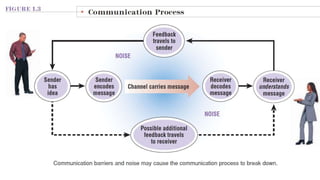
Elements of Communication
1) Sender – speaker/writer
2) Idea – information / idea / recommendation / request / order / decision /
…
3) Encoding – putting your idea in words, signals, signs, …
4) Medium – in what? Letter, typed, handwritten, photo, video, …
5) Channel – way
6) Receiver – listener/reader
7) Decoding –
listening/reading/opening/receiving/understanding/interpreting
8) Feedback – response/no response/positive/negative/…
What are the roles of the above 8 elements in the communication process?
Gerald R. Ford, 38th President of the
United States
“If I went back to college again, I’d
concentrate on two areas: learning to write
and to speak before an audience. Nothing in
life is more important than the ability to
communicate effectively.”
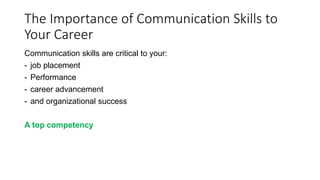
The Importance of Communication Skills to
Your Career
Communication skills are critical to your:
- job placement
- Performance
- career advancement
- and organizational success
A top competency
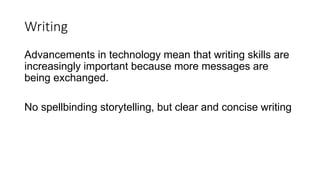
Writing
Advancements in technology mean that writing skills are
increasingly important because more messages are
being exchanged.
No spellbinding storytelling, but clear and concise writing
Assignments:
Barriers to Effective Listening – page 10
Tips for Becoming an Active Listener – page 11
Kinds of Communication
Verbal; oral, written
Non-verbal; gestures, signs, facial expressions, movements, eye
contact, … (Stronger than verbal communication)
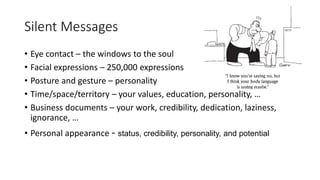
Silent Messages
• Eye contact – the windows to the soul
• Facial expressions – 250,000 expressions
• Posture and gesture – personality
• Time/space/territory – your values, education, personality, …
• Business documents – your work, credibility, dedication, laziness,
ignorance, …
• Personal appearance - status, credibility, personality, and potential
Review
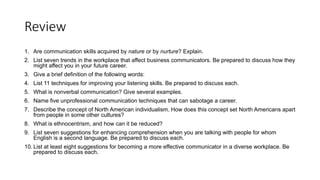
1. Are communication skills acquired by nature or by nurture? Explain.
2. List seven trends in the workplace that affect business communicators. Be prepared to discuss how they
might affect you in your future career.
3. Give a brief definition of the following words:
4. List 11 techniques for improving your listening skills. Be prepared to discuss each.
5. What is nonverbal communication? Give several examples.
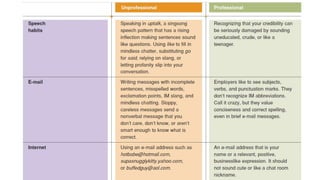
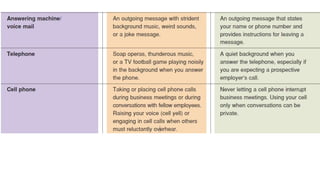
6. Name five unprofessional communication techniques that can sabotage a career.
7. Describe the concept of North American individualism. How does this concept set North Americans apart
from people in some other cultures?
8. What is ethnocentrism, and how can it be reduced?
9. List seven suggestions for enhancing comprehension when you are talking with people for whom
English is a second language. Be prepared to discuss each.
10. List at least eight suggestions for becoming a more effective communicator in a diverse workplace. Be
prepared to discuss each.

Communication Skills.pptx

  • 1.
  • 2.
    Communication Communication is thetransmission of information and meaning from one individual or group to another.
  • 3.
    Business • Busy (adj.) •Business (n.): being busy making your life – earning for your life; making ur career
  • 4.
    Layers of BusinessCommunication (3) 1) Downward communication; communicating with people of lower ranks 2) Upward communication; communicating with people of authority or higher ranks 3) Horizontal communication; communicating with your colleagues, rivals, and competition, and people of the same ranks Please find, at least, three examples of these layers of communication, and please explain how they show your professionalism and personality, and what you have to consider in each one.
  • 5.
    Two of Communication 1)External communication – communicating with other organizations, out of your organization structure, clients, … 2) Internal communication – communicating within the range of your organization – colleagues, supervisors, employers, boss, employees, …
  • 6.
    Formality in Communication Formalcommunication; considering and applying all the rules of standard communication – full sentences, courtesy, correctness, polite, word choice, tone, … - May I know how it happened? Informal communication; being friendly and direct and to the point. - How did it happen, sir? Choosing? - Know your audience. When to be formal and when to be informal? How?
  • 7.
    Elements of Communication 1)Sender – speaker/writer 2) Idea – information / idea / recommendation / request / order / decision / … 3) Encoding – putting your idea in words, signals, signs, … 4) Medium – in what? Letter, typed, handwritten, photo, video, … 5) Channel – way 6) Receiver – listener/reader 7) Decoding – listening/reading/opening/receiving/understanding/interpreting 8) Feedback – response/no response/positive/negative/… What are the roles of the above 8 elements in the communication process?
  • 8.
    Gerald R. Ford,38th President of the United States “If I went back to college again, I’d concentrate on two areas: learning to write and to speak before an audience. Nothing in life is more important than the ability to communicate effectively.”
  • 9.
    The Importance ofCommunication Skills to Your Career Communication skills are critical to your: - job placement - Performance - career advancement - and organizational success A top competency
  • 10.
    Writing Advancements in technologymean that writing skills are increasingly important because more messages are being exchanged. No spellbinding storytelling, but clear and concise writing
  • 14.
    Assignments: Barriers to EffectiveListening – page 10 Tips for Becoming an Active Listener – page 11
  • 15.
    Kinds of Communication Verbal;oral, written Non-verbal; gestures, signs, facial expressions, movements, eye contact, … (Stronger than verbal communication)
  • 16.
    Silent Messages • Eyecontact – the windows to the soul • Facial expressions – 250,000 expressions • Posture and gesture – personality • Time/space/territory – your values, education, personality, … • Business documents – your work, credibility, dedication, laziness, ignorance, … • Personal appearance - status, credibility, personality, and potential
  • 19.
    Review 1. Are communicationskills acquired by nature or by nurture? Explain. 2. List seven trends in the workplace that affect business communicators. Be prepared to discuss how they might affect you in your future career. 3. Give a brief definition of the following words: 4. List 11 techniques for improving your listening skills. Be prepared to discuss each. 5. What is nonverbal communication? Give several examples. 6. Name five unprofessional communication techniques that can sabotage a career. 7. Describe the concept of North American individualism. How does this concept set North Americans apart from people in some other cultures? 8. What is ethnocentrism, and how can it be reduced? 9. List seven suggestions for enhancing comprehension when you are talking with people for whom English is a second language. Be prepared to discuss each. 10. List at least eight suggestions for becoming a more effective communicator in a diverse workplace. Be prepared to discuss each.