Presented by:
Apurva Shrivastava
• According to Robert Anderson communication may be
defined as follows:
“Communication is the inter change of thoughts, opinion
or information by speech, writing or sign.”
• Communication occurs only when the receiver receives
the same intellectual and emotive message which the
sender sends.
•Communication is the most central aspects of all
managerial activities.
Communication is said completed only and
only when the receiver receives the same
message which the sender has transmitted .
But in practical life we also come through
the incomplete communication which leads
to misunderstanding among the receiver and
the sender . This phenomenon is basically
known as Barrier to Effective
Communication .
•As noise acts as the barrier to
communication it often
leads to misunderstanding
between the sender and the
receiver.
•It is a physical barrier which
is the most harmful barrier for
an effective communication
For example: In factories, oral
communication is rendered
difficult by the loud noise of
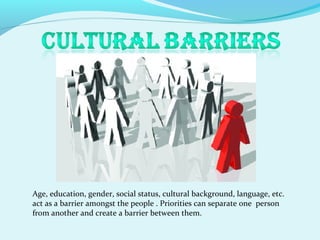
Age, education, gender, social status, cultural background, language, etc.
act as a barrier amongst the people . Priorities can separate one person
from another and create a barrier between them.
Your emotions could be a barrier to
communication if you are engrossed in your
emotions for some reason. A few of the
emotional interferences include hostility,
anger, resentfulness and fear. Emotional
states of mind play an important role in the
act of communication. If the sender is
perplexed, worried, excited, afraid, nervous
his thinking will be blurred and he will not
be able to organize his message properly.
If the sender of message lacks
behind in subject knowledge
of his/her subject then this
flaw will act as the barrier to
the communication.
HOW? The answer follows
as written below
The sender will not be able to
convey the message effectively
which lead to two serious
situation. They are:
1.Receiver may not be clear
about the sent message.
2.Receiver may
misunderstand the message.
People often become inattentive
while receiving a message in
particular, if the message contains a
new-idea. The human mind usually
resists change, for change makes
thing uncertain. It also threatens
security and stability.
Poor retention of communication
also acts as the barrier to the
effective communication. As per
researches are made the result
proves that the employees retain
only about 50%of the information
communicated to them . The rest is
lost. So if the message is to be
transmitted from lower level to top
level then scalar chain of command
is followed .
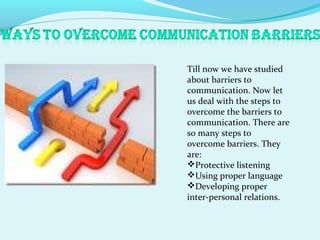
Till now we have studied
about barriers to
communication. Now let
us deal with the steps to
overcome the barriers to
communication. There are
so many steps to
overcome barriers. They
are:
Protective listening
Using proper language
Developing proper
inter-personal relations.
While communicating one should always take care of
the receiver. One should know that receiver knows the
code or language in which you are communicating the
message.
•Cultural Barriers can be minimized by communicating
the message in direct, simple and meaningful language.
•Communication is not effective if the receiver is unable
to understand the idea or thought of encoded message.
Barriers to communication

Barriers to communication

  • 1.
  • 2.
    • According toRobert Anderson communication may be defined as follows: “Communication is the inter change of thoughts, opinion or information by speech, writing or sign.” • Communication occurs only when the receiver receives the same intellectual and emotive message which the sender sends. •Communication is the most central aspects of all managerial activities.
  • 4.
    Communication is saidcompleted only and only when the receiver receives the same message which the sender has transmitted . But in practical life we also come through the incomplete communication which leads to misunderstanding among the receiver and the sender . This phenomenon is basically known as Barrier to Effective Communication .
  • 5.
    •As noise actsas the barrier to communication it often leads to misunderstanding between the sender and the receiver. •It is a physical barrier which is the most harmful barrier for an effective communication For example: In factories, oral communication is rendered difficult by the loud noise of
  • 6.
    Age, education, gender,social status, cultural background, language, etc. act as a barrier amongst the people . Priorities can separate one person from another and create a barrier between them.
  • 7.
    Your emotions couldbe a barrier to communication if you are engrossed in your emotions for some reason. A few of the emotional interferences include hostility, anger, resentfulness and fear. Emotional states of mind play an important role in the act of communication. If the sender is perplexed, worried, excited, afraid, nervous his thinking will be blurred and he will not be able to organize his message properly.
  • 8.
    If the senderof message lacks behind in subject knowledge of his/her subject then this flaw will act as the barrier to the communication. HOW? The answer follows as written below The sender will not be able to convey the message effectively which lead to two serious situation. They are: 1.Receiver may not be clear about the sent message. 2.Receiver may misunderstand the message.
  • 9.
    People often becomeinattentive while receiving a message in particular, if the message contains a new-idea. The human mind usually resists change, for change makes thing uncertain. It also threatens security and stability.
  • 10.
    Poor retention ofcommunication also acts as the barrier to the effective communication. As per researches are made the result proves that the employees retain only about 50%of the information communicated to them . The rest is lost. So if the message is to be transmitted from lower level to top level then scalar chain of command is followed .
  • 11.
    Till now wehave studied about barriers to communication. Now let us deal with the steps to overcome the barriers to communication. There are so many steps to overcome barriers. They are: Protective listening Using proper language Developing proper inter-personal relations.
  • 12.
    While communicating oneshould always take care of the receiver. One should know that receiver knows the code or language in which you are communicating the message. •Cultural Barriers can be minimized by communicating the message in direct, simple and meaningful language. •Communication is not effective if the receiver is unable to understand the idea or thought of encoded message.