Communication
   Skills


            1
Concepts
• Words Mean Different Things to
  Different People.
• The Initiation of a Message
  Provides No Assurance It Has
  Been Received.
• Communications Often Become
  Distorted as They Are
  Transmitted.

                                   2
Why is Communication
     Important?
• Everything a manager does
  involves communication.
• Effective communication
  skills can lead to problems
  for the manager.
• Communication of content
• Supportive communication


                                3
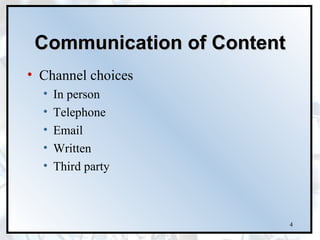
Communication of Content
• Channel choices
  •   In person
  •   Telephone
  •   Email
  •   Written
  •   Third party


                            4
Supportive
           Communication
• A focus on processes.
• Two categories:
 Coaching: giving advice, direction or
  information to improve performance… focus
  on abilities
 Counselling: helping the person understand
  and resolve a problem themselves by
  displaying understanding… focus on
  attitudes
                                           5
What Is the Interpersonal
Communication Process?
  • Communication
  • Sequential Steps
    •   Encoded
    •   Transmitted
    •   Decoding
    •   Noise
    •   Feedback

                            6
Exhibit 3-1: The Communication Process Model


                                           7
Basic Interpersonal
     Communication Skills
• Avoid Barriers to Communication.
• Send Understandable Messages:
  Effective communication.
• Actively Listen.
• Utilize Non-verbal Signals.
• Give and Solicit Meaningful Feedback.
• Adapt to Diversity of Communication
  Styles… try multiple channels

                                          8
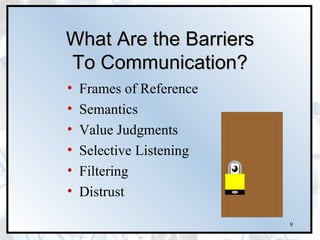
What Are the Barriers
To Communication?
•   Frames of Reference
•   Semantics
•   Value Judgments
•   Selective Listening
•   Filtering
•   Distrust

                          9
Attributes of effective
        communication
• Problem oriented not person oriented

“I don’t like the way you dress for work.”
“You are not very professional.”


                                             10
Attributes of effective
        communication
• Congruence versus incongruence
• Mismatch between what one feels/thinks
  and what one says

“I’m disappointed that we didn’t reach our
  target and that we aren’t getting our
  bonuses.”

                                             11
Attributes of effective
         communication
•  Descriptive versus evaluative
•  Avoid judgment
•  How:
4. describe objectively;
5. focus on the behaviour and your reaction not the
   other’s attributes;
6. focus on solutions
                  “You screwed up”

                                                  12
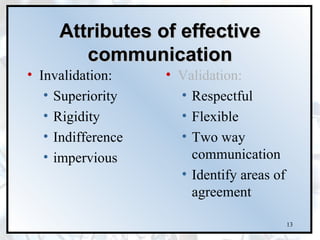
Attributes of effective
        communication
• Invalidation:     • Validation:
   • Superiority      • Respectful
   • Rigidity         • Flexible
   • Indifference     • Two way
   • impervious         communication
                      • Identify areas of
                        agreement

                                            13
Attributes of effective
        communication
• specific not global
         “you never ask for my advice”
                 “You are lazy”


                                         14
Attributes of effective
        communication
• Conjunctive not disjunctive
  • Lack of equal opportunity to speak?
  • Extended pauses?
  • Who controls the flow?
A continuum…


                                          15
Attributes of effective
        communication
• Owned not disowned
  • Use of “I statements” not “you or other
    statements”
           “I’ve heard that you…”


                                              16
Attributes of effective
        communication
• Two way not one way
  • Listening by responding


                               17
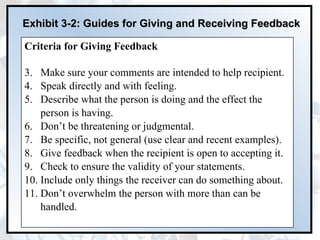
Exhibit 3-2: Guides for Giving and Receiving Feedback

Criteria for Giving Feedback

3. Make sure your comments are intended to help recipient.
4. Speak directly and with feeling.
5. Describe what the person is doing and the effect the
    person is having.
6. Don’t be threatening or judgmental.
7. Be specific, not general (use clear and recent examples).
8. Give feedback when the recipient is open to accepting it.
9. Check to ensure the validity of your statements.
10. Include only things the receiver can do something about.
11. Don’t overwhelm the person with more than can be
    handled.
                                                               18
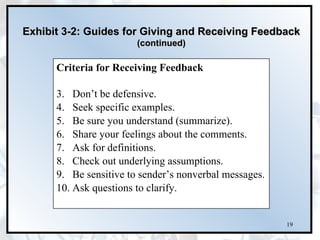
Exhibit 3-2: Guides for Giving and Receiving Feedback
                        (continued)

      Criteria for Receiving Feedback

      3. Don’t be defensive.
      4. Seek specific examples.
      5. Be sure you understand (summarize).
      6. Share your feelings about the comments.
      7. Ask for definitions.
      8. Check out underlying assumptions.
      9. Be sensitive to sender’s nonverbal messages.
      10. Ask questions to clarify.


                                                        19
How Do You Receive and
Understand Messages Accurately?
    • Listening
      • Active Listening
         • Sensing
         • Attending
         • Reflecting


                                  20
How Can You
Utilize Nonverbal Cues?
  •   Visual
  •   Tactile
  •   Vocal
  •   Time and Space


                          21
Exhibit 3.3: Means of Nonverbal Communication

                         VISUAL
Components           Examples                 Meanings Communicated

Image                Clothing, hygiene        Values, competence
Facial Expressions   Frown, smile, sneer      Unexpressed feelings
Eye Movements        Looking away, staring    Intentions, state of mind
Posture              Leaning in, slumped      Attitude
Gestures             Handshake, wave          Intentions, feelings


                         TACTILE

Touch                Pat on the back          Approval
                     Gentle touch on an arm   Support and concern


                                                                     22
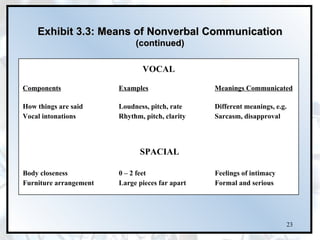
Exhibit 3.3: Means of Nonverbal Communication
                             (continued)

                               VOCAL

Components              Examples                 Meanings Communicated

How things are said     Loudness, pitch, rate    Different meanings, e.g.
Vocal intonations       Rhythm, pitch, clarity   Sarcasm, disapproval


                              SPACIAL

Body closeness          0 – 2 feet               Feelings of intimacy
Furniture arrangement   Large pieces far apart   Formal and serious


                                                                        23
How Can You Adapt to Diversity
  of Communication Styles?
  • Differences in
    Communication Styles
    •   The Socializer
    •   The Director
    •   The Thinker
    •   The Relater


                             24
Cultural Differences


                       25
Gender Differences


                     26
How Can You Facilitate
Communication with Diversity?
    •   Assume Differences
    •   Emphasize Description
    •   Empathize
    •   Treat Interpretations as
        Guesses


                                   27

Communication

  • 1.
  • 2.
    Concepts • Words MeanDifferent Things to Different People. • The Initiation of a Message Provides No Assurance It Has Been Received. • Communications Often Become Distorted as They Are Transmitted. 2
  • 3.
    Why is Communication Important? • Everything a manager does involves communication. • Effective communication skills can lead to problems for the manager. • Communication of content • Supportive communication 3
  • 4.
    Communication of Content •Channel choices • In person • Telephone • Email • Written • Third party 4
  • 5.
    Supportive Communication • A focus on processes. • Two categories:  Coaching: giving advice, direction or information to improve performance… focus on abilities  Counselling: helping the person understand and resolve a problem themselves by displaying understanding… focus on attitudes 5
  • 6.
    What Is theInterpersonal Communication Process? • Communication • Sequential Steps • Encoded • Transmitted • Decoding • Noise • Feedback 6
  • 7.
    Exhibit 3-1: TheCommunication Process Model 7
  • 8.
    Basic Interpersonal Communication Skills • Avoid Barriers to Communication. • Send Understandable Messages: Effective communication. • Actively Listen. • Utilize Non-verbal Signals. • Give and Solicit Meaningful Feedback. • Adapt to Diversity of Communication Styles… try multiple channels 8
  • 9.
    What Are theBarriers To Communication? • Frames of Reference • Semantics • Value Judgments • Selective Listening • Filtering • Distrust 9
  • 10.
    Attributes of effective communication • Problem oriented not person oriented “I don’t like the way you dress for work.” “You are not very professional.” 10
  • 11.
    Attributes of effective communication • Congruence versus incongruence • Mismatch between what one feels/thinks and what one says “I’m disappointed that we didn’t reach our target and that we aren’t getting our bonuses.” 11
  • 12.
    Attributes of effective communication • Descriptive versus evaluative • Avoid judgment • How: 4. describe objectively; 5. focus on the behaviour and your reaction not the other’s attributes; 6. focus on solutions “You screwed up” 12
  • 13.
    Attributes of effective communication • Invalidation: • Validation: • Superiority • Respectful • Rigidity • Flexible • Indifference • Two way • impervious communication • Identify areas of agreement 13
  • 14.
    Attributes of effective communication • specific not global “you never ask for my advice” “You are lazy” 14
  • 15.
    Attributes of effective communication • Conjunctive not disjunctive • Lack of equal opportunity to speak? • Extended pauses? • Who controls the flow? A continuum… 15
  • 16.
    Attributes of effective communication • Owned not disowned • Use of “I statements” not “you or other statements” “I’ve heard that you…” 16
  • 17.
    Attributes of effective communication • Two way not one way • Listening by responding 17
  • 18.
    Exhibit 3-2: Guidesfor Giving and Receiving Feedback Criteria for Giving Feedback 3. Make sure your comments are intended to help recipient. 4. Speak directly and with feeling. 5. Describe what the person is doing and the effect the person is having. 6. Don’t be threatening or judgmental. 7. Be specific, not general (use clear and recent examples). 8. Give feedback when the recipient is open to accepting it. 9. Check to ensure the validity of your statements. 10. Include only things the receiver can do something about. 11. Don’t overwhelm the person with more than can be handled. 18
  • 19.
    Exhibit 3-2: Guidesfor Giving and Receiving Feedback (continued) Criteria for Receiving Feedback 3. Don’t be defensive. 4. Seek specific examples. 5. Be sure you understand (summarize). 6. Share your feelings about the comments. 7. Ask for definitions. 8. Check out underlying assumptions. 9. Be sensitive to sender’s nonverbal messages. 10. Ask questions to clarify. 19
  • 20.
    How Do YouReceive and Understand Messages Accurately? • Listening • Active Listening • Sensing • Attending • Reflecting 20
  • 21.
    How Can You UtilizeNonverbal Cues? • Visual • Tactile • Vocal • Time and Space 21
  • 22.
    Exhibit 3.3: Meansof Nonverbal Communication VISUAL Components Examples Meanings Communicated Image Clothing, hygiene Values, competence Facial Expressions Frown, smile, sneer Unexpressed feelings Eye Movements Looking away, staring Intentions, state of mind Posture Leaning in, slumped Attitude Gestures Handshake, wave Intentions, feelings TACTILE Touch Pat on the back Approval Gentle touch on an arm Support and concern 22
  • 23.
    Exhibit 3.3: Meansof Nonverbal Communication (continued) VOCAL Components Examples Meanings Communicated How things are said Loudness, pitch, rate Different meanings, e.g. Vocal intonations Rhythm, pitch, clarity Sarcasm, disapproval SPACIAL Body closeness 0 – 2 feet Feelings of intimacy Furniture arrangement Large pieces far apart Formal and serious 23
  • 24.
    How Can YouAdapt to Diversity of Communication Styles? • Differences in Communication Styles • The Socializer • The Director • The Thinker • The Relater 24
  • 25.
  • 26.
  • 27.
    How Can YouFacilitate Communication with Diversity? • Assume Differences • Emphasize Description • Empathize • Treat Interpretations as Guesses 27