
Commonwealth
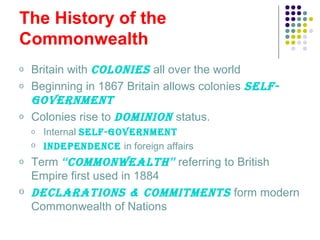
The History of the
Commonwealth
o Britain with Colonies all over the world
o Beginning in 1867 Britain allows colonies self-
government
o Colonies rise to dominion status.
o Internal self-government
o independenCe in foreign affairs
o Term “Commonwealth” referring to British
Empire first used in 1884
o deClarations & Commitments form modern
Commonwealth of Nations
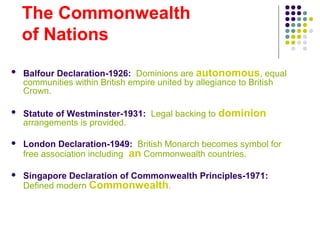
The Commonwealth
of Nations
 Balfour Declaration-1926: Dominions are autonomous, equal
communities within British empire united by allegiance to British
Crown.
 Statute of Westminster-1931: Legal backing to dominion
arrangements is provided.
 London Declaration-1949: British Monarch becomes symbol for
free association including an Commonwealth countries.
 Singapore Declaration of Commonwealth Principles-1971:
Defined modern Commonwealth.
Declarations Modernize the
Commonwealth
 Harare Declaration-1991: Reaffirmed Commonwealth
principles and:
 Stood against terrorism
 Pursued equality & participation by women
 Promoted sustainable development
 Promoted democracy
 Millbrook Declaration-1995: Firm action against
members who do not uphold Harare principles
 Suspension of participation at Commonwealth
meetings
 Complete suspension from the Commonwealth
 Commonwealth Ministerial Action Group Rapid Action
Force is created
Declarations Modernize the
Commonwealth (cont.)
 Limassol Declaration-1993, Edinburgh Declaration-
1997, & Fancourt Declaration-1999: Economic
matters, globalization and people-centered
development.
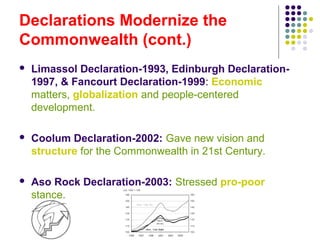
 Coolum Declaration-2002: Gave new vision and
structure for the Commonwealth in 21st Century.
 Aso Rock Declaration-2003: Stressed pro-poor
stance.
Who’s in the Commonwealth
now?
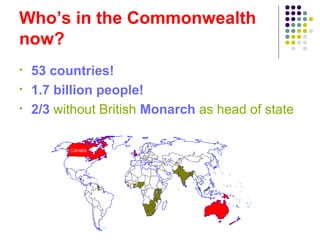
• 53 countries!
• 1.7 billion people!
• 2/3 without British Monarch as head of state
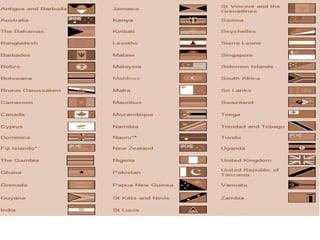
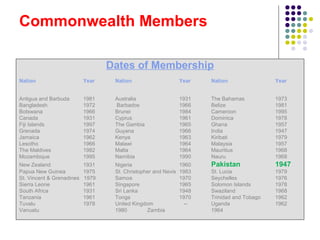
Commonwealth Members
Dates of Membership
Nation Year Nation Year Nation Year
Antigua and Barbuda 1981 Australia 1931 The Bahamas 1973
Bangladesh 1972 Barbados 1966 Belize 1981
Botswana 1966 Brunei 1984 Cameroon 1995
Canada 1931 Cyprus 1961 Dominica 1978
Fiji Islands 1997 The Gambia 1965 Ghana 1957
Grenada 1974 Guyana 1966 India 1947
Jamaica 1962 Kenya 1963 Kiribati 1979
Lesotho 1966 Malawi 1964 Malaysia 1957
The Maldives 1982 Malta 1964 Mauritius 1968
Mozambique 1995 Namibia 1990 Nauru 1968
New Zealand 1931 Nigeria 1960 Pakistan 1947
Papua New Guinea 1975 St. Christopher and Nevis 1983 St. Lucia 1979
St. Vincent & Grenadines 1979 Samoa 1970 Seychelles 1976
Sierra Leone 1961 Singapore 1965 Solomon Islands 1978
South Africa 1931 Sri Lanka 1948 Swaziland 1968
Tanzania 1961 Tonga 1970 Trinidad and Tobago 1962
Tuvalu 1978 United Kingdom -- Uganda 1962
Vanuatu 1980 Zambia 1964
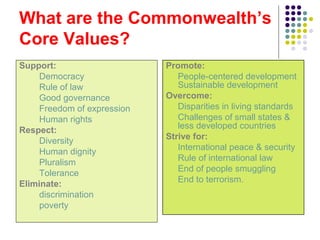
What are the Commonwealth’s
Core Values?
Support:
Democracy
Rule of law
Good governance
Freedom of expression
Human rights
Respect:
Diversity
Human dignity
Pluralism
Tolerance
Eliminate:
discrimination
poverty
Promote:
People-centered development
Sustainable development
Overcome:
Disparities in living standards
Challenges of small states &
less developed countries
Strive for:
International peace & security
Rule of international law
End of people smuggling
End to terrorism.
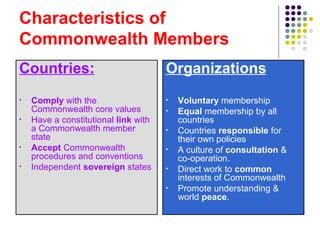
Characteristics of
Commonwealth Members
Countries:
• Comply with the
Commonwealth core values
• Have a constitutional link with
a Commonwealth member
state
• Accept Commonwealth
procedures and conventions
• Independent sovereign states
Organizations
• Voluntary membership
• Equal membership by all
countries
• Countries responsible for
their own policies
• A culture of consultation &
co-operation.
• Direct work to common
interests of Commonwealth
• Promote understanding &
world peace.
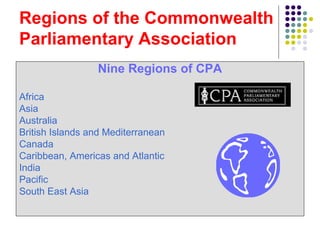
Regions of the Commonwealth
Parliamentary Association
Nine Regions of CPA
Africa
Asia
Australia
British Islands and Mediterranean
Canada
Caribbean, Americas and Atlantic
India
Pacific
South East Asia
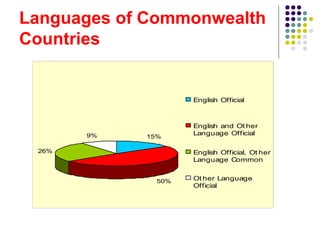
Languages of Commonwealth
Countries
15%
50%
26%
9%
English Official
English and Ot her
Language Official
English Official, Ot her
Language Common
Ot her Language
Official
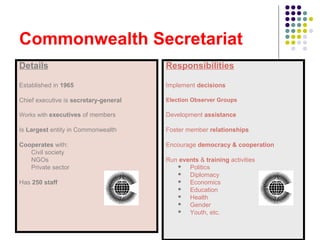
Commonwealth Secretariat
Details
Established in 1965
Chief executive is secretary-general
Works with executives of members
Is Largest entity in Commonwealth
Cooperates with:
Civil society
NGOs
Private sector
Has 250 staff
Responsibilities
Implement decisions
Election Observer Groups
Development assistance
Foster member relationships
Encourage democracy & cooperation
Run events & training activities
 Politics
 Diplomacy
 Economics
 Education
 Health
 Gender
 Youth, etc.
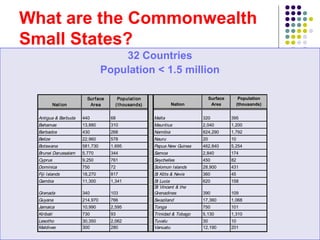
What are the Commonwealth
Small States?
32 Countries
Population < 1.5 million
Nat ion
Surface
Area
Population
(thousands) Nation
Surface
Area
Population
(thousands)
Antigua & Barbuda 440 68 Malta 320 395
Bahamas 13,880 310 Mauritius 2,040 1,200
Barbados 430 268 Namibia 824,290 1,792
Belize 22,960 578 Nauru 20 10
Botswana 581,730 1,695 Papua New Guinea 462,840 5,254
Brunei Darussalam 5,770 344 Samoa 2,840 174
Cyprus 9,250 761 Seychelles 450 82
Dominica 750 72 Solomon Islands 28,900 431
Fiji Islands 18,270 817 St Kitts & Nevis 360 45
Gambia 11,300 1,341 St Lucia 620 158
Grenada 340 103
St Vincent & the
Grenadines 390 109
Guyana 214,970 766 Swaziland 17,360 1,068
Jamaica 10,990 2,595 Tonga 750 101
Kiribati 730 93 Trinidad & Tobago 5,130 1,310
Lesotho 30,350 2,062 Tuvalu 30 10
Maldives 300 280 Vanuatu 12,190 201
Organizations in the
Commonwealth
• Commonwealth Parliamentary Association:
Consultation between and among Commonwealth
parliaments
• Includes sub-national legislatures
• Divided into regions
• Organizes annual conference
• Commonwealth Women Parliamentarians (CWP):
Provides professional development opportunities for
women MPs
• Commonwealth Local Government Forum (CLGF):
plays a parallel role to that of the CPA for local
governments.
Organizations in the
Commonwealth (cont.)
• Commonwealth Foundation:
• Strengthen civil society, democracy etc.
• Increase exchanges between organizations
• Improves standards of knowledge
• Commonwealth Games: Multinational, multi-sport
event, every four years
• Commonwealth Business Council: Devoted to
business interests in the Commonwealth
Organizations in the
Commonwealth (cont.)
•Commonwealth of Learning: A non-degree-granting
University for development and educational access for
commonwealth countries.
•Commonwealth Human Rights Initiative: Encourages human
rights but does not possess any executive powers
•Institute of Commonwealth Studies/Commonwealth Policy
Studies Unit: Think tank for the contemporary
Commonwealth.
•The Royal Commonwealth Society: Provides information
and education about the Commonwealth to all interested
persons.
CHOGM Meetings
 Established in 1971, replacing
Commonwealth Prime Ministers’ Meetings
 Held every two years
 Reiterate the core values and principles of
the association
 Review performance and global relevance
The Modern Commonwealth
Machine: What keeps it together?
• A common heritage of
• English language
• Law
• Parliamentary democracy
but…
• Language and legal systems have changed
• Many have dropped the bicameral parliamentary
system
yet, in spite of its variety, it is…
• A potent force for harmonizing differences
CHOGM: Governing the
Commonwealth
 Policy-making
 Performance evaluation
 Publishes decisions
 Outlines work
 Appoints secretary-general
Thanks
…………

Common wealth

  • 1.
  • 3.
    The History ofthe Commonwealth o Britain with Colonies all over the world o Beginning in 1867 Britain allows colonies self- government o Colonies rise to dominion status. o Internal self-government o independenCe in foreign affairs o Term “Commonwealth” referring to British Empire first used in 1884 o deClarations & Commitments form modern Commonwealth of Nations
  • 4.
    The Commonwealth of Nations Balfour Declaration-1926: Dominions are autonomous, equal communities within British empire united by allegiance to British Crown.  Statute of Westminster-1931: Legal backing to dominion arrangements is provided.  London Declaration-1949: British Monarch becomes symbol for free association including an Commonwealth countries.  Singapore Declaration of Commonwealth Principles-1971: Defined modern Commonwealth.
  • 5.
    Declarations Modernize the Commonwealth Harare Declaration-1991: Reaffirmed Commonwealth principles and:  Stood against terrorism  Pursued equality & participation by women  Promoted sustainable development  Promoted democracy  Millbrook Declaration-1995: Firm action against members who do not uphold Harare principles  Suspension of participation at Commonwealth meetings  Complete suspension from the Commonwealth  Commonwealth Ministerial Action Group Rapid Action Force is created
  • 6.
    Declarations Modernize the Commonwealth(cont.)  Limassol Declaration-1993, Edinburgh Declaration- 1997, & Fancourt Declaration-1999: Economic matters, globalization and people-centered development.  Coolum Declaration-2002: Gave new vision and structure for the Commonwealth in 21st Century.  Aso Rock Declaration-2003: Stressed pro-poor stance.
  • 7.
    Who’s in theCommonwealth now? • 53 countries! • 1.7 billion people! • 2/3 without British Monarch as head of state
  • 9.
    Commonwealth Members Dates ofMembership Nation Year Nation Year Nation Year Antigua and Barbuda 1981 Australia 1931 The Bahamas 1973 Bangladesh 1972 Barbados 1966 Belize 1981 Botswana 1966 Brunei 1984 Cameroon 1995 Canada 1931 Cyprus 1961 Dominica 1978 Fiji Islands 1997 The Gambia 1965 Ghana 1957 Grenada 1974 Guyana 1966 India 1947 Jamaica 1962 Kenya 1963 Kiribati 1979 Lesotho 1966 Malawi 1964 Malaysia 1957 The Maldives 1982 Malta 1964 Mauritius 1968 Mozambique 1995 Namibia 1990 Nauru 1968 New Zealand 1931 Nigeria 1960 Pakistan 1947 Papua New Guinea 1975 St. Christopher and Nevis 1983 St. Lucia 1979 St. Vincent & Grenadines 1979 Samoa 1970 Seychelles 1976 Sierra Leone 1961 Singapore 1965 Solomon Islands 1978 South Africa 1931 Sri Lanka 1948 Swaziland 1968 Tanzania 1961 Tonga 1970 Trinidad and Tobago 1962 Tuvalu 1978 United Kingdom -- Uganda 1962 Vanuatu 1980 Zambia 1964
  • 10.
    What are theCommonwealth’s Core Values? Support: Democracy Rule of law Good governance Freedom of expression Human rights Respect: Diversity Human dignity Pluralism Tolerance Eliminate: discrimination poverty Promote: People-centered development Sustainable development Overcome: Disparities in living standards Challenges of small states & less developed countries Strive for: International peace & security Rule of international law End of people smuggling End to terrorism.
  • 11.
    Characteristics of Commonwealth Members Countries: •Comply with the Commonwealth core values • Have a constitutional link with a Commonwealth member state • Accept Commonwealth procedures and conventions • Independent sovereign states Organizations • Voluntary membership • Equal membership by all countries • Countries responsible for their own policies • A culture of consultation & co-operation. • Direct work to common interests of Commonwealth • Promote understanding & world peace.
  • 12.
    Regions of theCommonwealth Parliamentary Association Nine Regions of CPA Africa Asia Australia British Islands and Mediterranean Canada Caribbean, Americas and Atlantic India Pacific South East Asia
  • 13.
    Languages of Commonwealth Countries 15% 50% 26% 9% EnglishOfficial English and Ot her Language Official English Official, Ot her Language Common Ot her Language Official
  • 14.
    Commonwealth Secretariat Details Established in1965 Chief executive is secretary-general Works with executives of members Is Largest entity in Commonwealth Cooperates with: Civil society NGOs Private sector Has 250 staff Responsibilities Implement decisions Election Observer Groups Development assistance Foster member relationships Encourage democracy & cooperation Run events & training activities  Politics  Diplomacy  Economics  Education  Health  Gender  Youth, etc.
  • 15.
    What are theCommonwealth Small States? 32 Countries Population < 1.5 million Nat ion Surface Area Population (thousands) Nation Surface Area Population (thousands) Antigua & Barbuda 440 68 Malta 320 395 Bahamas 13,880 310 Mauritius 2,040 1,200 Barbados 430 268 Namibia 824,290 1,792 Belize 22,960 578 Nauru 20 10 Botswana 581,730 1,695 Papua New Guinea 462,840 5,254 Brunei Darussalam 5,770 344 Samoa 2,840 174 Cyprus 9,250 761 Seychelles 450 82 Dominica 750 72 Solomon Islands 28,900 431 Fiji Islands 18,270 817 St Kitts & Nevis 360 45 Gambia 11,300 1,341 St Lucia 620 158 Grenada 340 103 St Vincent & the Grenadines 390 109 Guyana 214,970 766 Swaziland 17,360 1,068 Jamaica 10,990 2,595 Tonga 750 101 Kiribati 730 93 Trinidad & Tobago 5,130 1,310 Lesotho 30,350 2,062 Tuvalu 30 10 Maldives 300 280 Vanuatu 12,190 201
  • 16.
    Organizations in the Commonwealth •Commonwealth Parliamentary Association: Consultation between and among Commonwealth parliaments • Includes sub-national legislatures • Divided into regions • Organizes annual conference • Commonwealth Women Parliamentarians (CWP): Provides professional development opportunities for women MPs • Commonwealth Local Government Forum (CLGF): plays a parallel role to that of the CPA for local governments.
  • 17.
    Organizations in the Commonwealth(cont.) • Commonwealth Foundation: • Strengthen civil society, democracy etc. • Increase exchanges between organizations • Improves standards of knowledge • Commonwealth Games: Multinational, multi-sport event, every four years • Commonwealth Business Council: Devoted to business interests in the Commonwealth
  • 18.
    Organizations in the Commonwealth(cont.) •Commonwealth of Learning: A non-degree-granting University for development and educational access for commonwealth countries. •Commonwealth Human Rights Initiative: Encourages human rights but does not possess any executive powers •Institute of Commonwealth Studies/Commonwealth Policy Studies Unit: Think tank for the contemporary Commonwealth. •The Royal Commonwealth Society: Provides information and education about the Commonwealth to all interested persons.
  • 19.
    CHOGM Meetings  Establishedin 1971, replacing Commonwealth Prime Ministers’ Meetings  Held every two years  Reiterate the core values and principles of the association  Review performance and global relevance
  • 20.
    The Modern Commonwealth Machine:What keeps it together? • A common heritage of • English language • Law • Parliamentary democracy but… • Language and legal systems have changed • Many have dropped the bicameral parliamentary system yet, in spite of its variety, it is… • A potent force for harmonizing differences
  • 21.
    CHOGM: Governing the Commonwealth Policy-making  Performance evaluation  Publishes decisions  Outlines work  Appoints secretary-general
  • 22.