BY: CHELDY S. ELUMBA-PABLEO,MPA,LLB
INTERNATIONAL AND REGIONAL ORGANIZATION SUBJECT
• It is an intergovernmental organization founded on January
10, 1920 as a result of The Paris Peace Conference that
ended the First World War.
• It is the forerunner of UN brought about much international
cooperation on health, labor problems, refugee affairs and
the like.
BY: CHELDY S. ELUMBA-PABLEO,MPA,LLB
• It was formed by the victorious powers in 1919.
• It was designed to enforce the Treaty of Versailles and
other agreements that concluded World War I.
• It was intended to replace secret deals and wars as a
means for settling international disputes, with open
diplomacy and peaceful mediation.
BY: CHELDY S. ELUMBA-PABLEO,MPA,LLB
•It was set up by the Treaty of Versailles.
•It aims to stop wars, encourage disarmament,
and make the world a better place by improving
people’s working conditions, and by tackling
disease. BY: CHELDY S. ELUMBA-PABLEO,MPA,LLB
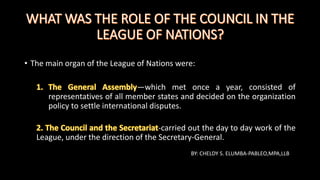
• The main organ of the League of Nations were:
—which met once a year, consisted of
representatives of all member states and decided on the organization
policy to settle international disputes.
-carried out the day to day work of the
League, under the direction of the Secretary-General.
BY: CHELDY S. ELUMBA-PABLEO,MPA,LLB
•The League of Nations (LN) was established with
three main constitutional organs:
1. The Assembly
2. The Council
3. The Permanent Secretariat
BY: CHELDY S. ELUMBA-PABLEO,MPA,LLB
• The League of Nations was an international organization which has a
headquarter in Geneva, Switzerland that was created after WW I to
provide a forum for resolving international disputes.
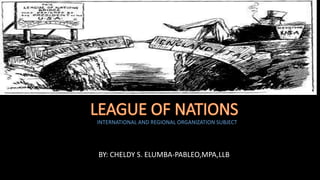
• Though first proposed by President Woodrow Wilson as part of his
Fourteen Points plan (called for the general association of nations for
mutual guarantees of political independence and territorial integrity
to great and small alike) for equitable peace in Europe, the United
States never became a member.
BY: CHELDY S. ELUMBA-PABLEO,MPA,LLB
• Most of the decisions made at the PARIS PEACE CONFERENCE were
made by the BIG FOUR, consisting of President Wilson, DAVID LLOYD
GEORGE of Great Britain, GEORGES CLEMENCEAU of France,
and VITTORIO ORLANDO of Italy. The European leaders were not
interested in a “just peace”. They were interested in retribution.
• Wilson met with stiff opposition-The Republican leader of the
Senate, HENRY CABOT LODGE, who was very suspicious of his treaty--
ARTICLE X OF THE LEAGUE OF NATIONS, viewed the League as a
supranational government that would limit the power of the
American government from determining its own affairs, making it
exempt from it so Democrats vote against it.
BY: CHELDY S. ELUMBA-PABLEO,MPA,LLB
1. The Permanent Court of International Justice (ICJ)-
world court, existed from 1922-1946.
2. The International Labour Organization-a UN’s agency
dealing with labour problems, particularly international labour
standards, social protection and work opportunities for all.
BY: CHELDY S. ELUMBA-PABLEO,MPA,LLB
• The International Court of Justice (ICJ)-or the “world court” is the principal
judicial organ of the UN which settles disputes between states.
• The Court has two functions:
1. To settle, in accordance with international law, legal disputes submitted
by States (binding ruling).
2. To give advisory opinions on legal questions referred to it by authorized
UN organs and specialized agencies (non-binding ruling).
BY: CHELDY S. ELUMBA-PABLEO,MPA,LLB
• The International Labour Organization (ILO) is a United Nations agency dealing
with labour problems, particularly international labour standards, social protection,
and work opportunities for all. Its aims and objectives were:
• 1. to promote and realize standards and fundamental principles and rights at work;
• 2. to create greater opportunities for women and men to secure decent
employment;
• 3. to enhance the coverage and effectiveness of social protection for all;
• 4. to strengthen tripartism and social dialogue (“employers and workers’
representatives”– the “social partners” of the economy – have an equal voice with
those of governments in shaping its policies and programmes).
BY: CHELDY S. ELUMBA-PABLEO,MPA,LLB
• World powers such as Britain, France, Italy and Japan were Council,
meeting 4-5 times a year to solve disputes.
• The League’s main strength came from the fact that was set up by the
Treaty of Versailles—which had been signed and agreed by the 32
nations.
• It means “influence” to force country to obey; It offers: Moral
Condemnation, Offer Arbitration (referee between quarrelling
nations), Apply Trading Sanction, and agree to Military Force
BY: CHELDY S. ELUMBA-PABLEO,MPA,LLB
• The three most powerful countries (US, Germany and Russia) were not members.
–Most Americans were isolationist, Russia were communist and hated Britain and
France, Germany were not allowed to join until 1925.
• The greatest weakness came from the fact that it was set up by the Treaty of
Versailles that had many flaws (like reparations), hated especially by Germans
and the Americans so the League was hated too.
• Without this 3 world powers, the League was too weak to make a big country do
as it wished. (for instance Italy bovver Corfu in 1923)
BY: CHELDY S. ELUMBA-PABLEO,MPA,LLB
• Although of the League of Nations was much of the work of
President Woodrow Wilson, America never joined the LN.
• This was for several reasons, firstly America had suffered
civilian casualties in the war, and many people in the USA
wanted to keep America out of Europe affairs because they
did not want to risk more Americans dying and sending
troops out to other parts of the globe would be very costly
venture.
BY: CHELDY S. ELUMBA-PABLEO,MPA,LLB
•It was a failure in the 1930’s because of British
and French self-interest, the countries began to
realise that the League didn’t have any power
and the League’s only way to stop them was to
emplace trade sanctions on them.
BY: CHELDY S. ELUMBA-PABLEO,MPA,LLB
1. THE UNITED STATES DIDN’T JOIN—The countries of Europe
were bitterly divided after WW I and were no mood to
establish a substantive organization dedicated to
promoting world peace and understanding.
The US being an outsider may have been a stabilizing force to
the group. But Congress was uninterested in entangling the US
any further in European affairs, until the second world war.
BY: CHELDY S. ELUMBA-PABLEO,MPA,LLB
2. THE TREATY OF VERSAILLES—The terms of the treaty
unfairly penalized Germany. Doing so made joining the
League more of a “punishment” than a boon.
The establishment of the UN after WWI didn’t make
the same mistake, which was partly why it has been
successful.
BY: CHELDY S. ELUMBA-PABLEO,MPA,LLB
3. THE LIMITED SCOPE OF THE LEAGUE—Many
countries which would have been beneficial to
the League simply weren’t invited to join. As a
result, it was a boutique organization, rather than
a true joining of nations.
BY: CHELDY S. ELUMBA-PABLEO,MPA,LLB
4. THE GENERAL STABILITY OF THE LEAGUE—
Many of the founding embers simply withdrew
from it as it became apparent that the League
was unstable and that its interests clashed with
their own.
BY: CHELDY S. ELUMBA-PABLEO,MPA,LLB
• 5. THE MYRIAD FAILING OF THE LEAGUE’S DIPLOMACY—The
League was unable to prevent foreign incursions or negotiate
their resolutions successfully after they occurred; from
Chaco War of 1922 to the Nazi annexation of Czechoslovakia,
the League’s toothless nature was apparent from its outset
which grew worse with time.
BY: CHELDY S. ELUMBA-PABLEO,MPA,LLB
6. COLONIALISM—It was simply incapable with the League’s existence.
While UN managed to survive during colonialism, it did so in the wake
of WWII and during the collapse of colonialism. The Leagues
membership expected that their questionable territorial claims were
above and apart from its purview.
This double standard weakened the legitimacy of the group and
ultimately resulted in its downfall.
BY: CHELDY S. ELUMBA-PABLEO,MPA,LLB
League of nations